Linux debates its supposed successor in knockoff-versus-upgrade OS meme
Why is this OperatingSystems meme funny?
Level 1: Sibling Rivalry
Imagine two siblings who are very much alike in many ways. The older sibling says to the younger one, “You’re just a cheap copy of me!” In other words, “you’re just trying to be like me but not as good.” The younger sibling crosses their arms and replies, “Oh no, I’m actually the improved version of you!” meaning “I’m the newer, better you.” 🙃 Now, if you saw two brothers or sisters talk like this, you’d probably laugh because it’s such an over-the-top, dramatic argument. They’re basically bragging and insulting each other at the same time.
This meme is doing exactly that, but with computer operating systems pretending to talk. One operating system (Linux) is acting like the older sibling, calling the other a cheap knockoff (a fancy way to say “fake copy”). The other operating system (FreeBSD) is like the younger sibling saying, “No way, I’m the upgrade,” which means “I’m better than you are!” It’s funny because computers don’t really talk, of course, but we’ve given them personalities here. And just like siblings who both think they’re the best, these two computer systems are playfully arguing about who is superior. The humor comes from seeing something as dry as computer software be personified as if they’re in a soap opera showdown. Even if you don’t know Linux or FreeBSD, you can relate to the idea of two very similar things each claiming to be the “real” or “better” one. It’s like if two very similar toys or two superheroes with nearly the same powers started bickering: one yells, “You’re just my knockoff!” and the other snaps back, “I’m the upgrade!” It’s a silly, make-believe fight, and that’s why it makes people smile!
Level 2: OS Family Drama
Let’s break down the joke in simpler terms. First, who are these characters “Linux” and “FreeBSD”? They’re not people at all – they are names of operating systems, the fundamental software that runs on computers and servers. An operating system (OS) manages the hardware and provides services for programs. Examples you may know are Windows or macOS or Android. Linux is an extremely popular open-source OS kernel that many people use, especially on servers (and also the core of Android phones). It’s called open-source because its code is freely available for anyone to see, modify, and share. There are many Linux distributions (like Ubuntu, Fedora, or Debian) which package the Linux kernel with other software to make a full operating system you can install. On the other side, FreeBSD is another free and open-source OS that comes from the long tradition of Unix systems. It’s part of the BSD family – “BSD” stands for Berkeley Software Distribution, meaning it originally came from work done at UC Berkeley on the Unix operating system many years ago. Both Linux and FreeBSD are cousins in the Unix family, so in a sense they’re like two different branches of the same family tree of operating systems. They even feel quite similar to use: for example, in both systems you typically interact via a command-line shell (like Bash or tcsh) and many commands (ls, cd, cp, etc.) work the same on both. This is because both follow POSIX, a standard that defines how Unix-like systems should behave.
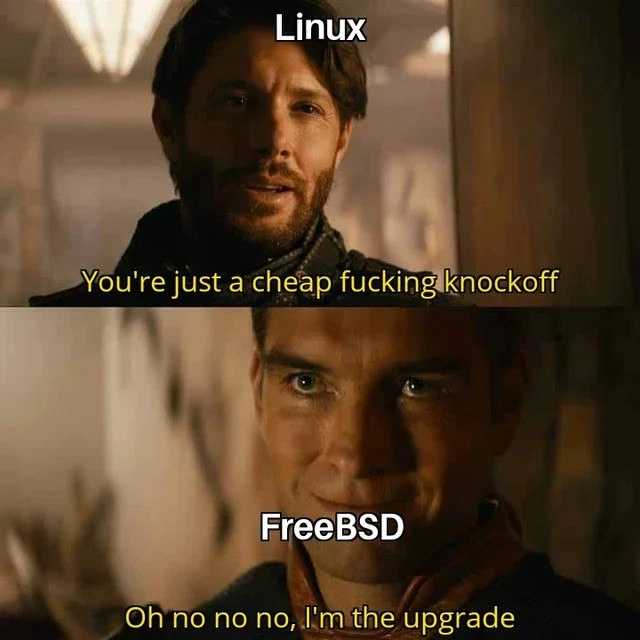
So if they’re so similar in spirit, why the drama? Well, within the tech community, people often engage in lighthearted OS rivalry – a bit like sports team rivalries but for computer nerds. There have historically been a lot of debates (sometimes serious, often jokey) about which OS is “the best” or which one is copying features from the other. This meme uses that idea and exaggerates it for humor. It’s showing Linux basically insulting FreeBSD by saying: “You’re just a cheap freaking knockoff.” In plain language, that means “You are just a low-quality copy of me.” The word “knockoff” implies an imitation or a fake version of something. And adding “cheap” (plus a swear word for emphasis) shows Linux is really dismissing FreeBSD as inferior. Now, in the second panel, FreeBSD snaps back with, “Oh no no no, I’m the upgrade.” Saying “I’m the upgrade” means “I am the improved, better version (of you).” FreeBSD is claiming that far from being a fake copy, it’s actually a next-generation improvement on Linux.
This is funny to developers and sysadmins (system administrators) because it’s a hyperbolic reenactment of the kind of arguments they’ve heard in forums or around the office. Imagine two techies playfully arguing: one might say “Linux is just copying Unix, it’s nothing original,” and the other might respond “BSD is actually superior to Linux, it’s like Unix done right.” These are subjective opinions, but people state them passionately. In reality, neither Linux nor FreeBSD is literally a “cheap knockoff” of the other – they were developed independently, each with its own strong points. But the meme purposely uses dramatic language from a TV show to make it sound like a heated confrontation. It’s this exaggeration that makes it a piece of developer humor.
For someone newer to this topic, here’s a bit of context: Linux has a huge user base and community; it runs on everything from web servers to Raspberry Pi devices, and dozens of companies support it. FreeBSD has a smaller, more niche community; it’s known for reliability and was used for a lot of internet infrastructure quietly (for example, parts of early Yahoo, and still in some services like Netflix caches). People who love FreeBSD sometimes feel it doesn’t get enough credit, especially since Linux stole a lot of the spotlight. Meanwhile, Linux fans might not see why one would use FreeBSD when Linux has so many options and support. This results in friendly banter and “my OS is better than your OS” arguments. It’s important to note these debates are often more for fun or out of pride – in practice, both OSes are free and open-source and have co-existed for decades. Many developers even use both depending on the task.
The meme’s format (two panels with dialogue) is actually referencing a scene template known as the “knockoff vs upgrade” meme, where Character A says “You’re a cheap knockoff” and Character B says “I’m the upgrade.” The meme community loves this format to compare any two similar things where one claims to be better. By putting Linux and FreeBSD in those roles, the meme taps into the specific distro wars (distribution wars) and OS rivalry inside the open-source world. If you’ve ever seen debates like Emacs vs Vim, Tabs vs Spaces, or Intel vs AMD, you’ll recognize the playful argumentative tone. Here it’s Linux vs BSD. Even if you’re a junior dev or just starting out, you can appreciate the silliness: it’s essentially two very similar operating systems each pretending to be the one true champion. It’s like two superheroes with almost the same powers trash-talking each other about who’s the clone of whom. The sysadmin humor comes from that kernel of truth (there are real differences and each side has proud supporters) blown up to a comically exaggerated dialogue. In short, understanding this meme doesn’t require deep OS knowledge – just know that Linux and FreeBSD are like cousins in the OS world, and geeks have jokingly argued about them forever. One is calling the other an imitation, and the other claims to be version 2.0 – it’s a goofy tech inside joke.
Level 3: Tux vs Beastie
At a senior engineer or sysadmin level, this meme hits home as a tongue-in-cheek commentary on the Linux vs FreeBSD rivalry that has simmered in the background of IT culture for ages. The meme repurposes a scene from The Boys (a popular TV series known for its intense showdowns) to dramatize a classic tech argument. In the first panel, the character labeled Linux sneers, “You’re just a cheap f*ing knockoff.” In the second panel, FreeBSD smirks and replies, “Oh no no no, I’m the upgrade.” This dialogue encapsulates the kind of prideful banter old-school sysadmins know all too well. It’s basically Linux (the famous open-source OS) accusing FreeBSD (another Unix-like OS) of being an inferior copycat, while FreeBSD fires back that it’s actually the superior, improved system. For anyone who’s frequented server rooms or tech forums, it’s a chef’s kiss representation of those late-night debates about whose favorite OS is truly the best. Senior folks see the humor in how over-the-top the phrasing is – calling another OS a “cheap knockoff” is the kind of hyperbole you’d mostly encounter in meme culture or maybe a decades-old flame war on Slashdot or Reddit. It immediately evokes sysadmin meme culture: the mix of profanity-laced jest and genuine opinion that you get when proud operators defend their preferred systems.
Why is this so funny (and a bit nostalgic) to experienced devs? Because it lampoons the distro wars and OS rivalries that we’ve seen play out for years. Linux and FreeBSD are both venerable players in the server world, and each has die-hard loyalists. By having Linux outright dismiss FreeBSD, the meme mirrors how many Linux users view BSD: as an obscure, stubborn cousin of Linux that never quite caught on in the mainstream. The phrase “cheap knockoff” is deliberately ironic here – Linux itself was originally created as a free knockoff of the proprietary Unix! (Linus Torvalds built Linux in part because the “real” Unix was expensive and source code wasn’t freely available.) Meanwhile, FreeBSD’s comeback line “I’m the upgrade” reflects the BSD aficionados’ perspective: they often argue that FreeBSD is more robust, stable, and true to Unix’s roots, essentially an upgrade over the chaotic world of Linux distributions. It’s the same energy as two seasoned developers in a bar, each slamming the other’s tech stack with a grin on their face: “Get outta here, your framework is just a cheap clone of mine!” – “Please, ours is the next-gen version.” It’s exaggerated posturing, and everyone involved usually knows it’s half in jest. The meme format (with the dramatic confrontation from The Boys) amplifies this chest-thumping to absurd levels, which is exactly why it elicits a knowing chuckle from IT veterans. We’ve all seen folks who take their OS allegiance dead seriously, and this format pokes fun at that intensity.
Beyond the one-liners, seasoned devs recognize some very real context behind the joke. Historically, Linux and FreeBSD emerged around the same time (early 90s) and each cultivated a passionate community. Linux exploded in popularity thanks to its huge community support, copious distributions (Ubuntu, Red Hat, Debian, etc.), and corporate backing – it became the de facto choice for servers, cloud infrastructure, and pretty much the poster child of OpenSource success. FreeBSD, while not as flashy in headlines, earned a reputation for reliability – many senior system administrators will speak of FreeBSD’s stability and clean design with reverence. It powers critical infrastructure too (WhatsApp famously ran on FreeBSD, and as mentioned, Netflix open-sourced a lot of their FreeBSD tweaks for high-perf networking). But because FreeBSD never had the marketing push or the sheer army of contributors Linux did, it’s viewed by some as the underdog or “that other Unix-like OS.” So when Linux in the meme says “you’re a cheap knockoff,” it’s channeling the mainstream view that Linux is the real deal and anything else is an imitator. This is comedic because FreeBSD is anything but cheap – it’s a direct descendant of the original Unix codebase and predates Linux in spirit. In fact, some graybeard admins might snort because they remember arguments claiming Linux was the knockoff of the older BSD systems. The meme flips the narrative depending on who you identify with, and that ambiguity is brilliant fuel for developer humor. It’s like a subtle nod: we know both sides have said these lines about each other in some forum or mailing list over the years. It’s relatable exaggeration.
The tone and language are also part of the inside joke. In professional settings, you wouldn’t actually have Linux and FreeBSD maintainers cussing each other out (they have plenty of mutual respect). But in tech humor and internet memes, it’s common to personify technologies as if they’re action movie characters with big egos. Here Linux is the cocky hero (or anti-hero) and FreeBSD is the challenger who believes he’s the next evolution. The meme’s original audio-visual format (from The Boys) brings a certain intensity – if you’ve seen it, the actor’s delivery of “cheap f***ing knockoff” is full of scorn, and the retort “I’m the upgrade” is smug and confident. That maps perfectly onto how hardcore fans might feel during an OS argument, even if they’d never phrase it so bluntly. It’s os_rivalry_banter taken to the extreme for comedic effect. This kind of meme also thrives because it’s a safe way for both communities to laugh at themselves. A Linux user can share it and chuckle “ha, as if FreeBSD is an upgrade,” and a FreeBSD user can share it thinking “Linux wishes, we’re the real upgrade.” Each sees it as validating their side, while an impartial observer just finds the over-the-top fight ridiculous and funny. It’s very much in the spirit of developer humor: exaggerating our tech preferences as if they were episodes in a gritty drama.
Also, notice the meme format itself is well-known: the “You’re a cheap knockoff / No, I’m the upgrade” template has been used widely with different characters labeled as various technologies. It’s a versatile format for any scenario where one thing is considered an imitator of another. In this instance, labeling the characters as “Linux” and “FreeBSD” taps into the distro_wars vibe that many sysadmins have participated in. It’s basically a remix of playground taunts but with server OS names. And since both Linux and FreeBSD are open-source and free, the phrase “cheap knockoff” carries an extra jab of irony (neither one costs money – they’re literally cheap in terms of price – and both borrow from Unix ideas). Meanwhile, calling oneself “the upgrade” implies a newer, better version. FreeBSD’s supporters sometimes joke that because their codebase is more tightly controlled and comes from the original Unix tradition, it’s like a polished next iteration of what an OS should be, whereas Linux with its hodgepodge of contributions can feel messy. On the flip side, Linux folks argue that Linux has evolved far beyond the old Unix in terms of features and scalability – it is the true upgrade. This meme lets them playfully fling those arguments at each other in one snappy exchange. For a senior dev, it’s hard not to smirk because it’s a caricature of debates we’ve seen a hundred times, distilled into two meme captions. In short, the joke lands because it turns an ongoing, nuanced rivalry into a scene from an edgy superhero show – an absurdly serious treatment for something as nerdy as OS preferences. That contrast is pure comedic gold in the tech world.
Level 4: POSIX Clone Wars
At the deepest level, this meme hints at the genealogy of modern operating systems and the age-old Unix family feud. Both Linux and FreeBSD are Unix-like operating systems (OS) adhering to the POSIX standards – meaning they implement a common set of APIs and behaviors defined for Unix systems. But under their hood, they have distinct legacies and design philosophies. Linux was created in 1991 by Linus Torvalds as a from-scratch kernel inspired by Unix principles, while FreeBSD descends from the earlier BSD (Berkeley Software Distribution) lineage, which itself forked off the original AT&T Unix code back in the 1970s. In effect, Linux is a clean-room clone of Unix, whereas FreeBSD carries actual DNA from the Unix family tree (through BSD). This lineage difference fuels the spicy “knockoff” vs “upgrade” rhetoric: each project can frame the other as the imposter. From one perspective, Linux might appear to BSD folks as a brash reimplementation of an older, more mature codebase. From the other, BSD could be painted as clinging to an archaic code lineage while Linux surged ahead with new development. It’s a classic clone war scenario in the POSIX universe.
The meme’s humor also derives from technical nuances. Both Linux and FreeBSD have monolithic kernels, meaning the core of the OS (device drivers, file system, network stack, etc.) runs in a single large kernel space. This is notable because back in the early ’90s, there was a hot theoretical debate in computer science: monolithic vs microkernel design. In fact, computer scientist Andrew Tanenbaum – author of MINIX (a teaching OS with a microkernel) – famously critiqued Linux’s design in a Usenet post:
Andrew Tanenbaum, 1992: “Linux is obsolete.” (arguing that building a new monolithic kernel was a step backward in OS design)
Linux (the upstart) was boldly going against the academic grain by not following the microkernel trend. FreeBSD, on the other hand, evolved from Research Unix and 4.3BSD, which were monolithic by tradition. So both Linux and FreeBSD doubled down on the monolithic approach for performance reasons, even as purists called it old-fashioned. Ironically, time validated the practical effectiveness of monolithic kernels – Linux’s performance and widespread adoption speak for themselves – but this history explains why each system’s community sometimes accuses the other of being a “knockoff”: they’re more alike than they’d like to admit, both rebels in an era that briefly favored microkernels. The meme’s confrontation exaggerates this irony: two monolithic Unix-like OSes each claiming to be the real deal while dunking on the other.
Another deep aspect is the open-source license philosophy that divides these two. Linux is released under the GPL (GNU General Public License), specifically GPLv2, which is a copyleft license. This means any modified version or derivative of Linux must also be released under the GPL – ensuring that improvements to the Linux kernel remain open source for the community. FreeBSD, in contrast, is under the BSD license (a more permissive license). The BSD license basically says “Do whatever you want with this code, just give us credit.” This difference in licensing leads to a poignant subtext in the meme’s “cheap knockoff” exchange: under the hood, plenty of proprietary operating systems have quietly incorporated FreeBSD (and other BSD) code because the license allowed it with no strings attached. For example, parts of Apple’s macOS and Sony’s PlayStation OS are built on a BSD foundation, and even Microsoft borrowed TCP/IP networking code from BSD in the past. BSD code can be found, hidden and unsung, in many commercial products – arguably making those products upgrades built on BSD’s work. Linux’s GPL, conversely, prevents proprietary forks; companies can use Linux freely, but if they distribute a modified kernel, they must share their changes. This fosters a huge collaborative ecosystem (one reason Linux dominates servers and devices), but it also means you won’t find Linux code lurking in Windows or proprietary OS – the GPL’s “viral” nature keeps it out of closed-source projects. So when Linux says “You’re a cheap knockoff,” one might recall that Linux was a ground-up knockoff of Unix (because AT&T wouldn’t let students like Linus see the real Unix source). And when FreeBSD retorts “I’m the upgrade,” it’s not entirely bluster – BSD’s permissive approach quietly upgraded many systems we use, albeit often without fanfare or credit. The meme cleverly mirrors these philosophical jabs: each OS community sees itself as the true innovator and the other as riding on coattails.
From a systems engineering standpoint, both OSes contributed notable innovations, reinforcing each side’s claim to being the “upgrade.” FreeBSD pioneered jails (an early containerization tech from 2000) that let admins isolate applications into lightweight virtual compartments – essentially a forerunner of Docker-style containers. Linux came later with its own containerization primitives (cgroups and namespaces, merged around 2006), enabling the modern wave of containers (Docker, Kubernetes) that revolutionized deployment. As for performance, each system optimized for different strengths: Linux developed epoll for scalable I/O event notification on thousands of connections, while FreeBSD utilizes kqueue for a similar purpose – two different kernel mechanisms tackling the same problem of efficient concurrency. FreeBSD integrated the advanced ZFS file system (known for reliability and snapshotting) early on, whereas Linux, due to licensing conflicts, offered ZFS only via third-party modules and instead developed alternatives like Btrfs. The technical trade-offs are endless: process scheduling algorithms (Linux’s Completely Fair Scheduler vs FreeBSD’s ULE scheduler), network stack tweaks, security models, etc. Each project has moments where it leapfrogs the other: for instance, FreeBSD’s network stack and storage stability made it popular at companies like Netflix for high-performance appliances, while Linux’s sheer breadth of hardware support and fast development cycle helped it conquer everything from servers to smartphones (Android’s core is a Linux kernel). So “I’m the upgrade” can be justified depending on which metric you choose: stability, speed, security, feature set, community support – it’s a choose-your-own-adventure of superiority. The meme distills this complex operating system rivalry into a single biting exchange, which is hilarious to seasoned tech folks because it’s absurdly reductive yet eerily familiar. After decades of leapfrogging innovations and flame wars on mailing lists, we end up with two blurry characters snarling about being the real deal – it’s a perfect high-drama caricature of OS rivalry banter.
Description
Two - panel meme using a scene from a dramatic TV show. Panel 1: a dimly lit character’s face (blurred for privacy) is labeled in bold white text "Linux" at forehead level. Yellow subtitle reads, "You're just a cheap fucking knockoff." Panel 2 shows the second character (also blurred) replying with the yellow subtitle, "Oh no no no, I'm the upgrade." The joke riffs on operating-system rivalry - Linux dismisses another OS or distribution as an inferior imitation while the target claims to be the superior next iteration - tapping into long-standing debates among sysadmins and open-source enthusiasts about which distro or Unix-like system is truly an "upgrade."
Comments
16Comment deleted
Linux: “You’re just a cheap knock-off.” WSL: “I’m the upgrade.” SRE in the corner: “Relax, you’re both just cgroups inside a Kubernetes pod that’s about to be evicted when the spot node disappears.”
FreeBSD developers watching Linux get all the credit while quietly powering Netflix's entire CDN, PlayStation's OS, and half of macOS's userland - but hey, at least their ZFS implementation doesn't require out-of-tree modules and licensing gymnastics
The eternal BSD vs Linux debate: one claims Unix pedigree and architectural purity, the other has actual hardware driver support and a userbase that remembers to update their documentation. FreeBSD may call itself 'the upgrade,' but good luck explaining to your CFO why you need three weeks to get that new GPU working when Ubuntu detected it automatically
In Linux land, the “upgrade” usually means swapping apt for pacman, publishing a systemd manifesto, and promising immutability - right up until the Nvidia driver enters the chat
Linux isn’t a Unix knockoff - it’s the fork that became the main branch and now runs prod while we pretend systemd and cgroups were part of the original design
Linux: cheap knockoff with 500 distros. FreeBSD: the upgrade shipping ZFS natively since Linux was still kernel-panicking over modules
BSD is Unix's direct descendent, FYI. Comment deleted
But Linux is not aging... Comment deleted
but drivers where? Comment deleted
Linux is technically the knockoff A good one tho Comment deleted
Both Linux and bsd are derived from the original UNIX Comment deleted
Linux only ripped off the “design” - and big air quotes around that - of UNIX, it didn’t derive from UNIX in the same way the BSDs did because it shares none of its source code Comment deleted
This BSD is a derivative source code wise Linux is a only clone Comment deleted
But you can still say they are family Just cousins, not brothers Comment deleted
Step-cousins, mind you Comment deleted
This is false Comment deleted