The 'Pay-in-Exposure' Internship: A Cautionary Tale
Why is this Career HR meme funny?
Level 1: Tricked into Free Work
Imagine your friend’s dad says to you, “Help me build a treehouse, and I won’t give you any money, but I’ll introduce you to some really cool kids in the neighborhood.” You’re excited because you think, “Wow, I’ll get to make cool new friends!” So you spend all summer hammering nails and painting that treehouse for free. When it’s done, you ask, “So, when do I meet those cool kids?” and the dad just shrugs or the kids come once, say hi, and leave. You’re left tired, with no money, and those “cool friends” never actually become your friends. You realize you did all that work for nothing you can actually use — no ice cream money, no real new friends, nothing. You’d probably feel pretty upset and fooled, maybe even yell “Nooooo!” like the character in the comic. The joke here is just like that: someone got tricked into working for free with a false promise of something fun later, and now they’re regretting it big time.
Level 2: Unpaid Gig Trap
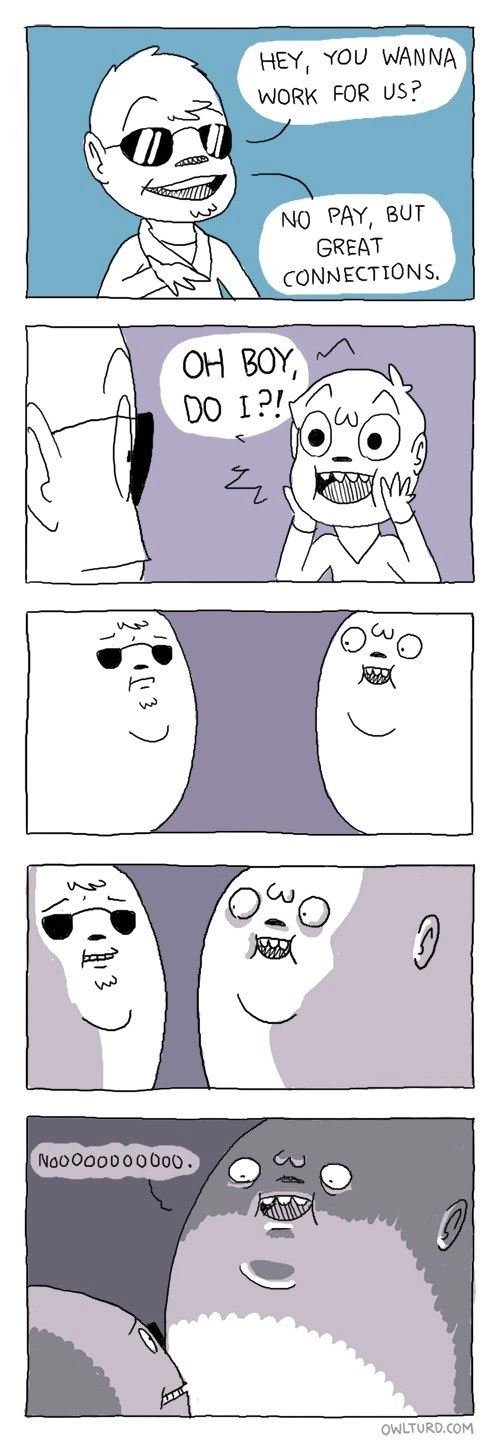
Let’s break down what’s happening in this comic in simpler terms, and why it’s funny (and frustrating) to developers just starting out. The scenario is a classic unpaid_work trap: a company or recruiter is offering a gig (a job or project) with no salary. Instead of money, they dangle the promise of “great connections.” In plain English, that means “We won’t pay you, but you’ll get to meet important people and make contacts.” This is sometimes called exposure_compensation – basically, they claim you’ll be “paid” in exposure to the industry or networking opportunities. It’s like saying, “We can’t give you dollars, but we’ll introduce you to folks or give you a nice line on your resume.”
In the first panel of the comic, the recruiter/manager character (bald head, sunglasses, big grin) is basically a walking red flag. He represents those shady parts of CorporateCulture that try to coat a bad deal with sweet words. When he says, “No pay, but great connections,” he’s using a flashy promise to cover up the fact that it’s an exploitative_offer. This is something you might encounter early in your career: someone might ask you to do programming work for free, maybe calling it an “internship” or a “volunteer developer role,” claiming you’ll meet CEOs, or get your name out there, or have something impressive to tell future employers.
In the comic’s second panel, we see the young developer character excitedly exclaim, “OH BOY, DO I?!” with starry eyes. This reflects how a junior developer or student might react if they don’t know better. When you’re new and eager, the idea of making great_connections can sound super valuable. After all, you’ve heard that “it’s not just what you know, it’s who you know,” right? The character is practically bouncing at the thought. This is the MisalignedExpectations at play: the newbie expects that these connections will lead to big opportunities or a foot in the industry door.
Now panels 3 and 4 show what those promised connections actually look like. The “connections” are drawn as two blobby, featureless people who have latched onto our poor developer. They’re not smiling, not helping – they’re just there, sort of pinning him between them. In real-world terms, this represents how those network contacts often turn out: not mentors or job offers, just two LinkedIn connections or some folks who frankly don’t care that much. The main character’s happy expression disappears; now he looks physically uncomfortable and mentally let down. He’s realizing that the “connections” aren’t doing anything for him. This is the moment a junior dev might think, “Hmm, I’m putting in all this effort and I’m not actually gaining any real experience or money or even useful recommendations. What am I doing?” In the comic, the connections are literally drawn as blobs to emphasize that they’re shapeless and not particularly useful – they’re practically free_labor weights on him.
By the final panel (panel 5), the situation goes from bad to comically worse: one of those blob connections has grown giant-sized and is looming over the developer, who is now screaming “Noooooooooooo.” The artwork is exaggerating the feeling of doom when reality hits. It’s like the weight of that bad decision (taking the unpaid gig) finally comes crashing down on him. In everyday terms, he’s realized he’s been tricked. The “great connection” might be a big-shot person or just the whole idea of networking itself, now feeling like a monster because it’s overshadowing the fact that he got nothing of real value. The scream is him going, “Oh no, what have I gotten myself into?!” – a mix of regret and horror. For a junior in a real job scenario, this is the feeling after you’ve worked a bunch of hours or weeks and finally accept that, “I’m not getting paid for this… and those ‘connections’ I was promised are not actually helping me get a paying job.” It’s a sinking feeling. The owlturd_comic style often uses these dramatic, almost absurd visuals (like a huge blob monster) to represent a very real emotional moment. Here it vividly shows the WorkplaceReality that the big promise turned out to be a big problem.
Now, why do developers find this comic so relatable and funny? It’s a form of DeveloperHumor rooted in shared experience. Many in tech have encountered something like this, especially early on. Maybe a startup said, “We can’t pay you, but you’ll get to work with experienced founders” or a friend on an indie project said “we have no budget, but if the product takes off you’ll be glad you were part of it.” These situations almost always end up one-sided. The comic is labeled “When recruiters pitch unpaid gigs as ‘great connections’ and you fall for it” — that caption itself is a wink to anyone who’s been in those shoes. It’s poking fun at the naive optimism we might have had and the sneaky way some companies try to justify unpaid_internship positions or unpaid roles. It falls under HiringHumor because it’s a joke about the hiring process and how absurd it can get. The IndustryIrony is that in an industry where skilled labor is in high demand, there are still offers where the only thing on the table is a handshake and a promise.
Importantly, this comic also serves as a bit of a caution for newer developers: if someone offers you “payment” in the form of exposure_compensation or networking, your guard should go up. Real CareerHumor often has a lesson: in this case, don’t let “great connections” be the only reward for your hard work. True, connections and experience are valuable, but a legitimate opportunity will usually value you enough to provide proper compensation (even internships in tech are usually paid these days, exactly because companies know your work has value). If a company truly thinks you’re worth bringing on for “great connections,” they should also think you’re worth at least minimum wage, right? The comic underscores that disconnect with its exaggerated horror ending.
Summing it up: the five pastel panels show a progression from hopeful to horrified, mirroring the emotional rollercoaster of a developer lured by a shiny but empty offer. It’s funny to laugh at the comic now, but only because it’s a WorkplaceReality we recognize and want to avoid. Next time someone says “it’ll be great for your portfolio and you’ll meet X, Y, Z influential people” instead of offering fair pay, remember the poor guy in this Owlturd strip and think twice. That laughter you hear from more experienced devs? It’s them saying, “Don’t be this comic. We’ve been there.”
Level 3: Networking for Nothing
This meme hits on a darkly comic truth in tech Career_HR and CorporateCulture circles: the infamous “work for exposure” scheme. It’s depicting an exploitative scenario we industry veterans know all too well. A shady recruiter (the bald guy with the sunglasses, practically a cartoon caricature of a slimy manager) says the magic words no developer wants to hear: “No pay, but great connections.” Immediately, any seasoned engineer’s internal alarm bells scream MisalignedExpectations. Why? Because we’ve learned the hard way that “great connections” won’t pay your rent, and those promises of networking are often as hollow as a cheap HTML template with no backend.
HEY, YOU WANNA WORK FOR US? NO PAY, BUT GREAT CONNECTIONS.
We’ve all heard some variation of that pitch, and it’s always a giant red flag. It usually translates to: “We need free_labor to boost our project, and in return you get… well, nothing tangible.” The comic exaggerates this with humor: the eager character shouts “OH BOY, DO I?!” — a wide-eyed newbie dev falling for the oldest trick in the CareerHumor book. Experienced devs cringe at this panel because we know that excitement all too often turns into regret. It’s a slice of WorkplaceReality served cold. The humor comes from empathy (many of us have been that eager beaver early in our careers) and from the absurdity: the manager’s offer is so blatantly one-sided that it’d be funny if it weren’t something that actually happens. The combination of HiringHumor and IndustryIrony here is potent: tech, an industry awash in cash, still has corners where people are asked to work for zero dollars on the vague promise of “connections.” It’s the equivalent of being told the pay is the friends we made along the way – a cynical joke that triggers both laughter and an eyeroll.
From a senior developer’s perspective, the comic’s visual metaphor nails it. The “connections” are drawn as blob-like, expressionless figures that literally squeeze the protagonist in panels 3 and 4. This is a clever representation of exposure_compensation in practice: those connections have weight but no real substance. They’re not lending him a hand, they’re just… there, inert and somewhat suffocating. In real life, that’s how these promised benefits often feel – you might get to name-drop a person you met or add a line on your LinkedIn, but you’re stuck in a position that’s giving you nothing to live on. The main character’s initially beaming smile fades to an awkward grimace as he’s sandwiched by two useless “contacts.” That transition is basically the timeline of someone accepting an exploitative_offer: enthusiasm crashes into reality. By panel 5, one massive blob (perhaps the grand “connection” he was promised, now revealed as an all-consuming owlturd_comic monstrosity) looms over him. He’s screaming “Noooooooooooo” in pure horror. It’s funny because it’s true: that’s the internal scream of any developer who realizes too late that they’ve been doing unpaid_work for a promise that evaporated. The gigantic connection blob can be seen as the overwhelming realization of being trapped – the weight of wasted time and the dominance of a “favor” that was never going to pay off. The comic exaggerates it to sci-fi monster proportions, which gives us a laugh, but underneath the humor is the shared war story: Never let them pay you in anything that’s not legal tender.
On a technical note, consider how a seasoned dev might pseudocode this scenario:
def evaluate_offer(pay, benefits):
if pay <= 0 and "connections" in benefits:
# This is essentially a trap disguised as an opportunity
raise RuntimeError("Exploitative offer detected: Pay in 'exposure' is not accepted.")
return "Legit offer"
# Example usage:
offer = {"pay": 0, "benefits": ["great connections", "experience"]}
try:
evaluate_offer(offer["pay"], offer["benefits"])
except RuntimeError as err:
print(f"🚩 {err}")
In the snippet above, any offer where pay == 0 and a benefit includes “connections” triggers a big red flag (we literally raise an exception named RuntimeError because it’s that bad). The printed 🚩 warning is the kind of reaction a battle-scarred developer has by instinct. In real life, of course, you can’t catch an exception to escape an unpaid gig you already fell for – which is exactly why this comic’s cautionary tale rings true. The code analogy just underscores the rule: if offer.pay == 0 and one of the perks is "great connections", then for your own sanity, you should .reject() that offer faster than a bug fix in prod on Friday evening.
The meme resonates among developers because it spotlights a WorkplaceReality often learned the hard way. Many of us have early-career stories of nearly falling (or actually falling) for the UnpaidInternship or “equity and exposure” spiel. The comic captures that shared experience with a mix of laughter and pain. It’s a gentle IndustryIrony reminder: in a field that prides itself on logic and problem-solving, we still have to debug the age-old problem of people trying to shortchange us on our very real labor. And if you’ve ever been in that spot, you laugh at this comic to keep from crying – because at least now you know better.
Description
This is a five-panel comic strip by artist Shen Comix (also known as Owlturd). In the first panel, a smug character with sunglasses offers a job with 'No pay, but great connections.' A second, naive-looking character eagerly responds, 'OH BOY, DO I?!' The following panels depict the naive character's face getting uncomfortably close to the first, then physically pressing into and distorting him. In the final panel, the naive character has inflated into a massive, grotesque blob, engulfing the smug character while uttering a prolonged 'Noooooooooooo.' The comic is a dark and humorous take on the exploitative nature of unpaid internships and offers of 'exposure,' a scenario familiar to many junior developers trying to enter the tech industry. It serves as a revenge fantasy against predatory hiring practices
Comments
12Comment deleted
The only 'great connection' you get from an unpaid internship is a persistent TCP connection to their production server that you're now solely responsible for
That “no pay, great connections” pitch is basically a SYN flood for senior devs - endless half-open handshakes, zero payload
The same VCs who won't invest without traction want you to build their nephew's "Uber for dogs" MVP for equity that vests after their Series B
This perfectly captures the moment a junior dev realizes that 'great connections' is just a euphemism for 'we'll add you to our Slack workspace before ghosting you after the unpaid MVP is done.' The transformation in the final panel represents the exact nanosecond when the candidate's excitement buffer overflows into existential dread - a stack trace of regret that no amount of 'exposure' can debug
Their 'connections': a hung process (ZZZ), MBA busy-wait on Jira, and noob endpoint spewing 500s
“No pay, but great connections” is the startup equivalent of TCP without payload - lots of handshakes, zero cash flow
“No pay but great connections” is just an unbounded connection pool - lots of open sockets, zero throughput to my bank account
no pay no code, only shit Comment deleted
that oddly looks like shen's old art style, but also not… Comment deleted
- but it's google - of course yes! Comment deleted
Work for coffee Comment deleted
Working for 1 plate of rice Comment deleted