The Developer's Instinctive Flight from Documentation
Why is this Documentation meme funny?
Level 1: Running from Help
Imagine you got a new big LEGO set or a cool toy that you have to put together. The toy comes with an instruction booklet that tells you exactly how to build it step by step – that booklet is like the official documentation. Now picture this: instead of reading the instructions, you toss the booklet aside and start trying to force pieces together on your own, randomly. Meanwhile, your parent or friend is holding the instruction booklet, watching you struggle, and asking, “Why are you running away from the instructions?” In other words, “Why won’t you read the guide that’s right here to help you?”
That’s exactly what this meme is showing, but with software developers and manuals. The developers are like the excited kid who doesn’t want to read the instructions. The official documentation is like that helpful instruction booklet (or a person holding it) who is baffled that you’re not even looking at it. It’s funny and a little silly because the developers are basically running away from something that would actually make their life easier – just like ignoring the toy’s instructions and then getting confused about why the toy isn’t coming together. The meme makes us laugh because we’ve all been in that situation in one way or another: sometimes we avoid reading instructions or help even though it’s right there, and then we end up frustrated. Here, the documentation is playfully acting like a person chasing after the developer, yelling “Why are you running?” – meaning “I’m trying to help you, why won’t you let me?” It’s a fun way to show the silly side of ignoring the help that’s available.
Level 2: Running from Docs
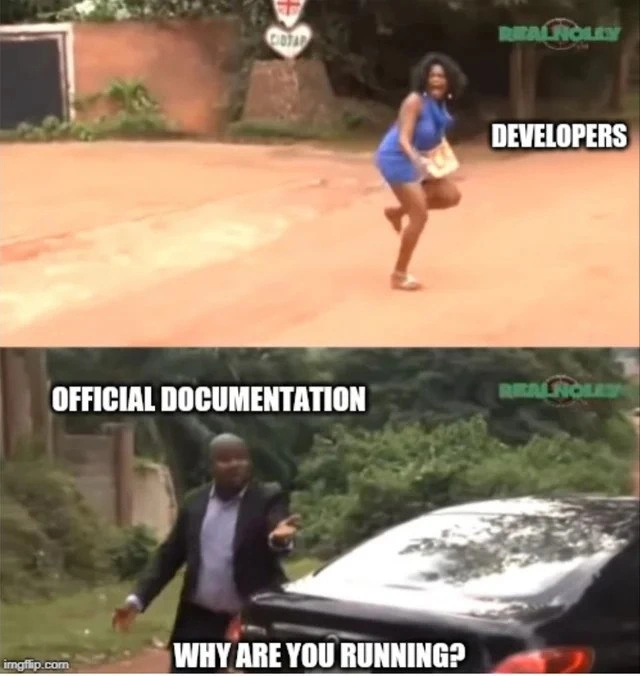
Let’s break down the meme in simpler terms. It’s showing a common situation every programmer eventually recognizes. Official documentation is basically the instruction manual or guide for a software tool, library, or product. It’s written by the people who created or maintain that thing, and it’s supposed to explain how to use it properly. In the meme, “Official Documentation” is personified as a man in a suit who’s astonished and asking, “Why are you running?” The top half of the meme has a woman labeled “Developers” literally running away. This visual gag is saying: developers often run away from the official docs instead of reading them. And the documentation (if it were a person) is standing there confused, asking why they’re avoiding the very help that’s available. It’s a funny take on DocumentationHumor and an everyday developer habit.
If you’re a new developer, you might have already experienced this. For example, say you’re using a new programming library and something isn’t working. The straightforward solution would be to read the library’s official guide or documentation to find the answer. But many times, a developer (whether out of impatience or habit) does this instead: they Google the error message or search for a quick answer on Stack Overflow. (Stack Overflow is a popular question-and-answer forum where programmers help each other out.) In other words, rather than opening the official docs, they look for a shortcut. This meme jokes about that tendency. The “Developers” running represents us programmers looking for an outside answer or just trying random solutions, while the answers in the official docs are literally chasing after us, waving, “Hey, I’m right here!”
A well-known phrase in programming circles is RTFM, which stands for “Read The Fine Manual” (the “F” actually stands for a not-so-polite word, but you get the idea). When someone says “RTFM” or “Did you read the docs?”, it’s often because the question being asked has an answer that’s clearly written in the documentation. It’s a slightly sarcastic way to tell a person, “You’d solve your problem quickly if you just read the official instructions.” This meme is essentially the visual version of that sentiment. It’s highlighting DocumentationAversion – a fancy term for the tendency to avoid reading manuals. The developer humor here is that everyone knows they should read the docs, yet so many of us procrastinate or skip it, and then act surprised when we run into problems. That’s why the man labeled “Official Documentation” is bewildered: he’s like, “I’ve provided all the answers, why are you running away from me?”
Another aspect is the learning curve when encountering new tech. Official docs can sometimes be long, detailed, or use very formal language, which might intimidate or bore people, especially those new to a technology. If you’re just starting out, cracking open a 50-page manual or a dense technical documentation page might feel overwhelming. So, it’s tempting to avoid it and search for a quick fix or a tutorial. The meme is funny because it exaggerates this common behavior. It’s as if the developers are literally fleeing to avoid having to read the manual. The relatable humor is that we’ve all done this at some point: skipped the boring instructions and tried to figure things out ourselves. And then, when things go wrong, we get frustrated. In real life, that frustration often leads us back to the documentation anyway, with a bit of embarrassment. The meme’s question “Why are you running?” is exactly what a senior engineer or the doc itself might say at that moment: “Why are you avoiding the guide that has what you need?” It’s a playful reminder that, yes, the official documentation exists for a reason – to save us time and trouble – and running away from it is kind of silly. This is a shared joke among developers because virtually everyone in software has learned the hard way at least once that reading the docs early on would have been the smarter move.
Level 3: The Great Documentation Chase
In this meme’s drama, official documentation plays the perplexed pursuer and developers are the ones sprinting away. It’s a parody of the famous Nollywood meme scene (complete with the green “REAL NOLLY” watermark) where a man shouts, “Why are you running?” at a fleeing woman. Here, the woman in the blue dress is labeled “Developers”, and the suited man is “Official Documentation” voicing utter confusion: “WHY ARE YOU RUNNING?”. This perfectly captures a classic RTFM_joke – that is, “Read The Fine Manual” (with a less polite word often meant by the "F"). The humor digs into our collective DocumentationWoes: despite having a manual or guide that explains everything, engineers often run away from it. It’s an inside joke about documentation aversion and the resulting developer frustration we’ve all seen.
From a seasoned developer’s perspective, this scenario is painfully relatable and darkly funny. We’ve all witnessed (or committed) the act of charging ahead on a coding problem while ignoring the official docs, only to crash into a wall of bugs or confusion. The meme exaggerates that habit by turning it into a literal chase scene. The official documentation stands there like “I wrote down all the answers for you!” while the dev darts off to do things the hard way. It highlights a recurring gap in Developer Experience (DX): maintainers publish extensive guides and reference materials for a tool or API, yet developers often prefer to experiment blindly or scour forums for a quick fix. The result? The devs are figuratively running in circles as the documentation chases after them yelling “why won’t you just read me?!”.
Why is this so funny (and true) for veteran engineers? Because we’ve been there. It’s a shared pain in the industry. You can almost hear the collective groan: here we go again, another dev skipping the docs. Maybe the official guide is even easily accessible (perhaps on a site like Read The Docs or a project’s wiki), but it might as well be invisible. Instead, the dev will:
- Google the error and click on some random blog.
- Copy-paste from Stack Overflow (hoping someone else solved this exact issue).
- Tinker with random fixes in code by trial-and-error.
All of this happens before they’d consider opening the actual documentation PDF or README. It’s the classic “Too Long; Didn’t Read” syndrome (commonly abbreviated as TL;DR). In other words, “Ain’t nobody got time for 30 pages of docs, I’ll just wing it.” Each bullet above is a rationalization devs use to dodge the manual. And when those ad-hoc attempts inevitably fail or lead to even more confusion, the developer is left frustrated, and the documentation is standing there, incredulous, asking that famous question from the meme: “Why are you running (from the answers)?”.
This is DocumentationHumor with a sting of truth. It pokes fun at how devs sometimes behave against their own interests. The official documentation is presumably the most accurate source – written by the library authors or product team, containing all those important details and edge cases. Yet, developers often treat it like it’s an angry boss to avoid, rather than a helpful teacher. There’s a bit of irony here that seasoned devs appreciate: skipping the docs can lead you straight into a pit of wasted time—like deploying a feature only to discover a hidden config gotcha that was clearly documented if you had bothered to read it. The meme’s absurd chase visualizes this irony perfectly. Relatable? Oh, absolutely. Every senior engineer can recall a 3 A.M. on-call nightmare that could have been prevented by ten minutes of reading the docs beforehand. As the saying goes in hindsight: “If only I had RTFM, I wouldn’t be debugging this mess now.”
In fact, maintainers and tech leads often feel exactly like that suited man in the bottom panel. They painstakingly write guides, FAQs, and comments in the code for others to follow. Then someone runs off, doesn’t read any of it, and cries for help when things break. The maintainer’s exasperated response is basically: “Did you read the docs I gave you? Why are you running from the documentation?” It’s the real-life equivalent of that meme quote. This dynamic is a well-known inside joke in developer communities – we even lovingly ridicule ourselves for it. The meme format makes it extra vivid: picture the documentation literally chasing after the programmer down a dusty road, baffled at being so blatantly neglected. It’s a documentation_chase_sequence we recognize from countless day-to-day scenarios in tech. In summary, at this senior level the meme is commenting on a core DeveloperExperience issue: having information available vs. actually using it. It wittily highlights the stubborn independence (or impatience) of engineers, the LearningCurve they sometimes unnecessarily steepen, and the eternal battle between devs and the docs meant to help them. Why are we running indeed? Because sometimes, we’re our own worst enemy when it comes to learning what we need to know.
Description
A two-panel meme using the 'Why Are You Running?' format to comment on developer habits. The top panel shows a woman in a blue dress running away frantically down a dirt road, with the label 'DEVELOPERS' superimposed over her. The bottom panel features a man in a suit standing next to a car, looking bewildered and gesturing with his hands as he asks, 'WHY ARE YOU RUNNING?'. This panel is labeled 'OFFICIAL DOCUMENTATION'. The meme humorously illustrates the common, almost reflexive tendency for developers to avoid reading official documentation, instead opting for trial-and-error, searching Stack Overflow, or watching tutorials. It personifies the documentation as being confused by this behavior, as it theoretically holds all the correct answers the developer is seeking
Comments
7Comment deleted
I don't always read the documentation. But when I do, it's after 6 hours of debugging, and I find out the feature was deprecated two years ago
Because by the time we figure out which version of your “official” docs matches what’s actually in prod, we’ve already packet-sniffed the API, generated the client, and merged to main
After 20 years in tech, I've learned that the only developers who actually read documentation are the ones who wrote it - and even they prefer the GitHub issues section where someone else has already asked why their example doesn't work in production
Documentation is like that production incident from 3am last Tuesday - everyone knows it happened, everyone agrees it was important, but somehow the postmortem never got written. Six months later, when the new architect asks 'why does this service have a 47-second timeout?', the only answer is a Slack thread from 2019 where someone said 'trust me bro' and three thumbs-up emojis. The real documentation was the friends we made debugging along the way
Official docs: “Why are you running?” - “Because your examples target v2, prod speaks v1.7, and the only spec that never lies is Wireshark.”
Our “official documentation” keeps asking why I’m running - because every example targets v2 while prod is on v5 behind three feature flags and a canary; at least StackOverflow tells me which wrong answer is the most recent
Official docs: so thorough they assume you already know what 'thorough' means