Are You Winning, Dev? Legacy Java 8 Migration Meets JDK 17 Reality
Why is this LegacySystems meme funny?
Level 1: Always One Step Behind
Imagine your dad asks you, “Are you winning?” while you’re playing a game that’s really not going well. In this scenario, the “game” is keeping up with something new, but our player (the developer) is hopelessly behind. It’s like your mom and dad set up a chore chart for you to clean your room and earn a shiny new toy from 2014, but you took so long that now it’s 2021 and that toy isn’t cool anymore — there’s a brand new toy out that you really want instead. You haven’t finished the original chore, and you’re already daydreaming about this new toy. Now picture your dad proudly hanging a “Parent of the Year” award on the wall for making the chore chart, then peeking into your room with a big grin asking, “So, are you winning, kiddo? Is your room all clean?” You, sitting amid the mess, are actually reading a catalog about that 2021 super-toy instead of cleaning. It’s funny because obviously you’re not done with the chore, and the reward your parents planned (the 2014 toy) is outdated — you don’t even care about it now. The question “Are you winning?” is ridiculous in this context. It’s as if the grown-up is out-of-touch with what’s really happening.
So in plain terms: the meme is joking that the developers are always a bit behind, working on old goals while new things keep coming out. The boss character thinks everything is great and asks cheerfully if the team has succeeded, but the team member is looking at something completely different (something much newer than the old goal). It feels like trying to finish yesterday’s task tomorrow, while today’s world has already moved on. Everyone can laugh because we’ve all experienced being behind on something while the world keeps racing ahead. The manager (like the parent) doesn’t realize how far behind things are, which makes the question “Are you winning?” comically off-base. In the end, the meme is a light-hearted way to say: sometimes, no matter how hard you try to catch up, you end up always one step behind — and it’s both frustrating and a little funny when others don’t even notice.
Level 2: Stuck on Java 8
At this level, let’s break down the technical and cultural references in the meme more clearly. The meme’s scenario is about a software project bogged down in updating its technology. Specifically, the team is trying to migrate to Java 8 — meaning they want to upgrade their application or code to run on Java version 8. Java is a popular programming language, and “Java 8” refers to a particular release of that language (released in 2014) that introduced big features like lambdas (a new way to write functions) and the Stream API for handling collections. By 2021, when this meme was posted, Java 8 was no longer new at all; in fact, much newer versions existed (Java 11 came out in 2018, and Java 17 was planned for late 2021). So if a company in 2021 still has a goal “upgrade to Java 8,” it’s running on very old software (likely Java 6 or Java 7 from the mid-2000s). That’s what we call a Legacy System: an old version of software or an old system that’s still in use. Upgrading it is part of modernization – bringing the technology up to date – but here the modernization plan itself got old!
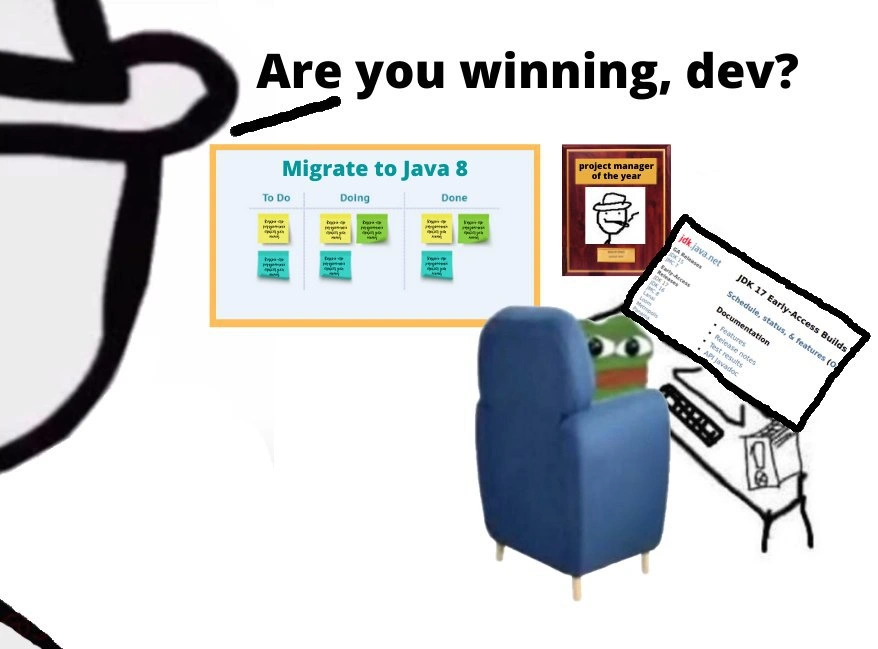
Now, look at that Kanban board in the image. A kanban board is a tool teams use to track work. It’s divided into columns like “To Do,” “Doing,” and “Done.” Each sticky note on the board is a task or a user story. For example, tasks to migrate to Java 8 could include things like “Update our code to remove old functions that Java 8 doesn’t allow” or “Test the application on Java 8 to see what breaks.” In the meme, the Migrate to Java 8 board has sticky notes in all columns, meaning some tasks are still to do, some are in progress (doing), and a few might be completed (done). Importantly, the very fact that this entire board exists means the project has been formally organized — someone (the project manager) has made a plan with lots of steps to get from the old Java version to Java 8. But evidently, it’s a slow-moving project. Many tasks aren’t finished. This visual tells us the team has been working on this migration for a while, but it’s not completed. It hints at a situation where every time they finish a few tasks, new issues pop up, or other work takes priority, so the migration drags on.
Meanwhile, the developer in the meme (the green frog character, Pepe), is shown looking at a computer screen that displays the JDK 17 Early-Access Builds page. Let’s break that down: JDK stands for Java Development Kit. It’s essentially the toolkit (compiler, libraries, etc.) needed to develop and run Java programs for a specific version. JDK 17 is Java version 17 — a much newer version than Java 8. When it says “Early-Access Builds,” it means Java 17 isn’t officially released yet; it’s in a preview/testing phase where developers can try it out early. So our frog developer is literally reading about a Java version that is nine versions ahead of the one his project is trying to adopt. That’s like if your school was just now getting computers with Windows 7, and you’re online reading about the upcoming Windows 11. It shows a huge gap between the project’s target and the current state of technology. The developer is likely interested in new features and improvements Java 17 will bring (things the current system won’t have for a long time, if ever). There’s also an element of procrastination or escapism implied: instead of slogging through the boring, frustrating work of migrating to Java 8, the dev is momentarily escaping by browsing something exciting and cutting-edge. Many developers can relate to that temptation!
Now let’s talk about the text “Are you winning, dev?”. This is a twist on a popular internet meme where a father asks his son playing video games, “Are you winning, son?” In meme culture, that phrase is used humorously when someone in authority (like a parent, or here a manager) checks in cluelessly on someone else’s project or hobby. In our context, the project manager (the boss, shown as the father figure silhouette on the left) is asking the developer if he’s “winning” – meaning “Are you succeeding? Is the project on track? Are you making progress?” It’s phrased in a naive, somewhat patronizing way. The developer clearly is not winning; in fact, his attention is on something else entirely (Java 17). The humor is that the manager is so out-of-touch that he thinks to casually ask if success has been achieved, when in reality things are off track. It highlights a common Project Management disconnect: the manager might not be aware of the details or the struggles, but still pops in to ask for a status in the simplest terms. If you’ve ever had a boss ask, “So, is it done yet?” when you’re knee-deep in problems, you’ll recognize this feeling.
Notice the plaque on the wall titled “project manager of the year.” It even has the father/manager’s image on it. This is a satirical detail. It implies that this manager got an award for being great at his job — perhaps he was praised for initiating this Java 8 migration project, or for being an outstanding planner. The joke is that despite this award, the project isn’t a success (it’s not even finished). It suggests a scenario where management celebrates themselves (giving each other awards or praise) prematurely or undeservingly. In many workplaces, you might see managers get credit for starting big initiatives (“We’re going to modernize everything!”), but the actual work is tough and falls on the engineers who struggle without much glory. Here the plaque is poking fun at that dynamic: the manager thinks he’s winning (trophy on the wall), so he asks the dev, “Are you winning?” The truth is quite the opposite.
Let’s also clarify Technical Debt because it’s central to this meme’s context. Technical debt is a metaphor in software development: it’s like debt in finances, but instead of money, you “owe” work on your code. For example, if you take a shortcut or delay an important upgrade (like skipping updates from Java 6 to 8 when you should have done it earlier), you accumulate “debt.” You save time in the short term (just as borrowing money gives you immediate cash) but you incur an interest – meaning it will cost you extra effort later to fix it. Migrating from a very old system is harder the longer you wait because the code base gets larger, more things break with new versions, and team knowledge of the old system fades. In our meme, the fact they are just now migrating to Java 8 (which is already legacy by 2021) implies they accumulated a lot of technical debt by not upgrading sooner. Now they have to pay that debt, and it’s painful – so painful that by the time they handle it, the world has moved even further ahead.
Every element of the meme reflects a real-life scenario many developers (even relatively junior ones) eventually encounter:
- Legacy Codebase: You might join a project and find out they are using an old version of a language or framework. It still works, but it’s out-of-date.
- Migration Project: The team plans an update (say, “We need to update to a newer Java, because the old one will soon be unsupported or lacks features we need”). This becomes a project with tasks and deadlines, often tracked on a kanban or similar board.
- Slow Progress: These updates can be surprisingly hard. For example, some libraries your application uses might not work on Java 8 without updates. Or certain code syntax changed. So developers must do a lot of testing and fixing. Other times, business needs push the upgrade aside (“feature development comes first”), so the migration keeps getting postponed.
- New Versions Released: While you delay, new versions (Java 9, 11, 13, 15, etc.) keep coming. So the gap widens. It’s a bit discouraging: you’re trying to catch up, but the finish line keeps moving further away, because technology doesn’t stand still.
- Management Perspective: Your managers might not grasp the technical complexity. They set a target like “upgrade to Java 8 by Q4” and expect it to happen. They may even celebrate the plan itself (“we’re modernizing our legacy systems!” announced in a meeting). The plaque in the meme is a tongue-in-cheek reference to that celebration. Meanwhile, engineers doing the work feel like the job is never-ending.
- Developer’s Resignation/Humor: The developer character (Pepe) is a bit of an inside-joke in internet culture, often used to represent someone feeling frustrated, tired, or resigned. Seeing him stare at the screen with Java 17 info suggests he knows how absurd the situation is. It’s both funny and a little sad – he might be thinking, “By the time we get to Java 8, we’ll want Java 17… what’s the point?” But instead of flat-out complaining, the meme format lets us laugh at the absurdity.
In simpler terms, this meme is categorized under Developer Humor and Project Management Humor because it highlights a goofy reality of software development: plans versus reality. It combines Modern vs Legacy tech commentary (Java 8 vs Java 17) with a jab at management (the “PM of the year” dad asking a naive question). If you’re a junior developer, it’s a window into why colleagues sometimes groan about “tech debt” or roll their eyes at big modernization announcements. The meme says: “We planned to catch up to an old version, but time flew and now we’re ridiculously behind — and management doesn’t quite get it.” It’s funny in the same way an inside joke is funny: once you’ve lived even a bit of this (like struggling to update something while newer stuff keeps emerging), you appreciate the irony.
Level 3: JDK Generation Gap
The meme dives straight into the absurdity of legacy migration timelines. In the familiar “Are you winning, son?” format, a black-outlined father figure (here standing in as a clueless project manager) asks, “Are you winning, dev?” The punch line? The poor developer — depicted as a weary Pepe-the-frog at his CRT monitor — is browsing JDK 17 release notes even though the team’s official goal (splashed on that bright orange kanban board) is still “Migrate to Java 8.” This stark Java version gap is the core of the humor: by the time management’s modernization plan to upgrade their Legacy System to Java 8 inches forward, Java 8 itself has long become old news, and Java 17 is on the horizon. It’s a textbook case of Technical Debt coming home to roost — the project is so far behind the technology curve that the “latest” version in the plan is itself nine years out-of-date.
On the kanban board (titled “Migrate to Java 8”), tasks are split into To Do, Doing, Done columns, each packed with tiny sticky notes. This suggests a massive legacy migration project broken into sub-tasks: perhaps updating libraries, fixing incompatible code, and testing on the new JDK. By the looks of it, plenty of sticky notes are still under “To Do” and “Doing.” In other words, the migration isn’t winning at all — it’s bogged down. Any experienced developer knows that migrating a large legacy codebase to a newer platform is a slog: you plan it in 2015 when Java 8 is shiny, but due to constant delays, shifting priorities, and technical pitfalls, you’re still at it in 2021, well after Java 11 (2018) and even Java 17 (2021) have come out. It’s like trying to catch a moving train that’s accelerating away. Every time you think you’re close to adopting “modern” tech, the definition of modern changes. The Languages category here (specifically the Java ecosystem) underscores how quickly versions evolve — Java’s on a six-month release cadence now, with LTS (Long-Term Support) versions occasionally (Java 8, 11, 17). If your enterprise plans say “we’ll upgrade to the latest LTS (Java 8)” but take 5+ years to execute, you’ll always be at least two LTS versions behind. This is essentially a tech debt treadmill: running fast just to remain outdated.
Now, the developer’s screen explicitly shows the jdk.java.net page for “JDK 17 Early-Access Builds”. That’s a hilarious detail for those in the know — JDK 17 early access in early 2021 means the developer is reading about upcoming features and fixes for a Java release that’s three major versions newer than the target of their migration. Perhaps this dev is daydreaming: “Forget Java 8, maybe we should jump straight to 17!” Or maybe they’re just procrastinating with some Modern vs Legacy window-shopping, checking out cool new language features (like text blocks, records, or pattern matching) that they cannot use at work for years to come. It’s a very developer thing to do: half out of frustration, half out of hope. We often keep an eye on bleeding-edge tech (like an early-access JDK) even while wrangling ancient code, because that contrast is our daily reality. The humor cuts deep: the dev is mentally in the future while physically stuck maintaining the past, a literal depiction of LegacySystemsAndModernization whiplash.
And let’s not ignore the cherry on top: the plaque on the wall reading “project manager of the year” emblazoned with that same fatherly figure. This is biting Management Humor. The Project Manager (PM) is apparently so proud of kicking off the “Migrate to Java 8” initiative that he’s awarded himself a trophy. It screams corporate satire: management celebrates the idea of modernization with awards and self-congratulation, while the developers are left to grapple with the messy reality of it (and possibly get blamed when it falls behind). The father/PM peeking in asking “Are you winning, dev?” is completely out-of-touch — he measures success in appearances (the project board exists, the initiative is started, trophy on shelf) rather than actual technical progress. Every seasoned dev who’s been through a failed upgrade or an overdue refactor can practically hear the tone-deaf status meeting: “So, are we done migrating to Java 8 yet? We promised it this quarter!” Meanwhile, the dev team knows that by the time they finish, the win will feel hollow because they’re still generations behind current tech. This disconnect — between management expectations and developer reality — is exactly what fuels the meme’s dark humor.
In real-world terms, the meme hits on a common enterprise scenario: an outdated migration plan that hasn’t kept pace with technology. It’s not just about Java; this pattern repeats with any stack: think of companies still migrating from Python 2 to 3 when Python 3’s been standard for a decade, or teams stuck on an old version of .NET while .NET Core is flourishing. The longer you delay these upgrades, the more technical debt interest accrues: libraries get deprecated, security fixes pile up, new versions introduce breaking changes that make the eventual jump even harder. Java 8 to Java 17 isn’t a trivial bump — for instance, Java 9 introduced the module system (Project Jigsaw) which can break classpath hacks, and each later version has its own adjustments. So if you’ve coded yourself into a corner on Java 6 or 7 and postpone upgrading until “later,” you might end up having to skip over multiple versions in one herculean effort. That kanban board likely has cards for “Remove usage of deprecated Date API”, “Refactor for Java 8 Streams and Lambdas”, “Test all critical workflows on JDK 8”, etc. The devs are slogging through those, while new deprecations and features (from Java 9-17) loom unseen. No wonder our Pepe-frog dev stares at the JDK 17 site with a mix of longing and cynicism — it’s the modernization mirage in the distance.
All of this is wrapped in a meme that fellow developers chuckle at because it’s painfully relatable. Legacy codebase upgrades are usually promised by management with bright-eyed optimism (“We’ll be on the latest version by Q3!”), yet management often underestimates the effort. They might even get recognition for “initiating” the upgrade (hence the ironic “project manager of the year” plaque), while engineers face the reality of spaghetti code and brittle integrations that make progress slow. The question “Are you winning, dev?” drips with sarcasm here: clearly, the dev isn’t “winning” at all in the traditional sense. The only “win” might be surviving another day of this thankless migration grind. The father/PM’s oblivious smile (we assume he’s smiling proudly on that plaque) just adds insult to injury — it’s the boss asking if the impossible task is done, without offering any help.
In summary, at this deep level the meme satirizes tech debt and management myopia: The team is stuck implementing an outdated plan (migrating to Java 8) while the industry (and the dev’s curiosity) has moved on to Java 17. It captures the LegacySystems pain: by the time you modernize to yesterday’s technology, today’s technology has already left you behind. Every senior developer who’s ever been cornered into maintaining ancient systems or chasing overdue upgrades sees a bit of their life in this image — and that mix of exasperation and gallows humor is exactly what makes it funny.
Description
Meme in the “Are you winning, son?” format: a black-outlined father figure peers from the left while large bold text reads “Are you winning, dev?” with a hand-drawn underline. Center stage is a kanban board bordered in orange that says “Migrate to Java 8” with the columns “To Do / Doing / Done,” each filled with tiny colored sticky notes whose text is too small to read. On the wall hangs a plaque titled “project manager of the year” showing the same father figure. In the foreground a Pepe-the-frog developer, seated in a blue arm-chair, stares at a CRT-style monitor displaying the jdk.java.net page header “JDK 17 Early-Access Builds” alongside bullet links for “Schedule status & features for release,” “Documentation,” “Release notes,” and “Security fixes.” The contrast between an overdue Java 8 migration backlog and the developer browsing JDK 17 pokes fun at legacy tech debt, unrealistic project plans, and management accolades
Comments
6Comment deleted
Totally winning - management’s kanban says “migrate to Java 8,” my IDE’s on JDK 17 EA, and prod still hums on Java 6; we’ve achieved Schrödinger’s upgrade: simultaneously legacy and bleeding-edge until audit opens the box
Nothing says 'enterprise agility' quite like spending 2024 migrating to a Java version from 2014 while your PM wins awards and you're secretly reading JDK 17 EA docs, knowing full well you'll be migrating to Java 11 in 2030
Still migrating to Java 8 in 2024 while Java 17 docs sit on your desk? That's not technical debt - that's a technical mortgage with compound interest. The real kicker? You'll need to migrate your migration tool before you can finish migrating. At least that 'Project Manager of the Year' award proves someone's winning... just not the dev team stuck in this temporal paradox where 2014 technology is still 'the future.'
Java 8 migration in eternal 'Doing' limbo - meanwhile, parallel threads crush LeetCode for that FAANG escape hatch
Nothing says enterprise agility like a Kanban titled "Migrate to Java 8" while the dev reads JDK 17 EA - shipping classfile version 52 in 2025 and calling it modernization
“Are you winning, dev?” - “Yep: our epic is ‘Migrate to Java 8’ because the vendor support matrix says so; I’m reading JDK 17 release notes to preview what I’ll be allowed to use in 2032.”