Even Divine Rest Can't Escape JavaScript Issues
Why is this Languages meme funny?
Level 1: Even the Boss Doesn't Get a Day Off
Someone builds something enormous and amazing in six days, takes exactly one day off — and on the very next morning wakes up to a pile of complaint letters saying "it's broken," with no explanation of what's broken or how. It's like baking a thousand cookies for the whole town, sleeping in once, and finding your mailbox stuffed with notes that just say "cookie bad." The joke is that no matter how powerful you are or how good your work is, the moment you share it with people, the complaints start — and they never, ever stop.
Level 2: Undefined Is Not a Function, Explained
The error on God's monitor is worth unpacking, because every JavaScript beginner meets it within their first week:
const user = { name: "Ada" };
user.greet();
// TypeError: user.greet is not a function
// (older engines: "undefined is not a function")
user.greet doesn't exist, so JavaScript evaluates it to undefined — and then you tried to call undefined like a function. The message is technically accurate and pedagogically useless, which is why it became legendary. It typically means one of: a typo in a method name, data that hasn't loaded yet, an import that didn't resolve, or an API that changed under you.
The other concept in play is the issue: on platforms like GitHub, users report bugs to a project's maintainers via an issue tracker. The comic's joke about "several issues posted" the morning after release reflects a rite of passage — the first time you publish anything (a library, an app, a school project on a public repo), you learn that shipping converts your code from your problem into everyone's problem, addressed to you. And many issues look exactly like the one shown: a single quoted error with no context, leaving the maintainer to divine the cause. Which, in this comic, is at least thematically appropriate.
Level 3: No Rest for the Maintainer
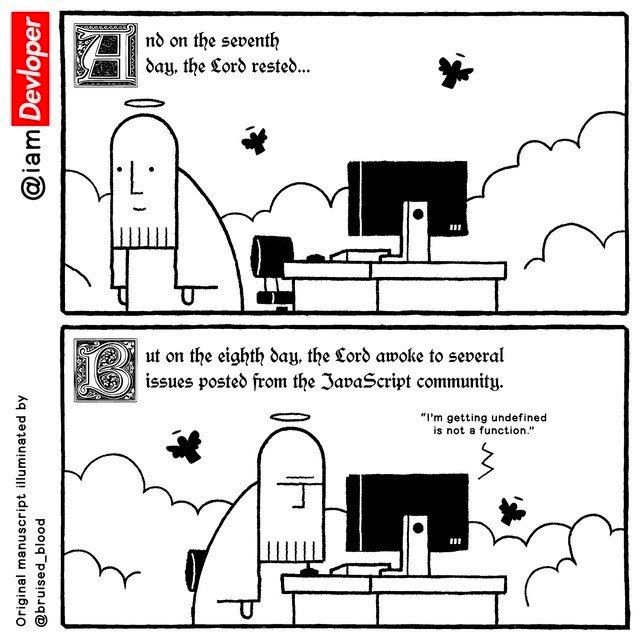
The comic's framing device — drawn in genuine illuminated-manuscript style with blackletter type and ornate drop caps, credited as an "Original manuscript illuminated by @bruised_blood" for @iamdevloper — casts the creation of the universe as a software release, and the punchline is brutally precise about what happens after every release:
And on the seventh day, the Lord rested... But on the eighth day, the Lord awoke to several issues posted from the JavaScript community.
The monitor in panel two displays the issue itself: "I'm getting undefined is not a function." — historically the most infamous error message JavaScript has ever produced, and a perfect choice because it is the bug report from hell: no stack trace, no reproduction steps, no environment details. Just a quote of the error, posted as if the maintainer's omniscience extends to the reporter's node_modules.
Several layers of satire compound here. First, maintainer burnout: even an infinitely powerful creator gets exactly one day of rest before the issue tracker fills up. Open-source maintainers recognize the slumped posture in panel two — it's the posture of opening GitHub notifications the morning after tagging v1.0.0. The release is never the end; it's the moment the support burden begins, and the gap between panel one's serene clouds-and-angels composition and panel two's hunched figure is the entire emotional arc of shipping software.
Second, the choice of the JavaScript community specifically. JS is the most deployed language on Earth, which means it has the largest population of users at every skill level filing issues simultaneously. Its dynamic, weakly-typed semantics make undefined is not a function a structural inevitability rather than a rare failure: call any property that doesn't exist as if it were a function, and the runtime cheerfully waits until execution to tell you. An entire ecosystem — TypeScript, ESLint, optional chaining (?.) — exists substantially to make this one error rarer. The comic predates none of the pain.
Third, there's the quiet theology joke for engineers: if the universe is a system, day eight is when the users found the edge cases. Any sufficiently large release discovers that the spec ("let there be light") and the implementation (browser inconsistencies) diverge immediately upon contact with the userbase. Creation was the easy part. Triage is eternal.
Description
A two-panel comic strip in a black-and-white, illuminated manuscript style. In the first panel, a serene, god-like figure with a halo is depicted resting at a computer desk set amongst clouds, with the caption: 'And on the seventh day, the Lord rested...'. The second panel shows the same figure, now looking weary and annoyed, with the text: 'But on the eighth day, the Lord awoke to several issues posted from the JavaScript community.' A speech bubble emerges from the computer screen with the classic error, '"I'm getting undefined is not a function."'. The comic humorously juxtaposes the biblical creation story with the relentless and often frustrating nature of software development, particularly within the JavaScript ecosystem. It suggests that the quirks and common errors of JavaScript are a universal pain point, so persistent that they would interrupt even a divine being's rest, a feeling deeply relatable to senior developers who have battled these very issues for years
Comments
8Comment deleted
On the eighth day, God saw 'undefined is not a function' and realized that letting there be light was easy; letting there be a globally consistent 'this' was the real miracle
God nailed let-there-be-light in O(1), but a junior sneaked `delete Function.prototype.call` into prod and omniscience still can’t explain “undefined is not a function.”
After 20 years in this industry, I've learned that JavaScript's type coercion isn't a bug, it's a theological argument about whether null and undefined can achieve enlightenment through equality
Even with omniscience and a six-day release cycle, day one post-launch is still triaging 'undefined is not a function' - maintainership is truly eternal punishment
Even the Almighty couldn't escape JavaScript's wrath on the eighth day - turns out 'undefined is not a function' is the one bug that transcends divine intervention. Proof that no matter how carefully you architect your creation, JavaScript will still find a way to make you question your life choices at runtime
Even omniscience can’t repro “undefined is not a function” - it only happens in prod when tree‑shaking drops a polyfill behind an A/B flag
JavaScript is where “undefined is not a function” means npm’s ^ grabbed a minor bump, the default export quietly became named, and someone destructured a method without bind - three decisions, one pager
JavaScript: Where even divine rest triggers an infinite loop of 'undefined' GitHub notifications