Skip to content
DevMeme
The Simple, Unbelievable Secret to Programming Skill
Learning Post #123, on Feb 14, 2019 in TG

The Simple, Unbelievable Secret to Programming Skill

Why is this Learning meme funny?

Level 1: The Mystery That Isn't

A wide-eyed person asks someone who's good at computers how they got so good. The answer is "practice" — the same answer your piano teacher gives, the same reason a kid who shoots a hundred free throws a day makes the team. But the asker doesn't want that answer. They'd rather believe it's magic, a gift from the sky, an unsolvable mystery — because if it's magic, they don't have to do the boring daily work. So they get told "practice" three times and still walk away calling it a mystery. The joke is that the secret was never secret; it was just unglamorous.

Level 2: What "Practice" Actually Compiles To

For programming specifically, practice isn't just hours logged — it's deliberate practice, which has a particular shape:

  • Reading errors instead of fearing them — every cryptic stack trace you actually trace teaches you more than ten tutorials you passively watch
  • Building things slightly too hard for you — the productive zone is "I don't know how to do this yet," not "I've done this five times"
  • Repetition until fluency — the first time you resolve a git merge conflict it takes an hour and a backup folder named project_FINAL_v2; the fiftieth time it takes ninety seconds. Nothing changed except reps
  • Feedback loops — code review, failing tests, and production incidents are the programming equivalents of a coach correcting your form

The "innate gift" theory in the comic is what psychologists call a fixed mindset, and it's actively harmful early in a career: it converts every struggle into evidence you're not one of the chosen, when struggle is literally the mechanism by which skill is built. The dev who seems to "just know" why the build broke has simply broken more builds than you've run. That's the whole secret, and it's why the character can answer while still typing — the answer and the activity are the same thing.

Level 3: The Talent Attribution Error

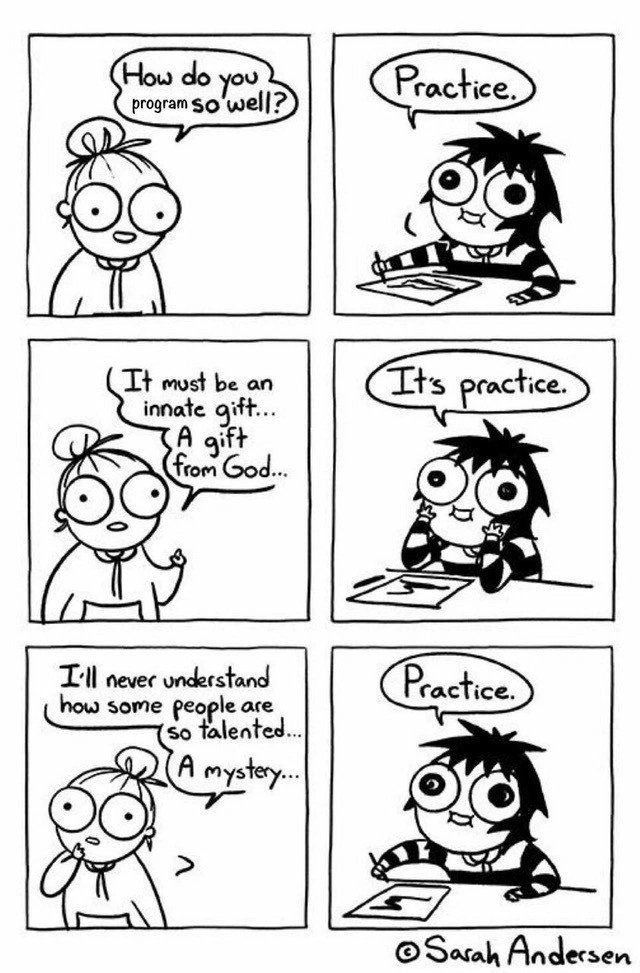
This six-panel Sarah Andersen comic — with the word program visibly pasted over the original question so it reads "How do you program so well?" — lands in dev culture because it names the industry's most persistent epistemological bug: attributing skill to essence rather than process. The asker escalates through three theories — "It must be an innate gift... A gift from God...", then "I'll never understand how some people are so talented... A mystery..." — while the programmer, never once looking up from the desk, returns the same value three times:

"Practice." / "It's practice." / "Practice."

The visual detail that makes it work: the programmer is working in every single panel. The answer isn't just spoken; it's being demonstrated in real time, and the asker still can't parse it.

For experienced developers this maps onto several real dysfunctions. First, the "10x engineer" mythology — the industry loves the narrative of the born wizard, because wizards are easier to headhunt than learning cultures are to build. If skill is innate, the org's job is talent acquisition; if skill is practice, the org's job is mentorship, slack time, code review quality, and tolerance for the thousands of bad commits that precede good ones. Guess which one fits neatly in a quarterly plan.

Second, the comic explains a chunk of imposter syndrome from the other direction. Juniors who believe in the gift-from-God model conclude, after their first brutal debugging session, that they lack the gift — when what they actually lack is the ten years of accumulated pattern recognition the senior next to them quietly grinds out. The senior's "talent" is mostly a cache: thousands of previously-seen stack traces, API quirks, and failure shapes, retrievable in O(1). The asker calls the cache a mystery because cache warm-up time is invisible from outside.

Third, there's a subtle satire of how the question is asked at all. The asker wants an answer that requires nothing of them — a gift can be admired, a mystery can be shrugged at, but practice is an actionable instruction, and actionable instructions are disappointing. The repeated deadpan "Practice." is the senior engineer's equivalent of closing a ticket as works-as-documented: the information was delivered three times; absorption is not the responder's department.

Description

A six-panel, black-and-white comic strip by Sarah Andersen. The comic features a conversation between two characters. In the first panel, a character with a hair bun asks, 'How do you program so well?'. In the second, the artist-coded character with spiky black hair replies simply, 'Practice.' The conversation continues with the first character refusing to accept this simple answer, speculating in the third panel, 'It must be an innate gift... A gift from God...'. The artist character calmly repeats in the fourth panel, 'It's practice.' In the fifth panel, the bun-haired character muses, 'I'll never understand how some people are so talented... A mystery...'. The final panel shows the artist character, still working, firmly stating one last time, 'Practice.' The comic satirizes the common misconception that programming ability is an innate talent rather than a skill developed through persistent effort. This resonates deeply with experienced engineers who understand that proficiency is the result of countless hours of coding, debugging, and learning, not some magical gift
Comments

8
Anonymous ★ Top Pick Some people think great coders are born with a gift. The truth is they just got the same null pointer exception enough times that they developed a sixth sense for it
  1. Anonymous ★ Top Pick

    Some people think great coders are born with a gift. The truth is they just got the same null pointer exception enough times that they developed a sixth sense for it

  2. Anonymous

    Programming ‘talent’ is really just 20 years of practice - specifically the practice of rewriting the same auth service after each architecture fad, from SOAP to REST to gRPC to whatever the board heard about at lunch

  3. Anonymous

    Twenty years in and I still tell juniors it's practice, while secretly knowing it's actually the accumulated trauma from debugging race conditions in production at 3 AM

  4. Anonymous

    Twenty years of practice, and people still call it talent - the only 'gift from God' here is the muscle memory for :wq

  5. Anonymous

    After 20 years in the industry, I can confirm: the 'innate gift' is just the ability to repeatedly bash your head against the same problem until either the problem breaks or you do - and then doing it again tomorrow. The real mystery isn't how some developers are so talented; it's how we convinced ourselves that reading Stack Overflow at 2 AM for the thousandth time counts as 'divine inspiration' rather than what it actually is: practice with extra steps and questionable sleep hygiene

  6. Anonymous

    No divine gift needed - just 10,000 hours practicing 'works on my machine' until it scales to prod

  7. Anonymous

    There is no 10x gene - just 10,000 iterations of write-run-profile-refactor, seasoned with code reviews and production scars

  8. Anonymous

    Secret to “10x talent”? Practice - 15 years of code reviews and 3 a.m. rollbacks until stack traces read like prose and you can smell a race condition from the hallway

Use J and K for navigation