Skip to content
DevMeme
1570 of 7435
Remember - No Comments
CodeQuality Post #1752, on Jul 3, 2020 in TG

Remember - No Comments

Why is this CodeQuality meme funny?

Level 1: No Hints Allowed

Imagine you and your friends are about to build a huge LEGO set, and one friend – let’s call him Kumar – stops everyone at the last second and says very seriously, “Remember — no instruction book.” Everyone nods as if they’re going on a secret mission, and they toss the LEGO manual aside. Now you all have to put this complicated set together with no hints or guides, acting like that was the plan. It’s a silly scene, right? Normally you’d use the instructions for a tough build, so treating “no instructions” like a strict, serious rule is funny. That’s exactly what this meme is doing with coding: writing code without any little notes or explanations (comments) is being treated as the ultimate rule. The picture shows a team of programmers as if they’re an elite military squad, but instead of guns they have keyboards, and they’re about to “launch” their software. The leader says, “no comments,” kind of like saying “no hints or notes.” It’s humorously exaggerating how some people say code should be written with zero extra help. The joke is that they’re taking a minor rule (not writing comments) and behaving as if it’s a high-stakes, do-or-die directive. Even if you don’t code, it’s like watching someone ban the instruction booklet when doing something complex – over-the-top and funny because it really isn’t that serious in real life.

Level 2: Code Speaks for Itself

Let’s break down the joke in simpler terms. In programming, a code comment is a piece of text in the source code meant for humans, not computers. It’s usually marked by special symbols (like // in JavaScript/Java/C++, # in Python, or /* ... */ for block comments in many languages) so that the compiler or interpreter ignores it. Comments are basically notes or explanations developers leave to clarify what the code is doing or why. For example, a comment might say, “// calculate interest rate based on balance,” just to help someone reading the code understand the next line. In school or early in your career, you’re often encouraged to write comments for clarity. It’s common to see beginner code with lines like:

score = score + 1  # increment score by 1

In the above Python snippet, everything after the # is a comment explaining the code. The comment here is telling us what the code does – but as you can probably tell, score = score + 1 is already quite understandable on its own. This is what some developers call an unnecessary comment because it doesn’t provide any new insight; it just restates the obvious. The idea of “self-documenting code” is that your code should be written so clearly (with good naming and structure) that it speaks for itself, making many such comments redundant. Instead of writing a comment like // check if user is admin, you might name your function or variable in a way that conveys that meaning, for example:

if (currentUser.isAdmin()) {
    grantAccess();
}

Here, isAdmin() is descriptive enough that you probably don’t need a comment to understand what’s being checked. This is a key part of CleanCodePrinciples – the notion that well-written code, with descriptive names (currentUser, isAdmin, grantAccess) and simple logic, can be as clear as plain English. Advocates of this style say that comments should be minimal or even unnecessary if you write code correctly. They often add that comments can become misleading later – if someone changes the code but forgets to update the comment, you end up with documentation that lies. That’s why some teams have a “no comments” policy (formally or informally) where they prefer you refactor the code to make it clearer rather than slap a comment on confusing code.

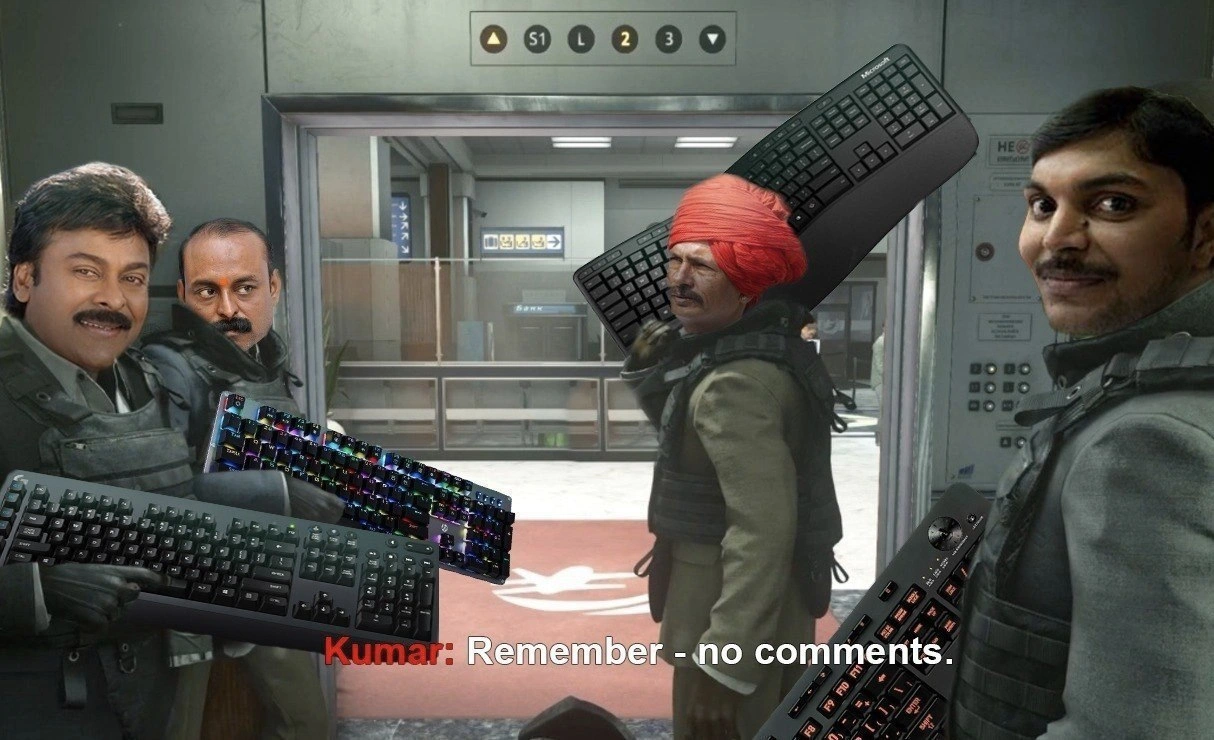
Now, why is the meme funny? It’s taking this no-comments policy to an extreme and framing it as a dramatic command. The image shows what looks like a team of special forces operators ready to storm a building (or rather, deploy some software). Their guns have been humorously replaced with keyboards, showing that a developer’s weapon of choice is the keyboard for typing code. The leader, named Kumar, is giving a very stern pre-mission instruction: “Remember – no comments.” If you’re not familiar, this line is a riff on a famous moment in a video game where an undercover agent says “no Russian” to remind the team not to speak a certain language during the mission (to avoid blowing their cover). In the context of coding, “no comments” means don’t write any comments in the code. The meme is mashing up a Call of Duty game scene with a programmer in-joke. The serious faces and tactical gear are over-the-top for something as ordinary as preparing code for release, and that’s exactly why it’s amusing. They’re treating a simple coding guideline like a critical military operation.

This touches on a real debate in software development about Documentation: should code alone be the documentation, or should we write extra notes and comments for clarity? On one side, people argue for writing clean, clear code with good naming – so future developers can read the code itself and understand what it does without additional commentary. On the other side, many developers (especially those who have inherited confusing projects) appreciate at least some comments or external docs to explain why something is done a certain way, or any tricky parts. There’s also a middle ground: for instance, writing comments for particularly complex sections or public APIs, but not for every single line.

In practice, what happens is during CodeReviews (where team members review each other’s code before it’s merged or released), style rules like comment usage are discussed. New developers might diligently comment every function and logic step (because that’s what they’ve been taught), only to have a reviewer suggest removing many of those comments. It can be surprising: you think you’re writing super understandable code by annotating everything, but the reviewer says, “Actually, the code is straightforward enough; the comment is unnecessary, and we prefer not to clutter the code.” Or maybe you leave a comment like // using a workaround for now, needs improvement and a strict teammate responds, “Don’t leave TODO comments, just open an issue,” or “Explain it in the commit message instead.” Some teams even use automated tools (linters or CI bots) that flag or reject certain comments, like any leftover /* TODO */ or commented-out code, treating them like errors. This can definitely feel like a comment crackdown when you first encounter it.

So, the meme is funny to developers because it exaggerates that feeling. If you’ve ever worked under a code style that forbids comments, it can feel as intense as being told by a squad leader, “We go in silent – no comments.” The keyboard_replaces_rifle imagery and the elevator scene dramatize the lead-up to a big release. “Squad gearing up for release” is something many dev teams joke about – deploying code can be tense, and everyone’s on high alert to follow procedures. Here one of the procedures is apparently no comments in the code, and it’s delivered as an iron command. It highlights the absurdity and humor in how seriously we sometimes take these rules. A junior dev looking at this meme might learn that yes, there are heated opinions on code comments! It’s poking fun at the idea that some seniors would rather enforce a clean code ideal to the letter (no comments whatsoever) than allow a bit of human-friendly documentation. The truth is, whether to comment or not is a nuanced decision, but the meme throws nuance out the window for the sake of a good joke. By understanding this context, you can see why the image is both funny and telling: it’s a caricature of real developer culture where something as small as a // comment can ignite big discussions.

Level 3: Clean Code Warzone

In this scene, a developer squad is literally suited up like a SWAT team for a code release. It’s a spot-on parody of the infamous Call of Duty mission briefing where the line “Remember, no Russian” is uttered – here replaced with “Remember — no comments.” Instead of rifles, the operatives brandish oversized keyboards as weapons (one even wears a full Microsoft keyboard as a helmet), and their faces are pixelated as if they're on some covert op. The image screams call_of_duty_reference, transplanting a military special forces vibe into a programming context. The humor comes from treating a mundane coding guideline like a life-or-death order. Kumar, the team lead in this meme, delivers the directive with gravitas, as if a CodeReview guideline were a wartime mission rule. This dramatic setup lampoons how seriously some teams enforce CodeQuality standards – in this case, an extreme “no comments” policy – by portraying the office as a battlefield and keyboards as guns. It’s a war on comments, literally a comment_wars scenario taken to absurdity.

Behind the joke lies a real-world software engineering holy war: the clean_code_vs_documentation_debate. On one side, you have the Clean Code purists (the “zealots” the meme mentions) who firmly believe code comments are a sign of failure – that good code should be so clear and self-explanatory that comments become unnecessary. This ideology, popularized by books like Clean Code by Robert C. Martin (a.k.a. Uncle Bob), treats comments as a last resort or even a code smell. For these folks, leaving a comment is almost like breaking cover on a stealth mission: it suggests the code wasn’t expressive enough to speak for itself. They’ll say things like, “Every comment is a failure to refactor.” They prefer clean, readable function and variable names over explanatory remarks. If the code needs a comment to be understood, they argue it should be rewritten until it’s obvious.

On the other side are the documentation advocates – developers who have been burned by ambiguous code and think a few well-placed comments or docstrings are invaluable for context. These are the battle-scarred veterans who’ve maintained legacy systems at 3 AM and wished there had been a guiding comment explaining why some bizarre logic was needed. They view the “no comments” doctrine as overkill. Sure, trivial or outdated comments can mislead (a stale comment is worse than none at all), but a thoughtful comment can save hours of head-scratching. This meme’s militaristic satire highlights how CodeReviews can feel when these two camps collide. A senior reviewer with a “no comments” ethos might drop into a pull request like a special forces commander, eliminating // lines with extreme prejudice. Meanwhile, the author of the code (or another reviewer) might protest, "But that comment was explaining a workaround!", only to be overruled by the clean-code commando quoting the company’s style guide chapter and verse. The subtitle text in the meme – “Kumar: Remember - no comments.” in red and white – mimics a game’s mission subtitle, implying that even a single stray comment in the code is as dangerous as blowing an operative’s cover.

The keyboard_replaces_rifle gag is more than just a visual pun; it signifies that programmers’ weapons are their keyboards and their ammo is code. The team is “gearing up for release” as if going into combat, which is exactly how a stressful production deployment can feel. The leader’s command forbidding comments reflects a kind of zero-tolerance policy some teams enforce for stylistic reasons. It satirically elevates a coding style rule to a militant mantra. Senior devs chuckle (or cringe) at this because many have experienced “comment wars” first-hand – those intense debates where one side deletes all comments in a codebase to purify it, and the other side sneaks them back in to clarify complex logic. It’s a tug-of-war between CodeQuality ideals: purity of code vs. clarity through documentation. And like any war, it can devolve into pettiness: I’ve seen PRs where a reviewer nitpicks every single comment, arguing they’re unnecessary, while the coder fights back to keep their one-line explanation that took 5 hours of debugging to discover. The meme exaggerates this conflict to hilarious effect: imagine a squad of devs breaching a codebase, ready to kill remove any comment on sight. The CleanCodePrinciples have been weaponized.

Ultimately, the humor resonates because it captures a truth of developer culture: we often adopt ridiculously serious attitudes about things like indent style, naming conventions, or comment usage – things that outsiders might consider trivial. Here, a single line of text – “Remember — no comments.” – encapsulates an entire philosophy and its absurd extreme. The “mission” framing implies that adhering to the no-comment rule is as critical as avoiding detection in an undercover operation. For seasoned developers, the meme is a wink and a nudge: Yep, we’ve seen those teams where making the code entirely self-documenting was treated like a sacred mission. It highlights the tension between writing self-documenting code and providing documentation for future maintainers. In reality, striking a balance is key – but where’s the fun in that? The meme goes all-in on one side for comedic effect, portraying the clean-code camp as an elite squad on a crusade to exterminate comments. It’s funny because it’s a little too real: we’ve all known a “Kumar” who sternly reminds us during crunch time, “No hacks, no shortcuts, and definitely no comments.” This overzealous enforcement of a code philosophy becomes laughable when taken to Rambo-esque extremes. DeveloperHumor often shines a light on our communal quirks, and this image does exactly that – turning a code style disagreement into an action movie scenario where the stakes (and the satire) are sky high.

Description

This is a photoshopped meme based on the controversial 'No Russian' level from the video game 'Call of Duty: Modern Warfare 2'. The scene is set in an elevator where soldiers are preparing for an assault. However, the soldiers' faces have been replaced with the faces of Indian men, and instead of holding guns, they are armed with various computer keyboards. A subtitle at the bottom, mimicking the game's dialogue, reads 'Kumar: Remember - no comments.' The humor stems from equating the dogmatic, and often debated, software development practice of writing no code comments with a high-stakes, violent military mission. For experienced developers, this satirizes the 'self-documenting code' purists who treat the avoidance of comments as an absolute rule, ignoring the nuances of maintainability and context for future developers who will have to work with their code

Comments

7
Anonymous ★ Top Pick The original developer followed the 'no comments' rule. Now we call that part of the codebase 'the airport level' - every new junior who goes in alone causes a massacre
  1. Anonymous ★ Top Pick

    The original developer followed the 'no comments' rule. Now we call that part of the codebase 'the airport level' - every new junior who goes in alone causes a massacre

  2. Anonymous

    “Release briefing: ‘Remember - no comments. If the intent isn’t obvious, future devs can just grep through twelve microservices and three years of ADRs to reconstruct our 2 a.m. thought process.’”

  3. Anonymous

    The team that wrote the authentication service everyone depends on, preparing to leave the company after their equity vested

  4. Anonymous

    When the senior architect says 'the code should be self-documenting' during a PR review, but you've just spent three hours reverse-engineering their 'elegant' one-liner that chains six ternary operators. The mechanical keyboard standoff that follows is less about RGB preferences and more about whether future maintainers deserve to understand what `const x = a ? b ? c : d ? e : f : g ? h : i` actually does at 2 AM during a production incident

  5. Anonymous

    No comments: the ultimate CAP theorem violation - consistency abandoned for stealthy availability until the next maintainer partitions your sanity

  6. Anonymous

    “Remember - no comments.” The enterprise pattern where documentation is a zero-knowledge proof: the code runs, but nobody - including compliance - can explain why

  7. Anonymous

    Architect: “Remember - no comments.” Eighteen months later, git blame is our documentation microservice and the bus factor is one very tired keyboard

Use J and K for navigation