Skip to content
DevMeme
1569 of 7435
Office Professional vs. Remote Work Guru
RemoteWork Post #1751, on Jul 2, 2020 in TG

Office Professional vs. Remote Work Guru

Why is this RemoteWork meme funny?

Level 1: School vs. Summer Break

Imagine you’re a kid who goes to school during the year and then has a long summer break at home. At school, you have a routine: you wear decent clothes (maybe even a uniform or your nicer T-shirts), you see your friends, play games like table tennis (ping-pong) during recess, and you generally look pretty normal because you’re around other people and teachers every day. Now picture what happens during summer vacation when you’re home for weeks. You might stay in your pajamas or comfy clothes all day, you don’t bother combing your hair sometimes, and you get super into your own hobbies. Maybe you even start dressing a bit silly or pretending to be a wizard or a monk during playtime because, hey, there’s no one to judge you except maybe your family. By the end of the summer, you look in the mirror and laugh because you’re so much more casual and maybe a little wild-looking compared to the clean-cut kid you were during the school year.

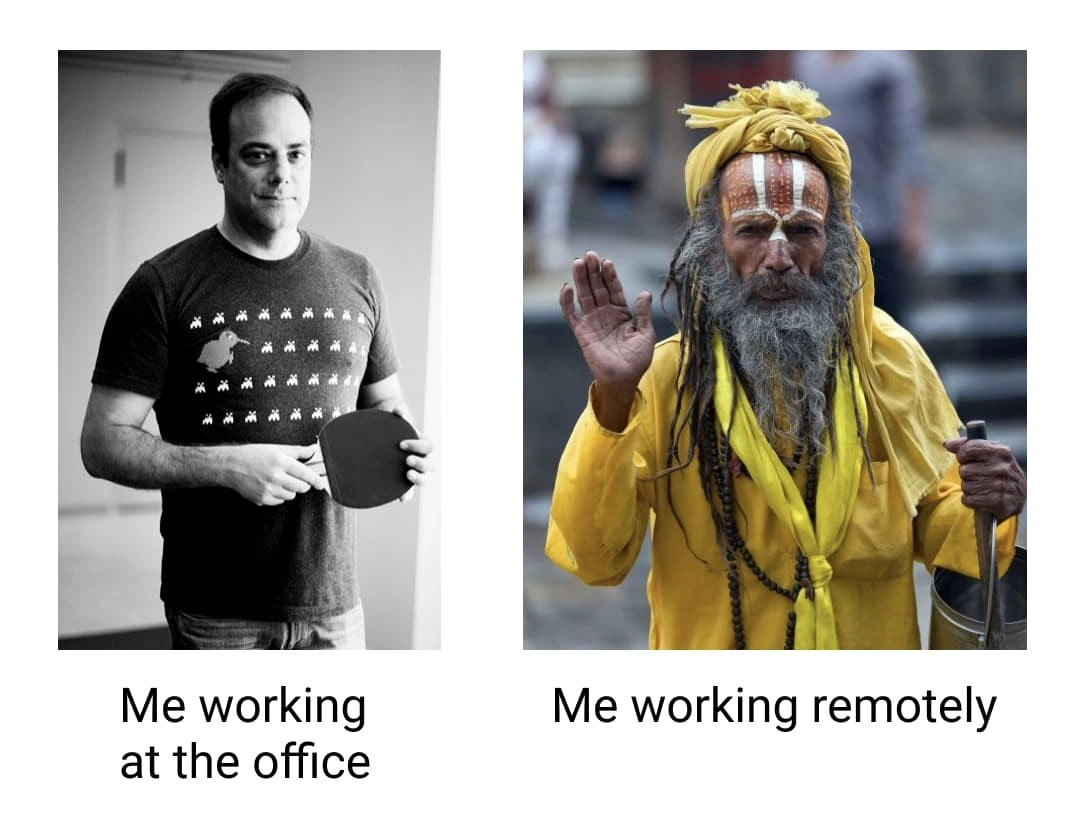
This meme is like that, but for a software developer. The left picture (“Me working at the office”) is like the developer at school: he’s playing ping-pong with colleagues and wearing his cool gamer shirt, looking like an everyday fun-loving guy. The right picture (“Me working remotely”) is like the developer on summer break: after working alone at home for a long time, he’s grown a huge beard, is wearing something totally different (like a robe and turban, almost a costume), and he’s living in his own world a bit like a wise old wizard. It’s a funny exaggeration that shows how the same person can seem to change when their environment changes. The reason it’s funny is the difference is so extreme and silly – we don’t actually turn into wizards or monks when we work from home, but sometimes it feels like we’ve changed a lot in our looks and habits. The meme makes us laugh because we recognize a truth in it (we do act different at home) and it uses a big, playful visual contrast to drive that point home, just like comparing a studious schoolkid to a free-spirited kid on summer vacation.

Level 2: T-Shirt to Turban

In this meme’s two panels, we see a dramatic before-and-after of a software developer’s work life. The left side is “Me working at the office.” Here, the developer looks like a typical office coder: he’s casually dressed and holding a ping-pong paddle, standing possibly in his company’s hallway or break room. Many tech offices have game areas – having a ping-pong table at work is so common that it’s almost a stereotype of OfficeCulture in tech. The idea is that during a break or after writing some code, developers might play a quick game of ping-pong with coworkers. It’s a fun perk that companies use to make the workplace enjoyable. So the ping-pong paddle in his hands instantly tells us, “This is a chill tech office where people play games when taking a break.”

Check out his T-shirt as well: it’s got rows of little alien figures from the classic game Space Invaders, and one of the rows has a little penguin figure. Space Invaders is a famous old video game (from way back in 1978) where you shoot down rows of aliens. It’s iconic in gamer culture, and a lot of programmers love retro games like that. The penguin on the shirt is a wink at another nerdy thing: the Linux operating system. Linux’s mascot is a cartoon penguin named Tux. Many developers use Linux for programming or servers, so the penguin has become a symbol in our tech community. By wearing a shirt covered in Space Invaders aliens and a random penguin, the person signals “I’m a geek and proud of it.” It’s playful and a bit witty – maybe the penguin is “invading” the alien formation, which geeky folks might chuckle at. In any case, the shirt screams “I’m a developer (and maybe a gamer) at the office.” In a lot of tech companies, dressing in jeans and a geeky T-shirt is totally normal — there’s usually no strict dress code as long as you’re decent. The left image is black-and-white, which could be just an artistic choice, but it might also make the office scene look a bit more plain or ordinary.

Now, look at the right side: “Me working remotely.” Suddenly, we see a total transformation. The person is depicted as an older, bearded monk or sage wearing a bright yellow robe and turban, holding a staff. This isn’t literally the same person from the office, of course — it’s a humorous exaggeration! The idea is that after working from home for a long time, the developer has become so relaxed and removed from the office world that he’s practically like a hermit or monk living in the mountains. This man in the photo actually resembles a Hindu holy man (often called a sadhu or yogi) who has given up normal society to pursue spiritual life. He has very long hair and a beard, painted markings on his forehead, and a hand raised as if he’s offering a blessing or just saying hello. The clothing is bright and flowing, a big change from the simple T-shirt and jeans. It’s full color, which makes it pop and seem almost otherworldly compared to the plain office pic.

So, why show a developer as a monk? It’s making fun of how WorkFromHome life can dramatically change a person’s habits and appearance. When people started working remotely (especially during the COVID-19 pandemic around 2020), a lot of developers stopped going to the barber or dressing up for work. At home, you can wear pajamas or a comfy bathrobe all day and no one knows (apart from maybe seeing your face on a video call). Many of us joked about wearing the same sweatpants for days or only looking presentable from the waist up on camera. Over time, hair grows out, beards get bushier, and some folks just embraced a more “natural” look. In this meme, the “remote me” has taken that to an extreme: he’s basically Gandalf or Dumbledore level of hairy and chill! The turban and staff are comedic — most developers didn’t literally start dressing like monks, of course. But it symbolizes freedom: when you work remotely, you can look like whatever you want. There’s no office dress code and no coworkers around in person, so you might develop your own quirky style (or no style at all).

The captions “Me working at the office” vs “Me working remotely” speak to a cultural gap that developers experienced. In the office, there’s a social atmosphere: you see colleagues, you might play games or chat about the latest TV show, and you generally keep up appearances (to some extent). The company provides recreational things like ping-pong or free snacks as part of its CorporateCulture, hoping to make work fun and interactive. Communication is often face-to-face — you can pop by a coworker’s desk or have a quick meeting. There’s a routine: you commute to work, maybe wear a half-decent outfit, and being around people kind of encourages you to stay groomed and on a normal schedule.

When you switch to remote work, a lot of that structure goes out the window. You’re mostly interacting through chat apps like Slack, emails, or video meetings. This is what we call asynchronous communication: instead of talking to someone right away, you often send a message and wait for them to respond when they can. (For example, you might ask a question in a chat at 10 AM, and your coworker replies at 10:30 or even later, because they might be busy or in a different time zone.) Work becomes more flexible and solitary. Without needing to go out, some people stop caring as much about their appearance. It’s not uncommon for a developer working from home to realize at 4 PM, “Oh, I haven’t showered or changed out of my pajamas today… oh well!” It sounds gross, but when you’re comfy in your home office and in the zone coding, it’s easy to lose track. Also, some people discovered new levels of comfort: like working barefoot, or setting up a desk on the porch, or yes, growing a big beard because why not?

The humor in this meme comes from how extreme the change is shown to be. Of course, not every developer literally becomes an elderly monk when they work remotely. But it feels like a funny truth that we all got a bit more like recluses during extended remote work. The left picture is a relatively young, modern tech guy; the right picture is an ancient-looking wise man. It’s a workplace contrast blown out of proportion to make us laugh. Many developers find it relatable because they experienced something similar, even if in a small way. For instance, a normally clean-shaven coworker might have grown a quarantine beard that made him look like a different person on the next video call. Or someone who used to dress in cool graphic tees at the office might now basically live in a bathrobe and joke, “I’m in wizard mode, coding spells all day.”

This meme also subtly references the big shift around 2020 when companies adopted remote-first policies due to the pandemic. “Remote-first” means the default is for employees to work from home and everything is organized to include remote workers (lots of online meetings, documents for everything, and flexible hours). That was a huge change for tech workers. Before, only some developers (like freelancers or those at remote-friendly companies) worked from home regularly; after the pandemic started, almost everyone in tech did, at least for a while. This sudden switch highlighted differences: people realized some things are easier at home (like focusing without office chatter, or not commuting) but also some things are harder (like collaborating, or feeling connected to teammates). The meme captures one of the fun aspects of that realization – “Wow, my daily life looks so different now!” It’s basically saying, Look at me: in the office I was a ping-pong-playing, casually nerdy engineer. At home, I’ve become this lone wise hermit mastering the arts of code and coffee.

In simpler terms, the left side shows the outside social version of a developer (engaging in the office environment), and the right side shows the inside private version (how they might feel and look after being alone for a long time). It’s a form of DeveloperHumor and WorkplaceHumor that rings true for those of us who went through this change. We laugh because we recognize a bit of ourselves in it. The meme is using very vivid images to make that point clear and funny. It’s a contrast between office culture vs. remote culture, and it highlights how working from home can turn even a ping-pong enthusiast into a kind of remote monk (at least in spirit).


Level 3: Ping-Pong to Prophet

At first glance, this meme humorously contrasts two extremes of developer life: the playful OfficeCulture versus the ascetic vibe of RemoteWork. On the left, we see the archetypal office developer indulging in a quick ping-pong break. The ping_pong_in_office scene is a familiar trope in tech companies – start-ups and big firms alike often boast game rooms with ping-pong or foosball tables as perks. It’s a symbol of a “fun” workplace where taking a break to smack a tiny ball around is part of the daily routine. The developer’s attire reinforces this laid-back office geek image: a classic black T-shirt emblazoned with rows of pixelated Space Invaders aliens and a lone penguin. This shirt isn’t random; it’s broadcasting nerd cred. Space Invaders is a legendary retro video game, a nod to classic arcade culture that many programmers adore. And that penguin? That’s likely Tux, the mascot of Linux (a popular open-source operating system). Wearing that combo in the office is like a silent code: “I love retro games and I probably hack on Linux.” In short, the left panel says: here’s me at the office, a casual gamer-coder type, enjoying the company’s cool perks (like ping-pong) in my nerdy tee. It’s depicted in black-and-white, perhaps to imply it’s a mundane, everyday scene or maybe just to contrast stylistically with the vivid right panel. Either way, it sets the stage: Office life is comfortable, a bit playful, and maybe a touch juvenile in its pastime – a DeveloperExperience filled with campus-like camaraderie and tangible perks.

Now, the right panel swings to a wild extreme. “Me working remotely,” it proclaims, over a full-color image of what looks like a Hindu sadhu or wandering monk. This elder has a long grey beard, a striking yellow turban and robe, face marked with white stripes of spiritual significance, holding a staff and raising a hand in a gentle greeting. The transformation is comically jarring: did our ping-pong-playing developer age 30 years and move to the Himalayas after a few months of WFH (Work From Home)? It sure looks that way! The meme exaggerates how one’s vibe can shift when working in isolation. The bright saffron-yellow robe and the staff are symbols of a hermit or guru lifestyle – think of a wise sage who’s renounced worldly offices and embraces solitude. The raised hand greeting even gives “Ascended master saying hello” energy. In reality, of course, the developer didn’t literally become a monk, but the joke lands because RemoteWorkCulture often encourages (or at least allows) a kind of fashion entropy and personal freedom that just doesn’t happen in the office. Without the office’s unspoken dress code and social expectations, developers in WFH mode can let their true selves (and hair) loose. That often means trading collared shirts or theme T-shirts for bathrobes, PJs, or any comfy clothes. Many devs jokingly admit that after months at home, they ended up with shaggy hair and big beards because, well, who’s going to see you on a daily basis? (Sure, there are Zoom calls, but there’s always the trusty webcam-off option or at least a ballcap to hide the chaos.) In effect, working remotely can make a once clean-cut ping-pong player look and feel like an enlightened coding hermit. The meme takes this to the extreme by actually showing a literal enlightened hermit figure.

Technically, this meme is poking fun at the post-2020 remote-first paradigm shift in our industry. Pre-pandemic, companies tried to foster CorporateCulture and bonding with on-site perks: think free lunch, bean bag chairs, and yes, ping-pong tables in the break room. These were more than just fun and games – they signaled a belief that a playful, collegial environment would spark creativity and keep developers happy (and coding longer hours, cynics might add). Ping-pong, specifically, became such a fixture of startup life that it’s practically shorthand for “hip tech office.” However, when 2020 hit, offices worldwide emptied out literally overnight. Suddenly even the best ping-pong table on the planet couldn’t help – nobody was there to use it. Companies and developers had to embrace RemoteWork en masse. This shift was huge: it wasn’t just a logistical change, but a cultural one. All those water-cooler chats and team lunches turned into Slack messages and Zoom calls. Communication went asynchronous by necessity – you might message a teammate and not get a reply for an hour because they were juggling homeschooling their kids or stepping out for a much-needed walk. Work hours became fluid. And crucially, the WorkFromHome dress code (or lack thereof) kicked in. Developers who used to rotate through a collection of quirky tech T-shirts at the office found themselves living in hoodies and sweatpants… and after a while, maybe just that one pair of sweatpants. The home_office_attire_evolution is real – when no one but your cat sees you each day, fashion norms tend to decay. It’s this decay (the meme’s “hermit-like freedom and fashion entropy”) that is being lampooned by showing the dev as a full-on mystical monk.

From a seasoned developer’s perspective, the workplace_contrast_meme also hints at a psychological shift. In the office, there’s a sense of youthful community – playing ping-pong with colleagues is a social, energizing break. The environment is structured: you commute in, you’re seen by your peers and managers, you have impromptu discussions at someone’s desk, maybe you all grab coffee at 3 PM. Your day has a rhythm regulated by the collective presence of others. Remote work, on the other hand, can feel like you’ve retreated to a mountain cave (or at least your basement). You gain freedom and focus but lose the immediate social interactions. Some developers found this solitude akin to entering “monk mode” – a term some use to describe a state of deep work and isolation, as if you’re a monk silently contemplating code. In monk mode, you might code for hours uninterrupted, emerging only for sustenance (or more coffee). It can be incredibly productive, almost a form of coding meditation, but it can also disconnect you from the outside world a bit. The meme’s humor plays on the stereotype that a few months of this turned us into wise but isolated creatures. The left image’s casual tech bro is worried about the next ping-pong match; the right image’s guru seems to have attained coding nirvana (and maybe forgotten what a razor is).

Importantly, this is WorkplaceHumor that a lot of developers find painfully relatable. It exaggerates a feeling many had: “Wow, I’ve changed since working from home.” In reality, you probably didn’t start wearing a turban and carrying a staff to your home office, but maybe you did start wearing blankets as shawls, or you realized one day you’ve been talking to your rubber duck (debugging partner) more than to real people. The gulf between OfficeCulture and RemoteWorkCulture can be that wide! And with remote work often comes async communication. That itself can alter one’s “vibe.” In an office, you get instant feedback – a laugh at your joke, a nod at your idea. Remotely, you often communicate via text. You might carefully craft a Jira ticket comment or a witty remark on Slack and then wait, alone, for responses. It’s a bit like sending messages out into the void and meditating until a reply comes – again, very monk-like if you think about it. The developer_identity_shift depicted here is comedic: from a sociable office geek to a solitary code sage. But underlying the joke is a real insight into how environment shapes behavior. Office developers might identify with the energetic, youthful aspects of tech life (gaming, rapid collaboration, the work hard play hard ethos). Remote developers might discover a more introspective, individualized workflow – we saw people embrace flexible schedules, adopt new hobbies (sourdough baking, anyone?), and even question the old 9-to-5 grind.

In summary (for the senior engineers still reading): this meme brilliantly captures a real DeveloperExperience_DX transformation that occurred in the software world. By using a stark visual and cultural contrast, it highlights the RemoteWorkCulture shift with wit. The left panel represents the bygone era of in-person office perks and nerdy camaraderie; the right panel symbolizes the new normal of working in isolation, bordering on becoming a mythical coding hermit. It’s funny because it’s true (to an exaggerated degree) – we recognize ourselves and our colleagues in these two states. We laugh, remembering the pre-pandemic office ping-pong tournaments we used to have, and then glance at our own pandemic-grown beards or the yoga pants we’ve been wearing for days. The juxtaposition is both absurd and insightful, making us chuckle at how much our work life and appearance might change when the setting flips. This kind of relatable DeveloperHumor thrives on shared experience: anyone who’s traded their office desk for a home setup in that era feels the joke. And beyond the laughter, it subtly comments on how corporate norms versus distributed teams can create entirely different lifestyles for developers. The “ping-pong player to remote monk” journey is a tongue-in-cheek reflection on the tech industry’s cultural evolution – and it’s one heck of a transformation meme.


Description

A two-panel comparison meme contrasting work personas. The left panel, labeled 'Me working at the office,' shows a clean-cut man in a black and white photo, wearing a t-shirt with a pixelated, Space Invaders-like pattern and holding a ping-pong paddle. This represents the conventional, sociable tech office environment. The right panel, labeled 'Me working remotely,' features a color photograph of a Hindu Sadhu (holy man) with a long grey beard, dreadlocks, a yellow turban and robes, and traditional face paint, raising his hand in a serene gesture. The meme humorously illustrates the drastic change in personal grooming and attire when transitioning from a corporate office setting to a work-from-home setup. It jokes that remote work leads to abandoning professional appearances in favor of a more ascetic, unkempt, or spiritually enlightened (and less corporate) look, a sentiment widely shared by developers during the global shift to remote work
Comments

7
Anonymous ★ Top Pick In the office, my IDE is dark mode. Working remotely, my entire life is dark mode, illuminated only by the glow of a failing CI/CD pipeline at 3 AM
  1. Anonymous ★ Top Pick

    In the office, my IDE is dark mode. Working remotely, my entire life is dark mode, illuminated only by the glow of a failing CI/CD pipeline at 3 AM

  2. Anonymous

    Office era: ping-pong paddle, sub-10 ms context switches; remote era: hermit beard, async queues everywhere - same throughput, just finally embracing eventual consistency

  3. Anonymous

    The same developer who argued passionately against video calls because "async communication is more efficient" now hasn't seen another human in six months and considers git commits a form of social interaction

  4. Anonymous

    The Space Invaders on his office shirt were a warning sign - he was already planning his escape from the corporate grid. Six months of remote work later, he's achieved true enlightenment: realizing that 'camera off' in standup meetings is the path to spiritual liberation, and that the only deployment pipeline that matters is the one from bed to desk chair

  5. Anonymous

    Office: Low-latency synchronous facade. Remote: Eventual consistency in grooming and deployments alike

  6. Anonymous

    Office me measures ping times with a paddle; remote me achieves write quorum only after three Slack threads and a Zoom huddle - eventual consistency, but with more beard

  7. Anonymous

    Office me ships p99 sub-5ms on the Ping service (via paddle); remote me runs eventual consistency - Slack pings get replies only after I reach quorum with coffee

Use J and K for navigation