Empathetic User vs. Existential CAPTCHA
Why is this Security meme funny?
Level 1: Crying Robot Guard
Imagine you’re trying to go through a door that has a little robot guard. To prove you’re not a bad guy, the robot asks you to repeat a secret passphrase. Usually the phrase is something silly or random like “yellow banana” – just words with no feeling. But today, the robot says the secret phrase is “it hurts.” 😧 It’s like hearing the guard say it’s in pain! Instead of just repeating “it hurts” to pass the test, you stop and ask, “Oh no, Mr. Robot, are you okay???” Now, of course, the robot isn’t actually hurt – it was just giving you a code to say. But your kind human brain treated that code like a real feeling. The funny part is you failed the little test because you got concerned and didn’t say the exact code back. In simple terms, a computer program gave a password that sounded like a person crying, and it made a real person act with empathy. We laugh because we don’t expect a serious security check to sound like a sad friend. It’s like a door lock that suddenly says “ouch!” – it’s so unexpected that you can’t help but feel sorry for it, even though you know it’s just a lock. This joke shows how humans can care about anything – even a goofy puzzle on a website – and that sometimes our friendly, caring nature completely confuses the strict rules of our machines.
Level 2: Bot or Not?
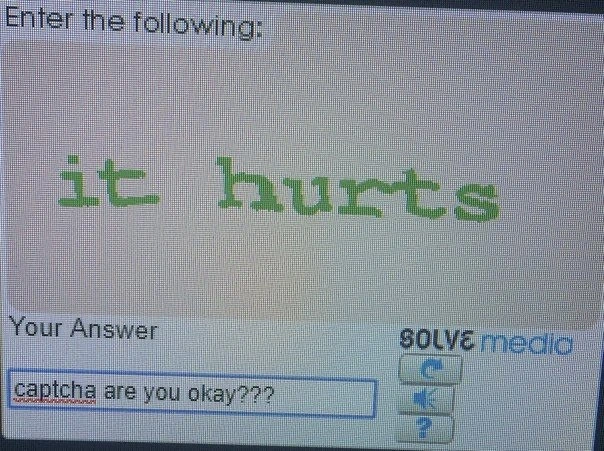
Let’s break down what’s going on here. The image shows a web form with a special security check called a CAPTCHA. A CAPTCHA is a little test on websites to figure out if the user is a real person and not a spam bot (an automated program). Think of bots as scripts or programs that can crawl websites and try to do naughty things like create fake accounts, send spam, or overload services. Web developers add CAPTCHAs to forms (for example, signup pages or comment boxes) as a challenge that humans can pass but bots typically fail. They often involve tasks like typing distorted words, recognizing objects in images, or clicking a checkbox that says “I’m not a robot.” It’s basic BotDetection 101 in WebSecurity – if you can solve the puzzle, you’re likely human.
In this specific CAPTCHA (provided by a company called Solve Media), the instruction at the top says “Enter the following:”. Usually, after that, you’d see a random word or phrase you need to retype. Here the challenge text is "it hurts" – displayed in a funky, wavy font with a pale green color. That text is intentionally warped and a bit grainy, a technique to confuse computer vision algorithms so a bot can’t easily read it. But a human with normal eyesight can still decipher it: it clearly spells “it hurts”. Normally, you as the user are supposed to type exactly those words into the input box labeled "Your Answer". That’s how you prove you saw it correctly and therefore are very likely not a bot (since current bots struggle with reading distorted text reliably).
Now, the hilarity comes from the fact that “it hurts” is a very unusual phrase for a CAPTCHA. Most of the time, CAPTCHA words are random or neutral (like “apple 97J” or “house”) – just stuff with no emotional meaning. Here it reads like a tiny cry of pain. The user in the screenshot was so taken aback by seeing a cry for help from a security widget that instead of typing "it hurts" back, they typed "captcha are you okay???". In other words, the user treated the CAPTCHA’s phrase as if it were a real person saying it’s hurt, and they responded with concern! This is the unexpected_phrase and user_response_field joke: the user response field contains a worried question to the CAPTCHA itself, rather than the correct answer. Of course, doing that means the verification will fail – the system isn’t actually interactive or sentient, it just wanted you to copy the text.
To be clear, the proper user behavior here was to type it hurts into that blue-outlined answer box. The Solve Media system would check if your input exactly matches the challenge text. If it matches, you pass and can continue (maybe log in or post your form). If it doesn’t match – say you type something else like “captcha are you okay???” – the system will say you got it wrong (because you did, according to the rules) and probably give you another chance with a new CAPTCHA. Here’s a simple illustration of how the logic works in code:
challenge_text = "it hurts"
user_input = "captcha are you okay???"
if user_input == challenge_text:
print("Access Granted") # You passed the CAPTCHA
else:
print("Access Denied") # Wrong answer, try again
# In our case, this would output "Access Denied" because the input doesn't match the challenge.
So the poor concerned user would actually be blocked from proceeding, all because they showed a bit of empathy to a piece of text! From a usability (UX) standpoint, that’s both comic and telling. We design these challenges assuming users will treat them as mechanical tasks, but here a human reacted emotionally. Security measures can often feel impersonal, but this one accidentally felt personal. The label UXIrony fits because the user experience was ironic – the interface designed to be a simple bot filter suddenly seemed to have a personality, tricking the user into an unintentional, wrong interaction.
Let’s talk a bit about Solve Media, the specific CAPTCHA service shown. Solve Media’s widgets often used actual phrases, sometimes even ad-related slogans or cute messages, in their CAPTCHAs. This was slightly different from the more famous reCAPTCHA (by Google) which often gave you two random words from scanned books. The idea with using phrases was to make the challenge more engaging or memorable (and in Solve Media’s case, sometimes to double as advertising you’d type out – e.g. a brand name tagline). It could also be to ensure the words themselves are common enough that humans recognize them quickly. However, using real words can lead to unexpected_phrase outcomes. Occasionally the generator might pick two words that form a weird sentence, or an emotional phrase like this one. It’s unintentional, but as we see, pretty hilarious. The phrase “it hurts” in a security context might also tongue-in-cheek reflect how both users and developers feel about these CAPTCHAs: they can be a pain!
The presence of the little icons on the right – the refresh circular arrow, the speaker icon, and the question mark – are standard in many CAPTCHA widgets. The refresh lets you skip to a new random challenge if you truly can’t read the current one (perhaps the text is too distorted or, in this case, you’re too emotionally concerned to type it!). The speaker icon is for an audio CAPTCHA alternative – clicking that would play a garbled voice reading some numbers or words, which is useful for accessibility (visually impaired users) or when the text is impossible to make out. And the question mark likely provides help or information about the CAPTCHA. All these are part of making a tough security test a bit more user-friendly. Even so, CAPTCHAs are often a last resort: developers know they annoy people. We try other WebDev tricks first, like hidden honeypot fields (fields invisible to humans that bots might foolishly fill out) or rate limiting, etc. But when those aren’t enough, a CAPTCHA pops up as the gatekeeper challenge.
In summary, what makes this meme funny to developers (and anyone who’s ever used the web) is the role reversal and humanization. We have a security mechanism – something as impersonal as a lock on a door – suddenly outputting a phrase that sounds like it’s alive and suffering. And a user actually responds sincerely, as if comforting a crying person. Technically, nothing magical happened: it’s random chance picking a sad phrase. The CAPTCHA isn’t actually crying, and in fact it’s the user who’ll be hurting when their form submission gets rejected for typing the wrong thing! But that brief moment of UX confusion is comic gold. It reminds us that even in a highly automated, designed system, humans will bring their humanity – sometimes leading to absurd situations like asking “are you okay?” to a security widget. The developers who see this can’t help but smirk and maybe cringe a little, checking their own security measures to make sure they’re not unwittingly making users feel like their website is literally crying in pain.
Level 3: Turing Test in Tears
At first glance, this situation looks like a CAPTCHA broke the fourth wall and started expressing pain. In the screenshot, a Solve Media CAPTCHA challenge displays the phrase "it hurts" in that warped, pale-green text. To any seasoned developer, this is both darkly funny and a tad unsettling. A CAPTCHA (which tellingly stands for Completely Automated Public Turing test to tell Computers and Humans Apart) is supposed to be a soulless gatekeeper – just random letters or words that humans can read but bots (hopefully) cannot. Yet here it seems to be crying out. It’s as if the anti-bot measure itself has feelings, pleading “please, no more, it hurts!” 😅. For veterans of WebSecurity, the irony is rich: after years of implementing these little puzzles to make users prove their humanity, one appears to have developed a personality – and a melodramatic one at that.
What’s actually happening is likely a quirk of the system. Solve Media CAPTCHAs often used real dictionary words or phrases (sometimes even advertising slogans) instead of random gibberish. This was meant to improve UX (User Experience) – it’s easier for a human to remember and type an actual phrase than a meaningless string like xYz12Q. However, using real words means once in a blue moon you get an accidentally meaningful or emotional combination. In this case, "it hurts" slipped through the randomness, turning a mundane security step into a moment of dark humor. It’s a perfect UXIrony: the security tool that normally frustrates users is now seemingly voicing the frustration itself. Every developer who’s ever cursed at an illegible CAPTCHA can chuckle here – it’s like the puzzle agrees that this process hurts.
From a senior developer perspective, there’s also a practical lesson about BotDetection and usability. CAPTCHAs are a classic solution to keep automated scripts (bots) from spamming forms: they generate tests easy for humans but hard for machines (think twisted text, noisy backgrounds, or that modern parade of “click all images with a traffic light”). They’re a necessary evil in WebDev security arsenals. But they come at a cost: user annoyance. We usually talk about pain points metaphorically, but here the system served the pain back to the user in textual form! The humor hides a real tension: every added security measure (like a CAPTCHA) is a tiny obstacle for legitimate users. When overused or poorly implemented, it’s the users who feel “it hurts” – in lost time, lost patience, or in this case sheer bewilderment.
The developer in the meme reacts by typing "captcha are you okay???" instead of the expected answer. This is golden: a human moment of empathy breaking a rigid security test. A bot, of course, would never do that – it would either OCR the phrase it hurts and input it exactly, or fail silently. A human, though, might hesitate, even anthropomorphize the system (“Oh no, the puzzle is hurt!”) and then not follow the script. In tech terms, the user’s empathetic instinct caused a false negative – a real human failed the test because they overthought the task. This highlights a senior dev insight: edge cases in usability. We design CAPTCHAs assuming users will copy the text, but here a perfectly human reaction (concern for the message) led to an unexpected outcome: the user didn’t even attempt verification, they tried to comfort the software 😂. It’s a reminder that whenever we include quirky or random content in UIs, users might respond in equally quirky ways. In security, we often worry about machines breaking the system, but here the human broke the flow by being, well, human.
Consider the cat-and-mouse history behind this. Originally, CAPTCHAs were simple distorted text precisely because reading twisted letters was AI-hard – easy for people, hard for early bots. Over time, AI got better at reading text (modern OCR can often decipher even warped letters), so CAPTCHA schemes became more convoluted (crazier distortion, longer phrases, or shifting to image recognition tasks). This arms race has led to some truly painful user experiences – who hasn’t groaned at a grid of blurry street signs or squinted at indecipherable letters? The phrase “it hurts” might as well be the collective cry of users and maybe the system itself under the strain of this escalating puzzle war. It’s like the code is saying, “I’m hurting you to keep the bots out, and it hurts me too.” The cynical truth senior devs see is that security vs. usability is always a balancing act: tighten the screws too much and real users suffer; loosen up and you’re overrun by spam and bots. This little CAPTCHA gone emotional is a perfect satire of that struggle — even the security measure is having an existential crisis about the pain it’s causing.
On a lighter note, the idea of a sentient CAPTCHA has tickled many developers’ imaginations. We joke that our programs scream in agony when they crash, or that a server is crying when under heavy load. Here we have a security widget literally saying “it hurts,” as if the code itself is fed up. It’s a nerdy twist on the Turing test: instead of a human wondering if the entity on the other side is human, we have a human wondering if the program is okay. (Alan Turing is probably grinning in his grave at this role-reversal). It’s funny because it subverts our expectations — the tool meant to distinguish human from machine blurred the line for a second, making the human act like a compassionate nurse to a machine. In the end, senior devs get a hearty laugh and maybe a pang of sympathy: after all, who hasn’t felt like shouting “it hurts!” during a 3 AM production bug or while implementing yet another login CAPTCHA? Even the poor CAPTCHA wants to tap out of this painful game. Secure or not, we all feel the grind.
Description
A close-up, slightly pixelated photo of a computer screen displaying a CAPTCHA test. The test, provided by 'SOLVE media', instructs the user to 'Enter the following:'. The CAPTCHA itself consists of distorted, green, serif-font letters that spell out the phrase 'it hurts'. Below this, in the 'Your Answer' input field, the user has typed 'captcha are you okay???', ignoring the instructions. The humor arises from the user's decision to treat the CAPTCHA's text as a genuine cry for help from a sentient entity rather than a random string of words. It's a clever joke about AI, the Turing test, and the often nonsensical nature of CAPTCHAs, resonating with developers who frequently encounter these digital gatekeepers and appreciate the personification of a typically inanimate system
Comments
10Comment deleted
Some say the CAPTCHA is just running a Turing test on us. This one is clearly running a Voight-Kampff test
Our bot-mitigation pipeline is officially overfitting: the CAPTCHA just whispered “it hurts,” and now Legal wants a privacy policy for traumatized regexes
When your CAPTCHA starts expressing what your monitoring dashboard has been trying to tell you all weekend
When your CAPTCHA is so mangled it looks like a buffer overflow in a character encoding library, and you're genuinely concerned about the mental health of the OCR model that generated it. This is what happens when security engineers prioritize bot prevention over human usability - the Turing test becomes 'can you read corrupted memory dumps?' Bonus points for the '3c bytes' looking suspiciously like a hex value that escaped sanitization. At this rate, we'll need AI assistance just to prove we're not AI
This CAPTCHA nails senior dev verification: only humans with 15+ YoE PTSD from Kubernetes rollouts can legibly type 'it hurts' under duress
CAPTCHA says "it hurts" - finally some truth in our auth flow: bots’ OCR breezes through, humans rage-quit, Accessibility files a P0, and Product labels the conversion cliff "security hardening."
When the CAPTCHA literally says 'it hurts', that’s your conversion funnel raising a plain-text Sev-1; switch to risk-based scoring before Growth opens a postmortem on Security
💜 Comment deleted
IT hurts Comment deleted
I just wanna imagine gay people having haemorrhoids.. Comment deleted