A Programmer's Cry for Help on a Python-Infested Island
Why is this Languages meme funny?
Level 1: Not That Kind of Help
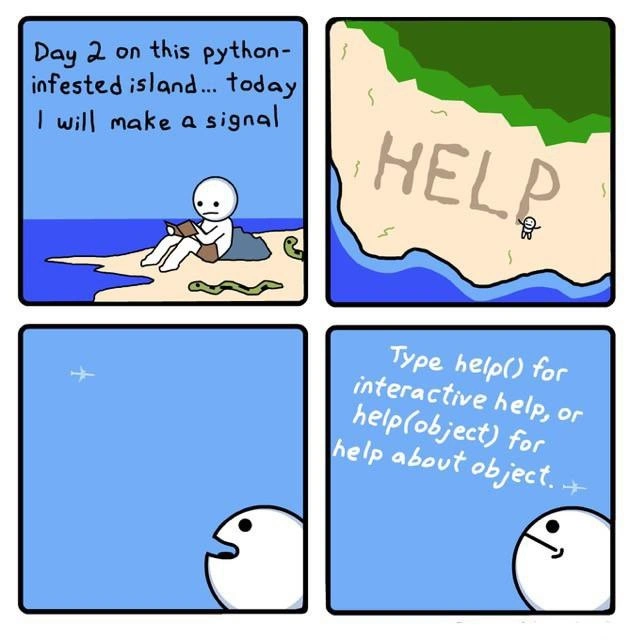
Imagine you’re alone on an island and you write a huge “HELP” sign for someone to save you. You’re hoping a plane will see it and send real help. But instead, the only answer you get is like a computer talking: “If you need help, do this and that…” It’s the wrong kind of help! That’s exactly what happens in this cartoon. The person asks for rescue, but instead of a rescuer, it’s as if a computer replied with instructions.
Think of it this way: if you shouted “Help!” because you were in danger, and instead of a person coming, an automated voice said, “For help, press the help button.” That would be pretty silly, right? You’d probably be standing there with your mouth open, thinking “uh, that’s not what I meant!” In the comic, the developer’s big “HELP” signal got answered by a Python program’s help message. It’s funny because the poor person wanted a human to help him off the island, but got a computer-style answer that isn’t useful for survival. It’s a mix-up: the word “help” meant “please save me” to the person, but was taken as “let me give you some info” by the computer. The humor comes from that confusion and the surprised look on the character’s face – he didn’t get the help he needed, just a nerdy response. In simple terms, the joke is showing how asking for help from a machine isn’t the same as asking for help from a person, and that mismatch is what makes us laugh.
Level 2: The Python Meaning of “HELP”
Let’s break down what’s happening in the comic and why it’s funny for those who use Python and the command line:
Python is a popular programming language (named after Monty Python comedy, though its logo often features two snakes). In the first panel, the text says “python-infested island” – there’s a green snake next to the character. This is a pun: it implies the island has actual pythons (snakes), but it’s also a wink to the Python programming language. The poor developer might be “infested” with Python in a figurative sense, meaning everything turns into Python code, which sets up the joke.
The character writes a huge “HELP” on the beach as a classic SOS signal. In survival situations, writing “HELP” or “SOS” in big letters is how you try to get a pilot’s attention. In the comic’s second and third panels, you see the giant HELP and a plane flying by – so far, it’s a normal rescue scenario.
Now the twist: in the fourth panel, instead of the pilot reacting normally, we see the text: “Type help() for interactive help, or help(object) for help about object.” This text is exactly what you’d see in a Python interactive session (the Python REPL or interactive console) if you type the word
helpby itself. In Python’s Command Line Interface (CLI),helpis a built-in helper. To actually use it, you’re supposed to call it like a function:help(). If you forget the parentheses and just typehelp, Python doesn’t execute help – it instead prints a little prompt telling you how to use it properly. It’s Python saying, “I see you typed ‘help’, but you need to call it as a function for it to work.” For example, if you open a terminal and run Python, it looks like this:
>>> help
Type help() for interactive help, or help(object) for help about object.
Here, >>> is the Python prompt. When we entered help without parentheses, Python returned that exact message seen in the meme. It’s basically an interactive help prompt—Python’s way of offering assistance on how to get documentation.
Why is that funny in context? Because the developer on the island wasn’t trying to invoke a Python command – they genuinely wanted real-world help! But to a Python developer (or apparently to the cartoon universe’s logic), the word “HELP” immediately calls to mind the
help()function. It’s like the environment “thought” the person was using Python. The SOS signal failed in a comical way: instead of rescue, it triggered a documentation tip. This is a big wordplay joke. The word “help” has two meanings here:- As an English word, it’s a cry for aid.
- In a programming context (especially Python or other CLI tools), it’s a command to get information.
The meme leans on our familiarity with developer tools. Many command-line programs use
--helpor a help command to explain usage. Python in interactive mode has this friendly built-in guide. The stranded dev presumably has been using these tools so much that even their desperate SOS is interpreted like a terminal command. It’s a mix-up of survival language and programming language.Let’s talk about that Python help system for a second. In Python’s interactive mode,
help()is super useful: you can dohelp(str)to read about the string type, or justhelp()alone to enter an interactive help interface (you can then type topics to get info). If you just typehelpwithout the(), Python doesn’t execute it – it’s waiting for you to either call it or do something with that object. The message “Type help() for interactive help…” is Python gently nudging you: “you might want to actually call this function.” It’s part of the developer experience to see messages like this when using a language’s CLI. Every Python learner likely encounters this once and quickly learns to add the parentheses.Now, in the comic, this Python interactive message popping up in the sky is unexpected for normal people, but very familiar to Python devs. The little stick-figure’s face in the last panel is in shock/disbelief 😮 because instead of actual help arriving, he basically got a computer manual response. It’s the ultimate facepalm for a developer: your SOS got interpreted as a computer command! This ties into a common coding humor theme: the computer does exactly what you tell it, not what you meant. Here the poor dev literally wrote “HELP” — the computer “obeyed” in its own way by showing help instructions, which is useless for getting rescued.
The meme also highlights how devs sometimes mix up contexts. Muscle memory is a big factor – as developers, we get so used to certain outputs that we start expecting them everywhere. The phrase “Type help() for interactive help…” is practically hard-coded into a Pythonista’s brain. So seeing “HELP” anywhere might subconsciously ping that memory. This comic takes that idea and runs with it: what if even reality acted like a Python prompt? It’s funny because it’s absurd — obviously in real life an airplane won’t show a Python message in the sky — but for a split second, an experienced coder might chuckle that the situation feels oddly familiar in a twisted way.
Lastly, it’s worth noting the visual style: a simple four-panel stick figure comic. This style is common in developer humor circles because it delivers the joke clearly without needing complex art. The focus is on the concept. The categories here (Languages, CLI, Developer Experience) all combine: it’s specifically about the Python language, using a CLI feature (
help), and it’s poking fun at a scenario from a developer’s experience (being so deep into coding that even your cries for help turn into code). It’s a textbook example of relatable dev experience turned into a joke. Even if you’re a junior developer just learning Python, once you’ve seen that help prompt a few times, you’ll appreciate why a giant “HELP” in sand triggering the same prompt is ridiculously funny.
Level 3: Context-Switching SOS
This meme mashes up a desert island survival trope with a programmer’s everyday reality, creating a hilarious context collision. In the comic, a stranded developer scratches a giant “HELP” into the sand hoping to get a rescue. But instead of a pilot seeing the SOS, the Python interpreter seems to respond! For an experienced developer, the punchline is instantly recognizable: the text in the sky – “Type help() for interactive help, or help(object) for help about object.” – is exactly what the Python REPL (Read-Eval-Print Loop) outputs if you type help without parentheses. It’s as if the whole world is running a Python session, and the poor castaway’s SOS was misinterpreted by the CLI as a command.
The humor here comes from developer muscle memory and programming language wordplay. Seasoned Python users have that help() prompt burned into their brain from countless hours in the terminal. The comic plays on how deeply this is ingrained: instead of reading “HELP” as a cry for rescue, our developer (and by extension, the reader’s brain) automatically triggers a Python help prompt. It’s a clever subversion of expectations – a classic “not the help I expected” situation. Essentially, the castaway got help alright – just not the kind of help that can get you off an island!
Notice the setup: “Day 2 on this python-infested island…” which is a sly double meaning. There’s a literal green snake next to the character (an island infested with pythons 🐍), but it’s also hinting that the island is metaphorically “infested” with the Python programming environment. The stranded dev is even shown reading a manual – possibly Python’s documentation – suggesting that the only companion on this island is the Python interpreter itself. By Day 2, they decide to make a signal for rescue, but their developer instincts (or this cursed island’s operating system-like behavior) turn the life-saving SOS into a Python CLI joke. This resonates with developers because we often joke that we see code everywhere; here that idea is taken to an absurd literal level. It’s a relatable dev experience: once you’ve immersed yourself in coding, sometimes your brain reflexively interprets everyday words like they’re code.
From an experienced perspective, this meme also pokes fun at how computers lack context. In a normal rescue scenario, “HELP” on a beach is unambiguous. But a computer (or a computer-like mind) takes things literally: it sees “help” and goes “Oh, you want the help function.” 😂 This absurd miscommunication is the core of the humor. It highlights the gap between human intention and machine interpretation (the DeveloperExperience_DX of constantly switching contexts). Every senior dev knows the pain and comedy of context switches – here it’s taken to the extreme where even a mayday signal gets parsed as code. The result is a perfect tech humor cocktail of surprise and recognition: we laugh because we’ve been conditioned to the same response as that plane, and we’re just as shocked as the stick-figure when that familiar Python prompt appears in the sky instead of a rescue. The CLI/terminal humor in that final panel is spot-on – it’s basically the computer’s version of saying “I see your request, but you might want to format it differently.” In other words: the developer tried to escape the island, but their tools left them marooned! It’s a scenario so ridiculous that only programmers would get it – and that’s why it’s hilarious.
Description
A four-panel comic strip illustrating a programming pun. In the first panel, a character is stranded on an island surrounded by snakes, with the caption: 'Day 2 on this python-infested island... today I will make a signal'. The second panel shows an aerial view of the character having written 'HELP' in huge letters on the sand. In the third panel, the character looks up hopefully at a distant airplane. The final panel reveals the response from the sky, formatted like a terminal output: 'Type help() for interactive help, or help(object) for help about object.' The character has a look of slight annoyance. The joke is a multi-layered pun on 'python' (the snake vs. the programming language) and 'help' (a distress signal vs. the Python `help()` command), which is perfectly relatable to any developer who has sought help and received a generic, though technically correct, instruction

Comments
10Comment deleted
That's the last time I ask for help escaping a legacy system. The response is always technically correct, completely useless, and suggests I read the three pages of documentation that still exist
Great - twenty years of Python and my SOS got shadowed by a built-in; nothing like a global namespace collision to turn a P1 incident into a survival one
After 20 years of Python development, I still remember the existential crisis when I first discovered help(help) - it's turtles all the way down, except the turtles are docstrings and the bottom is C source code you'll never read
Rescue denied: 'help' is not callable without parentheses. Day 3 he'll try HELP() and the plane will drop a 4,000-page docstring instead of a rope
When you're debugging a production outage at 3 AM and Stack Overflow is down, so you desperately type help() in the Python REPL hoping for divine intervention, but instead get a lecture about object introspection. At least the seagull understood the assignment - technically correct documentation is the best kind of correct, even when you're drowning in exceptions
Python island pro tip: help() scales better than Kubernetes but delivers zero uptime for real emergencies
Python’s “batteries included”: you write HELP in the sand, it flies by with pydoc - fantastic introspection, but rescue() still isn’t in the standard library
HELP without parentheses just returns the help object; if you wanted a helicopter, you needed help() - or at least import rescue
Kekis Comment deleted
Vim infested island. Comment deleted