Skip to content
DevMeme
450 of 7435
Sacrificing Bedtime Stories for GitHub Green Squares
Career HR Post #519, on Aug 5, 2019 in TG

Sacrificing Bedtime Stories for GitHub Green Squares

Why is this Career HR meme funny?

Level 1: No Bedtime Story

Imagine a dad who normally reads a story to his kids every night, but tonight he says, “Sorry, no story.” Why? Because he feels he needs to do extra homework for his job. Think of it like the dad has a chart full of gold star stickers for each day he does some coding. He wants to fill that chart with stickers so that someone who might give him a new job will be impressed. It’s just like when a teacher gives you a star for every book you read – some kids might start reading books just to get lots of stars, even if they’re too tired. In this silly scenario, the dad is skipping storytime to go “earn” another green sticker on his computer chart. It’s funny in a bittersweet way: the dad is so worried about showing off an attractive record to the job people (recruiters) that he’s missing a precious moment with his kids. Essentially, he’s choosing make-believe points on a screen over a real bedtime story. The meme makes us chuckle because it’s an exaggerated reminder that sometimes grown-ups focus on the wrong rewards, and it hints that balancing work and family is really important – after all, bedtime stories are pretty special, and no amount of green squares can replace that.

Level 2: Side Project Pressure

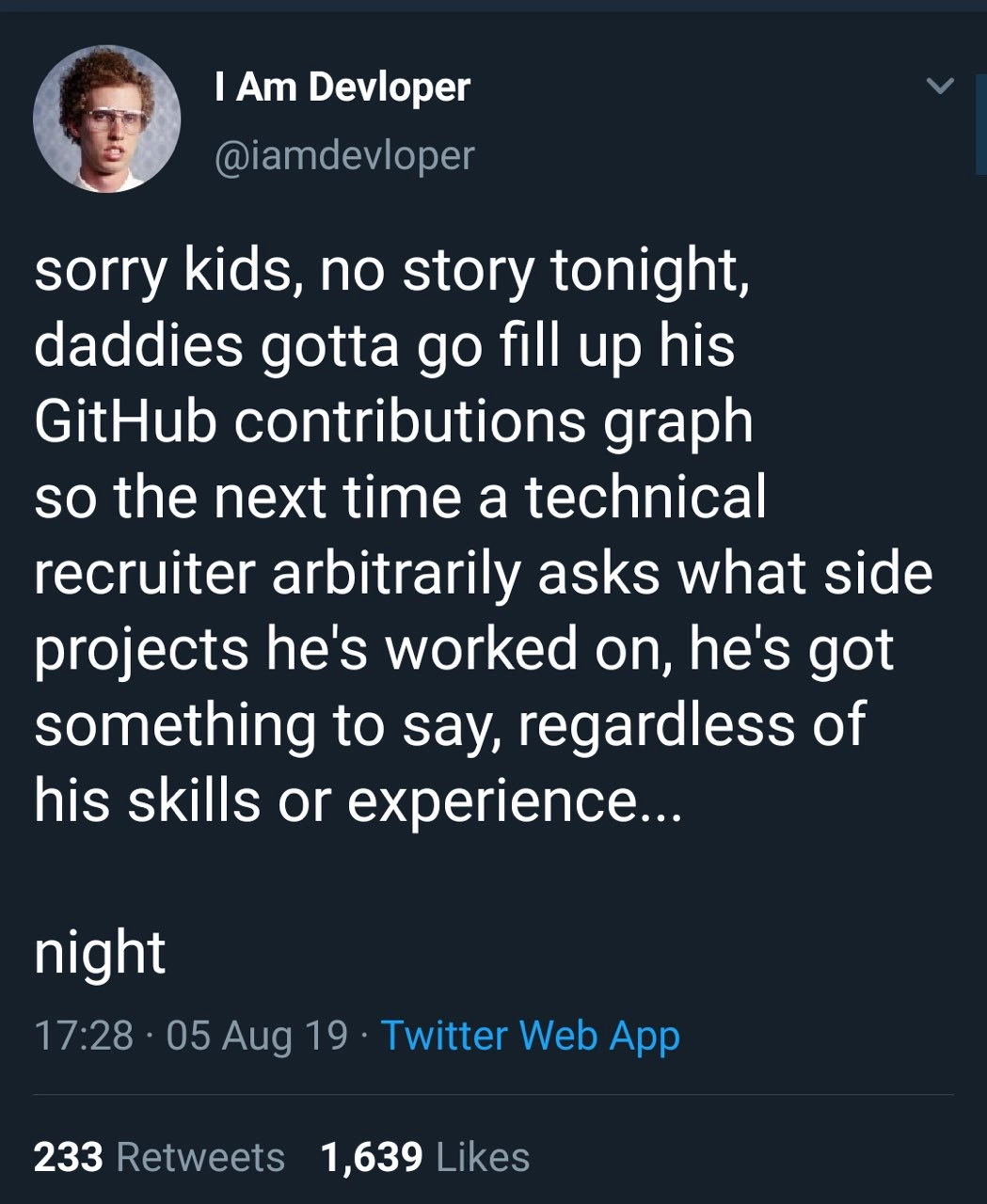
For newer developers, let’s break down what’s going on. The meme is a screenshot of a tweet joking about a father who tells his kids “no bedtime story tonight” because he wants to work on coding side projects and fill up his GitHub contributions graph. GitHub is a popular website where developers store and share their code, and it publicly shows a grid calendar of green squares indicating on which days you made contributions (like coding, committing changes, or opening issues). More contributions in a day make a darker green square. Many developers take pride in having a consistently green GitHub graph – it’s like a visual record of how active they are in coding.

Now, a technical recruiter is someone whose job is to find and hire developers for companies. Not all recruiters have programming expertise, so they often use quick checks to judge candidates. One common thing they ask is, “What side projects have you worked on?” Side projects are any coding projects you do outside of your main job – maybe a small app, a personal website, or contributing to an open-source project. Recruiters ask this because they’re trying to gauge your passion for technology and your experience beyond just your day job. In theory, having cool side projects or lots of open-source contributions can show that you love coding and have practiced various skills.

The tweet jokes that this dad is farming green squares (making sure his GitHub shows activity) just so he has an answer when a recruiter asks about side projects. The funny (and sad) part is the phrase “regardless of his skills or experience.” It implies the dad knows that simply having something on GitHub might impress some recruiters more than actual skill or years on the job. In other words, he feels pressure to demonstrate an online presence (a public profile with lots of code) to get his foot in the door in interviews. This reflects a real feeling in the developer community: if your GitHub looks empty, you worry it might hurt your chances of getting hired, even if you’ve been coding a long time privately or at work.

Work-life balance is a term used to describe the healthy boundary between your job and your personal life. The meme exaggerates a trade-off many people struggle with: parenting vs. coding or family time vs. work commitments. Here, a dad chooses coding over reading a bedtime story to his kids. It’s an example of the pressure some developers feel to keep up with expectations. Newer developers might notice peers or online communities talking about doing leetcode practice every night, pushing code constantly, or never “switching off.” The tweet is poking fun at that pressure by showing an extreme scenario.

Also, note the tweet’s tone: it’s satirical. The account “I Am Devloper” is known in dev communities for making fun of developer life. By saying “daddy’s gotta fill up his GitHub… so next time a recruiter asks… he’s got something to say,” it mocks how ridiculous this routine is. It points out a flaw in hiring culture: sometimes the number of side projects or the appearance of constant coding is valued more than reality. The dad in the joke might be a very skilled engineer, but he’s still afraid a recruiter will judge him for not doing extra projects. So he sarcastically says goodnight after prioritizing code over the bedtime story. This resonates with many in DevCommunities who discuss how interview processes can be overly focused on things like competitive programming, trick puzzles, or a pretty GitHub profile.

In summary, at this level we see the meme is about the pressure to maintain a public coding portfolio. It teaches new developers that while having side projects and an active GitHub can be helpful in a job search, it’s also a cultural pressure that can go too far. Good developers sometimes feel they must perform constant productivity online, even to the detriment of their personal life. The humor comes from recognizing this scenario and shaking our heads at how recruiters might “arbitrarily” ask about side projects as a checkbox, without truly understanding a candidate’s real qualifications.

Level 3: The Green Square Grind

In the senior developer circles, this meme hits a nerve because it skewers the vanity metrics culture in tech recruiting. The tweet shows a weary parent-developer who feels compelled to sacrifice family time to pump up his GitHub contributions graph. Why? Because apparently a wall of green squares on GitHub – those daily commit indicators – has become a proxy for passion and skill in some hiring conversations. It’s a darkly funny commentary on how technical recruiters (who often aren’t very technical) latch onto visible but shallow signals. Filling your GitHub profile with activity has basically become a game: commit early, commit often – even if you're just pushing minor changes or empty commits – so that your profile’s heatmap glows green. The humor here comes from how absurd and dysfunctional this incentive is: instead of reading bedtime stories to his kids, Dad’s busy grinding out commits to impress someone scanning his profile for “side projects.” It’s a Goodhart’s Law situation in action: when a measure (like GitHub commits) becomes a target, it loses its value as a true measure. The developer in the meme knows filling those squares says little about his actual skills or experience, but he’s cynically doing it anyway because he’s been burned by interviews that equate busy GitHub activity with being hireable.

This scenario is painfully familiar to experienced devs. Many of us have sat in interviews where some arbitrary side-project question comes up: “What do you code in your free time?” If you say you’re too busy with work or family, you fear coming off as not passionate enough. So what’s the “solution”? For some, it’s to artificially inflate that GitHub graph. We’ve seen folks embark on trivial side projects (yet another ToDo app in the latest JavaScript framework, anyone?) or contribute tiny fixes to open source just to have talking points. Some even joke about committing nonsense code at 11:59 PM every day to avoid any blank squares on the calendar. The tweet’s phrasing “fill up his GitHub contributions graph” perfectly captures this grind – it’s like watering a lawn to keep it green, except the lawn is your public coding profile and the water is meaningless commits. Work-life balance flies out the window; the developer becomes a gardener tending a pixelated green lawn for recruiters’ sake. It’s both funny and tragically accurate.

This meme also highlights the generational and lifestyle divide in tech. Older, battle-worn devs (often parents) might not have spare hours each night to hack on open source. Yet the industry’s hero-worship of the nonstop coder puts pressure on everyone to keep up. A savvy veteran might roll their eyes at a hiring process that values a “green square streak” over years of real-world engineering fire-fighting. But they’ve also seen how real this bias can be. The Twitter engagement numbers (hundreds of retweets, thousands of likes) show many developers relate – they’ve either felt this pressure or watched colleagues scramble to “look active” online. It’s a shared joke about the absurd hoops we jump through to meet flawed hiring criteria. And of course, the most jaded among us might even automate those hoops: why manually commit at midnight when a script can do it?

# A tongue-in-cheek "green square farming" script:
echo "daily grind" >> README.md   # append trivial text
git add README.md
git commit -m "Update docs for recruiter 👍"
git push origin main

(The above would ensure a commit each day – a satirical take on how far developers go to avoid blank days on their profile.) In summary, Level 3 reveals the bitter truth under the humor: tech hiring often prizes appearances (like a full contributions graph) over substance, incentivizing even dedicated dads to turn “family time” into “GitHub time.” It’s a sarcastic critique from those of us who’ve been around long enough to see how misguided metrics can warp behavior in the coding community. We laugh, but it’s the kind of laugh that comes with a knowing groan.

Description

A screenshot of a tweet from the popular satirical Twitter account 'I Am Devloper' (@iamdevloper), which features a profile picture of Napoleon Dynamite. The tweet, set against a dark blue background, reads: 'sorry kids, no story tonight, daddies gotta go fill up his GitHub contributions graph so the next time a technical recruiter arbitrarily asks what side projects he's worked on, he's got something to say, regardless of his skills or experience... night'. This post satirizes the pervasive pressure in the tech industry for developers to maintain a visually active GitHub profile. The joke is that the 'green squares' on the contribution graph have become a superficial metric for passion and productivity in the eyes of some recruiters, forcing developers to engage in performative work outside of their job, sometimes at the expense of personal time. It's a cynical take on how a tool for collaboration can be co-opted into a signaling mechanism for the hiring process, often disconnected from a developer's actual expertise
Comments

7
Anonymous ★ Top Pick Some developers have an 'infrastructure as code' setup for their side projects. I have an 'insomnia as code' setup that runs a cron job to make a trivial commit every night at 3 AM
  1. Anonymous ★ Top Pick

    Some developers have an 'infrastructure as code' setup for their side projects. I have an 'insomnia as code' setup that runs a cron job to make a trivial commit every night at 3 AM

  2. Anonymous

    Set a cron job to `git commit --allow-empty -m "goodnight"` at 23:59 - your kids still get a bedtime story, your GitHub stays evergreen, and you quietly teach them Goodhart’s Law before they can even spell “recruiter.”

  3. Anonymous

    Twenty years of shipping production systems, but apparently my credibility hinges on whether I remembered to commit my README updates daily for the past three months

  4. Anonymous

    Ah yes, the time-honored tradition of treating your GitHub contribution graph like a Tamagotchi - frantically feeding it commits at midnight so it doesn't die before your next recruiter call. Because nothing says 'senior architect with 15 years of experience' quite like a recruiter asking 'but what have you committed lately?' while your production systems handle millions of transactions. Pro tip: just write a cron job to commit README typo fixes daily - it's more honest than most technical interviews anyway

  5. Anonymous

    Recruiter-driven development: a 23:59 GitHub Action that touches README so my green squares meet their SLO - signal masquerading as software

  6. Anonymous

    Goodhart’s Law in recruiter-driven development: 23:59 whitespace commits keep the heatmap green while the family_time SLO burns red

  7. Anonymous

    Side projects? Nah, just 'git commit --allow-empty -m "refactor"' marathons to greenwash the graph while the enterprise monolith silently accrues tech debt

Use J and K for navigation