Insomnia as a Service: Dream Servers Are at Full Capacity
Why is this Infrastructure meme funny?
Level 1: Waiting in Line for Dreams
Imagine that falling asleep is like going to a big playground or amusement park where dreams are given out. There are only so many “dream rides” available. Sometimes, especially when lots of people go to sleep at the same time, all those dream rides are busy. This meme is joking that when you can’t fall asleep, it’s not just you – it’s like all the rides are full and you have to wait in line for your turn. You’re basically standing at the gate of Dreamland, tapping your foot, because there’s a sign that says, “All full, wait until someone leaves.”
It’s a very playful idea. Normally, we think we can’t sleep because we drank too much soda or we’re worried about a test or something. But this joke says, “Nope, the reason is technical: the dream servers are at capacity!” Think of a server like a dream factory or a dream-making machine. If too many people are using the dream factory at once, it can’t take more people until someone exits. It’s like when a bus or an elevator has a limit – if it’s full, you have to wait for the next one. Here, someone else has to wake up (get off the dream bus) before you can get on and fall asleep.
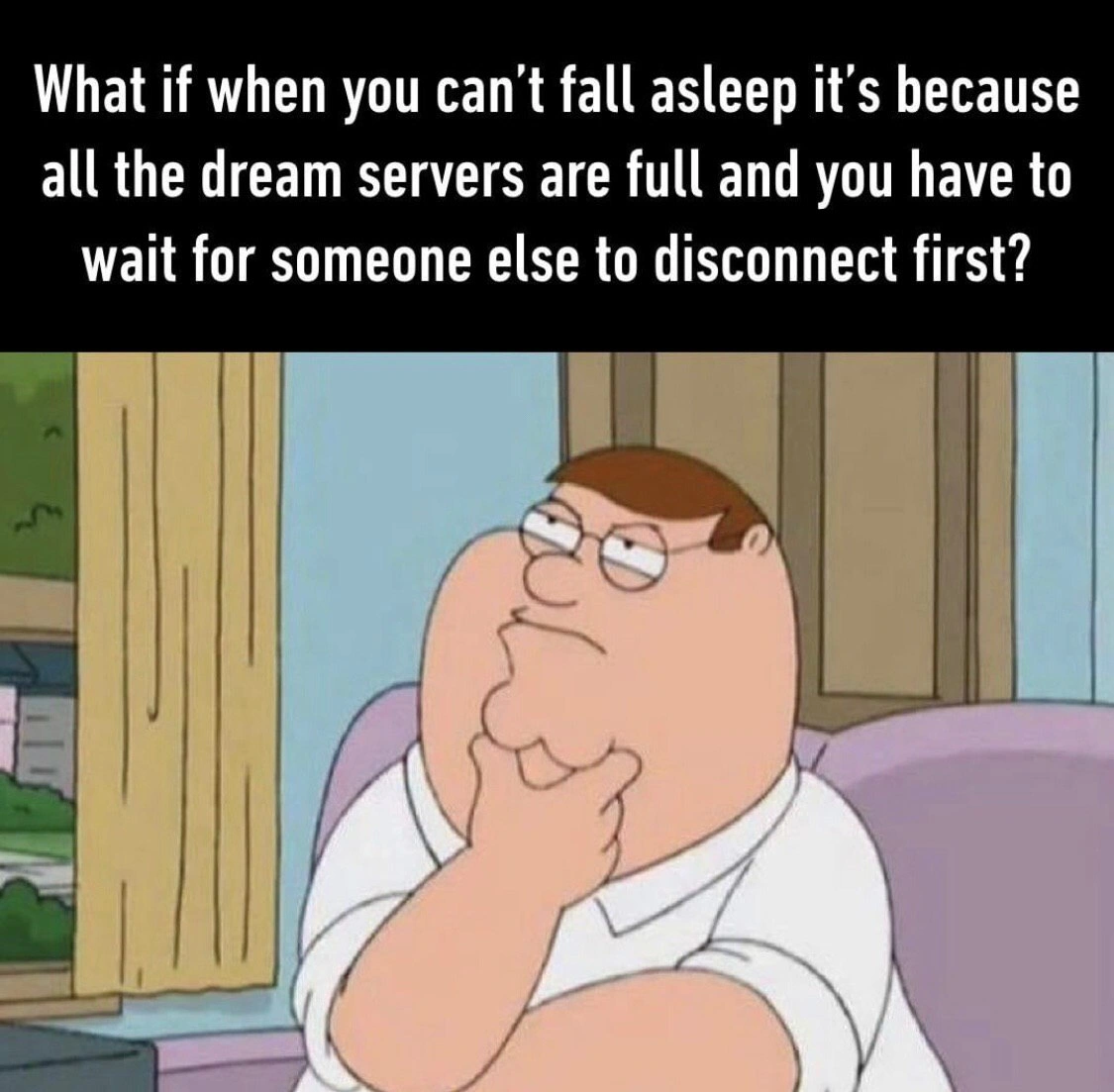
The picture in the meme shows Peter Griffin (a dad from a funny cartoon Family Guy) sitting on a couch looking very thoughtful, with a hand on his chin. He’s pondering this wild idea as if it’s a deep hypothesis. That’s part of the joke too – he’s treating a silly thought as something profound. We often do that when we’re tired and can’t sleep, right? We come up with crazy reasons or thoughts. This one just happens to use computer talk. It’s basically saying: what if dreaming was like an online game and all the slots were full? If you’re not a tech person, just picture trying to join a really crowded game or trying to get into a concert where they only allow a certain number of people. You’d have to wait outside until someone comes out. That’s the everyday equivalent.
So, in super simple terms: not being able to sleep is being compared to waiting in line because the “sleep building” is full. It’s funny because it takes a frustrating, mysterious thing (insomnia) and gives it a goofy explanation that sounds like it’s out of a sci-fi or video game. There’s no real “dream server” controlling sleep, but imagining one leads to a kind of “Haha, can you imagine?!” moment. It turns our annoyance at not sleeping into a scenario we can laugh about. Instead of feeling bad that you’re awake, you can chuckle and think, “Darn, I guess I’m just queued up for my dream. I hope someone logs out soon so I can get some rest!”
Level 2: Server Full IRL
Let’s break down the technical concepts in this meme and explain the joke in simpler dev terms. First, what do we mean by “dream servers”? In computing, a server is just a computer (or program) that provides a service to other computers or users. For example, a web server serves you web pages. In the meme’s imaginative scenario, a “dream server” would be a server that “serves” dreams to people’s brains when they sleep. Of course, in reality, dreams come from our brains, not an actual server farm, but the joke is pretending there’s a literal infrastructure behind sleep.
Now, the meme says these dream servers are “full” and you have to wait for someone to disconnect. In tech terms, that describes a max capacity issue. Real servers often have limits: maybe a database allows only 100 connections at once, or a game server caps at 50 players. “Server full” means it’s hit that limit. If you try to connect as the 51st player, you’ll either get an error or be put on hold until someone leaves. Many gamers have seen a “Server is full, waiting for open slot” message — that’s exactly what the meme text sounds like. It’s taking that scenario and applying it to insomnia: you can’t join the dream because there’s no open slot right now. It’s as if falling asleep were akin to logging into a busy website or game. That’s why it’s funny to people who manage servers — it’s a literal “server full error” happening IRL (in real life) to your brain!
Let’s go over a few key terms that relate to this scenario:
Scalability: This means how well a system can handle increasing loads. If more people want to use your application, can you just add more resources to handle them? A highly scalable design (like many cloud services) can grow on demand — add more servers, and no one has to wait. In our meme, the dream system is not very scalable, apparently. All servers are busy and they aren’t spawning new ones to cover the extra dreamers. That’s a scalability failure: the design can’t accommodate the peak demand of everyone who’s trying to sleep at once.
High Availability: This is about designing systems to be reliable and available for use almost all the time, often by having backups or multiple servers. For example, if one server is down or full, another can step in. If the dream service were highly available, you wouldn’t have to wait — another dream server would pick you up, or the system would have some redundancy. The joke implies the dream service isn’t meeting a 99.999% availability goal tonight! All nodes are maxed out, so it’s effectively a downtime (for you at least). In real infrastructure, high availability setups (like clusters of servers behind a load balancer) try to prevent any single point from becoming a bottleneck. Yet here you are, bottlenecked on sleep.
Load Balancing: A load balancer is like a smart traffic cop that distributes incoming requests to multiple servers so none of them overload. Imagine you have 10 servers that can each handle 100 users; a load balancer will send each new user to the server with free capacity. If one server is full, the load balancer moves on to find one that isn’t. If the dream system had a good load balancer, theoretically it would direct you to a dream server that has room. The fact that all dream servers seem full suggests even the load balancer (if one exists in this fantasy) has nowhere to send you — every lane is jammed. In everyday terms, it’s like every checkout line at the supermarket is full, and you just have to pick one and wait.
Queue: This is the waiting line. In computing, when too many requests come in, servers might put some requests in a queue – basically a list where each request waits until the server is ready to handle it. Some services inform you of your place in line (like “You are user 5 of 20 waiting”). In our sleep analogy, if you can’t sleep, you’ve essentially been placed in a queue for a dream. You’re waiting for your turn. “Waiting for someone to disconnect” is describing how a queue clears: one person leaving the service (waking up) allows the next person in line to start (fall asleep). If you’ve ever been on a crowded website on launch day and seen a message like “Hold on, we’re letting users in gradually,” you were in a queue for that service. This meme imagines an overnight queue at the gates of dreamland.
Server Full Error: This is a common error message especially in gaming or older online platforms. It literally means the server cannot accept any more users. For example, an FPS game server might say “Server full (32/32 players).” Sometimes the client app will auto-retry or give a countdown. In web terms, a server that’s too busy might throw a status code 503 Service Unavailable, which means “I’m up, but I can’t handle this right now.” The caption of the meme is basically a friendly wording of a server-full error: “please wait, all circuits are busy.” If we were to imagine it as an error dialog: “DreamServerError: Max connections reached. Please wait for an open slot.” It’s amusing because it’s treating insomnia as if it popped up an error message like that on your pillow!
Now, relate this to something a junior dev or anyone new to these concepts might have seen:
Online Games: Many of us experience this first here. You try joining a popular server in a game and it just won’t let you in until someone leaves. You might even see a queue number (like “You are #5 in line”). That’s essentially what the meme says is happening when you lie awake – you’re #5 in line for a dream right now!
Website Overload: If a small website suddenly gets a ton of traffic (say your friend’s blog goes viral), it might slow down or start refusing connections. A beginner might not realize at first that servers aren’t infinite. The first time you deploy an application and it crashes or hangs when too many people use it, it’s a learning moment: you discover terms like CPU bottleneck or out of memory or connection limits. The meme is leveraging that knowledge: we know overloaded servers cause delays, and it whimsically says maybe that’s why you’re tossing and turning.
Infrastructure in simple terms: Think of infrastructure as the framework or foundation that everything computer-related runs on – the servers, networks, and services behind the scenes. If we say the dream infrastructure is overloaded, we’re picturing, say, a bunch of servers in a data center (maybe run by “Sandman Corp.”) each hosting thousands of dreams. It’s a silly mental image, but that’s what the text conjures for an IT-minded person. And because we deal with infra problems at work, it’s funny to apply it to bedtime.
Distributed Systems: This term means a system that’s spread across multiple computers (servers) instead of just one. The caption mentions plural “dream servers”, implying a distributed system for dreams. In such systems, you also have to manage distribution of load and resources. One big concept in distributed systems is ensuring one node’s issues don’t cascade to the whole system. Here, though, it’s like every node is at full load – a distributed failure state. A newcomer to distributed systems learns about things like balancing load, handling failovers, etc. All that knowledge makes this one-liner about dream servers witty: it’s basically saying “Even distributed systems can hit a wall if every part is busy.” It’s a one-sentence crash course in why we design for redundancy and elasticity.
Meme Culture Crossover: As an aside, this meme also shows how tech communities enjoy crossing over technical jargon with everyday life. The image of Peter Griffin pondering is often used for “shower thoughts” or silly theories. Here the theory is techy: it’s turning a common struggle (can’t sleep) into what sounds like a system admin’s report. For a junior developer or someone just getting into the field, it’s a peek at how deeply we immerse in this stuff – to the point we joke about load balancers when we’re in bed. It’s a form of relatable, self-deprecating humor: “I’m such a nerd that I’m literally thinking about server load at 2 AM.” Don’t worry, it happens to the best of us!
In short, the meme uses straightforward tech ideas – servers, full capacity, waiting your turn – and uses them as an analogy for not being able to fall asleep. It’s funny to tech folks because it perfectly blends a personal experience with the kind of system issues we troubleshoot in our jobs. And even if you’re new to these terms, once you know them, you can see how cleverly the joke is constructed. Who knew insomnia could be explained by load balancing algorithms and server capacity? 😄
Level 3: 503 Dream Unavailable
For seasoned engineers, this meme hits a hilariously relatable nerve by framing insomnia as a classic infrastructure failure. The text reads like a tongue-in-cheek status message: “All dream servers are full. Please wait for someone to disconnect.” If life had an error dashboard, this would be a 503 Service Unavailable for your attempt to sleep. We’ve all dealt with servers refusing connections when overloaded – seeing that applied to dreaming is both absurd and brilliantly apt. It’s the ultimate DevOps lullaby: “Sorry, can’t sleep now, the cluster is at capacity.”
The humor comes from treating going to sleep as if it were logging into a busy system. Engineers spend their days talking about high availability, scalability, and load balancing. So at night, lying awake, it’s almost natural (in a very nerdy way) to wonder, “Is the reason I can’t connect to dreamland because of a scaling issue?” This meme basically says yes! It imagines a world where behind the scenes of our brain, there’s an infrastructure of “dream servers” processing everyone’s dreams. And right now, that infra is yelling “No capacity, come back later!” The result is a perfect blend of TechHumor and everyday frustration. It’s funny because it’s a hyperbolic tech explanation for a human experience we’ve all had. Instead of blaming coffee or stress for insomnia, the blame goes to a mythical server ops problem.
From a senior developer or SRE (Site Reliability Engineer) perspective, this scenario is a familiar failure mode: capacity exhaustion. We’ve seen it with real servers—when too many users flood a service, you get queued or kicked out. Think of a time you tried to join a massively popular online game or a live webinar. You might get a message like, “Server full, waiting for an open slot…” That’s literally what the meme text describes. It’s basically a production incident in the data center of Dreamland. The phrase “wait for someone else to disconnect” is the kicker — it’s exactly what you’d see in a multiplayer game lobby or an old-school chatroom with a user cap. It brings back memories of launching a new service without enough capacity: users sporadically get denied until someone else logs off. Every engineer who’s been through a rough launch or a Black Friday traffic surge can chuckle (or shudder) at that.
The meme also satirizes the lack of High Availability in this fictitious dream system. High-availability design says: no single point of failure, always have a fallback. Yet here, apparently all dream servers are jammed. That implies a pretty poor architecture by our dreamy DevOps team! 😜 Perhaps there’s only a single region or a monolithic dream server that everyone connects to. (Talk about a single point of failure for the world’s sleep!) In a real distributed system, we’d mitigate this by load-balancing across multiple servers in different zones. Ideally, if one “dream server” is full, a smart load balancer would route new dreamers to a less loaded server elsewhere. The fact you’re stuck waiting suggests either every node in the dream cluster is maxed out, or worse, they never implemented global load balancing for dreams. It’s a sly nod to Scalability nightmares in engineering: someone didn’t configure auto-scaling, and now users (sleepers) are stuck in a queue. One can almost imagine a harried on-call engineer in a celestial NOC (Network Operations Center) looking at an alert: “DreamServerPool at 100% capacity – users waiting!” and scrambling to spin up more cloud instances in AWS DreamRegion-1.
This humorous analogy also resonates on a personal level for developers. Many of us have experienced insomnia, especially after late-night coding or pager duty rotations. In those moments, our minds sometimes race with tech thoughts. The meme’s scenario is like something an overtired engineer would jokingly concoct at 2 AM: “Maybe I can’t sleep because the sleep microservice is rate-limiting me.” It’s self-deprecating, acknowledging how we techies often overlay systems logic onto our lives. We find it comforting (or at least diverting) to explain even our relatable human problems in terms of servers and queues – it gives a bizarre sense of control or understanding. Misery loves company, and here the company is an imagined global network outage for dreams.
Additionally, the use of the Peter Griffin “deep thought” image from Family Guy amplifies the comedy. Peter is a goofy character, and seeing him ponder such a pseudo-intellectual tech question makes it even funnier. It’s the memeCulture mashup: a pop-culture cartoon + a nerdy infrastructure joke. The contrast between the silly visual and the surprisingly plausible-sounding caption (plausible at least to those of us who speak in server metaphors daily) creates an irresistible irony. It’s basically a shitpost for sysadmins: coupling the stress of insomnia with the stress of systems engineering, and somehow making us laugh about both.
In practical terms, this meme also hints at the pains of capacity planning. Every experienced engineer knows that planning for peak load is hard. Under-provision, and users wait or get errors; over-provision, and you waste money. The dream operators clearly under-provisioned – a blunder we’ve all seen or made. It’s as if the “Dream Ops Team” thought the average load at 2 AM would be fine with current servers, but whoops, a twitch in usage and now we have a backlog of unslept humans. One can tongue-in-cheek imagine the post-mortem for this incident:
- Issue: Users experiencing delayed dream initiation (insomnia) due to server capacity.
- Root Cause: All dream servers in cluster at max utilization (lack of auto-scaling).
- Action Items: Implement better load balancing algorithms (maybe a round-robin of who gets to dream), add redundancy (new dream servers in other regions or realms), and possibly increase the timeout before a user gives up on connecting (so they keep trying instead of just staying awake all night).
It even invites a funny solution: maybe we should scale vertically by upgrading the dream servers (give them more RAM for processing dreams?) or scale horizontally by adding more dream servers (spread the world’s sleepers across more nodes). In distributed systems terms, maybe each person’s brain should be its own “edge server” for dreams (compute dreams on the edge, to avoid central bottlenecks!). The meme basically begs for those kinds of geeky what-ifs. And in telling this joke, it reminds all developers of the very real principle that no matter how well we design systems, there’s always a load scenario that can knock you over — even if that system is the universe’s dream machine.
Finally, consider the notion of counting sheep as a classic insomnia remedy. In this new light, counting sheep could be seen as the equivalent of a loading animation or a queue spinner while you wait for a dream server slot to open! It’s the system saying, “Hang tight, we’re connecting you… 🐑🐑🐑.” That little mental exercise is basically a way to occupy your mind (the client) until the server (dreamland) is ready. Seasoned devs can appreciate this parallel: when a request is queued, you often give the user some feedback (a progress bar, an estimated wait time). Counting sheep is the low-tech UX for a high-tech-sounding problem. This kind of layered joke – mixing genuine infrastructure issues with tongue-in-cheek life advice – is what makes the meme so shareable in tech circles. It’s a pain we know too well, repackaged as a surreal, funny thought.
Level 4: Sleeping Barber Concurrency
At the most theoretical level, this meme sneaks into classic distributed systems and concurrency theory. The idea of “all the dream servers are full, wait for someone to disconnect” maps uncannily to known computing concepts. In fact, it echoes the classic Sleeping Barber problem in operating systems: a scenario where a fixed number of barbers (servers) can service customers (sleepers), and if all barbers are busy and the waiting chairs (queue capacity) are full, new customers must wait (or get turned away). Here insomnia becomes a thread waiting on a resource lock – your brain’s dream request is blocked because the global dream service has reached its max concurrent sessions. This is essentially a concurrency constraint: only a certain number of “dream threads” can run at once, enforced by some cosmic semaphore.
Think in terms of a semaphore or token-bucket governing sleep: each dream server might issue a token when it has room for one more dreamer. If no tokens are available, your “dream connection” is put to sleep (ironically, not asleep but in a waiting state!). Only when another person wakes up (freeing a token) can the next waiting sleeper finally acquire a slot and drift into dreamland. In code, it’s as if:
Semaphore dreamSlots = new Semaphore(MAX_DREAMERS, true); // fair semaphore for dream slots
// Trying to "connect" to a dream server
dreamSlots.acquire(); // blocks if all slots (tokens) are in use
try {
dream(); // enter dream state
} finally {
dreamSlots.release(); // on waking up, free the slot for others
}
This snippet abstractly represents the dream server capacity (MAX_DREAMERS) and how a person might be forced to wait (can’t acquire) until someone else disconnects (release). From a theoretical perspective, this is a graceful form of admission control: it prevents overload by ensuring no more than N dream sessions run simultaneously, at the cost of queuing new requests (i.e., causing some of us to stare at the ceiling at 3 AM).
In queueing theory, if the arrival rate of requests (people trying to sleep) outpaces or even just equals the service rate (dream servers resolving people into sleep), the queue length can grow dramatically. In an $M/M/1$ queue model (a simplistic single-server queue), as utilization approaches 100%, the average waiting time skyrockets – practically, it’s like an infinite wait when the system is saturated. So if every dream server is operating at capacity, your expected wait time to fall asleep could be unbounded. That sounds a lot like those endless sleepless nights where the sandman’s “login server” is timing out on you. Little’s Law and other fundamentals tell us that when demand ≥ capacity, queues theoreticallly extend without limit – an insomniac’s nightmare literally and figuratively. In other words, if too many people try to connect to dreamland at once, somebody gets stuck waiting indefinitely.
This also brushes against the limits of scalability. In a perfectly scalable system, you’d just add more servers (spin up new dream instances) to meet demand spikes. But theoretical limits (like finite resources or coordination overhead) mean you can’t scale out instantaneously or infinitely. Perhaps the “dream infrastructure” has a fixed number of servers (maybe a design decision by the cosmic engineers upstairs), making it a bounded resource problem. It’s like a cloud service without auto-scaling: there’s an upper bound, and once reached, additional clients must wait. This constraint feels absurd in the context of dreams, which we like to think of as personal and boundless, but the meme humorously posits a fundamental resource cap on dreaming. Even the magical realm of sleep might be governed by something akin to a capacity planning formula.
From a historical and systems perspective, this scenario resembles early multi-user computer systems or even telephone networks. Older infrastructures had hard limits: e.g., only 10 people could use a given time-sharing computer at once, or only so many phone lines could connect to a switchboard (remember busy signals?). If you dialed in when all lines were used, you literally had to wait for someone to hang up. This meme is effectively painting insomnia as getting a cosmic busy signal. It’s a whimsical nod to the inevitability of queues and bottlenecks, a reminder that even in theory, unlimited simultaneous service is impossible beyond a point. In summary, at Level 4 we see the meme’s joke as an inadvertent reference to core computer science principles: bounded concurrency, queueing delays, and the sobering reality that even our dreams might be subject to a kind of cosmic load management algorithm. It’s a deep-cut insight hiding behind Peter Griffin’s pondering face – tying your sleepless night to the mathematics of wait times and resource allocation.
Description
A two-panel meme featuring the character Peter Griffin from the animated show 'Family Guy'. In the top panel, white text on a black background poses a philosophical question: 'What if when you can't fall asleep it's because all the dream servers are full and you have to wait for someone else to disconnect first?'. The bottom panel shows a still image of Peter Griffin sitting on his couch, resting his chin on his hand in a classic contemplative or 'shower thought' pose. The humor comes from applying a common technical constraint - server capacity and connection limits - to the biological and mysterious process of sleep and dreaming. For developers, particularly those in backend, DevOps, or infrastructure roles, the concept of a service being unavailable due to all connections being in use is a familiar and often frustrating reality. The meme humorously reframes insomnia as a simple resource allocation problem in a distributed system, a relatable analogy for a technical audience

Comments
7Comment deleted
My brain's dream orchestrator has no eviction policy for stale connections, so by 3 AM, it's just a bunch of idle sessions hogging all the threads
Can’t sleep? Finance re-tagged the REM cluster as “non-prod,” so your dreams are running on spot instances - any toddler’s nightmare can preempt your slot
Finally explains why counting sheep is just implementing exponential backoff with jitter while waiting for a connection slot to open up in the REM cluster
Ah yes, the classic 'max_connections' error in the REM sleep cluster. Clearly someone forgot to implement proper connection pooling in the human consciousness API, and now we're all stuck in a synchronous blocking call waiting for a slot. Should've gone with an async/await pattern for dreams - or at least set up auto-scaling for the dream infrastructure. This is what happens when you run critical systems without proper capacity planning and a 3 AM pager goes off in your subconscious
Insomnia is just the REM cluster hitting max_connections - enable exponential backoff with jitter and a cron to reap zombie sessions
Classic scalability fail: no auto-scaling group for dreams, just eternal wait for legacy sessions to timeout
Insomnia is just lock contention on the REM cluster; counting sheep is jittered backoff while a toddler holds a long‑running transaction at 3am