Skip to content
DevMeme
449 of 7435
Performative GitHub Activity for the Recruiter Gods
Career HR Post #517, on Aug 5, 2019 in TG

Performative GitHub Activity for the Recruiter Gods

Why is this Career HR meme funny?

Level 1: Skipping Story Time

Imagine your dad has a big chart that shows how often he practices his work, kind of like a sticker chart for coding. Each day that he writes some code, he gets a “green sticker” on that chart. He wants the chart to look really full and impressive because someone who might give him a new job is going to check it. It’s a bit like at school when a teacher looks at your homework sticker chart to see if you’ve been doing extra work. Now, tonight, Dad is choosing to add another sticker to his work chart instead of reading a bedtime story to you. He says “sorry, no story tonight” because he feels that chart needs to be filled up so he can impress the people at the new job. It’s funny in a way (and a little sad) because we all know a bedtime story with his kids is a really special moment to skip. But Dad is worried that if he doesn’t make his chart all green and full, the job people won’t realize how good he really is. So the joke is that he’s doing something kind of silly – missing story time – just to make his work chart look good.

Level 2: Side Project Pressure

Let’s break down the key ideas for a less experienced developer or someone new to this aspect of tech culture. The meme revolves around a few concepts: GitHub, side projects, and technical recruiter expectations. First, GitHub is a popular platform where developers store and share code. One feature of GitHub is your GitHub contributions graph – it’s that calendar-like grid of squares on your profile that shows how many contributions (like code commits, reported issues, or code reviews) you’ve made day by day. The more you contribute on a given day, the greener the square for that day. So if you code a little every day, your profile starts to look like a bright green garden. Some developers take pride in having a long streak of daily contributions or just an overall high count of contributions. It’s visually satisfying, like a streak in a game, and it’s out there for anyone (including recruiters) to see.

Now, side projects refer to coding projects you do outside of your main job or school work – basically on the side, usually in your free time. For example, a side project could be a personal app you’re building, contributing to an open-source library, or experimenting with a new programming language by writing a small game. Side projects are often fun and driven by personal interest, and they can help you learn new skills. However, they’ve also become a bit of a status symbol in tech job hunting. Many technical recruiters and interviewers will ask candidates about projects they’ve done in their spare time. Why do they ask this? The idea is that if you’re a truly passionate and up-to-date developer, you’ll be coding for fun, not just for work. Recruiters might not always be deeply technical themselves, so they use things like a lively GitHub profile or cool side projects as evidence that you have initiative and skills. This is what we mean by recruiter expectations – they expect serious candidates to have something going on the side, not just their day job coding tasks.

So what’s the pressure? Well, when everyone says “you need side projects to get noticed,” it can stress developers out. This meme captures that side project pressure. The developer in the tweet feels he must “fill up his GitHub contributions graph” in order to have a good answer when inevitably asked “What are you working on outside of work?” There’s an underlying truth here: some developers end up doing evening coding sessions after a full day of work, just to keep up appearances or to not fall behind in this competitive field. If you’ve ever heard peers or mentors say “You should contribute to open source” or “Build your portfolio on GitHub,” that’s the culture being referenced. It can be good advice for learning, but it can also turn into anxiety – like you’re not doing enough if you’re not constantly coding off the clock.

Now, imagine the added layer of being a parent or having family responsibilities. This is where parental guilt comes in. In the tweet, the developer (referring to himself as “daddy”) is apologizing to his kids for skipping their nightly bedtime story. That’s a pretty relatable scenario for anyone with kids: bedtime routines are important, and missing one can make a parent feel guilty. The joke here is that he’s skipping storytime not for something obviously urgent (like fixing a production server that’s on fire, which a family might understand), but to do something arguably superficial – padding out his GitHub activity just to impress a recruiter. This contrast makes it funny and pointed. He’s essentially saying, “I’m sorry, I can’t be a good dad right now because I have to look like a good coder online.”

So in summary, the meme mixes developer culture with a touch of dark humor: It highlights how the tech industry’s hiring practices (like obsessing over side projects and GitHub greens) can push developers to do things that might seem silly or unhealthy, such as coding late into the night at the expense of personal or family time. If you’re a junior developer, it’s a cautionary laugh – yes, side projects and a nice GitHub profile can help your career, but beware of taking it to extremes or feeling forced into it. Even experienced developers feel this tension, which is why this tweet resonated with so many people (notice the 1,639 Likes – that’s a lot of folks nodding along). It’s okay to have a life outside of coding, even if sometimes the industry makes you feel like you shouldn’t.

Level 3: Green Square Hustle

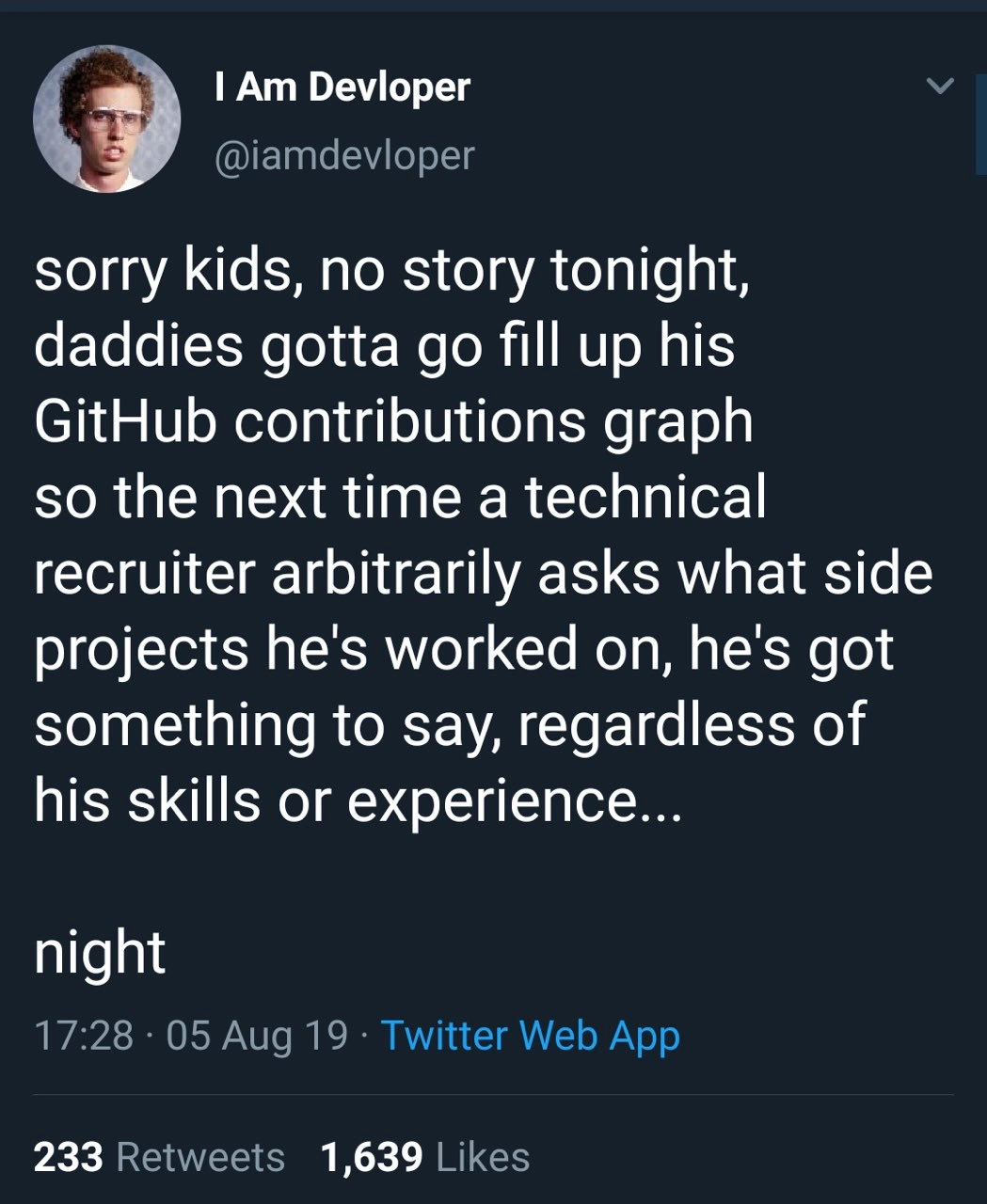
At the senior engineer level, this meme lands as a darkly funny commentary on resume-driven development – doing work just to check a box on your resume or GitHub, rather than for any real technical need. The image is a tweet where a developer literally skips reading a bedtime story to his kids so he can pump out some late-night commits. Why? To juice his GitHub contributions graph – that grid of green squares on GitHub profiles showing daily coding activity. It’s poking fun at how the tech hiring process sometimes values appearance over substance. A battle-hardened dev knows exactly what’s going on here: he’s sacrificing personal time to generate some “proof” of side projects for the next technical recruiter who asks, “So, what cool stuff are you hacking on in your free time?”. The humor (and pain) comes from how arbitrary recruiter expectations can be. The tweet explicitly says “regardless of his skills or experience,” implying that no matter how competent this developer is at his day job (he could be refactoring monoliths or firefighting production at 3 AM), some recruiters or interviewers will still judge him by those green squares or a quirky side project he can talk about. It’s a facepalm-worthy reality for experienced developers.

Under the hood, this is highlighting a widespread industry quirk: the GitHub contributions graph as a proxy for passion and skill. It’s an open secret among senior devs that a streak of daily commits on GitHub doesn’t necessarily equal skill – you can commit junk every day and get a solid green streak. In fact, many have joked about or even automated the process of keeping the contribution graph green:

# A tongue-in-cheek "green square" script: making trivial daily commits just to look active
echo "Bedtime story postponed" >> storytime.md
git add storytime.md
git commit -m "Chore: commit to keep GitHub streak alive [skip CI]"
git push origin main

(Above: a contrived example of a developer committing a nonsense update just to not break his commit streak.)

Experienced devs recognize the absurdity: They’ve seen solid engineers with 20 years of experience get strange looks in interviews for not having an active GitHub profile – maybe because all their code was proprietary or they were too busy leading teams to build toy apps at night. Meanwhile, someone with a flashy GitHub full of half-baked side projects might get undue credit. This meme nails that paradox. The dad in the tweet chooses to grind out some code at night (filling those green squares) instead of family time, illustrating the pressure to conform to unrealistic hustle culture. It’s a satirical take on how tech culture can guilt developers into feeling that coding 9-to-5 isn’t enough – you also need exciting side projects on GitHub to stay relevant in your career.

There’s also a layer of burnout and work-life balance commentary here. Seasoned engineers often talk about the importance of unplugging and spending time with family to avoid burnout. Yet, here we have “daddy” bowing to the unspoken rule that real devs code in their free time too. The parental guilt is palpable: “sorry kids, no story tonight…” – ouch. Any developer with kids (or even a pet waiting for a walk) has felt that tug-of-war between personal life and the relentless pace of tech. We laugh at this meme because it’s true in a tragicomic way: the industry’s obsession with visible metrics (commits, GitHub stars, StackOverflow rep) can push even a devoted dad to act a bit ridiculous.

Finally, consider how the tweet ends with “night” – as if he’s tucking in the conversation with a bitter goodnight after explaining his plight. It’s a mic-drop moment that says, “This is the absurd life of a developer sometimes… goodnight folks.” The humor hits hard because everyone in dev culture knows at least one person who “pads” their GitHub for show, or a company that equates GitHub activity with talent. It’s a senior-level inside joke about how technical excellence and interview theatrics diverge. We’re essentially laughing at the system - and if you’ve been around long enough, you’ve probably rolled your eyes at this system, too.

Description

A screenshot of a tweet from the popular satirical Twitter account 'I Am Devloper' (@iamdevloper), which features a profile picture of Napoleon Dynamite. The tweet, set against a dark blue background, reads: 'sorry kids, no story tonight, daddies gotta go fill up his GitHub contributions graph so the next time a technical recruiter arbitrarily asks what side projects he's worked on, he's got something to say, regardless of his skills or experience... night'. This post satirizes the pervasive pressure in the tech industry for developers to maintain a visually active GitHub profile. The joke is that the 'green squares' on the contribution graph have become a superficial metric for passion and productivity in the eyes of some recruiters, forcing developers to engage in performative work outside of their job, sometimes at the expense of personal time. It's a cynical take on how a tool for collaboration can be co-opted into a signaling mechanism for the hiring process, often disconnected from a developer's actual expertise
Comments

7
Anonymous ★ Top Pick Recruiters see a full GitHub graph and think 'passion.' Senior devs see it and think 'unpaid overtime' or 'a well-automated cron job.'
  1. Anonymous ★ Top Pick

    Recruiters see a full GitHub graph and think 'passion.' Senior devs see it and think 'unpaid overtime' or 'a well-automated cron job.'

  2. Anonymous

    Set up a 23:59 cron to auto-commit “Once upon a time…” so the GitHub lawn stays green, the kid still gets a story, and the recruiter can keep pretending LOC metrics beat 15 years of uptime scars

  3. Anonymous

    Twenty years of shipping production systems, but apparently my credibility hinges on whether I remembered to commit my dotfiles changes yesterday

  4. Anonymous

    Ah yes, the classic 'GitHub contributions graph' - the only place where your value as a 15+ YoE architect is measured by whether you committed 'fix typo' at 2 AM on a Saturday. Because clearly, those green squares are a more reliable indicator of distributed systems expertise than actually designing systems that don't fall over when three users log in simultaneously. Nothing says 'senior principal engineer' quite like frantically pushing empty commits to a personal repo the night before an interview, just so a recruiter who can't distinguish between Git and GitHub can check their arbitrary box. It's the technical equivalent of being asked for your GPA when you've already shipped products to millions of users - except somehow we've collectively decided this theater is acceptable

  5. Anonymous

    I replaced bedtime with a GitHub Actions job that commits a newline at 23:59 - now my ‘passion’ has 99.99% uptime and zero business value

  6. Anonymous

    Senior devs know: a flawless contribution calendar outshines a decade of on-call scars when facing that 'tell me about your side projects' grill

  7. Anonymous

    Nothing proves seniority like a GitHub heatmap greener than prod, powered by a 23:59 cron that commits whitespace - recruiters call it “passion.”

Use J and K for navigation