Skip to content
DevMeme
4930 of 7435
Kubernetes 'Simplifies' Operations, Right?
Containerization Post #5397, on Sep 5, 2023 in TG

Kubernetes 'Simplifies' Operations, Right?

Why is this Containerization meme funny?

Level 1: New Puppy, No Food

Imagine you convinced your parents to get a new puppy because you heard how fun and awesome puppies are. You bring the puppy home and you're super happy, proudly saying, "We have a puppy now!" But then your friend asks, "You did buy dog food and a leash, right?" Silence. You forgot all about that part. Now the puppy is bouncing around, and you have no food to feed it and no leash to take it for a walk. Suddenly, your fun new pet feels like a big problem because nobody planned who would take care of it every day. In the end, someone still has to run to the store, feed the puppy, train it, and clean up after it.

This meme is joking about a very similar situation, but with a technology tool instead of a puppy. The company got something powerful and new (Kubernetes is like the exciting puppy), and they were happy about it. But they forgot to plan for the daily care and feeding (the "Ops" work, like watching over the system and fixing issues – just like taking care of the puppy). Padmé’s worried face in the last panel is like the realization, "Uh oh, who's going to feed this thing?" The humor comes from that oops moment we all recognize – when someone is so excited about the new thing that they forget the basic responsibilities that come with it. It's funny and a little sobering, just like forgetting the dog food for a puppy.

Level 2: Ops Team Not Included

For those newer to this, let's break it down. Kubernetes is a popular system for running software in containers across a bunch of computers – it's basically a container orchestra. Companies say they're "moving to Kubernetes" because it can make deploying apps more consistent and scalable. It's part of the whole containerization trend (putting apps into isolated boxes called containers so they run the same everywhere). The key part to realize is that Kubernetes itself is complex software. It doesn't magically run on its own; you have to install it, configure it, and keep it running on servers (physical or cloud). "Ops" is short for operations – that covers all the work to keep servers, networks, and applications running smoothly after they're deployed. An Ops team (or DevOps engineers / SREs) are the people responsible for things like monitoring systems, responding to outages, scaling the infrastructure, applying security patches, and so on.

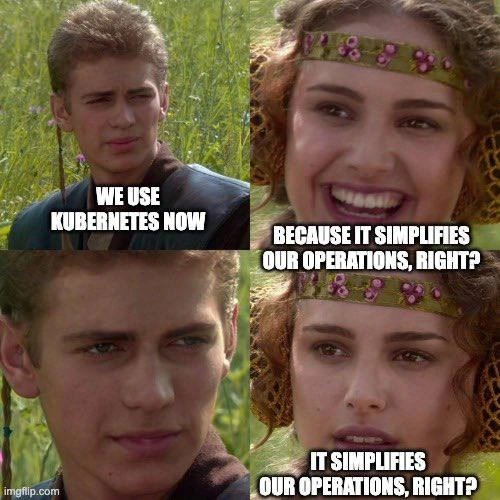
Now, the meme uses the Star Wars Anakin/Padmé format to illustrate a conversation. In the first panel, Anakin (representing management) proudly says "We use Kubernetes now." This implies management decided to adopt Kubernetes, probably because it's the cool new thing (everyone's talking about it in tech). In the second panel, Padmé (representing the developer or someone responsible for operations) asks, smiling, "...but you budgeted for our operations, right?". She's basically asking, "You did plan and allocate resources (time, money, people) to actually operate this Kubernetes system, right?" That's an important question because running Kubernetes day-to-day requires effort: you have to set up things like logging, monitoring dashboards, alert systems for when things break, backups, and also have people ready to fix issues.

The third panel shows Anakin still smiling but totally silent. Uh oh – his silence means he didn't actually budget or plan for any Ops work. Maybe management assumed that once Kubernetes is in place, apps run themselves and there's no need for an operations team (a misconception sometimes jokingly called NoOps). Padmé’s face in the fourth panel turns to shock and worry as she repeats "Our operations, right?". She's now realizing that management didn’t think about who will handle the DevOps side of Kubernetes. Essentially, they have this powerful new tool but no one to operate it properly. It's like getting a high-end espresso machine for the office but not hiring a barista or training anyone to use it. Sure, the machine can do great things, but someone still has to know how to clean it, service it, and make the coffee.

In real life, this kind of scenario is a DevOps pain point. Kubernetes can indeed improve things like deployment speed and reliability if used correctly. But it also adds a layer of complexity. For example, instead of one big server running your app, you might have 10 smaller containers running in a cluster. If one container or one machine fails, Kubernetes can spin up a replacement (that's good!), but only if everything is configured right and someone has set up the rules for it. If nobody is watching the system, a failure could go unnoticed or the automatic recovery might not work as expected. Monitoring tools (like Prometheus for metrics, or ELK stack for logs) need to be set up to alert humans when things go wrong. Updates to Kubernetes itself (new versions come out frequently) need to be applied, or else you risk security issues. All of that is part of "operations."

So Padmé’s concern is extremely valid. The meme humorously highlights a common mistake: adopting new tech without the supporting Ops team or budget. It's over-engineering in a way – using a very advanced solution without aligning resources to manage it. For a junior developer, the takeaway is that tools like Kubernetes are not plug-and-play appliances; they're more like a complex project that you continually manage. Just because your company uses Kubernetes doesn't mean you can forget about the traditional work of running software (backups, scaling, security, etc.). Often it means you need even more careful operations, because a Kubernetes cluster has many moving parts. If nobody plans for that, things can get messy fast. The meme is funny to developers because it's painfully true: we've seen managers tick the box "Cloud-native done!" and then act surprised when things still require effort. In short, "Kubernetes adoption with Ops team not included" is asking for trouble, and Padmé’s double-take in the meme is a perfect comedic depiction of that oversight.

Level 3: No One at the Helm

The humor here is a little painful for anyone who's been that DevOps/SRE person. It's a scene we've seen many times: upper management falls in love with a shiny tech trend (Kubernetes! Microservices! Serverless! – pick your fad), announces proudly "We're all in!", and expects instant DevOpsHumor nirvana. In the meme's Star Wars framing, Anakin (management) is grinning ear to ear saying "We use Kubernetes now", as if that buzzword magically solves all problems. Padmé (the engineer or maybe the sensible project manager) then asks with an optimistic smile, "...you budgeted for our operations, right?". That's the critical question hanging in the air. In too many real-world cases, that question is met with the same awkward silence you see in panel 3. Anakin's still smiling, but saying nothing – because in reality, they didn't budget for ops at all. Padmé’s face in the final panel, turning from hopeful to horrified, perfectly mirrors the engineer’s reaction when they realize, “Oh no, who's actually going to run this thing?!“

This joke lands so well in DevOps circles because it's DevOpsPainPoints 101. It's like adopting a cutting-edge orchestration tool but having no one at the helm (pun intended – Helm is Kubernetes’s package manager, and here we literally have no one steering the ship!). The organization expects the benefits of containerization – easy scaling, consistent deployments, high availability – but forgets that Kubernetes complexity requires human caretakers. On-boarding Kubernetes isn’t just a software install; it's a commitment. You need people who know how to monitor the cluster’s health, tweak resource limits, handle deployments, set up ingress and networking, manage storage volumes, and update the cluster version every few months. In a well-prepared team, you'd either have a dedicated Ops team or Site Reliability Engineers (SREs) for this. In a poorly prepared one, guess what happens? Either nobody does it (and things slowly fall apart), or the developers themselves become accidental sysadmins, fighting fires around the clock.

The meme’s scenario is all too familiar: It's Monday morning, leadership heard that "all the cool companies run on Kubernetes," and by Friday they've spun up a cluster (maybe even outsourced half of it to a cloud provider) and declared victory. But they treat it as if it were a set-and-forget appliance – just deploy your code and Kubernetes scales it, we're done here. What they miss is that Kubernetes is a living system that needs tending. Logs will fill up a disk somewhere, a node will die and kube-scheduler will valiantly reschedule pods... onto nothing if new nodes aren’t provisioned. Without someone keeping an eye, you'll get things like CrashLoopBackoff errors that linger, or a misconfigured update that brings down your app and nobody on call who knows how to rollback using kubectl. The result? Paging the one engineer who vaguely knows K8s internals at 3 AM on a Sunday.

From a senior dev perspective, the humor has a bittersweet ring. It's poking fun at that gap between adopting cool tech and doing the unglamorous work to support it – the DevOps gap. We've learned (sometimes the hard way) that there's no such thing as NoOps – if you think you have no Ops, then you are the Ops. The meme’s text "We use Kubernetes now" is basically management saying "Look, we bought this fancy self-driving car!" and Padmé's comeback "you budgeted for our operations, right?" is like asking "You did hire a mechanic and set aside gas money, right?" Silence. Cue the "this is fine (everything on fire)" kind of meme feeling. It's a classic DevOps humor scenario because every experienced engineer has either lived this or knows someone who has: where a project went all-in on a tech buzzword without staffing the expertise to run it. The joke sticks the landing by contrasting management's naive enthusiasm with the cold reality that technology doesn't run itself. We laugh, albeit with a groan, because we've survived those late-night Kubernetes cluster outages where management's promise of "It will simplify our operations!" turns into "Why is the entire system down and nobody knows how to fix it?"

Level 4: Conservation of Complexity

At first glance, Kubernetes promises to automate away all the messy deployment details – a container orchestra conducting itself. But there's a fundamental principle in software architecture often called the Law of Leaky Abstractions or a kind of conservation of complexity: if you hide complexity in one place, it pops up in another. Kubernetes is effectively a distributed operating system for containers, and distributed systems theory reminds us that you can't escape certain hard problems. Network partitions, node failures, and scheduling conflicts don't vanish just because you've containerized your app; instead, Kubernetes' control plane has to handle them. The meme nails this: management proudly proclaims "We use Kubernetes now!" as if that alone guarantees reliability. In reality, all the classic challenges of running software in production still exist under the hood.

Consider Kubernetes' reliance on an internal key-value store like etcd. Etcd uses the Raft consensus algorithm to keep the cluster's state in sync across multiple masters (control plane nodes). This gives strong consistency guarantees (a nod to the CAP theorem – Kubernetes chooses consistency over availability when partitions happen), but it also means the cluster can grind to a halt if the etcd quorum is lost. Someone has to care for that etcd cluster: backing it up, monitoring its health, planning for upgrades. There's no free lunch — or as seasoned engineers joke, Kubernetes is free like a puppy, not free like a beer. It's powerful containerization infrastructure, but it comes packaged with all the operations overhead that power entails. The scheduler in Kubernetes, for instance, is basically solving a bin-packing problem (NP-hard in theory) to decide which pod goes on which node given resource constraints. It's a minor miracle of engineering that this works as well as it does, but when it doesn't, it takes an experienced human to figure out why your pods are stuck in Pending or why the network overlay is misbehaving.

In essence, Kubernetes shifts a lot of operational complexity into a new layer – the cluster. You're not configuring individual servers as much anymore, true. Instead, you're writing declarative specs (hello, countless lines of YAML) and relying on controllers to maintain desired state. But all those controllers and virtual networks and volume provisioners are software components too, prone to the same old bugs and outages. The meme captures a scenario where management embraced this over-engineering without understanding the hidden drag: DevOps work doesn't disappear just because you have K8s; it simply changes form. It's the classic DevOpsPainPoints story: a highly scalable system will still fail spectacularly at 3 AM if nobody budgeted for the on-call engineer to respond. Despite the dreams of a "No-Ops" utopia, someone always ends up holding the pager for the cluster. If you don’t plan for that, the force (of chaos) will not be with you.

Description

A four-panel meme using the 'For the Better, Right?' format featuring Anakin Skywalker and Padmé Amidala from Star Wars. In the first panel, Anakin states, 'WE USE KUBERNETES NOW'. In the second panel, a smiling Padmé asks, 'BECAUSE IT SIMPLIFIES OUR OPERATIONS, RIGHT?'. The third panel shows Anakin with a blank, silent stare, offering no reassurance. The final panel shows Padmé's smile replaced with a look of dawning horror, as she repeats the question, 'IT SIMPLIFIES OUR OPERATIONS, RIGHT?'. The humor stems from the wide gap between the proclaimed benefits of Kubernetes and the often painful reality of its implementation. While pitched as a tool for simplification, its adoption frequently introduces a steep learning curve and a massive amount of new operational complexity, a sentiment deeply familiar to experienced engineers who have managed a migration to it
Comments

9
Anonymous ★ Top Pick Kubernetes doesn't simplify your operations. It just trades your monolithic legacy problems for a much more fashionable and expensive set of distributed microservices problems
  1. Anonymous ★ Top Pick

    Kubernetes doesn't simplify your operations. It just trades your monolithic legacy problems for a much more fashionable and expensive set of distributed microservices problems

  2. Anonymous

    Embracing Kubernetes without budgeting for SREs is just enterprise cosplay - looks sleek in the demo until the 3 AM etcd hiccup exposes all the duct-taped CronJobs backstage

  3. Anonymous

    After 15 years in the industry, I've learned that 'simplifies operations' is code for 'we'll need three more SREs, a dedicated platform team, and someone who actually understands NetworkPolicies' - but hey, at least our YAML files are now version controlled and we can blame git when the cluster goes down

  4. Anonymous

    Kubernetes: because nothing says 'simplified operations' quite like debugging a 47-service mesh at 3 AM while trying to remember which of your 12 YAML files controls pod affinity rules. Sure, it solved your deployment problems - by replacing them with a distributed systems PhD thesis that your entire team now needs to maintain

  5. Anonymous

    Kubernetes simplifies operations like a Rube Goldberg machine simplifies tying your shoes - elegant in theory, YAML apocalypse in practice

  6. Anonymous

    “We use Kubernetes now” - translation: we replaced SSH with kubectl and hired a platform team to keep etcd awake

  7. Anonymous

    Adopted Kubernetes; deployments are HA, and so is the absence of runbooks

  8. @endisn16h 2y

    this pic goes hard😤😤😤

  9. @karim_mahyari 2y

    We use Kubernetes now, but have no idea how it works.

Use J and K for navigation