Skip to content
DevMeme
2700 of 7435
A Shared Void for All Your Development Screams
Languages Post #2983, on Apr 18, 2021 in TG

A Shared Void for All Your Development Screams

Why is this Languages meme funny?

Level 1: Permission to Scream

Imagine you’re really upset or frustrated, and a friend hands you an empty box and says, “Here, you can yell into this box as loud as you want. It won’t yell back, but it might make you feel better – a little gift for you, just for relief.” That’s essentially what this meme is doing, but with coding words. In normal life, screaming into an empty space (like shouting into a pillow or an empty room) is a way to let out stress when no one can help – you don’t expect anyone to answer back from the emptiness. We sometimes joke about “screaming into the void” when we’re frustrated. In this picture, someone offers a tiny “void” (just a little dark hole) as a treat, meaning “go ahead, vent a bit, you deserve it.” Another person responds in a nerdy way by calling that little imaginary hole a “public static void,” which are just fancy programming words. Don’t worry about the exact words – the joke is that those words normally start a computer program and include the term “void,” which in programmer language means “nothing.” So it’s like they’re nicknaming this empty scream-space with a programmer term that literally means empty/nothing. Why is that funny? It’s like a secret handshake among coders – they took something very serious and technical from their work and used it in a warm and silly way to say “this nothingness is for everyone to use.” In simple terms, it’s funny because it mixes a caring, human gesture (“here’s a safe empty place to let out your screams”) with geeky computer lingo (“public static void”) to describe that place. Even if you don’t code, you can smile at the idea of friends sharing an “imaginary scream box” to help each other cope. The coders just gave that box a super techy name for extra giggles. It shows that even when programmers are stressed and feel like yelling, they still love to sneak in a little nerdy joke – and that little joke can make them feel a bit better, like a tiny treat.

Level 2: A Void for Everyone

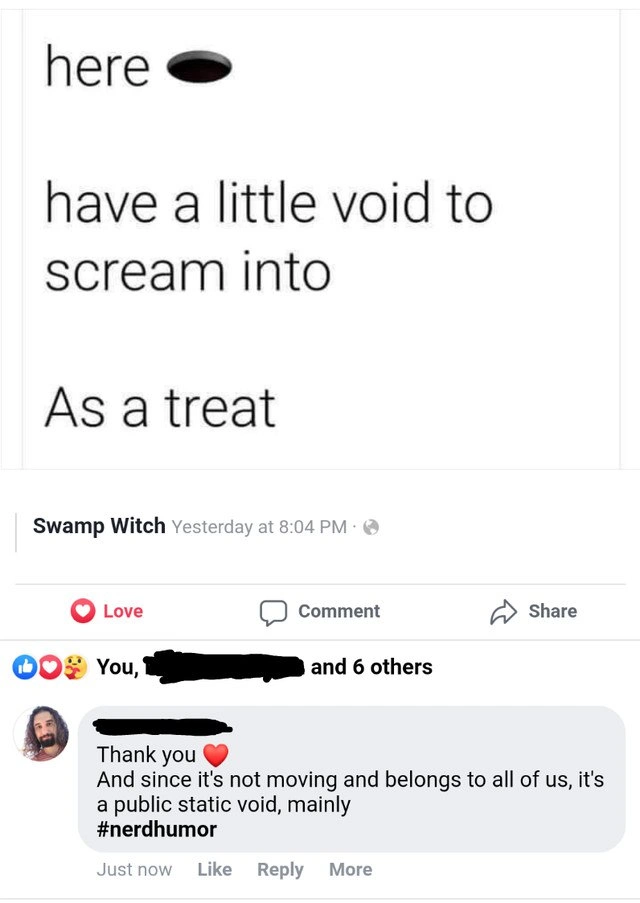
This meme plays on some very specific coding terms, so let’s unpack it in simple terms. In the image, someone says: “here, have a little void to scream into, as a treat.” They’re basically offering an empty space (the black oval in the picture) for you to yell into when you’re frustrated. It’s a tongue-in-cheek way of saying “I know you’re stressed, go ahead and vent your anger or frustration into this empty hole – you’ll feel better.” Now, a developer in the comments responds by calling that imaginary scream-space a “public static void”. If you’re new to programming, that phrase might sound vaguely familiar or maybe not at all. It’s actually part of a very common line of code in Java. Every Java program has a main function that starts the program, and it’s always defined with the keywords public static void at the beginning (specifically, public static void main(String[] args)). Those three words have special meanings in the code:

  • public – means everyone can access it. In Java, if a method is public, any other part of the program can use it. Think of it like a public park: open to all. In the comment, they said “belongs to all of us,” which is exactly the idea of public – it’s not private, it’s for everybody.
  • static – in coding, this means something belongs to the class itself rather than an instance of a class. If that sounds abstract, imagine a static method as a single toolbox that everyone shares, instead of each person having their own toolbox. There’s only one “static” method or variable, and it doesn’t move or change with each object. In plain English, static also means not moving (like static electricity, or a static display). The commenter jokes “it’s not moving,” hinting at this meaning. So the void is “static” in both the everyday sense (it’s literally a fixed hole, not going anywhere) and the programming sense (there’s one shared void for all, rather than each of us having a personal void!).
  • void – this one’s the key to the joke. In Java and many languages, void is a type that means “no value” or “nothing here.” When a function is declared void, it means it doesn’t return anything back to whoever called it. For example, a function public static void shout() would execute some code (maybe print “AHHH!” to the screen) but then return nothing – no result or output value comes back. Now, outside of programming, “the void” is a dramatic way to refer to emptiness or nothingness (imagine a dark empty space — that’s a void). There’s a common expression “scream into the void” which means venting or complaining without expecting an answer, like yelling into an empty canyon where no one’s around to hear you. So the original meme offered a tiny void (empty hole) for you to scream into. The commenter recognized that and humorously labeled it with the programming term public static void – effectively saying “this empty thing we all can use to scream is just like a public static void in code.” It’s a perfect pun because the literal void (empty space) matches the coding void (no return value). When you scream into this void, you’re not going to get any response back – just like a Java void method gives back nothing!

For a junior developer or someone learning to code, seeing public static void might trigger a memory of writing your first Java program. It’s that weird mandatory formula you had to type exactly, even if you didn’t fully understand it:

public static void main(String[] args) {
    // ... your program code here ...
}

Many of us learned it as a single chunk (publicstaticvoidmain) that we just typed to make the program run. Over time, you learn what each word means. This meme takes those words out of the usual code context and uses their meanings in a funny, literal way. It’s CodingHumor that combines a bit of real-life feeling with programming jargon. The Facebook comment even ends with “mainly #nerdhumor” – acknowledging that this is primarily a nerdy joke. Indeed, if you don’t know Java, you might not get why public static void is amusing at all. But if you do, it clicks: “public static void” is like an inside joke among Java programmers (and some C# folks and other language users too) because it’s such a staple of starting a program. It’s also a phrase that, on its own, sounds kind of mysterious if you don’t know programming (public static void… huh?). Here, it gets a new, cute meaning: a public static void is reimagined as a shared, unchanging empty space for all of us to yell into when we’re having a rough time. In a supportive, comedic way, the person is saying, “We all have stress, so here’s a common void we can all use. Don’t worry, it’s available to everyone (public), it’s always there (static), and it expects nothing in return (void).”

This is a great example of how developer communities bond over technical puns. The meme was posted on a social media timeline (like a public wall) where fellow coders hang out. One person offered emotional support in a nerdy format (“have a void to scream into”), and another person built on it with a programming reference. If you’re new to these communities, it might seem strange, but this is pretty common in DeveloperHumor circles – people love to take programming terms and twist them into everyday life metaphors. It lightens the mood and also rewards those who have learned the sometimes arcane language of programming. Plus, it’s oddly comforting: even a thing that literally means “nothing” in code (void) can be turned into a kind of in-joke support system among programmers. After all, coding can be tough, and having a laugh like this reminds you that others feel the same pain (and scream internally, or externally, at bugs). So, in summary, public static void in this context means “an empty place that anyone can use, which gives you nothing back” – which is both a programming concept and exactly what you need when you just want to shout and not worry about the consequences. It’s a nerdy way of saying “I hear you, let’s all let out a scream into the abyss together, and that’s okay.”

Level 3: The Sound of No Return

At first glance, this meme is a brilliant collision of Java syntax and existential catharsis. The top panel offers an imaginary void – a literal black oval – where you can “scream into” nothingness to relieve your frustrations. That alone is a bit of dark developer humor (who hasn’t wanted to yell at their code and get only silence back?). The punchline comes in the Facebook comment, which slyly transforms that existential void into a chunk of Java code. A user replies:

"Thank you ❤️ And since it's not moving and belongs to all of us, it's a public static void, mainly #nerdhumor."

Seasoned developers immediately recognize the phrase public static void as part of the signature of a Java main method – the very first line you write in any Java program. It’s a tiny code ritual etched into our muscle memory: public static void main(String[] args). In fact, seeing “public static void” alone might trigger a reflex to mentally add “main(String[] args).” Here, the commenter deliberately stops at void to spotlight the word as an object in its own right – the void is the thing being offered as a treat. It’s a clever subversion: in code, void isn’t an object at all but a return type meaning “nothing.” Yet the meme treats “the void” like a noun you can hand to someone (a little hole to yell into). This twist tickles the programming brain because it breaks a rule in a witty way – void is normally intangible, but we’re play-pretending it’s a concrete gift.

Let’s break down the comment’s double meaning: “it’s not moving and belongs to all of us” maps to static and public in programming terms. In everyday English, static means stationary (not moving) and public means open to everyone. In Java, a public method is one any other class can call, and a static method belongs to the class itself (there’s only one shared copy, no matter how many objects exist). So a public static method is essentially a globally accessible action – it “belongs to all of us” in the program. By describing the imaginary scream-space as public and static, the commenter wittily implies this void is a globally shared, unchanging place for anyone to use. And of course, void in Java indicates the function returns nothing. The comment turns that into an object of emptiness: the classic phrase “screaming into the void” literally means you get nothing back for your screams (no help, no echo – just silence). In coding, a function declared void similarly gives back no value. This parallel is the crux of the joke: a function that returns nothing, a scream that gets nothing – either way, there’s “no return.” It’s the sound of no return; you can yell all you want into this function/void, but nothing comes out.

For veteran developers, this hits a comedic sweet spot. It mixes a LanguageQuirk from Java with a bit of nerd humor wordplay. The hashtag #nerdhumor is spot on – only those who know the lingo will chuckle. It’s a classic inside joke in the programmer community: we take a routine piece of code and interpret it through an absurdly literal, non-code lens. Every Java dev has written public static void main countless times, often without thinking about the individual words. Here we’re prompted to consider them literally – imagine if “void” weren’t just an abstract concept but an actual hole in the universe you could scream into when main (life) gets tough! This kind of DeveloperHumor also doubles as coping mechanism. There’s a grain of truth: coding can be frustrating to the point you feel like shouting into the abyss. Who hasn’t spent 3 hours debugging only to end up exclaiming into an empty office (or Slack channel) “why won’t this work?!” – effectively screaming into the void because no answer comes back. The meme takes that relatable frustration and gives it a whimsical tech twist. The wordplay on public static void makes the joke mainly technical pun, part programming pun and part gallows humor about our mental state after battling tough bugs.

It’s also worth noting the communal tone. A void to scream into “that belongs to all of us” implicitly recognizes that DevCommunities share these struggles. The meme originates from a Facebook timeline; one developer says “here, have this little void as a treat,” and another thanks them and extends the joke in code-speak. It’s a tiny moment of camaraderie: we all feel this way sometimes, here’s a public, shared outlet for our angst. Ironically, screaming into a void is usually a solitary, futile act – but by labeling it a public static resource and joking about it together, the community turns loneliness into togetherness. The “void” is no longer just an empty null space; it’s a running gag that binds the commenters. In a sense, this meme itself became a public static void in the Facebook feed – an unmoving post visible to everyone, where each developer scrolling by could mentally deposit a scream or a laugh. No, it won’t solve any production issues or return a value (true to form, nothing comes out of a void), but it feels good to know it’s there. The code may return nothing, but the camaraderie yields a grin – and that’s the treat.

Description

A screenshot of a social media post, likely from Facebook, that presents a clever programming joke. The original post, by a user named 'Swamp Witch', shows the text 'here' next to a black hole emoji, followed by 'have a little void to scream into As a treat'. Below this, another user has commented, 'Thank you ❤ And since it's not moving and belongs to all of us, it's a public static void, mainly #nerdhumor'. The humor is a technical pun that will resonate with any developer familiar with C-family or JVM languages like Java or C#. The commenter cleverly maps the abstract concept of a shared 'void' to the programming construct 'public static void'. 'public' means it's accessible to everyone ('belongs to all of us'), 'static' means it's a single, shared instance not tied to a specific object ('it's not moving'), and 'void' means it's a method that doesn't return any value, making it a perfect metaphorical destination for screams that expect no reply. The meme plays on the shared stress of software development and the specific, nerdy language used to describe it

Comments

15
Anonymous ★ Top Pick A `public static void` is the ultimate sink for developer frustration; it accepts all input without complaint and returns nothing, just like the Jira backlog
  1. Anonymous ★ Top Pick

    A `public static void` is the ultimate sink for developer frustration; it accepts all input without complaint and returns nothing, just like the Jira backlog

  2. Anonymous

    Our new coping pattern is a public static synchronized void scream(): globally accessible, returns nothing, and every stop-the-world GC pause doubles as mandatory mindfulness

  3. Anonymous

    After 20 years in tech, I've learned that 'public static void' isn't just a method signature - it's a perfectly accurate description of my emotional availability during production incidents

  4. Anonymous

    The beauty of a public static void is that it's accessible to everyone, doesn't require instantiation, and returns absolutely nothing - making it the perfect metaphor for both enterprise architecture meetings and the developer's inner emotional state at 3 AM debugging production issues. At least this one is thread-safe for concurrent screaming

  5. Anonymous

    Public static void main(): the corporate void - everyone can scream into it, nothing returns, but the globals are different afterward

  6. Anonymous

    If that void is public and static, at least make it synchronized - otherwise everyone’s screams interleave and the traces read like a race-condition postmortem

  7. Anonymous

    public static void main: the thread-safe black hole where enterprise devs dump outage PTSD, no synchronization needed

  8. @pyproman 5y

    Another void:

    1. @PopovichVladimir1 5y

      негр обнаружен

  9. @pyproman 5y

  10. @feskow 5y

    scream > /dev/null

  11. @PopovichVladimir1 5y

    nigger found

    1. Deleted Account 5y

      .

  12. @PopovichVladimir1 5y

    аааахахахаххаахха

  13. Deleted Account 5y

    void main()

Use J and K for navigation