Pfizer's Pivot to a SaaS Business Model
Why is this IndustryTrends Hype meme funny?
Level 1: Like a Club Membership
Imagine you have a special club card that lets you play at your favorite playground or get candy from a shop, but it only works for one year. After a year, you have to get a new sticker on the card to keep it valid. This meme is joking that getting a Covid vaccine shot every year is kind of like that – like having a membership you must renew annually. In simple terms, it’s saying, “You can’t just get the shot once and be done; you have to come back again and again, sort of like paying for a yearly subscription.” That’s funny because we usually think of subscriptions as something for magazines or Netflix or a gym, not for vaccines. The tweet is making a playful comparison: needing a booster shot each year is like your body has a membership program with the vaccine. Each booster is like paying the yearly fee to stay protected. The core of the joke is that we normally don’t use business words like “subscription” for medicine, so it sounds silly. It’s a bit like if someone said your health has a yearly plan you need to renew – that idea is so unexpected that it makes people chuckle. Essentially, the meme uses a very easy analogy: staying safe from Covid is now a little like having a yearly club membership – you have to keep it up to date!
Level 2: Everything as a Service
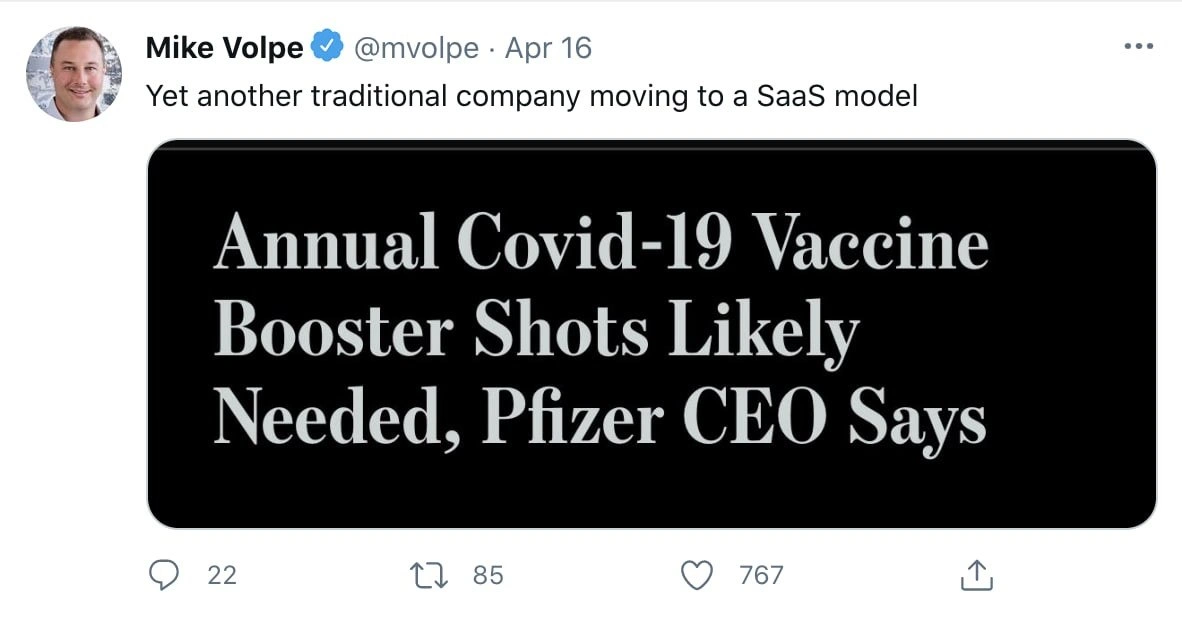
This meme is joking about the trend of turning products into services that you pay for regularly. In the image, we see a tweet from a verified user named Mike Volpe. He says, “Yet another traditional company moving to a SaaS model.” Below that, there’s a headline about Covid-19 vaccine booster shots likely being needed every year (as stated by Pfizer’s CEO). To unpack the joke, let’s define a few terms:
SaaS – This stands for Software-as-a-Service. It’s a business model where instead of buying software once, you subscribe to it and pay periodically (monthly or yearly) to keep using it. For example, think of paying for Netflix or Spotify: you don’t buy a physical product; you pay for continuous access. In the developer world, SaaS is extremely common – companies offer their software tools via the internet, and you pay a subscription fee. It’s popular in the tech IndustryTrends because it provides a steady stream of income for the company and always-updated software for the user.
Traditional company – This means a company that’s been around a long time (not originally a tech startup) and usually had an old-school business model. Pfizer, a big pharmaceutical company founded in the 1800s, is one example. Another might be an automobile manufacturer or a book publisher – firms that historically sold physical goods or one-time products. When the tweet says “yet another traditional company moving to SaaS,” it implies many old companies are now trying to act like tech companies by offering subscriptions. This is part of a broader IndustryTrends_Hype where even non-tech businesses adopt tech-like models (often to appear modern or boost profits).
Subscription model – This refers to the practice of charging customers repeatedly over time for continued access to a product or service. Instead of a one-time payment, it’s like a magazine subscription or gym membership: you pay monthly or annually. In tech, a subscription could be for cloud storage, an app, or an API service. Here the tweet humorously suggests that annual vaccine boosters are akin to a subscription – you have to “renew” your protection each year with another shot. It’s subscription_humor because it treats a health measure like a paid yearly plan.
Now, the meme’s format is a tweet with a headline image embedded. The tweet text is the joke setup: calling annual boosters a “SaaS model.” The image of the headline (which says “Annual Covid-19 Vaccine Booster Shots Likely Needed, Pfizer CEO Says”) is the context. On Twitter, people often share a news headline and add a witty comment above – that’s what happened here. The counts at the bottom (22 replies, 85 retweets, 767 likes) show that many people engaged with it, meaning the joke resonated. Developers on Twitter likely liked or retweeted this because they found the analogy clever.
So why do tech folks find it funny? Because buzzwords like “SaaS model” are everywhere in tech and CorporateCulture right now. If you’re a junior dev or new to the tech industry, you might have noticed many services you use are subscription-based. Perhaps you use a code editor that charges a yearly license, or your team pays for a project management tool monthly. This is by design – companies love the recurring revenue. It’s become so common that we jokingly apply the “X-as-a-Service” label to anything. For instance, you might hear someone quip about “Pizza-as-a-Service” (imagining a pizza subscription) or call their daily coffee routine “Coffee-as-a-Service.” These aren’t real products, just playful uses of the buzzword. In the same vein, this meme calls vaccine boosters essentially “Vaccines-as-a-Service.” It’s an analogy: obviously vaccines aren’t software, but the need for a yearly booster is compared to having to renew a subscription every year.
For a junior developer, this joke also highlights how tech people sometimes reduce complex ideas to simple models they understand. Fighting a pandemic with vaccines is a serious, multifaceted challenge – but here it’s cheekily reduced to a familiar pattern: get update -> pay again -> repeat annually (just like an app that reminds you to renew). It’s a form of TechHumor that uses the language of our work (SaaS, subscriptions, models) in an unexpected place. If you’re new to corporate jargon, it might help to know that tech companies often talk about things like “moving to the cloud” or “transitioning to SaaS” as part of modernizing. So seeing that language applied to a vaccine can be surprising and funny. Essentially, the tweet is saying: “Ha, Pfizer is doing the same thing software companies do – ensuring we have to keep coming back every year, like a subscription.”
It’s also referencing corporate culture in a tongue-in-cheek way. In many companies, especially startups, there’s pressure to find a business model that makes money continuously. One-time sales (like selling a piece of software on a CD for $50) have given way to ongoing services (like $5 per month forever). As a newcomer in tech, you might notice how product managers and business folks get excited by words like “recurring revenue,” “customer retention,” and “Annual Recurring Revenue (ARR).” This meme taps into that: the idea that a CEO would be happy to make something needed every year because it means regular demand. When Pfizer’s CEO said boosters will likely be needed annually, techies jokingly interpret it as if he’s talking like a software CEO announcing a new subscription offering. Of course, in reality, vaccines aren’t about profit in the same way software is – it’s about public health – but the joke deliberately ignores that to make a funny point.
In summary, the meme uses an annual_boosters_saas_analogy to get a laugh. It draws a parallel between Covid vaccine boosters and a SaaS subscription in a very straightforward way. A junior dev can understand it like this: Getting a Covid shot every year = kind of like paying every year for a service. The tweet is effectively calling the yearly vaccination plan “Pfizer’s subscription service.” It’s a lighthearted take on how the tech industry’s favorite business model (subscriptions) seems to appear everywhere, even in pandemic solutions. And it’s a bit of a gentle jab at how everything nowadays — from software to toothbrushes to yes, vaccines — can be seen through the lens of “as-a-Service” if you’re steeped in tech lingo.
Level 3: Shots as a Service
This meme cross-pollinates pandemic news with tech industry buzzwords. It shows a tweet stating “Yet another traditional company moving to a SaaS model” above a headline that reads “Annual Covid-19 Vaccine Booster Shots Likely Needed, Pfizer CEO Says.” The humor hits experienced developers right away: it’s equating annual Covid-19 vaccine boosters to a SaaS subscription. In the software world, SaaS (Software-as-a-Service) is the hot business model where instead of selling you a product once, companies sell subscriptions for continuous access (think monthly fees for Adobe Creative Cloud or Office 365). Here, the joke is that even Pfizer – a huge pharmaceutical firm, certainly not a software company – is seemingly adopting the “as-a-Service” trend by making us get yearly booster shots. It’s a razor-sharp bit of TechSatire mixing health and tech IndustryTrends.
At a deeper level, this is a witty piece of business model commentary. Seasoned engineers have lived through the era when every company, from legacy enterprises to mom-and-pop startups, announced they were “moving to a SaaS model.” Why? Because recurring revenue is the holy grail of CorporateCulture in tech. One-time sales are nice, but predictable yearly or monthly income — Annual Recurring Revenue (ARR) in biz-speak — is pure gold. We’ve seen IndustryTrends_Hype like this before: software that you used to buy once (or install from a CD-ROM, remember those days?) suddenly became subscription services on the cloud. For example, Adobe moved from selling Photoshop as a boxed product to forcing designers onto a Cloud subscription. Microsoft did the same with Office, preferring you pay every year. Even automobile companies are dabbling with subscriptions for features (pay-per-month for heated seats, anyone?). The tweet’s author, presumably a tech insider, jokes that Pfizer’s plan for yearly vaccine boosters is just another instance of this “everything-as-a-service” mania. It’s a classic case of tech Buzzwords bleeding into real life: vaccination-as-a-service – an absurd concept that lands as dark humor because, well, it feels like something a cynical exec might actually say in a meeting.
The juxtaposition of a serious health update with SaaS lingo is what makes developers smirk. There’s an unspoken camaraderie in tech circles: we’re all a bit jaded from hearing phrases like “digital transformation” and “subscription model” applied to every conceivable business. So when we see “Annual Covid-19 Vaccine Booster” rebranded as a subscription service, it’s hilariously on point. It’s as if the Pfizer CEO’s statement triggered our techie PTSD of countless product meetings: “How do we lock in users for recurring revenue?” Cue the eye-rolls from veteran devs who’ve integrated one too many billing APIs. TechIndustryHumor often thrives on these parallels. We know boosters are needed for scientific reasons, not because some PM wants monthly active users, but re-framing it this way mocks the CorporateCulture where every solution somehow becomes a “service” with a payment plan. The meme exaggerates reality just enough to be funny: it’s subscription_humor blending two worlds. After all, if subscription models can invade everything from razors to coffee pods, why not vaccines? “Vaccine-as-a-Service (VaaS), coming to an app near you,” as a snarky developer might quip.
Importantly, the tweet calls Pfizer a “traditional company” to highlight the contrast. Pfizer is a 172-year-old pharma giant — about as far from a cloud-native startup as you can get. In tech lingo, traditional firms are those legacy companies that didn’t start in the Internet era. So seeing a headline implying annual booster shots (a medical necessity) and jokingly labeling it as a SaaS pivot is the punchline. It taps into the TechSatire vein where we poke fun at IndustryTrends_Hype: think of all those times your office suddenly wanted to put everything “in the cloud” or turn products into “X-as-a-Service” because investors love steady revenue. There’s a shared understanding among senior devs that this trend can be overzealous. Once the SaaS craze took hold, everything started looking like a subscription opportunity to business folks – sometimes bordering on the ridiculous. This meme simply extends that ridiculousness to an extreme: life-saving vaccines falling prey to the subscription model.
From a senior perspective, there’s also a sly nod at how corporate incentives work. A veteran developer has sat through meetings where the CFO or CEO is giddy about “ARR growth” and “customer lock-in.” Reading “Annual COVID-19 Booster Shots Likely Needed” with that context, one can almost hear a cheeky inner voice: “What’s next, Pandemic-as-a-Service?” 😏 The meme hints at the cynical notion that companies (even outside tech) might love the idea of a product you have to keep using annually. Sure, scientifically we need boosters to maintain immunity – viruses mutate, immunity wanes – but the joke playfully ignores the science and zeroes in on the business angle. The Pfizer CEO is quoted, which the meme’s author playfully interprets as a CEO strategically announcing a new revenue stream. You can imagine an over-the-top parody press release: “Pfizer introduces Vaccine 2021™, an annual subscription to keep your immune system patched with the latest updates!” It’s funny because it’s TechHumor draped on a serious scenario – a kind of absurdist analogy that highlights our tech brain’s tendency to see business models everywhere.
In the day-to-day reality for developers, this resonates with the constant push to turn products into services. An experienced dev might recall fending off a proposal to make some internally used tool into a “platform” with subscription tiers – Buzzwords flying left and right. That memory makes the phrase “Yet another traditional company moving to a SaaS model” extra amusing. It’s dripping with sarcasm: Oh great, here we go again. The wording “yet another” suggests this is a pattern we’re all painfully aware of. And indeed, in the tech industry, we’ve watched everything from file storage (hello Dropbox) to personal finance software to video games pivot to subscription or cloud-based services over the last decade. We even joke about absurd extensions like “Pizza-as-a-Service” or “Laundry-as-a-Service.” So why not “Immunity-as-a-Service”? The meme is effectively tagging the Covid-19 vaccine boosters as Pfizer’s new SaaS offering, implying a tongue-in-cheek comparison between getting your yearly shot and renewing your Netflix subscription. The annual boosters SaaS analogy lands because it’s a mashup of contexts – the seriousness of a global health measure with the trivial corporate-speak we use for software products.
To a seasoned programmer, there’s also ironic humor in the implementation of this “service.” In code, we might picture the vaccine booster schedule as a function that runs once a year, like a cron job for your immune system. A tongue-in-cheek way to express it in pseudo-code might be:
// Pseudocode for Vaccine-as-a-Service model:
function annualBoosterSubscription() {
giveShot(); // initial dose
schedule(365, giveShot); // schedule next booster in 365 days
}
This little snippet imagines the Covid vaccine rollout the same way we’d schedule recurring software updates or subscription renewals. The comment jokingly labels it “Vaccine-as-a-Service model,” which is exactly how the meme invites techies to think. It’s as if we’ve abstracted public health into an API call with yearly execution. A grizzled engineer might chuckle at this abstraction: we’ve basically written a cron job to giveShot() every year. That’s the developer brain finding patterns – even life-saving shots become just another scheduled task in the subscription_humor playbook.
Ultimately, the meme tickles the TechIndustryHumor bone by highlighting how pervasive the SaaS mindset has become. It’s poking fun at CorporateCulture and the relentless march of the subscription model. For senior developers who’ve seen trend after trend, it’s equal parts funny and facepalm-worthy. The idea of Pfizer adopting a subscription pricing strategy for vaccines is obviously a joke, but it’s a spot-on analogy for the current era where everything feels like a service you have to keep paying for or keep doing. In short, “Shots as a Service” perfectly captures the meme’s satirical spirit: even something as non-software as a vaccine shot can be humorously framed in tech’s favorite business model. And if you ask a cynical veteran developer, they might jokingly warn: Brace yourself, because at this rate, even oxygen might become O2aaS (Oxygen-as-a-Service) someday! 🙃
Description
A screenshot of a tweet from user Mike Volpe (@mvolpe). The tweet, dated April 16, reads: 'Yet another traditional company moving to a SaaS model'. Below this text is an embedded image showing a news headline in a large, serif font on a black background: 'Annual Covid-19 Vaccine Booster Shots Likely Needed, Pfizer CEO Says'. The bottom of the screenshot shows the tweet's engagement metrics: 22 comments, 85 retweets, and 767 likes. The joke draws a cynical but sharp analogy between the pharmaceutical industry's plan for annual vaccine boosters and the tech industry's pervasive shift from one-time product sales to a subscription-based 'Software as a Service' (SaaS) model. For senior tech leaders, this is highly relatable, as it frames a major public health strategy in the familiar, and sometimes controversial, business terms of recurring revenue and customer lifetime value. It's a commentary on the 'everything-as-a-service' trend bleeding into other industries
Comments
41Comment deleted
Pfizer adopting the SaaS model is bold. Can't wait for the patch notes on v1.2 of the vaccine and the inevitable 'deprecating support for the 2021 version' announcement
Pfizer just deprecated the LTS immunity build and went full “Immunity-as-a-Service” - yearly patch, no rollback, and the release notes still say “miscellaneous stability improvements.”
Just wait until Pfizer discovers the enterprise licensing model - unlimited boosters for your entire org, but you'll need a separate contract for contractors and have to true-up annually based on headcount
Pfizer's pivot to a subscription-based immunity model demonstrates perfect product-market fit: mandatory compliance, zero churn risk, government-backed customer acquisition, and annual recurring revenue that would make any SaaS CFO weep with joy. Finally, a business model where 'lifetime value' takes on a delightfully literal meaning, and your retention strategy is literally written into public health policy. It's the ultimate enterprise contract - no negotiation on terms, automatic renewals, and if customers try to churn, society does your sales follow-up for you
Pfizer's vaccine: peak SaaS - annual renewals or your immunity's trial expires, forcing 100% churn-proof retention
Immunity-as-a-Service: perpetual license deprecated - now it’s annual patches with auto-renew; Enterprise tier includes zero-day variant SLAs, and rollback is not supported
Nothing says predictable ARR like converting a one‑time jab into an annual mRNA patch - perfect NRR with enterprise‑grade vendor lock‑in
This Covid-19 thingy is a trap.. I don't mean it does not exist, I mean the following: This "edited" version of an already existing virus does not kill !! People are dying by other ways, different ways.. It's another fake illness to control people, to make slaves, to let you busy with something that does not exist !! Some other examples of fake illnesses: AIDS: Several symptoms combined together to make a fake illness that does nothing. AIDS does not exist, do not use its medicament and you'll stay safe ! Cholesterol: This substance exists, but it does nothing bad, charged with fake crimes. Cancer: It can be cured, but they need people to buy a never-ending treatment. - Those are the ones I can prove, flagrant proofs.. but the list is too long. PS. Sorry for the off-topic, but it's a crime to not tell the truth. If you (some people) do not agree, it's your choice, but do not fight what's beyond of your understanding. Comment deleted
okay… > This "edited" version of an already existing virus does not kill It's not edited, and it does kill. Just like the flu, it does, though many survive. > It's another fake illness to control people, to make slaves Controlling people isn't really helpful if all you can tell them is to basically do nothing or wear masks. So, this theory failed the motive check. > AIDS very much exists, it attacks the immune system, which means if you don't take the meds, you're gonna die from the common cold. > Cholesterol Ok, that one is kinda true. It's viewed way more critically than it actually is. There are more important things to keep track of, but ignoring cholesterol isn't really good either. > Cancer Cancer are malfunctioning cells. They're still a part of your body, which means it's incredibly hard to kill them without damaging the rest of the body. That's why it's (afaik) the Nr. 1 killer in developed countries. It can be cured if you have a non-aggressive kind, but once it's bloodbourne, you're basically dead. If the gov. would actually try to control us that much, it'd probably just do a north korea. It works, and much more effectively than whatever you're proposing. There are actual conspiracies out there, but they're way more simple like google favouring its own products in its search engines, ad market and browser. There was also a collection of companies which were selling light bulbs that were made so they failed faster, so the consumer would have to pay more often. That pretty much stopped with the invention of LEDs though, since those last basically forever. And nestlé steals water. But that's all just large corporations being assholes. We can just not buy their products. The thing with governments is that enough people are involved that holding something a secret is impossible. Comment deleted
This is the official version of the Matrix reality. If you (humanity) are unable to assimilate something, do not counter it! I said I have proofs. Take few hours and search for something different than the screen put in front of your eyes. If you want to see something else, it's you (people) who should find the way. Comment deleted
Led are pretty much not forever in consumer lightbulbs Comment deleted
Imagine looking at how much the government fucks up literally anything it tries to do, and how they couldn't work together to do absolutely bloody anything, and then thinking "gee, I bet they are all working together to fake this global pandemic" Comment deleted
Imagine searching for proofs of what's already said.. Comment deleted
I would pretend that it is not a troll post and I will answer seriously. If you are hanged, you do not die from the rope, the rope is totally harmless. The lack of oxygen (caused by it) however is not. Similarly AIDS itself is not harmful, but its effects make you totally defenseless against common illnesses and effectively kills you pretty fast. Covid also attacks your oxygen supply, and if something is slightly off in your organism it will get VERY BAD. And if it gets bad faster than you are able to work up antibodies - you die. So you don't die of covid, or aids, or a rope. But it is what kills you. Comment deleted
AIDS does not exist !! Is it that hard to search for proofs or is it harder to break the dogma ? Comment deleted
if aids doesn't exist, why does your mama have it? Comment deleted
Looks that your mother had a cancer while being pregnant! the proof? The brain tumor that makes you rude and disrespectful. We can't blame you, you're mentally ill 😭. Comment deleted
says the guy who just accused someone of severe brain damage. regardless, please keep the insults and accusations down. (both of you) Comment deleted
I'm sorry, but this "person" went too far. The person to blame is the one who started a war, my answer is such a mirror. as a victim, I can't be as responsible as him/her/it. Comment deleted
Everyone who participates is to be held responsible. Now shut up Comment deleted
"Now shut up" What about this ? Comment deleted
you realise writing 'them' is 7 characters shorter than 'him/her/it' and more inclusive too Comment deleted
yeah ok, just getting tired of him Comment deleted
it was fun while it lasted! Comment deleted
i suspect he is still in the chat Comment deleted
He isn't in the chat, but I can't see the list of people that are subscribed to the channel, so he might still be watching there. Comment deleted
he did reply in pm to what i've said in this chat, so yeah Comment deleted
If this is true we can continue our pro-conspiracy talk. Lemme start: Earth is not flat Comment deleted
telegram is obviously paid by russian officials. Putin is watching us 👀 Comment deleted
In this case let's send a big hello to Tver with a notion that this thread is absolutely hilarious. https://twitter.com/christogrozev/status/1384885575073902592 Comment deleted
bruh Comment deleted
also, jokes aside, i'd actually love to see mathematical proof that aids doesn't exist Comment deleted
Sometimes, my Almighty Omniscience may give proofs for respectful open-minded people.. When they need to know more.. Comment deleted
i said show me, not tell about how good it is Comment deleted
petition to ban this user Comment deleted
Imma take you literally Comment deleted
"this" != me Comment deleted
just before to forget your channel. Tell me what you will do if someone says the same thing about your mother, and answer please !! Comment deleted
you'll stay safe from the Truth! farewell bis Comment deleted
yesss Comment deleted
Lol Comment deleted