The Bell Curve of a Developer's Intellectual Curiosity
Why is this Learning meme funny?
Level 1: Just for Fun
Imagine three students in a school. One little kid is super curious and will read or play with anything that looks interesting – even if it’s a big book of magic spells or star signs that have nothing to do with homework, just because it’s cool. In the middle, there’s a very average student who only studies exactly what the teacher assigns – nothing more. They read the textbook chapters that will be on the test and wouldn’t ever open a book that isn’t required. Then there’s another kid, a really advanced one, who’s like a young professor. This kid will grab the most challenging book in the library – say a college math book or a complex science project – even if no one told them to, just because they find it fascinating. Now, it’s funny because the first kid and the super advanced kid are both learning things just for fun, driven by curiosity (even though one is learning something a bit silly like “magic” and the other something really hard like advanced math). The middle kid thinks the other two are odd for wasting time. But the joke is that sometimes the really smart people end up behaving a bit like the really curious beginners – they both follow their interests passionately, while the ones in the middle just do their homework. This meme is showing that both the “not-so-smart” and the “genius” characters love learning things just because they’re interesting, whereas the average one only learns when they have to. It’s like saying: the bravest explorers (and also the most naive adventurers) both wander off the beaten path, while the regular folks stick to the road. That contrast is what makes it funny and relatable: in learning, sometimes the people at the top and bottom ends of the curve have more in common with each other than with those in the middle, all because they’re doing things just for fun.
Level 2: Astrology, Java & Haskell
Let’s break down the visual elements and concepts in this meme to see what’s going on:
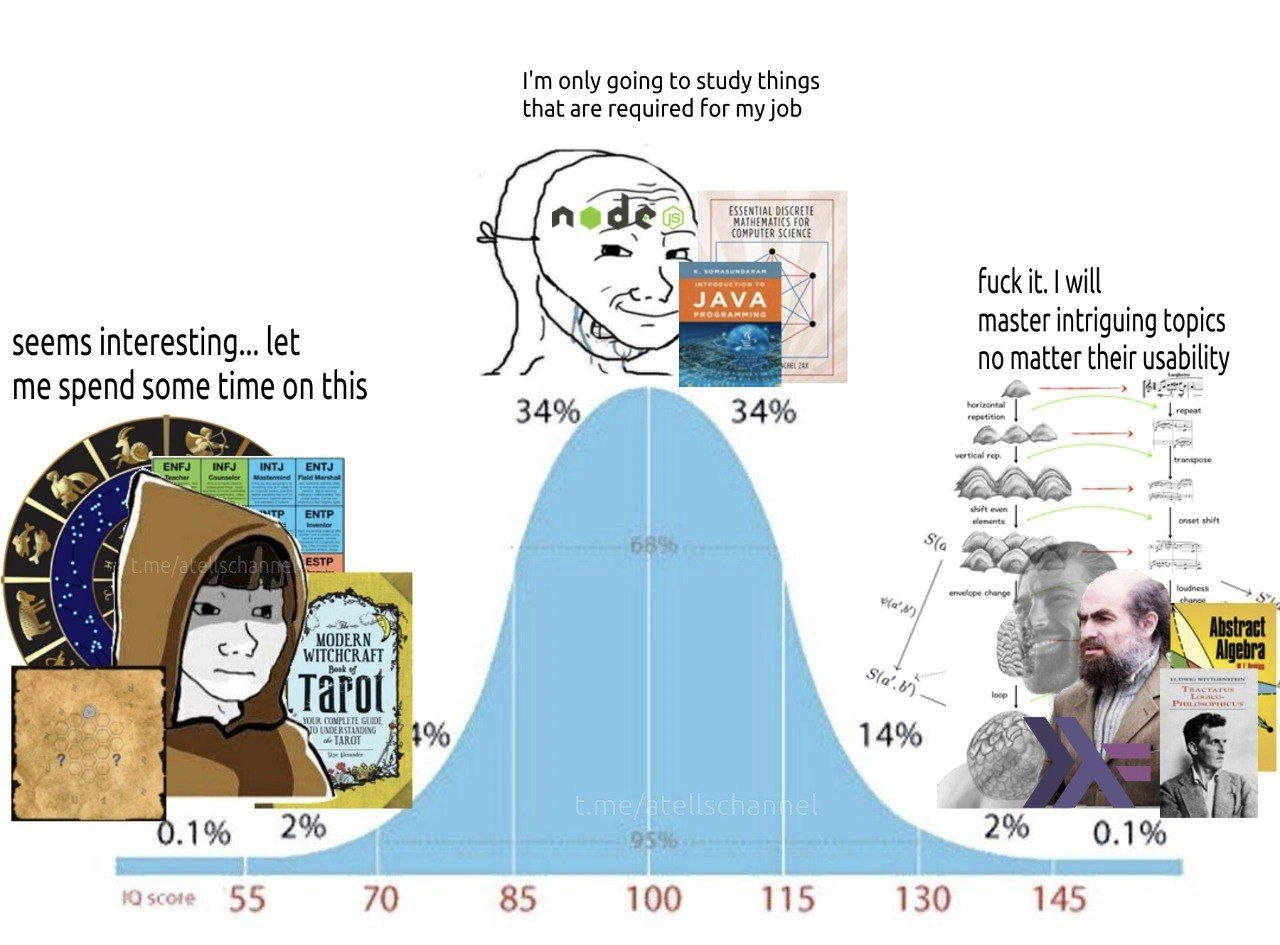
Bell curve IQ distribution: The blue curve with percentages (0.1%, 2%, 14%, 34%, etc.) is a standard depiction of a normal distribution (bell curve) of IQ scores. Most people are in the middle ( IQ ~100 is average, covering about 68% within one standard deviation), and very few are at the extreme low (~55 IQ) or extreme high (~145 IQ) ends (only 0.1% at those tails). In meme culture, this bell curve is often used to label the far left and far right with similar or aligned views, in contrast to the large group in the middle. It’s a template to humorously show how the “simple-minded” and the “genius” oddly agree or behave similarly, while the “mid-level smart” folks differ.
Left side (IQ ~55) – Hooded figure with astrology and tarot: This character represents a very low IQ individual (per the meme’s exaggeration) who is nonetheless curious and finds complex-looking things interesting. The hooded cloak and the items around him signal an interest in mystical or esoteric topics. There’s a zodiac wheel behind him – that’s the circle with symbols for the 12 astrological signs (Aries, Taurus, etc.). Astrology is a belief system that the positions of stars and planets can influence human personalities or fate. It’s generally considered pseudoscience (not backed by scientific evidence), but it’s visually complex and has many people fascinated by its patterns. In front of him is what looks like a chart of MBTI personality types (labeled ENFJ, INFJ, INTJ, etc. – another popular but not strictly scientific system for classifying personalities). He also has a book titled “Modern Witchcraft Book of Tarot” – tarot cards are used in fortunetelling and involve elaborate symbolic imagery. And he’s got a parchment with a mysterious puzzle or alchemy diagram. The caption for him says: “seems interesting… let me spend some time on this.” All these items paint a picture of someone studying something unconventional simply because it intrigues them, not because it has practical use. In a developer context, this is analogous to a newbie programmer or hobbyist getting distracted by something like solving a maze on a paper just because it looks like a puzzle, or diving into a completely unrelated topic (like say trying to see if astrological signs can be generated with code) just for fun. It emphasizes curiosity over practicality. The meme humor comes partly from the absurdity: why would a software developer (presumably) start studying tarot or zodiac charts? They normally wouldn’t if the goal is to get a programming job, but this character isn’t thinking about what’s required – he’s just following his interest, however misdirected it might be.
Middle (IQ ~100) – Wojak midwit with Node.js and Java books: The middle figure is drawn as the “midwit” Wojak, a popular meme character representing an average or moderately intelligent person (often slightly smug or confident in his ordinary logic). The green logo on his forehead is Node.js – a runtime environment that allows you to run JavaScript on the server side. Node.js is extremely popular in web development; many modern web servers and tools are built with Node. Having that logo on his head signifies he’s thinking in terms of mainstream, in-demand tech. He’s holding two textbooks. One is “Essential Discrete Mathematics for Computer Science” – discrete math covers foundational math topics used in computing (like logic, combinatorics, graph theory). The other is “An Introduction to Java Programming”. Java is one of the most widely-used programming languages, especially in corporate and enterprise environments (banks, large companies) and is a common teaching language in universities. Java is considered a very practical skill because many jobs list Java as a requirement, and it’s a classic choice to learn for career prospects. His caption says: “I’m only going to study things that are required for my job.” This means he’s focusing on Learning only what has clear, immediate career benefits. If his job (or desired job) needs Java, he’ll learn Java (and probably not bother with, say, learning Haskell or Rust if they’re not in the job description). He’ll study Discrete Mathematics because maybe it’s in his CS degree requirements or he knows he needs some math for technical interviews – but he won’t delve into, e.g., number theory for fun beyond what’s absolutely necessary. This mid-level perspective values practicality and efficiency in learning: time is spent on ContinuousLearning only insofar as it improves job performance or leads to a promotion. It’s a bit like a student who says “will this be on the exam? if not, I won’t study it.” In developer terms, he might skip learning about outdated languages, ultra-academic topics, or experimental tech – unless one day it becomes required at work. This approach has benefits (focused expertise in relevant areas) but can also limit one’s growth or creativity because you’re not exploring beyond the LearningCurve you need to climb for your current role. The meme uses him to represent the majority of developers who sit in that big central part of the bell curve – doing what’s needed, no less, no more.
Right side (IQ ~145) – Bearded man with Haskell, Abstract Algebra, and diagrams: The rightmost figure is portrayed as a wise, highly intelligent person (genius-level IQ in the meme’s exaggeration). He has a thoughtful or intense expression and sports a beard (perhaps to signal an older or scholarly vibe). In front of him we see the purple Haskell logo (which is actually a combination of the lambda symbol “λ” and an equals sign, stylized). Haskell is a purely functional programming language known for its strong type system, use of monads, and ties to academic computer science. It’s not commonly required in most software development jobs (except maybe specialized roles or some finance and research sectors), but it’s famous for teaching you deep concepts about programming and computation. Many passionate programmers learn Haskell to improve their skills or because they enjoy its elegance, even if they don’t use it at work. Next to it, he has an “Abstract Algebra” textbook – abstract algebra is a branch of mathematics dealing with algebraic structures like groups, rings, and fields. It’s quite theoretical and typically beyond the scope of what you need for everyday programming. However, abstract algebra concepts are relevant in cryptography, error-correcting codes, and advanced algorithm design. The fact that he’s reading it “no matter [its] usability” (as his caption says) indicates he’s learning it out of pure interest in math. There are also some complex diagrams shown above him – they look like wave or signal processing diagrams, maybe something related to physics or advanced algorithms (hard to make out, but they have terms like “horizontal repetition,” “vertical rep.,” “envelope shape,” etc.). This suggests he’s dabbling in topics like advanced physics, signal processing, or maybe audio synthesis – again, things that are intellectually complex and not directly needed for a typical software job, but fascinating to a curious mind. His caption contains an expletive: “f**k it. I will master intriguing topics no matter their usability.” This humorously shows his bold, free-spirited approach – he’s basically saying “I don’t care if this is useful or not in a practical sense; I’m going to learn it because it’s intriguing to me.” This is the hallmark of someone who loves knowledge. In a dev context, this might be the programmer who tries out new programming languages, reads academic papers, or builds hobby projects with obscure tech just out of passion. They might implement a neural network from scratch, or learn about compiler design by writing one, even if their day job is, say, making a website in Node.js – simply because they find it rewarding. This frame of mind is celebrated in many TechCulture stories (think of famous programmers writing insane projects in their free time) and is part of the ContinuousLearning ethos that the best developers advocate – never stop learning, even if it’s not immediately useful, because it broadens your mind and skill set.
Contrast and joke: The meme sets up a contrast: Astrology vs. Java vs. Haskell as study choices. It’s a spectrum from something almost scientifically baseless (astrology) through something practically useful and required (Java and related CS basics) to something scientifically deep but not required (Haskell and abstract math). The humor comes from the idea that both the low-end and high-end characters are willing to engage with esoteric or intriguing subjects without concern for utility. The leftmost says “seems interesting, I’ll spend time” (even if it’s tarot cards), and the rightmost says “I’ll master it anyway” (even if it’s Haskell monads that have no immediate use in his job). Meanwhile, the middle character is the straight-down-the-line worker who won’t touch anything “weird” unless it’s part of his job description or syllabus. For many developers, this meme is recognizable and funny because it exaggerates real attitudes. Some new devs do get sidetracked on weird tangents (maybe not astrology, but e.g. obsessing over a niche tool or writing their own game engine before learning basics). Many mid-career devs have indeed said “I have no time for X unless it pays the bills.” And many experienced or highly skilled devs eventually loop back around to exploring fun concepts just for the joy of it, reminiscing about the wonder they had as beginners, but now with the brainpower to tackle truly hard stuff. This meme captures those archetypes in one image. It’s DeveloperHumor that also touches on the philosophy of self_directed_learning_philosophy: learning for personal growth vs learning for necessity. By using the bell curve template, it playfully suggests that maybe the really smart approach is actually to be curious and open-minded, just like a newbie but at a higher level – whereas being moderately smart might trap someone into a strictly practical mindset.
In summary, the image is a comparison of three “developer study habits” personas:
- The left novice-type (low IQ end) who’ll study anything that seems cool or mysterious (even non-scientific stuff like astrology or tarot). This shows raw curiosity without direction.
- The middle pragmatist (average IQ) who studies only what is explicitly required (programming languages like Java, necessary math, common frameworks like Node.js) – no less, but definitely no more. This shows a focus on tangible results and career.
- The right enthusiast expert (high IQ) who will study even very advanced or niche topics (like Haskell, abstract math, complex theory) simply because they find it intriguing, not caring if it’s “useless” in the short term. This shows a return to curiosity, but informed by expertise and a drive for mastery.
All three are exaggerated stereotypes for comedic effect, and the bell curve implies these attitudes correspond loosely to increasing intelligence (with the twist that the extremes share a similarity in attitude that the middle lacks). The meme uses labels like LearningCurve, AcademicVsPracticalSkills, and language logos to make its point in a visual way that developers and tech folks can chuckle at and perhaps see a bit of themselves in.
Level 3: The Pragmatic Plateau
At the middle of the bell curve (the midwit_template character), we see the quintessential pragmatic developer mindset. This figure, plastered with a Node.js logo and clutching “Essential Discrete Mathematics for Computer Science” and “Introduction to Java Programming,” declares:
“I’m only going to study things that are required for my job.”
This is the AcademicVsPracticalSkills dilemma in a nutshell. The mid-tier developer (IQ around 100 in the meme’s exaggerated scale) represents those in tech who prioritize practical skills and immediate job requirements over any extraneous learning. It’s a familiar attitude in many workplaces: Why waste time on theory or unrelated topics when there’s a backlog to get through and a specific tech stack to master? This character has Java and Node.js – two hugely mainstream, employable technologies – literally on his mind and in hand. Java is a staple language for enterprise and taught in many CS programs, valued because “that’s what the job asks for.” Node.js (the logo on his forehead) symbolizes modern practical web development; it’s a tool you learn because so many jobs require JavaScript on the server. He’s also holding a Discrete Mathematics textbook, which is interesting: discrete math is a core CS_Fundamentals subject (covering logic, set theory, graphs, combinatorics) that underlies algorithms and data structures. However, the midwit’s vibe suggests he’s studying discrete math not out of love for math, but because it’s part of the required curriculum or needed to pass interviews. In other words, he treats even fundamental theory as a box to check off on the way to a job, not as something intrinsically fun. This is a very pragmatic plateau – doing the minimum necessary learning to be competent and employable, but no more. It reflects a common TechCulture scenario: developers hitting a comfort zone. Once they’ve learned enough to build CRUD apps, manage a database, and deploy to the cloud, they often stop exploring new concepts unless forced. Continuous learning becomes task-driven rather than curiosity-driven. The humor is slightly satirical: the mid-level dev appears rational and even a bit smug (“I won’t waste time on useless stuff, I’ll be efficient”). But the meme implies he might actually be missing out on the wonder and deeper mastery that come from learning “unrequired” topics.
This ties into a workplace reality: People often advise junior devs to focus on job-required skills – frameworks, languages in demand, the latest libraries – rather than “reinventing the wheel” or studying theory that “you’ll never use.” Our midwit character embodies that advice to an extreme: he won’t venture outside the Learning path that leads directly to a paycheck. It’s a bit of a jab at those who see programming merely as a 9-to-5 craft, not a passion. We’ve all met developers who say things like, “Why learn language X or that weird paradigm if my job doesn’t use it?” or “I’ll pick it up when I need it.” That attitude can keep you productive in the short term, but it’s also how you end up with a very narrow skill set and possibly tech stagnation. The meme exaggerates it to make us laugh (the Node-foreheaded midwit literally has blinders on to anything outside his job’s tech stack, even though on either side people are discovering cool stuff).
Now, contrast him with the two extremes on this galaxy_brain_learning_spectrum. The leftmost (IQ ~55) is a hooded novice who finds everything “interesting” and will “spend some time on this” even if it’s astrology or tarot – clearly not required for any coding job! This low-end character is actually open-minded to a fault. He represents the wide-eyed beginner or outsider who might latch onto any intriguing concept with enthusiasm, even if it’s complete pseudoscientific or irrelevant nonsense. There’s a hilarious irony here: the DeveloperHumor trope that a clueless newbie might end up deep in totally the wrong resources. It’s like a new programmer deciding to study ancient Egyptian hieroglyphs or mystical puzzle boxes because, hey, it looks like a pattern and programming is about patterns, right? In the image, the hooded figure is literally surrounded by a zodiac wheel, an MBTI personality-type chart (the grid with INFJ, ENTP, etc., which is a pop-psychology sort of cousin to astrology), a “Modern Witchcraft Book of Tarot,” and some mysterious parchment puzzle. None of these are standard developer fare. The joke is that this far-left character has unfocused curiosity – they’ll chase any shiny concept (“seems interesting…”) with zero filtering for actual utility. In real dev life, this could be like a newbie spending hours customizing their text editor with elaborate themes and fonts or getting obsessed with coding an RPG in assembly before learning basic Python – fun, yes, but not exactly LearningCurve-efficient for getting a job. However, note the positive angle: at least they have curiosity and a willingness to explore, which the middle person lacks. The meme implies a sort of horseshoe theory of learning: the naive beginner and the seasoned expert both are okay exploring strange, intriguing topics just for the sake of learning, whereas the mid-level person has become a bit closed-minded or utilitarian.
Then on the rightmost end (IQ ~145) we have the galaxy brain guru with a beard, immersed in Haskell (the purple lambda Haskell logo is shown), “Abstract Algebra,” and even what looks like advanced wave mechanics or signal processing diagrams. His caption:
“fk it. I will master intriguing topics no matter their usability.”**
This fellow is the mirror image of the leftmost, but with disciplined curiosity. He’s the type of developer who might read research papers for fun, implement a compiler in Rust over the weekend, or learn quantum computing algorithms not because work demands it, but because they find it intellectually stimulating. If the left is dabbling in witchcraft, the right is dabbling in Ocaml or some obscure algorithm – both are off the beaten path, but the latter will have something real to show for it (even if it’s only a personal satisfaction or an open-source project that few others grok). This is celebrated in dev culture as the mark of true passion or genius: the willingness to dive into CS fundamentals or new programming paradigms purely out of interest. It’s how you get self-taught experts in areas like machine learning before it was cool, or folks who played with Linux in the 90s just because it was fun (and later that became a career advantage). The meme humor is that the highest IQ guy’s approach (“learn it all!”) weirdly aligns with the lowest IQ guy’s approach (“ooh, shiny!”), while the average Joe is in the middle going “Nope, only Java and what $WORK tells me to learn.” Everyone in tech knows someone who is the “140 IQ polyglot who codes in Haskell and talks about math after work” – they might be seen as eccentric, but often revered. They’re the opposite of the code-monkey who just clocks in and out.
Why is this funny and resonates? Because it’s true enough to make us laugh at ourselves or colleagues. Many developers start out with a burst of enthusiasm (maybe not for astrology, but say tinkering with game mods or weird languages), then get “serious” and focus on career skills to land a job – maybe grinding through Java classes and learning just enough Node.js/React because that’s what the job postings want. Later, some developers re-discover the joy of learning for its own sake: perhaps they attend a functional programming meetup and get blown away by a concept like monads, or they read about logic programming, or concurrency models, etc., and they realize how fun it is to learn things beyond the immediate bullet points of their job. The meme captures that lifecycle in a comedic bell curve. It jabs at the study_priorities_debate: Should you learn only what is useful or also what is interesting? The midwit says “only useful things, please,” but the extremes show that there’s value (or at least joy) in exploring whatever fascinates you.
From an organizational perspective, you see this play out in teams too. The “mid” developers may resist adopting a new tool or language unless it’s proven and required. They might say things like, “Why would we use Haskell? That’s not practical for our product; stick to Java.” Meanwhile, an intern (beginner) might propose something totally wild they saw on Hacker News (maybe not astrology, but perhaps a blockchain solution for a simple database – a different kind of “tarot-level” overkill 😄). And a staff engineer or architect (expert) might champion using an unexpected but elegant approach (like a bit of formal verification, or a purely functional section of the system) simply because they understand its long-term benefits or they find it elegant. The mid-level pragmatist in the daily stand-up is like, “No nonsense, guys, let’s do what’s required.” This tension can be both frustrating and funny in real life. Each stance has pros and cons: the mid-level’s focus on requirements keeps projects on track, but can also cause innovation stagnation; the extremes’ curiosity drives innovation or learning, but taken too far could be impractical (we don’t actually want our junior dev spending a sprint on tarot readings, or our senior dev rewriting the codebase in Haskell just for fun – unless it truly brings value). The meme humorously implies that, in terms of raw intellectual vibe, the curious newbie and the seasoned expert have more in common with each other than with the in-between “just-a-job” developer.
Finally, the use of the bell curve image with exact IQ percentiles is a classic meme structure to amplify the joke. It’s saying this isn’t just three random people – it’s almost like a LearningCurve distribution across the population. The bulk (68% around the middle) are those nose-to-the-grindstone, learn only what you must types. The rarities (the 0.1% on either tail) are those who follow weird passions, whether it’s misguided (left tail) or enlightened (right tail). In developer humor, this midwit_template is common: average folks overthink or play it safe, whereas super-smart folks and very simple folks might oddly agree on a something that the average dismisses. It’s an inversion of expectations that tickles our sense of irony. Here, the agreement is “study intriguing things just because” – a philosophy shared by the naïve enthusiast and the wise expert, but scoffed at by the practical mid-level person. It’s a fun commentary on the ContinuousLearning culture: the truly passionate will learn regardless of immediate use, much like a true beginner who doesn’t know what’s useful or not will learn anything that attracts them. Both have a kind of purity in their approach: one from ignorance, one from wisdom. Meanwhile, the mid-level approach is portrayed as a bit cynically utilitarian, which seasoned devs find amusing because many of us remember being told not to waste time on things “outside the scope,” yet some of the best ideas or careers come from exactly those outside explorations. In summary, this meme exaggerates and compares the study_priorities_debate in tech, making us laugh at how the TechCulture often has this unspoken spectrum – from the quirky “astrology” learner, to the no-nonsense Java coder, to the Haskell-wielding scholar – each with their own approach to Learning and growth.
Level 4: Magic & Monads
At the deepest level, this meme plays on the esoteric ends of the learning spectrum – linking mystical pseudoscience and advanced computer science theory. On one end, we have astrology and tarot – systems of symbols and patterns that claim to reveal hidden truths. On the other end, we have Haskell and abstract mathematics – formal systems of symbols and patterns that actually do reveal hidden truths (at least in the realm of computation). This is a tongue-in-cheek juxtaposition of mysticism vs. mathematics. Both astrology and advanced CS theory involve complex rule-based frameworks understood by a devoted few: an astrology chart and a Haskell type system can each look like arcane scripts to the uninitiated. The meme’s highest IQ character embracing category theory and monads (a famously abstract Haskell concept derived from category theory) is the intellectual mirror to the low IQ character dabbling in zodiac signs. In a way, monads in functional programming have a nearly mystical reputation among average developers – often joked about as if they are magical incantations. Here the meme cheekily equates studying monads with studying magic. The bell_curve_meme format suggests that what the average mind (in the middle) dismisses, the outliers (both low and high) indulge in, each for different reasons – one due to ignorance or innocence, the other due to wisdom or extreme curiosity.
Under the hood, there’s a CS_Fundamentals insight: true mastery in software often requires diving into theoretical foundations (like lambda calculus, category theory, or Abstract Algebra). The rightmost figure’s textbooks (Abstract Algebra, theoretical physics diagrams) hint at disciplines that form the bedrock of computing theory and cryptography. Haskell, being rooted in lambda calculus and category theory, encourages thinking of programs in terms of mathematical functions and abstractions. Studying such topics isn’t directly required for making a web app or mobile service – much like studying wave mechanics diagrams isn’t required to play a simple guitar melody – but it can yield a profound ContinuousLearning payoff in the long run. The meme exaggerates this by saying the genius will learn intriguing topics “no matter their usability.” It nods to the idea that some developers pursue knowledge for its own sake, echoing the culture of TechCulture research and passion projects (think of a programmer exploring quantum computing algorithms or writing a compiler for fun). Historically, many breakthroughs in computing (from cryptographic primitives to optimization techniques) come from people enthralled by theory. The meme hints that an extreme “galaxy brain” developer knows this, embracing theory even if it’s not immediately applicable – trusting that deep understanding of CS fundamentals (like those in Abstract Algebra or type theory) can eventually lead to better code, new languages, or innovative solutions. It’s the self_directed_learning_philosophy taken to the extreme: learning for enlightenment, not just for employment.
Interestingly, there’s also a subtle commentary on pattern-seeking behavior. Humans at both extremes love patterns: the leftmost figure sees patterns in zodiac signs and tarot cards, while the rightmost finds patterns in mathematical structures and Haskell’s type system. Both are constructing meaning from complexity. The difference is that one pattern system is empirical and logical (mathematics that underpins reliable software), and the other is mystical and unempirical (astrology’s arbitrary star alignments). Yet, cognitively, both activities scratch a similar itch – the desire to understand a complex system that feels intriguing or bigger than oneself. The meme humorously equates the appeal of these systems, if not their validity. It’s a nerdy inside joke: diving into a monad tutorial can feel as perplexing as deciphering a horoscope, but one of these will actually improve your coding skills! By placing Haskell next to the zodiac, the meme invites us to laugh at how from the mid-level perspective, both ends look a bit absurd: “Why would you waste time on tarot_vs_haskell_contrast topics that don’t directly help with your app development?” But for those at the extremes, the usefulness is secondary to the interestingness. In theoretical computer science (and hardcore functional programming circles), there’s an almost philosophical joy in mastering concepts that have elegance and purity, just as a mystic finds joy in contemplating spiritual symbols. The galaxy_brain_learning_spectrum depicted here winks at the notion that true geniuses often loop back to a kind of childlike curiosity (sometimes in highly sophisticated form). In fact, in the history of science and tech, you’ll find geniuses like Ada Lovelace or Alan Turing who balanced practical invention with deep theoretical or even whimsical explorations. The meme’s high-IQ guru might recall how Turing studied abstract computation (developing Turing machines, a very theoretical model) just because it was fascinating – which later turned out to revolutionize computing. That extreme end knows that today’s impractical theory can become tomorrow’s essential technology. Meanwhile, the left extreme is a playful reminder that curiosity can lead you down some bizarre rabbit holes (like trying to “debug” your fate with a tarot spread) – not all who wander are lost… but some kind of are! This duality of LearningCurve – where one end loops into pseudo-learning and the other into hyper-advanced learning – underpins the meme’s nerdy humor.
Description
This image uses the IQ Bell Curve (or 'Galaxy Brain') Wojak meme format to illustrate the intellectual journey of a developer. On the far left, representing low IQ scores, a hooded Wojak is surrounded by images of astrology, Myers-Briggs personality types (ENFJ, INTP, etc.), and 'Modern Witchcraft Tarot,' under the text 'seems interesting... let me spend some time on this.' In the center of the curve, representing the average majority, a smug Wojak (the 'midwit') is shown with the Node.js logo and textbooks for 'Introduction to Java Programming' and 'Essential Discrete Mathematics for Computer Science.' The accompanying text is, 'I'm only going to study things that are required for my job.' On the far right, at the highest IQ level, an enlightened, bearded figure is surrounded by complex diagrams, the Haskell language logo, and books on 'Abstract Algebra' and Wittgenstein's 'Tractatus Logico-Philosophicus,' with the caption, 'fuck it. I will master intriguing topics no matter their usability.' The meme humorously critiques the pragmatic but narrow-minded phase many developers go through, suggesting that true expertise involves a return to a purer, more profound curiosity that transcends immediate job requirements, embracing deep, theoretical, and even esoteric subjects

Comments
10Comment deleted
The midwit optimizes their code for the next performance review; the principal engineer optimizes their brain by reading abstract algebra, preparing for the inevitable day they have to explain monads to the midwit
Stuck between interns shipping horoscope microservices and mids glued to JIRA, I’m over here encoding the entire backlog as a Haskell type with zero inhabitants - proving feature-complete at compile-time
After 20 years in tech, I've learned the real bell curve distribution: 2% studying category theory for fun, 68% grinding LeetCode for FAANG interviews, and 30% who've transcended to only learning technologies that will be deprecated before their PR gets merged
The midwit studies exactly what the job requires; the tails study category theory - and somehow it's the tails who end up explaining why the build is a monad
This meme perfectly captures the eternal tension in software engineering: the junior who learns only what's needed for the sprint, the architect who insists category theory is essential for understanding monads in production code, and the consultant who somehow convinced management that Mercury retrograde affects deployment success rates. The real wisdom? Knowing when discrete math actually matters (database indexing, algorithm optimization) versus when you're just procrastinating on that Jira ticket by reading Knuth for 'professional development.'
Middle of the bell curve you ship Node/Java; right tail you explain the incident postmortem with monoids and functors - and the SREs quietly approve
Senior devs plot means at 'Hibernate drudgery', but fat tails in Node prototypes and Tarot load-balancers reveal the true multimodal mess
Senior arc: MBTI-driven retros → “only learn Node/Java for the ticket” → late-night Abstract Algebra because the CI pipeline is suspiciously a monoid
Like for Wittgenstein Comment deleted
it's actually reversed irl Comment deleted