Developer laments English syntax like a buggy, namespace-less programming language
Why is this Languages meme funny?
Level 1: Words are Hard
Imagine you’re playing a game where the rules keep changing, and even the referees (who aren’t official, they just like to yell from the sidelines) can’t agree on those rules. That’s what speaking English can feel like, especially to someone who likes things to be clear-cut. This meme is a funny way of saying that the English language is kind of a mess – like a big toy box where pieces from different sets are all jumbled together. The developer jokingly treats English like a computer program that wasn’t built very well.
Think of it this way: if English were a toy car, it’s as if it has loose parts and extra buttons that nobody knows how to use, but it still somehow runs. People drive it every day (we speak English and get the message across), but every so often a self-appointed “mechanic” (the grammar police 😊) will shout, “Hey, you’re not using that button correctly!” It doesn’t stop the car from going, but it’s a bit annoying. And unlike a well-organized toolbox, all the screws and nails (words and meanings) in English are thrown into one big drawer. Sometimes you pull out a word and – surprise! – it has two totally different uses, just like finding a tool that oddly fits two different bolts.
So why is this funny? The developer was asked to name a programming language they don’t like (maybe expecting “Java” or “C++”). Instead, they named English, the language we’re using right now. It’s unexpected and silly. They complain about English with the kind of gripes a programmer would have about bad code: too many weird symbols, unclear guidelines, no safety checks. It’s like saying, “English is that confusing game with no instruction manual and lots of people yelling rules that aren’t even real rules.” For anyone who’s ever struggled with a tough grammar rule or a confusing sentence, that comparison brings a laugh of recognition. In simple terms, the meme jokes that talking in English is harder and messier than coding – and coming from a programmer, that’s saying a lot!
Level 2: Code vs English Syntax
Let’s break down the jargon in that tweet and why it’s funny, especially if you’re newer to programming. The joke is comparing English (a human language) to a programming language, and pointing out that English would be a pretty terrible programming language by computer standards! Here are the key terms and concepts referenced, explained in simple tech terms and their English parallels:
Syntax: In programming, syntax is like grammar – the rules for how you write code so that the computer can understand it. For example, in many languages every statement ends with a
;and parentheses must match up. If you violate syntax, the code won’t run. English also has grammar rules (word order, punctuation, etc.), but they’re much looser. When the tweet says “English. Syntactically garbage,” it means English grammar is all over the place with exceptions and odd structures that a programmer finds illogical or messy. Unlike a cleanly designed coding syntax, English lets you get away with saying things in many different (and sometimes incorrect) ways and still be understood. To a developer, that feels like a language with bad syntax design.Operators: In programming, an operator is a symbol or keyword that performs an operation, like
+for addition or&&for “and” logic. In English, what would an operator be? Maybe punctuation or little words that connect parts of a sentence (like commas, periods, conjunctions “and/or”). The tweet complains about “far too many useless operators that barely anyone knows how to use anyway.” Think about a semicolon;in English writing – many native speakers aren’t sure when to use semicolons, and you can usually get by without them. That’s like having an obscure operator in a programming language that almost no one uses correctly. Another example is the word “whom” – technically the object form of “who” – which acts sort of like a special-case operator in grammar. Many people aren’t 100% sure how to use whom properly, and you can communicate fine while ignoring it (though some grammar enthusiasts will insist on it, just like a code purist insisting on a particular formatting). So, English has all these little grammar bits (operators) that feel unnecessary to the practical communicator – just as a programmer might view some rarely used language feature as needless complexity.Compiler: A compiler is a program that translates source code (what you write) into an executable program (machine code) and also checks for errors in the process. If you write something that doesn’t make sense to the compiler (say
if (x 5 }– missing an operator and brace), it throws an error and stops. The tweet jokes that English has a compiler with “obscure rules… that don’t actually stop the compilation but raise warnings.” Of course, English doesn’t literally have a compiler; the role of compiling meaning is played by our brains or perhaps by grammar-checking software. The idea is: even if you break some English grammar rules, people can often still understand you – so “compilation” (communication) doesn’t stop. Instead, you might just get a warning. For instance, starting a sentence with “Because” might get you a teacher’s red pen warning in school, but everyone still gets what you mean (sentence didn’t truly fail to convey meaning). The “open source grammar police” mentioned are those folks (often on the internet or in comment sections) who aren’t official teachers or anything but love to point out grammar mistakes – much like how contributors in an open-source project might nitpick someone’s code style. They’re not the actual compiler (they can’t force you to fix the error), but they’ll sure warn or scold you about it!Typesafe / Type Safety: Type safety in programming means that the language prevents you from mixing up different kinds of data in dangerous ways. For example, if you have a variable that’s a number, a type-safe language won’t let you suddenly treat it like a text string or an object. It catches those mistakes so you don’t end up adding 5 to “hello” by accident. When the tweet says English is “not typesafe,” it’s pointing out that words in English can serve as different types of thing without any clear separation. Take the word “orange.” In English that could mean a fruit (noun) or a color (adjective). There’s nothing to stop someone from using it in a confusing way because English won’t enforce type rules. In programming terms, English is dynamically typed or even untyped – any word can play any part. It’d be as if you had a variable that sometimes is a number, sometimes a string, and the language doesn’t warn you at all. That can lead to misunderstandings, just like type bugs in code. A typesafe language (like Java or C#) would make you clearly distinguish those meanings (like having
Color.OrangevsFruit.Orangeas separate namespaces… which brings us to).Namespaces: In code, a namespace is a way to group names (of variables, functions, etc.) so that you don’t have conflicts. For instance, two different libraries might both have a function called
calculate(). If you import them both, you can use namespaces (or modules/packages) so that you callMathLibrary.calculate()versusPhysicsLibrary.calculate(), and the computer knows which is which. The tweet says English “has no namespaces” – meaning there’s no built-in system to avoid two words or phrases having the same name or looking similar. In human language we often have homophones (words that sound alike) or homonyms (words that are spelled the same or sound the same but mean different things). For example, “bank” (a river bank vs a money bank) or “read” (present tense vs past tense pronunciation differs). English relies on context to disambiguate, and sometimes we even add clarifiers (“the company Apple” vs “an apple the fruit”) which is a bit like manually namespacing by additional description. But there’s no formal rule like programming has. To a developer, that lack of organization feels like having every function in one global file – chaos! The meme exaggerates that feeling: a programmer might joke, “Ugh, English is one giant global namespace of words – no wonder there are so many naming collisions!” It’s funny because we don’t usually think of words as needing namespaces, but the analogy makes sense if you’ve wrestled with ambiguous names in code.
So, the whole tweet is basically a LanguageComparison joke, using software terminology to describe the quirks of English. It’s calling English out as if it were badly written software: poor structure, too many rarely-used features, and not enough error-checking. For a junior developer (or anyone new to these concepts), the humor becomes clearer once you know these terms:
- They expected the answer to be a programming language, but he answered with a human language.
- He frames normal English things (grammar rules, words, punctuation) as if they were programming features and bugs.
- This mash-up of worlds is funny because it’s an unexpected answer that actually makes a surprisingly good point – English is pretty inconsistent, especially when you’re used to the precision of code.
One more layer: developers are known to have strong preferences (and dislikes) for programming languages. You’ll hear debates like “tabs vs spaces”, or “Java vs Python” passionately argued. By saying he “dislikes” English, the author is poking fun at that culture, implying “You think Java has problems? Look at English!” It’s a playful reminder that sometimes the tools we use in everyday communication are far messier than any software tool. The term “grammar police” is also something many people recognize: it’s those who love correcting others’ English. By calling them “open source,” he’s humorously equating volunteer grammar correctors to open-source contributors who zealously enforce coding standards. If you’ve ever had someone correct a trivial grammar mistake in your chat or tweet, you know the feeling – that’s the “warning” the tweet mentions.
In essence, even without deep technical knowledge, you can appreciate the joke: it’s saying English is like a programming language that would drive developers crazy. It mixes the world of coding with everyday language rules. The tags like SyntaxHumor and LanguageQuirks fit because it’s humor born from quirky language rules. And it being a twitter_thread_meme means this exchange got screenshot and shared because a lot of devs related to it. So if you sometimes feel English has too many weird rules and exceptions – well, this meme is right there with you, just expressing it in programmer-speak!
Level 3: Undefined Grammar Behavior
At this level, every experienced developer reading that tweet is chuckling and nodding, because it’s so true: English breaks all the rules we hold dear when writing software. The meme brilliantly uses programmer lingo to roast English for its quirks. It starts with a classic setup: a Twitter user asks devs, “Is there a programming language you dislike?” – a prompt known to ignite language wars in the developer community. You’d expect replies bashing JavaScript’s coercions, Java’s verbosity, or the infamous quirks of PHP. Instead, one witty dev goes completely meta and answers “English.” 😂 This unexpected twist immediately signals we’re in for some premium DeveloperHumor.
Now the reply reads like a code review takedown of the English language: “Syntactically garbage, far too many useless operators...”. Any programmer has ranted about a language’s syntax before – maybe the unnecessary semicolons in JavaScript or the arrow function punctuation in C++. Here, English gets the same treatment. Ever struggled with where to put a comma, or the proper use of “whom”? Those are our “useless operators” in English – hardly anyone knows all the rules, yet pedants insist on them. It’s like having a programming language feature that 90% of devs never use correctly (imagine an esoteric language keyword that only elder wizards understand). When he says “barely anyone knows how to use [them] anyway,” we sense that collective eye-roll developers reserve for obtuse syntax rules. This is SyntaxHumor at its finest: we’re essentially laughing at grammar as if it were an arcane programming API.
The tweet continues: “so many obscure rules in the compiler that don’t actually stop the compilation but raise warnings from open source grammar police.” This line is pure gold. In real programming, a compiler (or linter) might permit something sloppy but emit a warning. English, of course, doesn’t have a compiler – it has us, the readers/listeners, and perhaps tools like spell-checkers. The “open source grammar police” is a tongue-in-cheek reference to those self-appointed guardians of grammar on the internet who love to correct others. (Think of them as the Stack Overflow users leaving snarky comments about code style, but for language.) They’re “open source” because no one officially hired them; they just take it upon themselves to enforce rules, much like an open-source community project where contributors might nitpick your code formatting. The tweet suggests English has all these weird grammar rules that technically don’t prevent you from being understood (the sentence still compiles in the brain of your conversation partner), but you might get a metaphorical warning in the form of a grammar correction. For example, starting a sentence with “And” or mixing up “its” vs “it’s” won’t render your sentence incomprehensible (no real compilation error), but boy, will some grammar enthusiast point it out with glee! It’s a perfect parallel to a scenario developers know well: code that runs but triggers a linter or compiler warning – it works, but purists will insist you “fix” it.
Finally, “It’s not typesafe and has no namespaces.” Here the developer mindset shines through unmistakably. Type safety is a cornerstone of many programming languages – it helps catch errors where, say, you treat a number as a string or mix up data types. When he says English is not type-safe, he’s referring to how words can mean many things and change their role. In a statically-typed language like Java, if you declare int age = 5;, you can’t suddenly use age as if it were a text string or an object; the compiler stops you. But in English, a word like "set" can be a noun, verb, adjective – you name it. You only figure out the intended type by context (akin to runtime). Seasoned devs often joke about languages like JavaScript being “not type-safe” because you can add a number to a string ("5" + 5 yields "55" in JS 😱). English is even more chaotic – it’s like a language where any variable can morph into any type on the fly and the interpreter (your brain) just tries to keep up. If you misuse a word, English won’t throw a compile error; at most, your listener will pause and say, “Wait, what do you mean exactly?” (that’s a runtime error, so to speak).
And namespaces – ah, those are how we avoid naming collisions in code. If two modules have a function named calculate(), putting them in different namespaces or classes prevents a clash. English, by contrast, throws everything into one gigantic namespace called “the English lexicon.” So we get a ton of naming collisions: the word “bat” can mean a flying mammal or a piece of sports equipment; “Java” can refer to coffee or the programming language or an Indonesian island. There’s no neat scoping like Coffee.Java vs Language.Java to differentiate them. Instead, we rely on context: our human compiler deduces meaning from surrounding words or shared knowledge. If someone says “I saw a bat,” how do we resolve the meaning? That’s like the interpreter doing duck-typing, trying one meaning and if it doesn’t fit, trying another. It’s messy and every seasoned dev can appreciate how much easier life is when you can namespace things to avoid such confusion. So when the tweet laments no namespaces, it’s comically treating every ambiguous word as a bug that a better-designed language would have solved via scoping. (Imagine if English required you to qualify “bank” as finance.bank vs river.bank to eliminate ambiguity!)
All these jabs at English resonate with developers because it echoes our daily gripes about communication in a team. How often have bugs arisen from a miscommunication or an ambiguous comment? We prefer the precision of code, where at least the computer will force clarification. English feels like that legacy system nobody officially designed, yet everyone has to use. It has quirks upon quirks due to historical accidents (much like legacy code that’s been patched over years). The humor also hints at a cultural meme: developers sometimes struggle with or poke fun at human language and social communication, half-joking that they “speak code better than English.” This tweet takes that sentiment and runs with it in a very technically specific way. It flips the typical “which programming language sucks?” debate on its head and reminds us that for pure consistency and logic, even our favorite hated programming language (be it JavaScript, Java, C++, etc.) is a paragon of rigor compared to the free-for-all that is English. And yet, English is the lingua franca of programming documentation and developer discussions – the irony! 😆
In summary, an experienced dev reading this sees a layered joke:
- LanguageComparison gone wrong (or oh-so-right): a natural language vs programming languages.
- LanguageQuirks in English likened to software bugs: irregular verbs are like deprecated APIs, silent letters are like undefined behaviors, weird idioms are like unchecked exceptions.
- A dash of reality: we’ve all been corrected by the “grammar police” on a forum or code review for something trivial – this calls that out.
- And a shared catharsis: Yes! Human language is messy and that’s hilarious when you frame it in code terms.
The post succeeds as TechHumor because it speaks to that inner software architect in us, the one that secretly wishes everything in life had clean syntax and a logical type system. By mocking English for lacking these, the tweet implicitly pats every programming language on the back for at least trying to be consistent – and gives us a good laugh about the one language none of us can avoid using daily, flaws and all.
Level 4: Context vs Context-Free
In the realm of formal language theory, programming languages are designed with strict, context-free grammars (often defined in Backus-Naur Form) that a compiler can parse unambiguously. Every statement in C++ or Python must conform to a well-defined syntax; if you put a { or ( out of place, the compiler/interpreter complains immediately. Natural languages like English, however, are a wild Type-0 beast in the Chomsky hierarchy – effectively unrestricted grammars that have evolved organically over centuries. There’s no single authoritative "spec" or BNF for English; its rules are riddled with exceptions and contextual dependencies (very context-sensitive). This tweet humorously treats English as if it were a poorly implemented programming language, highlighting how it would violate a compiler’s expectations at every turn.
Consider the idea of operators and syntax in English: we have punctuation and conjunctions that resemble operators (and, or, commas, semicolons), but their usage is so inconsistent that even fluent speakers debate them. For example, the so-called "Oxford comma" (a comma before the last item in a list) is an optional operator that sparks endless holy wars – imagine a programming language where an operator’s usage is optional and style-dependent! A compiler for English would face ambiguous grammar all the time. Linguists attempt to formalize English grammar with context-free rules, but inevitably have to bolt on semantic analysis to resolve ambiguities. The sentence “The old man the boat.” is grammatically valid yet confuses our mental parser because we expect “old” as adjective, not realizing “man” is used as a verb here. A strict compiler might choke on such ambiguity, but the human brain (a robust parser with tons of built-in heuristics) manages to compile meaning from it – albeit sometimes with a delayed segfault of understanding.
Type-safety? Not in English! In coding, type-safety means you can’t, say, treat an integer as a function or call methods on a boolean without an error. But English words shift types fluidly: “google” started as a noun (the company), became a verb (“to google something”), and no compiler stopped it. Any noun can verbify, any verb can nounify – talk about dynamic typing! The tweet calls English “not typesafe” because a word’s meaning isn’t fixed; context is the only thing preventing type errors (and sometimes context fails, leading to hilarious misunderstandings). And namespaces? Those are a way to avoid naming collisions in code (like Math.PI vs Greek.PI if you had two Pi constants). English has no true namespace mechanism – meanings collide all the time. “Keyboard”, “mouse”, “java”: without context, who knows whether we mean a musical instrument or input device, an animal or a pointer, coffee or a programming language? It’s all in one big global namespace of English vocabulary, with only the implied context acting as a feeble namespace. To a compiler, that’s global scope insanity – akin to having every variable ever declared in one giant bucket, waiting for collisions. No wonder we get so many “warnings” (i.e., “Did you mean...?” clarifications) in everyday communication.
This is all to say: natural language is flexible and powerful precisely because it’s not rigidly specified. But from a seasoned developer’s perspective, that flexibility looks like syntax garbage collection run amok. The tweet’s author dons a compiler-writer hat and jokingly critiques English for things that computer scientists and language designers usually avoid in programming languages. The humor lives in this incongruity: treating the rich chaos of human communication as if it were poorly-written code. And indeed, any compiler enforcing English grammar would be issuing warnings and errors left and right – yet humans somehow execute English code daily, segfault-free (most of the time). It’s a testament to our brain’s interpreter that we can handle a language with so many edge cases and no formal spec. In short, the meme taps into a deep truth recognized in both computer science and linguistics: natural languages are beautifully complex systems that completely defy the neat type-safe, strictly-scoped world of programming languages.
Description
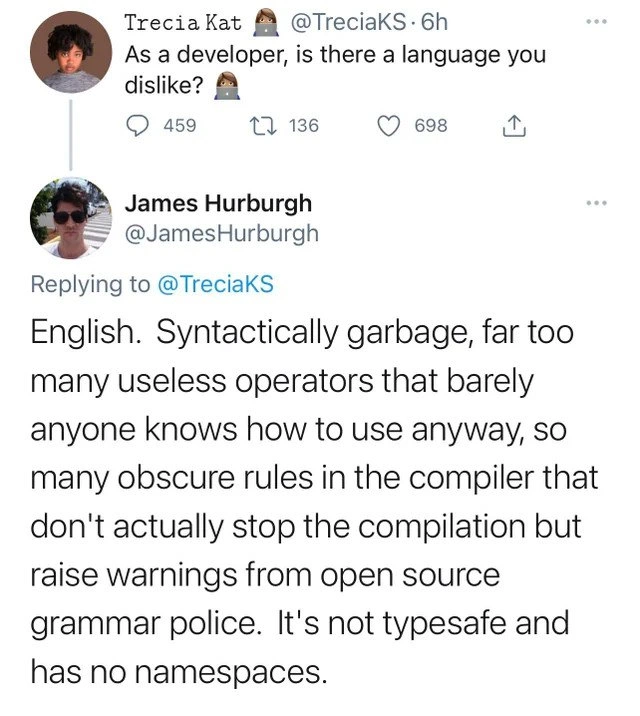
Screenshot of a two-tweet exchange on Twitter with avatars blurred for privacy. Top tweet from “Trecia Kat 🙆🏽♀️ @TreciaKS · 6h” reads: “As a developer, is there a language you dislike? 🤦🏽♀️” and shows 459 replies, 136 retweets, and 698 likes beneath. A threaded reply from “James Hurburgh @JamesHurburgh” (labelled “Replying to @TreciaKS”) states: “English. Syntactically garbage, far too many useless operators that barely anyone knows how to use anyway, so many obscure rules in the compiler that don't actually stop the compilation but raise warnings from open source grammar police. It's not typesafe and has no namespaces.” Visually it is the standard light-mode Twitter UI with profile photos and rounded tweet cards. Technically, the meme repurposes compiler terminology - operators, namespaces, type safety, warnings - to humorously critique natural language, playing on developers’ frustrations with ambiguous grammar versus deterministic code

Comments
11Comment deleted
English is basically a 1,000-year-old monolith: silent letters as feature flags, irregular verbs as breaking changes, and the change control board is still a committee of poets pushing straight to prod
English is the only language where production deployments work perfectly despite having undefined behavior everywhere and no one actually knowing the spec
Ah yes, English - the only language where the compiler accepts 'I before E except after C' as a rule but throws runtime exceptions on 'weird', 'science', and 'species'. No wonder we prefer strongly-typed languages where 'read' doesn't have two pronunciations depending on tense, and where the linter actually catches ambiguity before production. At least with C++ template errors, you know the compiler is *trying* to help
English is a legacy DSL: dynamic scoping, overloaded operators, and a feature-flagged Oxford comma - spec varies by style guide and prod breaks whenever Marketing reviews the PR
English is that legacy monolith where undefined behavior depends on locale - no spec, no types, and the parser treats tone as significant whitespace
English: no namespaces, so 'bank' (river) and 'bank' (finance) pollute global scope forever, CAP theorem be damned
You just don't have syntax highlighting ) Comment deleted
I feel that human language syntax highlighting will be AI's job unless it's the logical language Comment deleted
you already know greentext, now get ready for *insert this image* rainbow text Comment deleted
automatic pos-tagging already does the job :) Comment deleted
Egelme joliaho kerme lipokris hikasid Comment deleted