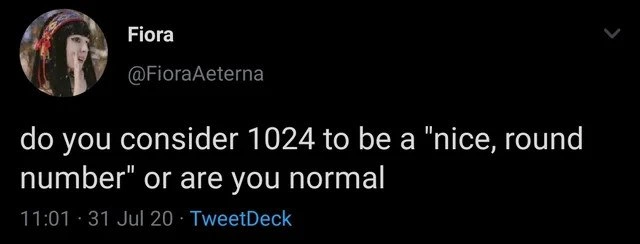
Programmers debate if 1024 is truly a nice, round number
Why is this DevCommunities meme funny?
Level 1: Counting in Twos vs Tens
Imagine you have two friends who like to count things in completely different ways. One friend counts the usual way you learn in school – by tens. This friend thinks numbers like 10, 100, or 1000 are super nice and tidy because they’re easy to count with (we have ten fingers, after all!). To them, saying “Let’s make it a round number” usually means ending on something like 10 or 100. For example, if they’re collecting stickers and have 92, they might want to get to 100 because 100 feels like a satisfying stopping point – a nice round number in the normal way.
Now your other friend is a bit… different. Let’s say this friend loves to count in twos, always doubling the amount. They go 2, 4, 8, 16, 32… and so on. This friend finds numbers like 16 or 32 super satisfying because in their world of counting, those are the neat milestones. It’s kind of like how some people who work with eggs think in dozens (12s) instead of tens. If you’ve seen eggs sold, they often come in a carton of 12. Someone who grew up on an egg farm might think “12 is the perfect number of eggs to have” because it fills the carton just right, whereas most people would think “Huh? Isn’t 10 or maybe dozen (12) eggs a bit random? Shouldn’t we count 10 or 20 as a full set?”
The meme is exactly like that, but with the number 1024. In normal everyday thinking, 1000 is a nice even number (imagine 1000 as ten hundreds – it ends in three zeros, looks very clean). But in computer land, people count in twos (binary), and 1024 is like their special “round” number because it’s 2 doubled over and over a total of 10 times. To a computer-savvy person, 1024 feels as complete and satisfying as 1000 does to everyone else. It’s as if computers or programmers have their own secret counting system.
So the tweet in the meme jokes: “Do you consider 1024 to be a nice, round number, or are you normal?” It’s saying, “Hey, are you one of the quirky folks who counts the computer way (and thinks 1024 is a perfectly neat number), or are you just a regular person who thinks only 1000 is neat?” It’s funny because it teases the computer folks for being a bit odd in a friendly way. If you laugh at it, you’re basically admitting, “Haha, yeah, I’m one of those odd ones who thinks 1024 is cool.”
Think of it this way: One kid says, “I like counting to 100 because it’s a good, round number!” and another kid replies, “Oh, I like counting to 128 instead, it feels perfect to me.” Most kids would look at that second kid like, “128? That’s a weird place to stop!” But the kid who loves 128 might have a special toy or game that works in twos (like stacking blocks that double each time), so 128 isn’t random to them at all. In the end, the meme is poking fun at how people who program or work with computers have their own little world of numbers that seems strange to everybody else. It’s a playful way to say, “We nerds might be different, but we sure love our weird ways of counting!”
Level 2: Binary vs Decimal Thinking
Let’s break down exactly what this meme is talking about in simpler terms. The core joke is about binary vs. decimal thinking and what qualifies as a "nice, round number." In everyday life, we use the decimal (base-10) number system. That means we have ten digits (0 through 9), and we tend to think of numbers like 10, 100, 1000 as neat or special. For example, if someone says “Let’s round it off to a nice round number,” they might suggest going to 100 or 1000 because those end in zero and are easy to work with. A round number in this common sense often means “a multiple of 10 or something ending in one or more zeros.” This is ingrained in us partly because we have 10 fingers for counting, which is a big reason our whole world uses base-10.
Computers, on the other hand, count using binary (base-2). Binary has only two digits: 0 and 1. Everything in a computer’s hardware is based on two states (like on/off, true/false), so binary is natural for them. In binary, powers of two create the “nice round numbers.” A power of two means multiplying 2 by itself some number of times: for example, $2^5$ (read as “two to the power of five”) equals 32, $2^6 = 64$, $2^7 = 128$, $2^8 = 256$, $2^9 = 512$, and $2^{10} = 1024$. Notice a pattern? Each time you increase the exponent, the number doubles (since base is 2). So the sequence of powers of two goes 32, 64, 128, 256, 512, 1024, 2048, and so on, doubling each step. In binary these all look like a 1 with a bunch of 0s after it: just like 1000 has trailing zeros in decimal, numbers like 256 or 1024 have trailing zeros in binary. For instance, 1024 in binary is 10000000000 (which is 1 followed by 10 zeros in base-2). That’s as clean and round as “1000” is in our usual decimal system.
Now, the tweet specifically asks: “Do you consider 1024 to be a nice, round number, or are you normal?” The joke here is comparing two mindsets:
The techie mindset: If you have a tech or programming background, you might actually chuckle and think, “Yeah, 1024, that’s a nice round number!” Because you know it’s $2^{10}$, a very tidy binary milestone (often associated with 1 Kilobyte in older terms). This is the powers_of_two_joke that only works if you know the binary significance of 1024. In a community of coders or computer scientists, calling 1024 “nice and round” feels logical (and humorous, because we know it’s a nerdy logic).
The normal mindset: If you aren’t thinking in binary, 1024 just looks like a random four-digit number. A “normal” person would consider 1000 a round number (since it’s a thousand, a big even number in decimal) and would likely find it bizarre to treat 1024 as something special. So a normal person would answer, “Huh? Of course 1024 is not a round number — it’s oddly specific!”
The tweet’s phrasing “or are you normal” implies that considering 1024 round is not normal – it’s a quirky tech insiders’ thing. It’s basically asking, “Are you one of those computer geeks, or are you a regular person?” If you laugh at 1024 being “round,” you reveal your membership in the techie club (with pride!). This contrast is the heart of the geek humor: it’s funny because it’s true, and it playfully labels geeks as the abnormal ones (in reality, within developer culture, that “abnormality” is totally normal!).
To further clarify, let’s talk about the kilobyte aspect, since 1024 is famously connected to that. In computing history, 1024 bytes = 1 kilobyte (KB) was a common understanding. Technically, in pure math terms, kilo- means 1000 (just like a kilometer is 1000 meters). But computers used 1024 (which is $2^{10}$) because of binary convenience. For a long time, nobody in tech blinked at the idea that “1 KB = 1024 bytes” – it was just how things were calculated in programming and operating systems. So in the computer world, 1024 had the nickname “kilo.” Nowadays you might encounter the term kibibyte (KiB) for 1024 bytes, which is an attempt to make it less confusing (1 kilobyte should really be 1000 bytes, 1 kibibyte is 1024 bytes). But in casual CodingHumor and conversation, developers still often use KB to mean 1024 bytes out of habit. This tweet is slyly nodding to that insider knowledge: the idea that 1024 has a built-in familiarity and roundness if you’ve spent time dealing with bytes and bits.
The format of the meme itself is a tweet screenshot. It’s literally a dark-mode screenshot from Twitter (note the black background and the blue-gray handle). Tweet memes are popular in tech circles because a lot of TechTwitter influencers and developers use Twitter to share quick jokes or observations. The user “Fiora @FioraAeterna” made this witty comment, and it resonated enough with the community that it got screenshotted and shared around as a meme image. The style is simple: white text on black (which, fun fact, many programmers prefer interfaces in dark mode – maybe because we stare at screens all day and dark backgrounds are easier on the eyes). There are no other images or flashy graphics, just the text of the tweet, because the humor is entirely in that one clever line.
To sum up this level: The meme is an example of DeveloperHumor that plays on a basic computing concept (binary numbers). If you’re new to coding or computer science, just remember: 1024 = 2^10, which is a round number in binary the same way 1000 is round in decimal. The tweet is funny because it jokingly labels people who think that way as not normal – implying that in developer land, being not normal is actually pretty common! Once you understand the context that 1024 is a power of two and why tech folks care about that, the joke clicks. It’s a lighthearted nod to CSFundamentals knowledge in everyday geeky life.
Level 3: The Cult of 1024
Within developer circles, 1024 has an almost cult-like status as a “nice round number.” The tweet in the meme captures this perfectly:
Fiora (@FioraAeterna): “do you consider 1024 to be a ‘nice, round number’ or are you normal”
This tongue-in-cheek question draws a line between two camps: those who instinctively nod at hearing "1024 is a nice round number" (the initiated geeks) and those who go "Huh? That’s so oddly specific" (the normals). The phrasing “or are you normal” playfully suggests that finding 1024 pleasing is a quirky abnormality – essentially a badge of nerd honor. It’s a gentle form of gatekeeping humor common in DeveloperHumor: if you chuckle at the idea of 1024 being round, you’re part of the in-group that groks low-level CS fundamentals. If you don’t, well, you’re just normal. 😏
Why is this so funny (and relatable) to devs? Because it resonates with real-world experiences in DevCommunities. Software engineers, computer scientists, and hardware folks constantly work with power-of-two numbers. We allocate arrays of size 256, discuss 512 MiB of RAM, or set buffer limits to 4096 bytes. Over time, you develop an intuition that numbers like 256 or 1024 are satisfying stopping points — they’re “round” in the sense that they align perfectly with binary boundaries. There’s a shared understanding (almost an inside joke) that 1024 = 2^10 is the “true” kilobyte and thus feels complete. This tweet basically asks: “Are you one of us, who celebrates hitting 1024 as a milestone, or are you a regular person who only celebrates 1000?”
In practice, this binary vs decimal thinking gap has caused plenty of confusion and humor. For instance, consider storage sizes: a hard drive advertised as 500 GB (500 billion bytes) might show up on your computer as only ~465 GB. Why? Because the OS is counting in 1024s (gibibytes), while the drive manufacturer counted in 1000s (gigabytes). The first time a junior developer or power user encounters this, they might be perplexed or even suspect they got cheated out of capacity! Seasoned developers just grin — they’ve long made peace with the kilo vs kibi mismatch. It’s practically a rite of passage in geek culture to realize that “our” definitions of kilobyte, megabyte, etc., differ from the everyday definitions. The meme riffs on that culture: once you catch yourself thinking “I’ll just round this to 1024” in a design discussion, you know you’ve turned into the resident geek.
This tweet also highlights how TechTwitter and other dev communities bond over such niche humor. A simple one-liner about 1024 being round elicits a flood of knowing replies and upvotes/likes, because it’s so true for those in the know. It’s a form of communal laughing at ourselves. We programmers realize how absurd we must seem to others: Who else gets giddy about the number 1024? 😅 But we embrace it. It’s similar to how gamers revere the number 255 or 256 (the classic max value of an 8-bit byte plus one) or how Linux folks joke that everything is a file. These are insider references that double as geek cred.
There’s even a subtle historic and emotional layer: Many of us learned about 1024 early in our careers or education (like the first time you truly grasp that 1 KB = 1024 bytes, not 1000). It’s a Eureka! moment that stays with you. After that, hitting 1024 of something – whether it’s users, followers, or the size of a dataset – gives a secret little thrill because 1024 triggers that “hey, that’s 2^10!” reflex. The tweet’s author, Fiora, is effectively winking at all those experiences and saying “If you feel that little thrill, congrats, you’re as weird as we are.” It’s inclusive in a weird way: making being “not normal” a point of pride for developers.
From an organizational perspective, this mindset even sneaks into decisions. Engineers might set default limits or magic numbers to 1024 just because it feels neat under the hood. For example, a config might allow 1024 concurrent connections or a game might cap an inventory at 256 items. Non-engineers might wonder “why such an odd cap?” but to the dev who implemented it, those were nice, clean numbers. This disconnect can produce funny moments in cross-functional meetings or code reviews, where someone asks, “Why 1024? Why not a round number like 1000?” and the developer responds with a bemused look, “But… 1024 is a round number — at least to us!”
In summary, the meme is geek humor distilling an entire dev worldview. It satirizes the way developers have their own norms (pun intended) that seem abnormal to outsiders. Everyone in the Cult of 1024 finds the tweet hilarious because it’s a mirror: Yes, we really do think like this. And if you don’t get it yet, just give it time hanging around programmers — soon you’ll be rejecting decimal “niceness” and celebrating every time something hits a power of two, too.
Level 4: Roundness in Radix 2
At the most theoretical level, this joke hinges on the concept of number bases and what it means for a number to be "round." In mathematics and computer science, a "round number" is an informal idea usually tied to the numeral system you’re using. Humans normally use decimal (base-10), so we see numbers like 100 or 1000 (which are $10^2$ and $10^3$) as nice, round numbers because they end in one or more zeroes in base-10. Computers, however, operate in binary (base-2), so a number like 1024 is special because it is $2^{10}$. In binary notation, 1024 is written as 10000000000 (a one with ten zeroes following it), which looks perfectly round in base-2:
1000 (decimal) = 1111101000 (binary)
1024 (decimal) = 10000000000 (binary)
In the table above, notice how 1000₁₀ appears as a jumbled 1111101000 in binary, whereas 1024₁₀ comes out to a very clean 10000000000₂. This illustrates the core of the joke: “roundness” is relative to the base. In radix-2 (binary), 1024 is as round as 1000 is in decimal. Formally, 1024’s binary form has ten trailing zero bits, meaning it’s divisible by $2^{10}$ with no remainder. Likewise, 1000 in decimal has three trailing zero digits, meaning it’s divisible by $10^3$ exactly. Each system views its powers of the base as the clean milestones: $10^3 = 1000$ is a neat round thousand in base-10, while $2^{10} = 1024$ is a neat round "kilo" in base-2.
This ties into fundamental CS_Fundamentals and how computers manage data. Digital systems use binary addresses, so memory and storage capacities often come in powers of two. For example, a memory chip with 10 address lines can uniquely address $2^{10} = 1024$ memory locations. That’s not an accident or arbitrary preference—it’s baked into hardware design. Each additional address line doubles the addressable space, so capacities jump from 512 to 1024 to 2048, and so on. As a result, classic memory sizes (and many other computer structures like file block sizes or screen resolutions) tend to be powers of two. Early developers became deeply familiar with these binary-friendly quantities. 1024 isn’t just any number to a computer—it’s 2^10, a fundamental block size (historically even called a “kilobyte” in computing, though strictly speaking that’s a kibibyte now).
Speaking of terminology, there’s a historical footnote: for decades 1 KB (kilobyte) was informally used to mean 1024 bytes in computing, because 1024 (~$10^3$) is the nearest power of two to one thousand. Technically, in the SI decimal system kilo- means 1000 exactly, so this was a bit of a cheeky repurposing by early computer engineers. To clear up confusion, standards bodies later introduced kibibyte (KiB) for 1024 bytes, distinct from kilobyte (KB) = 1000 bytes. But old habits die hard – many programmers still casually say “1 KB = 1024 bytes” as if it’s normal, while a physicist or a hard drive manufacturer might insist 1 KB = 1000 bytes. This lingering ambiguity is exactly because 1024 feels so "round" and natural in binary-centric contexts. It’s a great example of how fundamental binary thinking permeates computing.
In summary, the meme exploits the dual meaning of "round number" by tapping into the base-2 mindset. It’s implicitly referencing the mathematical elegance of 1024 as $2^{10}$, a power-of-two milestone that’s as pivotal in binary as 1000 is in decimal. The humor comes from the collision of these perspectives: one might even call it a decimal_vs_binary_thinking showdown distilled into a single number. When you’re steeped in computer science fundamentals, thinking in powers of two becomes second nature — so much so that 1024 can emotionally feel as “round” as a big round 1000 does to everyone else.
Description
The image is a dark-mode screenshot of a tweet captured from the TweetDeck interface. The tweet shows the profile name “Fiora,” handle “@FioraAeterna,” and reads: “do you consider 1024 to be a "nice, round number" or are you normal”. Below the text is the timestamp “11:01 · 31 Jul 20 · TweetDeck”. No other visual elements are present; the background is solid black, and the text is white with the handle in gray-blue typical of Twitter UI. Technically, the joke plays on how developers and computer scientists instinctively regard powers of two - specifically 1024 (2^10, the binary ‘round number’ for one kibibyte) - as “round,” highlighting insider numeric intuition versus everyday decimal thinking. The humor targets tech-savvy audiences frequenting tech Twitter, reflecting CS fundamentals and developer culture

Comments
6Comment deleted
Product: “Cap the free tier at a nice, round 1,000 users.” Me: “Done - 1024, for cache-line alignment.” Finance is still hunting for the mysterious 2.4 % revenue leak
The same engineers who insist 1024 is a round number will spend three meetings debating whether to use 1000 or 1024 for the kilobyte conversion in their monitoring dashboards
Of course 1024 is round - it's 2^10, perfectly divisible by every power of two below it. Meanwhile, 1000 is just... messy. It's got factors like 5 and awkward remainments when you're trying to address memory. Any architect who's debugged off-by-one errors in buffer allocations knows that 1024 is as round as numbers get. The real question is: do you say 'kilobyte' and mean 1024, or have you surrendered to the SI overlords and their base-10 'kibibyte' nonsense?
If 1000 feels round, you sell storage; if 1024 feels round, you operate it
1024's perfectly round - in binary, it fills 10 bits without waste; 1000 just overflows like a bad malloc
In engineering, 'round' means the low 10 bits are zero; marketing calls 1000 round, but the allocator calls that a fragmentation demo