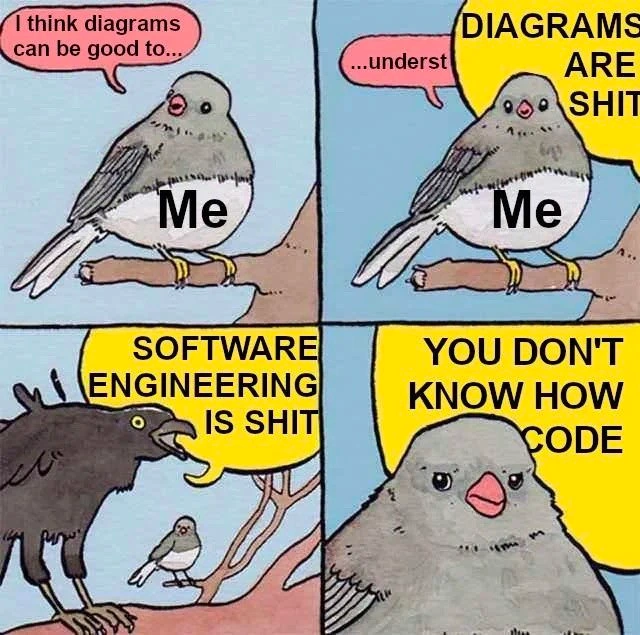
Trying to praise architecture diagrams, but the rant escalates instantly
Why is this Documentation meme funny?
Level 1: When a Helpful Idea Turns into a Shouting Match
Imagine you and your friend are building a big LEGO castle together. You say, “Hey, maybe we should look at the instruction pictures so we know how the pieces fit.” You’re just trying to be helpful so that your castle turns out right. But suddenly, another kid nearby jumps in and yells, “Instructions are stupid!” Now you’re surprised – that was a strong reaction! Before you can respond, they yell even louder, “Building castles is stupid!” They’re not even talking about the instructions anymore; now they’re saying the whole activity you’re doing is dumb. Finally, they point at you and shout, “You don’t even know how to build!”
At this point, you’re left holding your LEGO brick, feeling pretty annoyed and confused. All you did was suggest using a helpful little diagram, and somehow it made this other kid start shouting that everything is bad and that you’re bad at building. Sounds crazy, right? That’s exactly what this meme is joking about. In a grown-up world, instead of LEGO instructions, it was a software diagram, and instead of a kid yelling, it was someone in an online chat. The small bird in the picture is like you trying to politely share an idea. The big bird and big yellow words are like the loud kid who starts screaming over you. It’s funny in the cartoon because the overreaction is so sudden and over-the-top. It’s as if a simple suggestion of “let’s use a plan” turned into a ridiculous shouting match about how “plans are awful, building is awful, and you’re awful for suggesting it.”
Anyone who’s ever tried to nicely suggest something in a group, only to get shouted down, can relate to that poor little bird. The humor comes from how silly and extreme the situation is. It reminds us of a playground argument where one kid takes things way too far. In real life, most people don’t actually scream like this about diagrams, but the meme makes it extreme to make us laugh. We laugh because we know sharing ideas should be a good thing, and seeing it turn into a cartoonish fight is ironic and absurd. It’s like offering to help bake cookies and someone screaming “Recipes are trash! Baking is trash! You don’t even know how to cook!” – so over-the-top that you can’t help but chuckle at how wrong it all went. The meme, in simple terms, is about trying to be helpful and getting unfairly yelled at, shown with funny birds and big loud text.
Level 2: Communication Breakdown in Architecture Discussions
This meme shows a simple conversation about using architecture diagrams blowing up into a big argument. Let’s break down what’s happening and why developers find it funny:
What’s an architecture diagram? It’s basically a picture that represents how a software system is organized. For example, imagine drawing a chart with boxes for different parts of an app (database, server, client) and arrows showing how data flows between them. Developers create these diagrams as part of documentation or design planning, to help others understand how everything fits together. It’s like a blueprint for software. Along with written design documents, diagrams can make complex systems easier to discuss. This falls under Software Architecture – the practice of planning and describing the high-level structure of software. New developers often encounter tools like UML (Unified Modeling Language) or simpler flowcharts to sketch out ideas before or while coding.
Why would someone say diagrams are bad? In software teams, there’s a bit of a culture divide. Some folks love documentation and planning, others prefer to dive straight into coding. You might have heard the phrase “the code is the documentation,” which means some developers rely on reading the actual code to understand the system rather than reading separate docs or diagrams. They worry that diagrams get out-of-date as the code changes, or they’ve seen people spend too much time making fancy charts instead of writing working code. So, they feel diagrams can be a waste of time or even misleading. This meme exaggerates that viewpoint: the big bold text “DIAGRAMS ARE SHIT” represents someone loudly declaring that diagrams are garbage. It’s an anti-diagram rant in visual form. The small bird (labeled "Me") was politely saying, "I think diagrams can be good to… understand," trying to argue that diagrams help with understanding complex code. But before they can finish, they get cut off by that big negative statement. This is a comedic way to show how, in real life, a calm suggestion can be interrupted by a louder, harsher opinion in a group chat or meeting.
How does it escalate from there? After the first interruption, the meme shows a bigger bird (a black, more aggressive-looking bird) swooping in with another yellow speech bubble shouting “SOFTWARE ENGINEERING IS SHIT.” This represents someone jumping into the discussion and taking the negativity even further. Instead of just arguing about diagrams, now they’re saying the entire field of software engineering is garbage. Software engineering here means the whole practice of designing, documenting, testing, and maintaining software in a disciplined way (not just writing code quickly). It includes things like using design patterns, doing code reviews, making design documents, and yes, drawing diagrams. So calling “software engineering” crap is basically dismissing all structured programming practices. It’s an overreaction – like going from criticizing one tool (diagrams) to criticizing the idea of having any structure or process at all. In a real-world context, this might be a frustrated developer who has had bad experiences with bureaucracy or too many meetings, and they vent by claiming everything about formal software development is pointless. It’s the kind of statement you sometimes see in internet arguments where someone goes way off-topic: the conversation was about one detail, and suddenly a person is ranting about how the whole industry works. The meme makes this literal by having a bigger bird literally swoop in, symbolizing an outsider butting into the conversation with an even louder voice.
Finally, the personal insult. The last panel shows a close-up of the small bird with an exasperated expression, while another giant yellow text box yells “YOU DON’T KNOW HOW CODE.” Grammatically, that phrase is a bit off – it sounds like it should say "you don't know how to code." The broken English is actually part of the meme template (intentionally mimicking how an angry rant might come out nonsensically). But the meaning is clear: it’s an attack on the first bird (the person who liked diagrams), basically claiming “you have no coding skills.” This is what we call an insult or ad hominem attack – instead of sticking to the topic (are diagrams useful?), the angry ranter is now just insulting the person. In developer communities, unfortunately, this happens when discussions get heated: someone might say “If you need diagrams, you must not be a real programmer.” It’s a way of gatekeeping or shutting down the conversation by making the other person feel inferior. The small bird’s annoyed look in the last panel perfectly captures how it feels to be on the receiving end of that: you start a discussion politely, and suddenly you’re being yelled at and told you’re not good enough. Not fun in real life, but in the meme it’s portrayed in such an exaggerated, sudden way that it becomes laughable. It’s developer humor poking fun at our own communication failures.
Why do developers find this relatable? Think of times you’ve been in a group chat or a meeting where you suggest something harmless like, “maybe we should write some documentation for this project” or “let’s draw a quick diagram so everyone understands the design.” Often, most people might agree or at least not mind, but there’s occasionally that one person who feels very strongly the other way. Maybe they had a bad experience with over-documentation, or they’re just having a rough day. They might respond with something extreme like “Documentation is a waste of time, we should just be coding. This whole planning thing is nonsense.” That can really derail the discussion. Instead of calmly debating the pros and cons of a design document, it becomes an argument about philosophy or an attack on competence. For a newer developer (or any reasonable person), this is bewildering. The meme is a lighthearted way of showing that bewilderment. In the picture, the small bird (you, the reasonable dev) is literally overshadowed by giant text and a bigger bird (the loud opinionated dev). It’s a communication conflict visualized: the original point got lost as louder voices took over.
Let’s connect this to everyday developer life a bit more. Documentation vs. code is a classic debate. Early-career devs often hear mixed messages: one mentor says “Always write README files and design docs so others can follow your work,” while another colleague says “Don’t waste time on that, just write clean code.” Both sides have valid reasoning in context, which is why a balanced discussion is useful. But balance isn’t what we see in the meme – we see the discussion going off the rails. It’s basically showing a worst-case scenario. It’s humorous to developers because it’s an exaggeration of real disagreements they have. The categories mentioned (Documentation, Design Patterns/Architecture, Communication, Developer Experience) all play a role here. The meme touches on how Developer Experience (DX) can be improved with good documentation and diagrams, but also how communication about these practices can break down. It even hints at the idea of architecture trade-offs: every approach (like spending time on design vs. jumping into coding) has pros and cons, but instead of thoughtfully discussing trade-offs, the people in the meme just start shouting slogans like “X is shit.”
Visually, this cartoon uses the bird meme template as a metaphor. The small grey bird labeled "Me" stands for a developer (often the person sharing the meme imagines themselves as that bird) who’s trying to say something thoughtful. The bigger, darker bird represents those aggressive responders or trolls who might dominate a Slack thread. The huge yellow speech bubbles are a comic way to show loudness and interrupting. The first bird’s speech bubble is small and pink, indicating a normal tone. Suddenly a big yellow block of text “DIAGRAMS ARE SHIT” appears – it’s almost like someone shouting in all-caps in a chat. Then an even bigger yellow box with “SOFTWARE ENGINEERING IS SHIT” appears next to the large bird, showing that now the loud person is basically yelling over everyone. In the final image, the small bird’s face is up close with a frown, while another large yellow text “YOU DON’T KNOW HOW CODE” hovers above – the equivalent of someone yelling directly at you. The imagery is spot-on: it feels like being yelled at by bigger, louder creatures.
For a junior developer or anyone new to these dynamics, the meme is a reminder that tech discussions can sometimes get surprisingly hostile over small things. It’s saying, “you might just be trying to help or share knowledge (like by drawing a diagram), but beware – some might jump in and turn it into a silly fight.” Importantly, this is meant in jest. Not all dev conversations go this way! Most teams have plenty of reasonable discussions. But this meme became popular because it captures that one time it did happen, and the absurdity of it. It’s both a joke and a little caution: when you’re in those Slack or forum debates, watch out for that moment when constructive criticism turns into a pointless rant. If you see someone basically shouting “X is trash and you are too,” you’ll know the conversation has lost its usefulness (and you might just feel like that poor little bird thinking “...what just happened?”). In summary, Level 2 shows us the concrete situation: a conversation about using diagrams to understand code, and how it humorously blows up into an argument about the worth of software engineering, depicted by birds and big text. It teaches that in software teams, good communication is as important as good code – because without it, discussions can devolve exactly like this meme, albeit usually in less cartoonish ways.
Level 3: From Diagrams to Diatribes
At the senior engineering level, this meme hits uncomfortably close to home. It portrays a communication breakdown that many experienced developers recognize from heated Slack debates or architecture review meetings. The small grey bird labeled "Me" is trying to make a nuanced point: "I think diagrams can be good to…underst[and]". Before they can even finish saying "understand," they get utterly steamrolled by louder voices. A gigantic yellow caption "DIAGRAMS ARE SHIT" erupts behind them, cutting off the thought. This is the first stage of a classic tech hot-take cascade: a calm, measured statement is immediately met with an absolute dismissal.
From there, the rant escalates absurdly: a larger, darker bird swoops in shouting "SOFTWARE ENGINEERING IS SHIT". The conversation has now blown past the original topic (diagramming) into a sweeping condemnation of the entire discipline of software engineering. Finally, the coup de grâce: "YOU DON'T KNOW HOW CODE" – a personal attack questioning the first speaker’s competence. In the span of a few seconds, a polite comment about architecture diagrams degenerated into a full-blown flame war. This progression is hilariously over-the-top, yet any battle-scarred developer will tell you it’s a spot-on parody of how tech discussions can spiral out of control.
Why is this so funny (and painful) for seasoned devs? Because we’ve all been there. The meme exaggerates a pattern we see often in developer forums and Slack channels: one person suggests a reasonable idea about improving documentation or using an architecture diagram for clarity, and suddenly someone else is ranting about how all documentation is useless and questioning your coding skills for even bringing it up. It’s a textbook example of straw-man arguments and one-upmanship in tech conversations. The first bird in the comic was talking about using diagrams to aid understanding – a fairly uncontroversial, moderate stance. But along comes the “big bird” with an all-caps ultimatum that diagrams are worthless, immediately reframing the discussion as if the original poster claimed diagrams are a panacea. This kind of reply not only dismisses the specific point, it nukes the entire concept from orbit.
This reflects an age-old cultural divide in programming: code vs. diagrams, or more broadly, "just code it" vs. "plan it out." The meme’s big yellow text (“DIAGRAMS ARE SHIT”) is practically the battle-cry of the code-only purist. There’s a contingent of developers who believe that the only truthful documentation is the code itself. They’ll say, “The code is the design document. Diagrams just get outdated and lie.” This mindset harks back to the Agile Manifesto’s principle of valuing “working software over comprehensive documentation.” Indeed, during the Agile revolution, many devs swung hard from heavyweight UML specs to zero documentation, because lengthy design documents had become synonymous with waterfall-era bureaucracy. In their eyes, drawing fancy boxes-and-arrows is indulgent “architecture astronaut” stuff – time that could be spent writing real code. So when our small bird cautiously praises diagrams for understanding, the heckler hears a ghost of Big Design Up Front and reflexively fires off the “diagrams are crap” broadside. It’s a knee-jerk reaction born of witnessing architecture diagrams that never matched reality or endless DesignPattern discussions that produced more paper than product.
But the meme doesn’t stop at trashing diagrams. It ups the ante to trashing software engineering itself. This is where a bit of dark developer humor kicks in – the idea that everything about software engineering is pointless. It’s a parody of the cynical veteran mentality turned toxic: “Software engineering is shit” basically throws the baby out with the bathwater. The large black bird’s extreme stance satirizes that person in the chat who can’t resist generalizing. Perhaps they had one too many encounters with over-engineered systems or ivory-tower architects and now they’ve swung to the opposite extreme, claiming the entire field of systematic software design is nonsense. It’s an all-or-nothing worldview: if some documentation is bad, then all of software engineering must be bad. This, of course, is a gross exaggeration – a real developer having this view unironically is either trolling or deeply jaded. Seasoned professionals usually learn that architecture trade-offs exist: sometimes a quick UML sketch or a high-level diagram prevents a ton of confusion, and other times lengthy specs truly are a waste. But in an internet argument, all nuance goes out the window. The meme captures that absurd leap from a single point about diagrams to a fiery damnation of the entire practice of software engineering. It’s funny because it’s a caricature of the worst kind of tech rants, where the scope of anger expands with each sentence.
Finally, we reach the personal attack: “YOU DON’T KNOW HOW CODE.” This is the ad hominem cherry on top of the rant sundae. In many online tech spats, when one can’t win on ideas, they start attacking the person. Here, the implication is that if you find diagrams helpful, you must be a poor coder. It’s the no-true-Scotsman fallacy of programming: “Real programmers don’t need diagrams; if you do, you must not be a real programmer.” The meme is mocking this gatekeeping attitude. Ironically, some of the best engineers out there do sketch out diagrams to communicate complex SoftwareArchitecturePatterns or system interactions clearly. Wanting a visual aid doesn’t mean you “can’t code,” it means you care about communication and shared understanding. But in the heat of an argument, the angry responder isn’t interested in that distinction. They’re interested in scoring points and shutting down the discussion by questioning the poster’s credibility. The small bird’s face in the last panel says it all: a mix of annoyance and disbelief, like “Did this really just escalate to that?” It’s a perfect representation of that feeling when you tried to make a mild, constructive comment in a meeting or chat, and suddenly you’re being personally attacked out of left field.
Technically speaking, the meme format itself (often called the overshadowing bird meme) is doing a lot of work to sell the joke. The huge yellow speech bubbles visually overshadow the pink speech bubble of the small bird, just like a loud voice drowning out a quieter one. The larger black bird physically appearing frames the moment when a conversation gets “hijacked” by someone barging in with a louder, more extreme opinion. This format is popular because it perfectly illustrates how it feels when a reasonable discussion is dive-bombed by a wild rant. It’s developer humor, but it’s really about human communication failures. Anyone who’s been on the receiving end of a toxic online reply or a code review turned rant will recognize the dynamic. Documentation humor like this resonates with engineers because it’s an exaggerated reflection of real challenges: balancing code vs documentation, opinionated colleagues, and the difficulty of keeping conversations productive.
Underneath the laughter, there’s a kernel of truth: in real projects, finding the sweet spot between just coding and over-documenting is hard. Good engineers try to use diagrams and docs judiciously to avoid chaos. But poor communication or egos can derail even that effort – much like the poor “Me” bird got derailed here. So experienced devs laugh at this meme and then quietly recall that time a Jira discussion or Design Document review went down this exact path. It’s a cathartic kind of humor: “Haha, yes, this is exactly what happens when I merely mention writing documentation in our team chat.” The meme serves as a small cautionary tale too – a reminder of how not to react when someone brings up a tool or practice you personally dislike. In summary, Level 3 appreciation of this meme comes from recognizing the architecture debate it lampoons, the decades-long pendulum swing between planning and coding, and the sadly familiar escalation from civil discourse to incendiary flame war. It’s funny, it’s frustrating, and it’s a scene that plays out in tech far too often – which is why senior devs smirk and sigh knowingly when they see it.
Description
Four - panel cartoon featuring small grey birds meant to represent "Me" sitting on a branch. Panel 1: the bird says in a pink speech bubble "I think diagrams can be good to...". Panel 2: the same bird continues "...underst" but is interrupted by a huge yellow block of text behind it reading "DIAGRAMS ARE SHIT". Panel 3: a larger, darker bird swoops in from the left yelling over a yellow background "SOFTWARE ENGINEERING IS SHIT" while the small bird watches helplessly from below. Panel 4: a close-up of the small bird looks annoyed as another yellow caption shouts "YOU DON'T KNOW HOW CODE". The meme parodies discussions in tech Slack channels where nuanced points about using architectural diagrams for shared understanding quickly devolve into loud, absolutist hot-takes dismissing diagrams, software engineering as a discipline, and a developer’s competence
Comments
7Comment deleted
I posted a C4 diagram to discuss the async boundary; within three replies it was “diagrams are waterfall,” “real engineers just grep,” and somehow we were debating tabs vs. spaces - turns out the most distributed system is consensus in Slack
The four stages of seniority: Junior who believes in documentation, Senior who's seen too many outdated diagrams, Staff who questions everything we've built, and Distinguished Engineer who's transcended language itself
Tech Twitter is the only place where 'sequence diagrams help onboarding' escalates to a referendum on whether you've ever compiled anything
This perfectly captures the three stages of a developer's relationship with architecture diagrams: Stage 1 (Junior): 'UML can help us communicate!' Stage 2 (Mid-level): 'These diagrams are always outdated anyway.' Stage 3 (Senior): *Aggressively defends the codebase as the only source of truth while simultaneously complaining that nobody understands the architecture.* The real irony? The bird yelling 'YOU DON'T KNOW HOW CODE' is the same one who refused to document anything, creating the very knowledge gap they're now weaponizing. Classic case of documentation debt coming home to roost - literally
Every “diagrams are useless” engineer becomes a PlantUML power user at 3am incident triage when the SLO is “find the TLS terminator.”
'Diagrams clarify architecture' - the mantra right before 'RTFC' in every PR review
Suggest a small C4 diagram to align boundaries and you’re suddenly “anti‑code” - declared by the same crew who document our architecture as SSH aliases, utils.jar, and Slack lore