The Existential 'Why' of a System Crash
Why is this Bugs meme funny?
Level 1: Caught in Your Own Trap
Imagine you set up a silly prank that ends up splashing back on you. For example, a kid might balance a bucket of water on top of a door, planning to soak their friend as a joke. But then you walk through the door first and splash – you’re drenched in water! You’d stand there soaked, thinking, “How did this happen?!” even though, of course, it happened because you set the trap. This meme is basically that scenario in a computer world. The developer wrote a program that was like a trap or a bomb for the computer (he essentially “played with fire”), and when it blew up, he’s left staring at the flames saying “Why?!” It’s funny in the same way it’s funny when a prankster pranks themselves: the culprit and victim are the same person. In simple terms, the guy broke his own computer with the very thing he made, and now he’s bewildered that it’s broken. It teaches a little lesson with a laugh: if you’re not careful, you can end up tripping on your own banana peel – caused by nobody else but you!
Level 2: Why Did It Break?
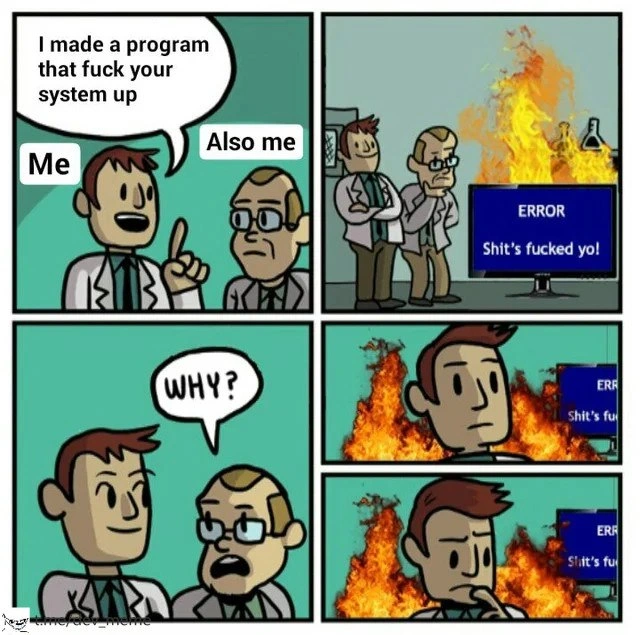
This cartoon meme is illustrating a scenario every coder dreads: your own code caused a major crash, and now you’re left asking “Why did this happen?!” In the panels, we see two cartoon scientists labeled "Me" and "Also me." They’re actually the same person – the labels hint at an internal dialogue. The first “Me” creates a disastrous program, and the second “Also me” is the part of you that has to deal with the mess. It’s like one half of the developer proudly says, “Look, I wrote this script that will wreck the system!” and the other half, later on, is standing in front of a burning computer screen asking “WHY (did it break)?” in bewilderment. The humor comes from that contradiction: the developer intentionally wrote something risky or destructive (maybe thinking it was a clever fix or a quick hack), but is then surprised when everything goes wrong. It’s a tongue-in-cheek take on DeveloperSelfDeprecation – basically making fun of ourselves as developers when we do something dumb.
Let’s break down the elements for a newer developer (or someone outside tech):
- The “program that fk your system up”** – Crass language aside, this means a script or piece of code that will seriously mess up your computer or server. For example, imagine a short script (an automated program) meant to clean up old files. If written carelessly, it might delete the wrong things – like critical system files – effectively breaking everything. In programmer slang, we sometimes call such harmful scripts “footguns,” because using them is like shooting yourself in the foot. Here the meme’s scientist literally built a digital footgun and pulled the trigger.
- Prod (Production) – The meme implies this disaster happened in production (“prod” for short), which is the live environment where real users or data are. Breaking things in prod is a big no-no because it affects real customers or essential operations. It’s the difference between messing up a practice game versus messing up the championship. You might test code on your own machine or a staging server, but production is the real deal – and here it’s gone up in flames. Quite literally, the cartoon shows flames around the monitor, symbolizing a production outage (an incident where a live system is down or malfunctioning).
- “ERROR – Shit’s fucked yo!” – Normally, error messages are dry and technical, like “NullPointerException at line 42” or “Segmentation fault (core dumped).” This one is intentionally over-the-top and colloquial. It’s like the computer itself throwing its hands up and saying “Everything is screwed, dude!” in plain (if crude) English. This emphasizes just how badly things broke. It’s also poking fun at unprofessional error handling – maybe the developer never expected this code to run in production and put a joking message there, which now comes back to haunt them. Many junior devs learn the hard way: any joke or temporary hack in your code will eventually be seen by someone (often at the worst time).
- On-call and debugging – The situation shown is every on-call developer’s nightmare. On-call means you’re the person responsible for being available at odd hours if something goes wrong in production. Picture getting a phone alert at 2 AM that the server is down, and discovering the cause is a bug in a script you wrote. Now you have to debug (find and fix the problem) under pressure. The meme’s final panels – the character’s stunned silence against a fiery backdrop – perfectly capture that “I’m in trouble” feeling. You’re simultaneously panicking and kicking yourself. Debugging_Troubleshooting in this context might involve sifting through logs (where that crazy error message would appear) to trace back to the faulty code. The “WHY?” is literally the question you’d be asking as you hunt for the root cause. And then the awful realization: I did this.
- Code Quality and QA – This catastrophe hints that proper CodeQuality practices were skipped. In a healthy development process, you’d have QA (Quality Assurance) or code reviews catching dangerous code before it hits prod. For instance, if the script had to run, maybe it should have a safety check like “Are we in production? If yes, don’t execute the destructive part.” The meme shows what happens when such safeguards are missing or when we cut corners. The developer essentially performed a live experiment on the system with disastrous results – like a lab experiment gone wrong. In real life, junior devs learn quickly that a lack of testing or oversight can lead straight to production fires. Always respect the power of your code, because a small oversight can cascade into a major bug.
In simpler terms: The meme is a funny dramatization of a developer’s worst-case scenario of their own making. The same person who wrote the bad code is now facing the fallout. It’s both a joke and a cautionary tale. The takeaway for a junior developer is, “Be careful with what you deploy. That ‘clever’ quick fix might come back to bite you.” The humor softens the lesson: everyone makes mistakes, and sometimes our code does exactly what we told it to – to our regret. The meme’s popularity in dev circles comes from people commenting, “Haha, I’ve been that person.” It’s a rite of passage in software development to, at least once, break something and then stare at your screen in disbelief thinking, “I have no one to blame but myself.”
Level 3: Arsonist and Firefighter
This meme hits that too real sweet spot for any battle-scarred developer. It shows a programmer acting as both the arsonist (starting the fire with bad code) and the firefighter (now desperately trying to put out the production blaze they caused). In the first panel, “Me” proudly proclaims “I made a program that fk your system up”** – basically bragging about a script with catastrophic potential. The second panel smash-cuts to the inevitable inferno: servers (or a monitor) in flames, displaying the blunt error message ERROR – Shit's fucked yo!. This is not your typical polite stack trace; it’s a comically unprofessional cry of defeat, as if the program itself throws up its hands and says “Yep, everything’s on fire, my dude.” The humor here is dark and deeply relatable: DeveloperHumor born from ProductionIncidents we’d rather forget.
For seasoned devs, the scene evokes all those self-inflicted outages and OnCallHumor nightmares. It’s a scenario we know well: you deploy something a bit sketchy (maybe skipping tests or bypassing QA) and boom! you’re paged at 3 AM because that “brilliant” idea turned into a bug bonfire. The meme personifies the classic internal dialogue after such a screw-up. The “Me” in the lab coat is the reckless coder in us all – “What could possibly go wrong?” – merging a bit of mad-scientist glee. The “Also me” is the shocked, regretful side of us, standing in the smoky aftermath asking “WHY?” as if they didn’t already know. It’s DeveloperSelfDeprecation at its finest: we are both the culprit and the victim of our own poor decisions. The flames raging in panels 4-5 perfectly capture that on-fire feeling of a production outage, while the main character’s blank stare screams facepalm. He has no answer to “WHY?” because deep down he knows why – he wrote that damn script!
This is funny because it’s true. In real life, many catastrophic BugsInSoftware are self-inflicted. Perhaps a developer ran a maintenance script on the wrong database, or pushed code with a hidden logic bomb. We’ve all heard war stories of a single stray character or a “harmless” one-liner bringing systems down. The meme exaggerates it to an absurd level (writing a program explicitly designed to torch the system), but it’s poking fun at a real phenomenon: being the architect of your own ProductionIncident and then acting surprised. It highlights a key irony in software engineering: computers will do exactly what you tell them to, even if you’re telling them to blow everything up. As a senior dev, you chuckle (and maybe cringe) because you remember your own “oh no… I did this” moments. The debugging_headaches that follow are a special kind of torture – scrambling to undo the damage you caused, all while asking yourself how you ever thought this was a good idea. It’s a mix of humor and horror, the quintessential “OnCall paged-for-my-own-bug” experience distilled into five panels.
To ground this in reality, here are a few classic self-inflicted outages that this meme brings to mind:
- Accidental
rm -rf /: The infamous command that wipes the root directory. One misplaced/in a cleanup script and you’ve essentially set your whole server on fire. (Yes, this has happened – goodbye system files, hello chaos.) - Dropped the production database: Running
DROP TABLEor a destructive migration on the prod DB instead of the test environment. In an instant, all user data is gone. The “Me” who wrote that script is the same “Me” panicking as the site goes down. - Debug message gone wild: A developer leaves a cheeky error message (like
Shit's fucked yo!) in the code, assuming it will never actually show up. Fast forward to a crash in production, and that exact phrase is now lighting up your logs – oops. Nothing says “professional” like an error that includes profanity and slang, right?
The meme resonates with senior engineers because it encapsulates that tragicomic reality: we are often our own worst enemy in code. It’s a nod to poor CodeQuality practices (like lacking code reviews or testing), and the shared understanding that even the best of us have unleashed a self_sabotage_script or two. There’s also an underlying commentary on responsibility. Notice how the character in the lab coat isn’t blaming anyone else – he’s just silently reckoning with his mistake as everything burns. In the real dev world, after you douse the flames of an outage, you have to own up to the post-mortem: “Root cause: developer deployed a script that inadvertently caused system meltdown.” This meme is basically that confession, but in a humorous comic form. It’s saying: “Hey, we’ve all been the idiot who pushed the big red button.” It’s a dark little form of group therapy for programmers – we laugh so we don’t cry. And next time, hopefully, we’ll think twice before lighting the match.
Description
A multi-panel comic strip with a teal background. In the first panel, a developer character labeled 'Me' proudly says, 'I made a program that fuck your system up,' to a skeptical colleague. The next panel, labeled 'Also me,' shows both characters watching a computer monitor that is engulfed in flames. The screen is blue and displays 'ERROR Shit's fucked yo!'. In the third panel, the colleague asks the developer, 'WHY?'. The final two panels show a close-up of the developer's face, looking pensive and confused, with the burning disaster in the background, unable to answer. The meme humorously depicts a developer's impulse to create something powerful or experimental without considering the consequences, only to be stumped when faced with the resulting chaos and asked for a reason. It captures the spirit of 'doing it because you can,' which sometimes leads to self-inflicted, catastrophic bugs
Comments
7Comment deleted
Some developers write tests to prevent failure. Others write `rm -rf / --no-preserve-root` in a shell script just to see if the intern running it has sudo access. It's all just 'research'
Yesterday-me named the migration “cleanup_final.sql”; today-me is on the war-room call learning that `DROP SCHEMA CASCADE;` is, in fact, both cleanup and final
When you've spent 15 years perfecting chaos engineering practices only to realize you forgot to implement the 'engineering' part - now you're just the senior architect of a distributed dumpster fire wondering if your resume should list 'entropy maximization' as a core competency
The real production incident isn't the cascading system failure - it's explaining to the CTO why your 'quick hotfix' just took down three availability zones and triggered every PagerDuty alert simultaneously. At least the post-mortem will be interesting: 'Root cause: Developer achieved enlightenment and transcended concern for uptime SLAs.'
I built a chaos injector to test our blast radius; turns out it perfectly matches my on-call rotation
Self‑hosted Chaos Monkey: sudo in prod, no feature flags, and a postmortem template prefilled with “insufficient blast radius control” - signed by the same person who got paged
Error messages so honest, even the compiler swears - finally, some straight talk from the stack trace