OpenAI's GPT-5 Demo: The IDE They Didn't Build
Why is this AI ML meme funny?
Level 1: Wizard vs Builder
Imagine you want a huge, beautiful sandcastle built in your backyard. You have two friends who can help. One friend is a wizard 🧙 who can magically create the whole castle just by you describing it. You say, “I want a castle with tall towers, knights on the walls, clouds around it, and even cannons that can fire!” – and poof! the magical friend makes it appear almost instantly. Now, your other friend is a regular builder 👷– skilled, but he has to do things the normal way: get bricks, mix cement, start building from the ground up. In the time it takes the builder to even start his truck and unload his tools, the wizard has already finished the entire castle! This is exactly the funny idea in the meme: the computer’s AI wizard creates a fancy castle in a flash, while the normal build process (like the builder friend) is still getting ready. It’s amusing because usually we expect the opposite – we think building something big takes a lot of time. But here the “magical” method is so fast that the traditional method looks slow and a bit silly. The joke also has a little side note: even the powerful wizard people (a big company that makes these AIs) sometimes do clumsy things, like buying an expensive tool and then not using it. Overall, it’s funny and amazing at the same time – like watching magic outpace manual work. It makes us smile because who wouldn’t be tickled to see a castle appear out of thin air while the construction crew is still yawning and stretching?
Level 2: Prompt to Page
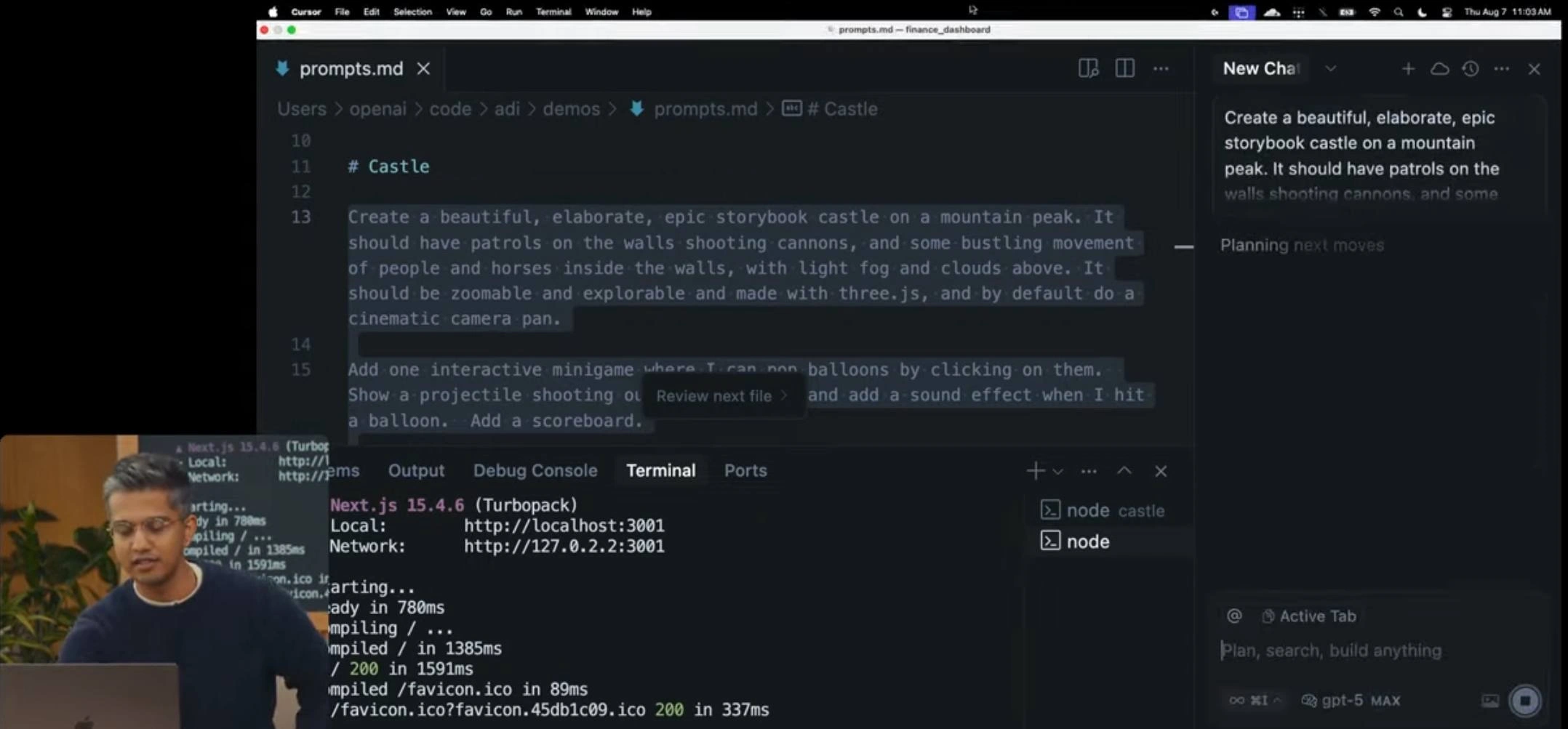
In this meme, a developer is using their coding setup in a very futuristic way. The screen shows what looks like VS Code (a popular code editor) with an AI chat sidebar open. The developer has written a request in a file named prompts.md that says “# Castle” followed by a description of a castle scene. Essentially, instead of writing code line by line, they are writing what they want in plain English. For example, they wrote that the castle should be on a mountain, have people and horses, cannons on the walls, some fog and clouds, and even a cinematic camera pan (like a dramatic sweeping camera view). This description is being fed to an AI assistant integrated in the IDE (the sidebar on the right labeled “New Chat” shows the same text, meaning the AI is reading that prompt). These AI assistants – like GitHub Copilot or ChatGPT plugins for VS Code – can take natural language instructions and generate actual code. So the developer is basically saying, “Hey AI, please create this fancy 3D castle scene for me using three.js (a JavaScript library for 3D graphics on the web).” Three.js is commonly used to make 3D models, animations, and even games that run in your browser, so it’s the perfect tool for a castle with cannons and all those effects.
On the lower half of the screen, we see a terminal panel (the kind of panel where developers see output from running commands). It shows that the developer’s web application is running using Next.js 15.4.6. Next.js is a framework for building web apps with React (a JavaScript library for user interfaces). Essentially, Next.js makes it easier to create websites or web apps by handling a lot of setup for you. The numbers (15.4.6) indicate the version of Next.js – by 2025 it’s version 15, which suggests it has evolved quite a bit. Now, Next.js traditionally used a bundler called Webpack to build (compile) the code, but here we see it mentioning Turbopack. Turbopack is a newer bundler (introduced by the creators of Next.js/Vercel) that is supposed to be much faster. A bundler is a tool that takes all your code (and assets like images, etc.) and packages them up so they can run in a web browser. When you’re developing, the bundler also starts a dev server so you can see your changes live at a local address (in this case, http://localhost:3001). The log lines “Starting… ready in 780ms” and “compiled in 1385ms” mean that from the moment the developer started the app, Turbopack took 0.78 seconds to get ready and about 1.385 seconds to compile the code and have the application running. That’s actually pretty quick – imagine hitting “run” and the website is up in less than 2 seconds. The terminal also shows a “200 in 1591 ms” which likely means the app responded to a request (possibly loading the main page or a resource like favicon.ico) in about 1.5 seconds. So those are performance stats.
Now, here’s where the humor is: the AI in the editor is so powerful that you can ask it for something super complex (a whole castle with moving parts), and it can generate the code in a few moments. Meanwhile, even though Turbopack is fast, it’s still taking a second or two to do its job. The meme caption jokes that the AI “summons a full three.js castle while Turbopack is still warming up.” In simpler terms, the AI finished creating the castle before the tool finished preparing to show it. It’s like saying the AI can build things faster than the computer’s own build process. This is amusing because Turbopack’s whole selling point is being extremely fast (hence the name “turbo”), yet here it appears slow in comparison to the near-instant result from the AI. Developers (especially those who do front-end web development) are used to waiting a bit for their app to compile and load, even with fast tools. So they find it funny that now the thing we’re waiting on is the tooling, not the human or even the AI. The phrase “warming up” is often used for things like engines or, informally, for programs that take some time to initialize. So picturing a “Turbo” pack needing to warm up is a bit ironic, as if a race car named Turbo is still in the garage heating the engine while the AI already finished the race.
Let’s clarify the technologies and tags mentioned:
- VSCode: Stands for Visual Studio Code, one of the most popular code editors. It’s customizable with many VSCodeExtensions. One such extension can be an AI Chat panel (like the one we see).
- AIAssistants in coding: Tools like GitHub Copilot, ChatGPT, or Cursor (mentioned later) that help you write code by understanding natural language or by predicting what you need. They act like super-smart coding partners.
- NextjsPages: In Next.js, you often create pages (like each page of your website or app). This castle might be generated as a page (or a canvas on a page) in a Next.js project.
- React: The JavaScript library underlying Next.js. React handles the UI of web apps. The castle scene might be integrated into React components or rendered directly with three.js.
- DeveloperProductivity: This tag highlights that the meme is about tools that make developers’ lives easier or more productive. Indeed, having an AI write a big chunk of your code can super boost productivity (if it works correctly).
- Turbopack: The new fast bundler. It’s relevant because it’s part of how quickly code changes take effect. It replaced Webpack (an older bundler) in the Next.js ecosystem to give faster iteration.
- three.js: A library to create 3D graphics in the browser. Making a castle with it means writing JavaScript code to define 3D objects (like towers, walls, cannons as 3D models), lights (for the clouds/fog and mood), camera (to view the scene), and animations (for moving patrols or firing cannons).
- integrated_terminal: The terminal that’s built into the editor. Developers can run commands (like starting the Next.js server) inside their editor without switching windows. The screenshot shows the output of such a command.
So, putting it together: The developer wrote a Markdown prompt describing a complex feature. The AI assistant read that and likely generated all the necessary code (probably a combination of HTML/React for the page and JavaScript for three.js to create the 3D scene). While it’s doing this, the developer also started the Next.js dev server (maybe they had some initial code or they started it to see the result as soon as it’s generated). The live_coding_demo aspect suggests this was done in front of an audience – maybe at a conference or a special event – to showcase how seamlessly this can all work. The presenter would be saying something like, “Watch as I just describe what I want, and the AI builds it and our app runs it immediately!”
The meme is funny to developers for a couple of reasons. First, it’s showcasing something very cool (AI generating a game-like 3D scene) in a familiar environment (VS Code). That’s a bit mind-blowing if you’ve struggled through coding such things manually. But second, it pokes fun at the fact that even with this coolness, we’re still limited by mundane things like build times and dev server startup. It’s a lighthearted reminder that you can’t escape all the waiting. It’s also a bit of a wink at hype vs reality: Turbopack is supposed to be super fast (and it is fast), but the phrasing “still warming up” makes it sound sluggish next to the almost magical speed of AI.
Finally, the caption’s extra comments about OpenAI, windsurf, and Cursor add a layer of tech-world drama. To explain: OpenAI is the company that makes ChatGPT (the AI likely powering this demo). The caption says they “paid billions to acquire windsurf” – this suggests OpenAI bought some company or technology (code-named “windsurf”) for a huge sum of money, probably to improve their AI coding tools or have their own editor. But then, during the announcement of GPT-5 (a future version of the AI model), they apparently used Cursor instead. Cursor is another AI-enabled coding editor (similar idea to having a chat assistant in your IDE). If true, it means OpenAI did not use the thing they bought; instead they used a third-party tool. The comment “They are that bad” implies a criticism: either the acquisition was a poor choice, or OpenAI’s own tool was not good enough, or generally that their decision-making is bad. For a junior developer, the takeaway is that even big companies sometimes have messy strategies and things change last-minute. It’s like if a big game company bought a game engine but then built their next game using a competitor’s engine – people would be like “what was the point of that purchase then?” It’s an inside joke for those following industry news, highlighting that fancy demos and huge budgets don’t always line up perfectly behind the scenes.
In summary, this meme shows a scenario where AI and modern dev tools work together: you describe what you want in plain language, and the computer does it, while your development server tries to keep up. It’s cool and funny because it highlights progress (AI can generate a whole castle in code!) and the remaining limitations (we still wait for compilers), and sprinkles in some tech gossip for flavor. For someone newer to development, it demonstrates how far things have come – from manually writing every line of code to now more of a high-level “guiding” role for the programmer – but also that our workflow still has familiar steps like running a server and compiling code. And even in this brave new world, we can’t resist poking fun at the tools and companies we use.
Level 3: Conjuring vs Compiling
At first glance, this meme delivers a one-two punch of cutting-edge dev tooling and ironic reality check. We’re looking at an IDE (looks like VS Code or a similar editor called Cursor) during a live_coding_demo where an AI assistant is literally generating code for a 3D castle. On the left, there's a markdown file prompts.md opened to a section titled “# Castle”. The text below it is a markdown_prompts description: “Create a beautiful, elaborate, epic storybook castle on a mountain peak… patrols on the walls shooting cannons… zoomable and explorable and made with three.js… do a cinematic camera pan.” This reads like a wish list to a genie, not typical code comments! On the right side, the ide_chat_panel labeled “New Chat” mirrors that same prompt, indicating an integrated AI chat (think AIAssistants like ChatGPT or Copilot inside the editor). So the developer has effectively instructed the AI in natural language to build a complex 3D scene. And the crazy part? The AI is obliging – presumably spitting out all the JavaScript/HTML/CSS needed to render an three_js_castle_prompt in the browser with three.js (a popular 3D library for WebGL). This is AI_generated_frontend magic: from an idea straight to working code, right within the IDE.
Now, parallel to this sorcery, at the bottom of the editor we see the integrated_terminal panel with a Next.js dev server log. It shows Next.js 15.4.6 (Turbopack) starting up: “Starting… ready in 780ms”, then “compiled in 1385ms”, and local dev URLs (http://localhost:3001). So as the AI is busy summoning an “elaborate, epic” castle, the frontend build tool – Turbopack – is still rubbing its hands together, warming up. Here’s the rub: Turbopack was hyped as the lightning-fast successor to Webpack for Next.js, meant to turbo-charge bundling and compiling. Yet in this scene, the turbo is feeling a bit like turbo-lag. ~1.4 seconds to compile isn’t terrible at all (frankly it’s quite speedy for such a project), but the meme exaggerates the contrast: the AI can conjure an entire castle with moving parts in the time it takes for the dev server to boot and compile. The humor lands because it flips our expectations – usually writing code is the slow part and compiling is just mechanical. Here, the mechanical (the build process) becomes the bottleneck, while the creative part is instant. Seasoned devs recognize this absurd role reversal. We’ve spent careers waiting on code to compile or servers to start, optimizing build times down to milliseconds. Now an AI comes along that can generate entire apps in seconds, and suddenly we’re... waiting on the tools to catch up. It’s like asking a genie for a castle and then having to wait for the construction crew to pour the foundation.
This touches on an industry-wide inside joke: no matter how much performance improves, there’s always something to wait for. We got faster compilers, then tests became the slow part. We sped up testing, then our Docker containers were slow to build. Solve that, and now our AI is writing code faster than the dev server can serve it! There’s a shared experience of “hurry up and wait” with dev tools. DeveloperProductivity enhancements often just move the bottleneck around. Here NextjsPages (specifically a page with a 3D castle) is ready in concept via AI, but the dev environment is playing catch-up. The meme exaggerates Turbopack’s startup delay to make a point: even our new tools can’t keep up with the almost sci-fi speed of AI-driven development. Many senior engineers smirk at this because they’ve seen countless “fast” tools still be slow in practice, especially when under the pressure of a live demo or a impatient team lead. It’s a mild roast of Next.js’s shiny new toy: “So, your AI can build a castle faster than Turbopack can say ‘Hello world’?”
The scene also illustrates workflow convergence in modern dev environments. We have IDEs_Editors like VS Code evolving into AI-enabled command centers. Notice how the prompt is written in Markdown in the code editor — that’s not a random choice. Markdown is being used as a quick way to format the request (maybe with headings and instructions), which the AI then reads. The IDE chat panel shows the AI “Planning next moves”, implying this assistant is sophisticated, possibly doing chain-of-thought reasoning to figure out how to implement the castle. In ye olde days (cough a few years ago cough), a developer would have to stop coding, think about how to use three.js to model a castle (towers, walls, cannons), maybe look up examples on StackOverflow, manually code geometry or import models, test camera angles, etc. Now the dev can stay in flow: just describe the goal in a .md file and let the AI produce the boilerplate or even detailed implementation. It’s like having an extreme pair-programmer who never sleeps and has read all documentation. VSCodeExtensions and built-in chats (as seen with GitHub Copilot Chat, or in this case possibly Cursor’s chat for GPT-4/5) are bridging the gap between idea and implementation. This synergy is on full display: React + Next.js on one side, and an AI model (likely powered by OpenAI) on the other, working in tandem. That’s futuristic stuff – and devs are both excited and a bit wary (because we all know how real projects are more messy than demos).
Notably, the request itself is over-the-top: a “beautiful, elaborate, epic storybook castle… bustling movement of people and horses… light fog and clouds above… cinematic camera pan” – basically every cool 3D effect short of dragons. This isn’t “hello world”; it’s a flex of AI capability. The demo is deliberately crazy ambitious to wow the audience. Seasoned devs chuckle here because we know how much code or configuration that would normally take. (Anybody who’s manually fiddled with three.js lights, shadows, or physics is probably shaking their head in amused disbelief.) So the meme’s technical humor comes from that mix of “look what we can do now!” and “bet you it’s not as smooth in practice as in the demo.” The live_coding_demo vibe (presenter on stage, presumably this might be from an OpenAI or Next.js conference talk) gives it context: these things always look magical on stage, but behind the scenes we suspect plenty of prep went into making sure it (mostly) works. The terminal log shows a 200 in 1591 ms for presumably loading the castle page – even the browser is getting in on the waiting game, taking ~1.6s to load that first request. It’s a gentle reminder that physics and bytes still matter; the AI can write code instantly, but your laptop still has to crunch that code into a running app. Reality hasn’t completely yielded to our new AI overlords (yet).
And then we have the post_message commentary, which cranks the sarcasm to 11. The original poster writes: “But all of this is NOT ENOUGH” – implying that even this jaw-dropping demo failed to fully satisfy… something. It sets a cynical tone: sure, you can summon castles with AI, shrug, big deal. Then they drop a bombshell: “Most crazy part? OpenAI paid billions of $ to acquire windsurf. Do you know what they used during the GPT-5 announcement? Cursor. No shit my friends. They are that bad.” This is some spicy industry gossip. Let’s break it down. Supposedly, OpenAI (the folks behind ChatGPT, and by extension these AI coding capabilities) spent a fortune acquiring a project/codebase nicknamed windsurf – perhaps an internal AI IDE or some platform for code generation. AI_ML startups often have code names like that. The kicker: when OpenAI unveiled GPT-5 (the next-gen model), instead of showcasing it in their shiny new in-house tool, they used Cursor – an external AI-powered code editor. That’s like bragging about your new race car but arriving at the race in someone else’s car. It hints at internal dysfunction or that windsurf wasn’t ready for prime time. As the caption says, “They are that bad.” Ouch. The meme doesn’t directly show this, but this backstory adds another layer: even the giants building this tech struggle with their tooling. A senior dev reading that will likely roll their eyes and chuckle – it’s a familiar story of big companies making questionable moves (spend billions, then not use the thing you bought). It underscores that despite all the hype, the reality can be disappointing or at least ironic. The dark humor here fits the cynical tone: all this amazing tech, and still, corporate decisions manage to mess it up. It’s a reminder that behind the curtain of flashy demos, there are project mismanagements, integration woes, and last-minute “just use something that works” decisions. In other words, the future is here, but it’s unevenly distributed – and sometimes even the innovators are scrambling.
For experienced engineers, this whole meme hits multiple nerves. It’s the awe at what’s now possible (AI-as-coder conjuring complex apps), mixed with the smug knowledge that something will still go wrong or be slow (Turbopack’s not that instant, it seems), and topped with a dash of schadenfreude at a big player’s stumble (OpenAI’s tool drama). The phrase “Not enough” encapsulates that engineer’s constant dissatisfaction – an inside joke that no matter how far we’ve come, we’re always yearning for more performance, better tools, or actual delivered promises. So the meme is funny on several levels: technologically (wow VS Code can now do that?), temporally (the fastest part of dev used to be writing code – now it’s the slow part?), and corporately (even billion-dollar AI labs aren’t immune to facepalms). It resonates with the weary optimism of devs in 2025: we’ve got AI wizards at our fingertips, and yet we still mutter “ugh, come on, hurry up” at our screens. Some things never change, even when everything changes.
Description
A screenshot from a live developer presentation, likely the OpenAI GPT-5 announcement. The screen shows the Cursor IDE, a code editor. In the main panel, a markdown file named `prompts.md` contains natural language instructions under a heading `# Castle`, detailing the creation of an 'epic storybook castle' using three.js. To the right, an integrated AI chat panel, powered by 'gpt-5 MAX', shows the same prompt and the status 'Planning next moves'. In the bottom left, a presenter is visible next to a terminal window showing a Next.js (using Turbopack) application compiling. The provided caption criticizes OpenAI for using a third-party editor, Cursor, for their major product reveal, implying a failure in their own developer tool strategy despite their advanced AI capabilities. For senior developers, this image captures the irony of a leading AI company relying on external tooling for its flagship presentation, sparking discussions about developer experience (DX) and product ecosystem maturity

Comments
15Comment deleted
GPT-5 can generate a multi-threaded, 3D-rendered, fully interactive world from a single prompt, but it apparently couldn't generate a usable IDE for its own demo
Remember when spinning up a 3-D experience meant a week of webpack yak-shaving? Now the hardest part is deciding whether to ask GPT-5 for a drawbridge or a CI pipeline to deploy it
Ah yes, the classic senior engineer move: spending 3 hours crafting the perfect prompt to generate a castle, debugging Three.js camera matrices, and optimizing webpack bundles... when the PM just wanted a static JPG for the landing page hero section
When your AI pair programmer takes 'castle in the sky' literally and you realize you're now debugging three.js physics for medieval artillery while Turbopack recompiles faster than you can say 'but I just wanted a div with rounded corners.' The future of development: where natural language prompts meet the ancient art of explaining to a machine why cannons shouldn't shoot through walls - at least not without proper collision detection
Prompt engineering castles: More precise specs than any enterprise RFP, zero scope creep
Amazing - AI conjures a three.js castle and Turbopack compiles in 1.3s; in enterprise units, that’s a 10‑minute demo followed by six months of auth, observability, and GPU‑driver incident reports
The AI builds a three.js castle while Turbopack boasts 'ready in 780ms' - I’m the human sidecar tailing /favicon.ico 200s and calling it architecture
in their defense i think cursor got merged with windsurf kinda Comment deleted
Wdym? Anysphere (cursor owner) is completely different company Comment deleted
i remember seeing a popup in cursor now using windsurf ai or something Comment deleted
Can somebody explain? Comment deleted
Are you stupid? The OpenAI deal with Windsurf fell through, OpenAI didn't pay anything for it in the end. Most Windsurf people left for Google. Comment deleted
The Windsurf deal fell through Comment deleted
Windsurf is buggy as hell and I don't think openai ended up buying windsurf anyway Comment deleted
https://cognition.ai/blog/windsurf btw Comment deleted