Skip to content
DevMeme
1388 of 7435
The Unspeakable Horror of Your Own Legacy Code
CodeQuality Post #1561, on May 11, 2020 in TG

The Unspeakable Horror of Your Own Legacy Code

Why is this CodeQuality meme funny?

Level 1: When Your Mess Scares You

Imagine you find an old drawing you made when you were younger, and it’s really messy. You pick it up and go, “Eww, did I do this?!” You feel shocked and a bit embarrassed, almost like the drawing is a spooky monster you accidentally created. This meme is funny for the same reason: it’s like a person seeing a messy project they made a long time ago and jumping back in surprise. We’ve all had times we made a big mess — maybe a crazy painting or a sloppy craft — and when we see it later, we can’t believe it was our work. Here the “old code” is that old messy creation, and “Me” is just the person now realizing how scary that mess really is. It’s a goofy way to say sometimes we are scared of the messes we ourselves made, and it makes us laugh because we know it’s true!

Level 2: Spaghetti Code 101

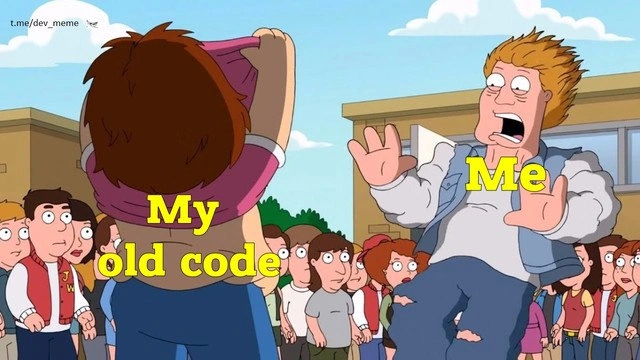
Let’s break down the scene and the concepts for those newer to coding. In the image, a character labeled “Me” is freaking out, leaning back with eyes wide. Opposite him is another character doing something shocking (pulling their shirt up) labeled “My old code.” This silly cartoon illustrates how a developer feels when revisiting legacy code they wrote in the past. It’s like the code is suddenly exposing all its ugliness, and the developer is horrified and embarrassed. The crowd of onlookers in the background adds to the drama – it’s as if everyone is watching you confront this ugly thing you created. In real life, of course, it’s usually just you alone at your desk, but it feels like an awful lot of eyes are on that bad code once you see how messy it is.

Now, what do we mean by “old code” and why is it scary? Old code (often called legacy code) is any code that was written a while ago and has been sitting around, especially if it hasn’t been updated to current standards. It might be code you wrote when you were less experienced, or code someone else wrote who has long since left the company. Often, legacy code lacks proper documentation or tests, making it hard to understand or change. Think of it as an old, creaky machine that nobody fully knows how to operate anymore. When you finally open it up (i.e., read the source code), you might find all sorts of confusing or outdated things inside that make you go “Whoa, that’s not good!”

One common issue with legacy code is poor code quality. Code quality refers to how well-written and maintainable the code is. High-quality code is clean, organized, and easy to read; low-quality code is, well, the opposite. The meme text “My old code” suggests the code in question probably isn’t high quality – otherwise you wouldn’t be recoiling in horror from it! Developers sometimes call messy, poorly organized code “spaghetti code.” Why spaghetti? Imagine a bowl of spaghetti noodles all tangled together – it’s hard to follow one noodle from start to finish, right? Spaghetti code is like that: lots of twisty interconnected logic that’s hard to unravel. For example, you might find a single function that tries to do everything at once, with tons of nested if statements and loops inside loops. Here’s a tiny illustration of what spaghetti code might look like:

// A quick and dirty example of spaghetti-like logic
function processItems(items) {
    for (let i = 0; i < items.length; i++) {
        if (!initialized) 
            initialized = true;  // using a global flag in a weird way
        if (i < items.length / 2) {
            doTask(items[i]);
        } else {
            doTask(items[i]);
            doAuxTask(items[i]);  // duplicate call, hint of copy-paste
        }
    }
    if (!initialized)
        initialize();  // forgotten second initialization? Bug hazard!
    // ... imagine 100 more lines of this mixed logic ...
}

In the messy code above, you can spot a few issues: it re-initializes things in strange places, repeats code, and likely has some logic errors (notice the contradictory initialized checks). Real spaghetti code can be much more complex and tangled, but the feeling you get is similar – confusion and “yikes, this needs cleaning up.”

So why would my own code shock me? Shouldn’t I know what I wrote? Well, over time developers improve their skills. Code written by “past you” might not meet the standards of “present you.” It’s actually a good sign if you can spot things you did wrong in older code – it means you’ve learned a lot since then! But it’s still an uncomfortable feeling. You might discover that you left some quick hacks in place. Maybe you find a comment from your younger self like // TEMPORARY FIX, will rewrite later. News flash: “later” never happened, and now you’re staring at that temporary fix which has become a permanent part of the system. This is where the idea of technical debt comes in.

Technical debt is a metaphor describing how cutting corners in code (for the sake of speed or convenience) creates an “IOU” that you (or someone else) will have to pay back eventually. For example, you choose a quick solution that works for now, but isn’t very clean or future-proof. You save time in the moment (like taking on debt), but the cost comes due when someone has to fix or update that code later (paying off the debt with interest, usually in the form of extra headaches). In our meme scenario, the old code probably has a lot of these little debt markers – things that were done hastily or without foresight – and now the developer is essentially cashing the check and feeling the pain. Refactoring is the process of rewriting or restructuring that code to improve it without changing what it does. It’s like cleaning up the mess: untangling the spaghetti into neat separate strands. But as the tags RefactoringNeeded and RefactoringPain suggest, that can be a difficult and painful task. If the code is especially bad, just the thought of refactoring it can make a developer cringe.

The humor in this meme also taps into developer self-deprecation. That’s when programmers make fun of themselves. Here, “Me” is terrified of code that “Me” wrote. It’s a joke at our own expense: we often complain about bad code as if some clueless person wrote it, only to realize with a facepalm that we were the author all along. It’s both funny and a little embarrassing. There’s even a common anecdote among programmers: “I opened the blame tool to see who wrote this horrible code, and it turned out to be me.” (git blame is a command that shows who last modified each line of code; it’s cheekily named because you use it to find out who to “blame” for a piece of code.)

In summary, the meme shows a developer freaked out by their own old code, highlighting issues of code quality and technical debt in a lighthearted way. It’s poking fun at that moment of shock and regret we feel on seeing how we used to write code, before we knew better. For newer developers, the takeaway is: everybody writes embarrassing code at some point, and encountering it later is almost a rite of passage. The good news is it means you’re improving. The bad news is you might have to clean up that old mess – and that’s where the real work (and sometimes pain) of refactoring begins. But at least you can laugh about it with other devs, because trust us, everyone has been there!

Level 3: Ghost of Code Past

Opening up a dusty legacy codebase can feel like summoning a long-buried monster. The meme captures that jump-scare moment when a developer (the shocked blond labeled “Me”) comes face-to-face with “My old code” in all its ghastly glory. Seasoned engineers know this horror intimately: the scariest code you’ll ever read often has your own name in the commit history. This image exaggerates that encounter by depicting the old code as a shameless flasher, suddenly exposing all the ugly hacks and secrets we’d rather keep buried. It’s a perfect satire of developer self-deprecation and the visceral code horror reaction we get seeing our past sins laid bare.

Why is this so funny and painful? Because it’s true. We’ve all dived into a module or script we wrote years ago and thought, “What on earth was I thinking?” The humor works on multiple levels. First, there’s irony: the same person who wrote the code (me) is now terrified of it. It’s like Dr. Frankenstein screaming at his own creation. In real projects, deadlines and pressure often force us into technical debt — quick-and-dirty solutions that future us is left to untangle. This meme is essentially a PTSD flashback to every refactoring horror show: the late-night on-call emergency patch, the clever convoluted workaround, the 500-line function nobody dared to touch. Over time, those expedient fixes turn a codebase into a minefield of surprises. Coming back to that mess is a Developer Regret rite of passage, where you realize the true cost of all those shortcuts.

The industry pattern being skewered here is the accumulation of tech debt and spaghetti code. That old code likely started out innocently enough, but as features were bolted on and bugs patched hastily, it morphed into an unmaintainable tangle. Everyone preaches “write clean code” and “leave the campground cleaner”, yet reality often intervenes. Business needs change, teams sprint ahead, and that promised refactor gets postponed... indefinitely. Eventually, someone (probably you or an unlucky coworker) has to face the demon you inadvertently created. The shared trauma in this meme comes from those real-world war stories: discovering a function named doEverythingFinal_FINAL() thousands of lines long, or a comment that reads // FIXME: this is a hack left festering since 2015. It’s a universal experience in teams that code evolves and decays, especially when code quality takes a back seat to speed. The onlookers in the background of the image amplify the embarrassment – they’re like your peers or junior devs watching you confront code you wrote in your “wild west” days. Developer humor often laughs at this discomfort, because if we didn’t, we might cry instead.

Let’s talk about why such old code can be truly horrifying from a technical perspective. Over time, best practices change and our skills improve – what seemed like a decent solution years ago might look like spaghetti code now. Spaghetti code is code with a tangled control flow, as messy and intertwined as a bowl of noodles. These legacy bits are often riddled with anti-patterns and code smells that experienced devs learn to avoid. Imagine cracking open a file and finding things like:

  • God Functions: one giant function that does everything, hundreds of lines long, with no clear structure. Maintaining this is a nightmare because a change in line 50 could unpredictably break something in line 250.
  • Cryptic Names: variables or functions called data, temp, or stuff with no context. Past-you didn’t leave a map, so now it’s a guessing game. Was temp2 the user input or the processed result? Who knows!
  • Magic Numbers & Hidden Assumptions: hard-coded values (42, 3.1415, 666) floating in the code with zero explanation. They might be critical limits or just leftovers from testing, but without comments, each is a jump scare.
  • Copy-Paste Coding: blocks of duplicate code scattered around. You fix a bug in one place, only to discover the same bug lives on in three other clones of that code. Surprise!
  • Forgotten TODOs: comments like // TODO: refactor this or // FIXME: improve performance that were never addressed. They glare at you, a mocking reminder that “later” never came.
  • Swallowed Errors: try { ... } catch (Exception e) { /* ignore */ } – essentially the code saying, “If something goes wrong, just pretend it didn’t happen.” This is a ticking time bomb in production, and now it’s yours to defuse.

Each of these is a symptom of technical debt haunting the code. The longer it’s left unchecked, the harder and scarier it is to fix – just as debt accrues interest, messy code accumulates complexity interest. This is why refactoring such a legacy system can feel so daunting: you’re performing surgery on a patient (the code) that’s held together by duct tape, with no tests to catch if you accidentally sever an artery. It’s a mix of fear and regret – fear that any change might break something, and regret that you (or your predecessors) ever let it get this far.

The meme nails the self-reflection horror: the developer character labeled “Me” isn’t just scared; he’s recoiling as if confronted with something indecent. That’s exactly how it feels to stumble upon your own cringe-worthy code — it’s embarrassing, like being caught with your pants down in front of your professional peers. We joke that “my code works, I don’t know why, and I’m afraid to touch it.” Now present-you has to deal with past-you’s crimes code, and it’s almost a split personality moment. The context tags call it old_code_phobia and self_refactoring_terror for good reason. There’s a moment of panic: Can I even understand what I did back then? Will fixing this break everything? Senior devs have felt that dread when tasked with updating a hairy legacy module.

Why do smart people keep ending up in this situation? The meme hints at the systemic issue: technical debt is often sacrificed to ship features on time. Organizations reward quick delivery – “we’ll clean it up later” is the mantra – but they rarely schedule that cleanup. So the cruft piles up. Even the best engineers have to make trade-offs, and sometimes the easiest person to shortchange is your future self. It’s a bit tragicomic: you cut a corner to save the day, and years later you’re cursing that decision, effectively getting bitten by your own shortcut. This vicious cycle continues industry-wide because incentive structures favor new features over maintenance. Thus, every veteran coder at some point opens a file and experiences that sinking feeling of Developer Regret: the realization that the last person who touched this code (often you) left behind a mess. And now you’ve got to clean it.

In summary, the meme is hilarious (and horrifying) because it dramatizes a scenario that is all too real in software development. It’s poking fun at code quality issues and our collective failure to always write beautiful code. The crowd of students watching in the image might as well be your teammates or an audience of junior devs during a code review, all rubber-necking at the spectacle of crappy legacy code being exposed. The TechDebt and RefactoringNeeded tags underline that looming pain: eventually, someone must pay off that debt by refactoring the codebase, and it’s usually a painful, eye-opening process. Refactoring pain indeed – it’s both a technical challenge and a blow to the ego to realize you left such a beast lurking in the repo. But hey, if you can’t laugh about it, you’ll never survive in this field. This meme bonds developers together in that cathartic laughter, as if to say, “We’ve all been there, and yes, it was terrifying… but at least we can joke about it now.”

Description

This meme uses a still from the animated TV show 'American Dad!'. In the foreground, a character with their back to the viewer, labeled 'My old code' in yellow text, is lifting up their pink shirt, exposing their back to a crowd. Another character, labeled 'Me', is recoiling in horror with a terrified expression, hands held up as if to ward off the sight. The background shows a crowd of onlookers with shocked and confused faces. There is a watermark for the Telegram channel t.me/dev_meme in the top left. The meme humorously captures the universal feeling among software developers of being embarrassed or horrified when revisiting code they wrote in the past. As a developer's skills and knowledge of best practices improve over time, their previous work can seem poorly structured, inefficient, or naive, leading to a strong sense of cringe and a desire to disown it
Comments

7
Anonymous ★ Top Pick My old code has no unit tests, but it does have a 'Here be dragons' comment. I'm not sure which is scarier
  1. Anonymous ★ Top Pick

    My old code has no unit tests, but it does have a 'Here be dragons' comment. I'm not sure which is scarier

  2. Anonymous

    Revisiting my 2009 repo is like catching past-me streaking through prod - globals flapping in the wind, a 2 000-line switch statement for modesty, and zero regard for thread safety

  3. Anonymous

    The only thing worse than inheriting someone else's undocumented legacy system is realizing the git blame points to [email protected] from 3 years ago, and the commit message just says 'fixed stuff'

  4. Anonymous

    Every senior engineer has that moment when they git blame their own code from three years ago and realize they've been the villain in their own origin story all along. The real technical debt was the confidence we had along the way - back when we thought nested ternaries and 500-line functions were 'elegant solutions' and comments were for the weak

  5. Anonymous

    Every time my old code shows up, I’m reminded that “temporary hack” is industry slang for “future platform with SLAs and 17 shadow cron jobs.”

  6. Anonymous

    Proof of temporal coupling: six months later the abstraction screams, tests are still 'TODO', and git blame calmly replies, 'also you.'

  7. Anonymous

    When your 2015 'temporary hack' surfaces as the load-bearing pillar of a multimillion-dollar monolith

Use J and K for navigation