Skip to content
DevMeme
1738 of 7435
A Unifying Truth in Programming and Mathematics
Mathematics Post #1942, on Aug 20, 2020 in TG

A Unifying Truth in Programming and Mathematics

Why is this Mathematics meme funny?

Level 1: Unity in Numbers

Imagine two people who usually do very different things finding out they both know the same little fact. Say one friend is really into computers and coding, and another friend is really into math and numbers. They might seem pretty different, but then they both realize something simple and cool: if you multiply 3×2×1, you get 6. They both learned this at some point, and they’re excited that they share that knowledge. It’s like a tiny “secret” they have in common. In the picture, this is shown by the two friends clasping hands in a super enthusiastic handshake, almost like high-fiving but even more epic. It’s funny and sweet because the thing they agree on is so basic – it’s just a small, simple math fact – yet it makes them feel connected. The joke is that even people from two different worlds (coding and math) can become instant buddies when they discover they’re on the same page about something as simple as “3 times 2 times 1 equals 6.” It’s a little celebration of friendship over a shared bit of knowledge.

Level 2: Factorial Basics

Let’s break down the pieces of this meme. First, factorial is a math operation that multiplies a series of descending natural numbers. For example, 3! (pronounced "three factorial") means 3 × 2 × 1, which equals 6. The exclamation mark ! is the notation mathematicians use for factorial. So the text "3! = 6" is stating a simple math fact: if you have 3 items, there are 6 different ways to arrange them. This idea comes from combinatorics, the area of math that deals with counting things like arrangements and combinations. It’s a basic concept taught in both math class and programming class. In fact, if you’ve taken an introductory computer science course, you probably encountered factorials when discussing algorithms – for instance, to analyze how many possible orders a set of data can be arranged in, or as a classic example when learning recursion.

In programming, computing factorial is a common exercise. It’s often used to teach recursion or loops because the definition is simple: n! = n × (n-1) × ... × 1. Many languages don’t have a built-in factorial operator (since, in actual code, ! usually means “not”), so you write a function for it. Here’s a quick Python example to illustrate how a coder might implement the factorial of a number:

def factorial(n):
    return 1 if n <= 1 else n * factorial(n-1)

print(factorial(3))  # prints 6

As you can see, calling factorial(3) returns 6, matching the math fact 3! = 6. Both a programmer and a mathematician would nod at that result because it’s straightforward and universally true. There’s no ambiguity: it doesn’t matter if you’re running a script or doing it by hand, 3 × 2 × 1 will always give 6.

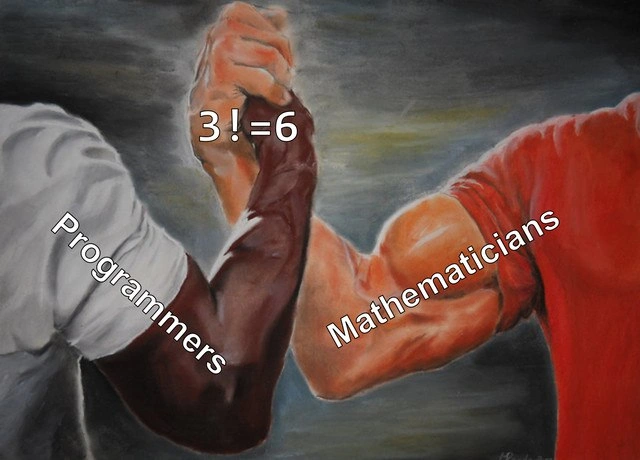
Now, about the image itself: it’s using a popular meme template often called the Predator handshake (based on a scene from the 1987 Predator movie where two characters lock hands in a show of macho camaraderie). In memes, this template is used to show two different groups agreeing strongly on something. Typically, each arm is labeled as a group, and the clasped hands in the middle are labeled with whatever concept they both support. In our case, the left arm is labeled "Programmers" and the right arm is labeled "Mathematicians." The hands meeting in the middle are labeled "3! = 6." This setup implies: Programmers and Mathematicians coming together over their shared understanding that 3 factorial is 6. The muscular arms and intense grip are exaggerated for comedic effect – obviously calculating 3! isn’t a life-or-death feat of strength, but portraying it that way is what makes it funny. It’s tongue-in-cheek: a very simple fact is treated with the same epic importance as, say, two action heroes forging an alliance.

For a junior developer or someone new to these fields, the meme is pointing out that programming and math have common ground. Even if one person spends their day writing code and another spends their day solving equations, they both learn basic things like factorials. It’s a little wink to how interconnected these disciplines are. The meme falls into both CodingHumor and math humor. If you’ve learned about factorials in either a programming course or a math class, you’ll get why they’re shaking hands over "3! = 6": it’s a friendly nod to the overlap between the two worlds. In short, the meme says: programmers and mathematicians may have differences, but they totally agree on this one basic thing, and that playful agreement is worth a laugh (and a dramatically overdone handshake).

Level 3: Permutation Pals

This meme uses the famous Predator movie arm-wrestle handshake format to highlight a happy agreement between two camps: Programmers and Mathematicians. In the image, each muscular arm is labeled with one of those groups, and their clasped hands have the caption 3! = 6. If you're in on the joke, you immediately recognize that “3 factorial equals 6” is an absolutely true statement in both math and programming circles. The humor comes from how dramatically this ultra-simple fact is being celebrated. The Predator-handshake meme is usually about two very different folks finding common ground, and here that common ground is a piece of nerdy trivia both sides love. It’s saying that despite any differences, when it comes to the fact that 3! is 6, both developers and mathematicians will clasp hands like action heroes in firm agreement.

Why is that funny? For one, 3! = 6 is almost childishly simple – it’s likely one of the first non-trivial facts you learn in combinatorics or in a CS fundamentals class. Yet the meme portrays it as a cause for an epic alliance with bulging biceps and intense pride. The contrast between the simplicity of the fact and the over-the-top intensity of the handshake creates the comedy. It’s like saying: “Look, even programmers and mathematicians – who might not always see eye-to-eye – become instant best buddies over this one obvious truth!” The exaggerated musculature and dramatic lighting parody how we sometimes overhype even the littlest shared nerd fact. Both communities have a stake in this one: developers likely encountered factorials when learning to write a factorial() function or studying algorithms, and mathematicians use factorials routinely in formulas for probability and counting problems. There’s a real sense of “I know that one too!” satisfaction.

Another layer of chuckle comes from the notation itself. In many programming languages, the ! symbol means a logical NOT, so writing 3! in actual code would usually be a mistake (it might read as “not 3”, which is nonsense in most contexts). But here everyone instantly switches to math mode and reads 3! as factorial. Any coder who’s taken basic discrete math recognizes it – no confusion, just a quick moment of “Yes, 3 factorial is 6, of course!” There’s no debate to be had, no off-by-one errors, no edge case exceptions. It’s a rare moment of pure, wholesome agreement.

Ultimately, the meme taps into a warm feeling of solidarity over shared knowledge. It’s a wink to how computer science and math have a big overlap. Many programmers have sat through enough math classes to know the factorial by heart, and many mathematicians have written a bit of code to verify their calculations. So both sides can nod knowingly. It’s the kind of joke that might appear in a developer humor forum or a classroom slideshow, where a simple algorithm humor reference doubles as a math joke. In an industry where debates can rage over things like “tabs vs spaces” or where pure math proofs and practical coding solutions diverge, it’s refreshing to see a trivial fact become a unifying handshake. For anyone with a foot in both CS Fundamentals and Mathematics, this little permutation gag is a grin-inducing reminder that at the core, we’re often geeking out over the same things.

Level 4: Combinatorial Consensus

Under the hood of this joke is a foundational concept from combinatorics: the factorial function. Both mathematicians and seasoned programmers engage with factorials, albeit in different contexts. In mathematics, $n!$ (n factorial) gives the number of ways to arrange n distinct items – it's a cornerstone of formulas for permutations and combinations. Meanwhile, in algorithm analysis, a programmer knows that dealing with an $O(n!)$ algorithm (like brute-forcing all permutations of n elements) means the computation will explode in complexity as n grows. The equality 3! = 6 is a simple instance of this concept, but it represents something bigger: a universal truth that both a formal proof and a computer program will confirm exactly the same way. It’s a tiny equation that sits at the intersection of CS_Fundamentals and Mathematics, illustrating how discrete math underpins computing logic.

For mathematicians, 3! = 6 is trivial to derive by definition (3! = 3 × 2 × 1) or to prove via induction. For programmers, it’s just as straightforward to validate by writing a quick recursive function with a clear base case. Interestingly, that recursive definition F(n) = n * F(n-1) mirrors the inductive definition in math – a handshake between proof and implementation. This parallel isn’t a coincidence: many ideas in coding are essentially constructive versions of math principles. Both camps also recognize how quickly factorial values grow. By 4! = 24, 5! = 120, and 10! = 3,628,800, the numbers get huge, illustrating the infamous combinatorial explosion. A mathematician might even bring up Stirling’s approximation for estimating large factorials, while a programmer might worry when their data type will overflow from big values. Yet at the modest value of 3! = 6, there’s no such drama – just a solid fact on which both sides wholeheartedly agree. The meme’s dramatic handshake humorously symbolizes this rare consensus on a fundamental idea that’s equally at home in a theory lecture or a code snippet’s output. It’s a small number with an outsized ability to make math and code folks alike grin in solidarity.

Description

A meme using the 'Epic Handshake' format, which depicts two muscular arms (one Black, one white) clasping hands in a powerful agreement. The left arm, belonging to a man in a white shirt, is labeled 'Programmers'. The right arm, from a man in a red shirt, is labeled 'Mathematicians'. At the point where their hands meet, the text '3 != 6' is overlaid. The brilliance of this meme lies in the dual interpretation of the text. For mathematicians, '3!' signifies the factorial of 3 (3 * 2 * 1), which equals 6. Thus, the statement '3! = 6' is true. For programmers, '!=' is the 'not equal to' comparison operator, meaning the statement '3 != 6' also evaluates to true. The meme humorously celebrates a rare moment of syntactical overlap where both disciplines arrive at the same correct conclusion through entirely different logical paths
Comments

7
Anonymous ★ Top Pick This is the only expression that passes both a code review and a mathematical peer review without a single clarifying comment
  1. Anonymous ★ Top Pick

    This is the only expression that passes both a code review and a mathematical peer review without a single clarifying comment

  2. Anonymous

    Programmers and mathematicians happily unite over 3 ! = 6 - right up until the architect points out our microservice choreography has 8 ! possible call sequences and everyone remembers why observability budgets exist

  3. Anonymous

    After 20 years in the industry, I've learned that the real factorial is the number of times you'll have to explain to a PM why '3! = 6' doesn't mean your unit tests are broken - it's just math asserting dominance over your carefully crafted boolean expressions

  4. Anonymous

    The beautiful moment when programmers see '3!=6' and experience a microsecond of cognitive dissonance - their parser screaming 'boolean comparison!' before their mathematical cortex kicks in with 'ah yes, factorial.' It's the rare operator overload that exists across disciplines, reminding us that whether you're calculating permutations for algorithm complexity or just trying to figure out why your inequality check compiled but returns the wrong result, context is everything. Mathematicians never had to debug the ambiguity; they got the exclamation mark first

  5. Anonymous

    3! = 6 is the one cross‑discipline contract nobody bikesheds; after that, the bang is logical‑not, Ruby‑dangerous, TypeScript non‑null, or Bash history expansion depending on which service you’re debugging

  6. Anonymous

    Programmers iterate to 6, mathematicians prove it recursively - truce before stack overflow hits

  7. Anonymous

    3! = 6: the last noncontroversial bang. Ask about 0! and you’ll learn who studied combinatorics and who just needed the recursion to terminate before the pager fired

Use J and K for navigation