The Developer's Bedtime Paradox
Why is this Testing meme funny?
Level 1: Who Checks the Checker?
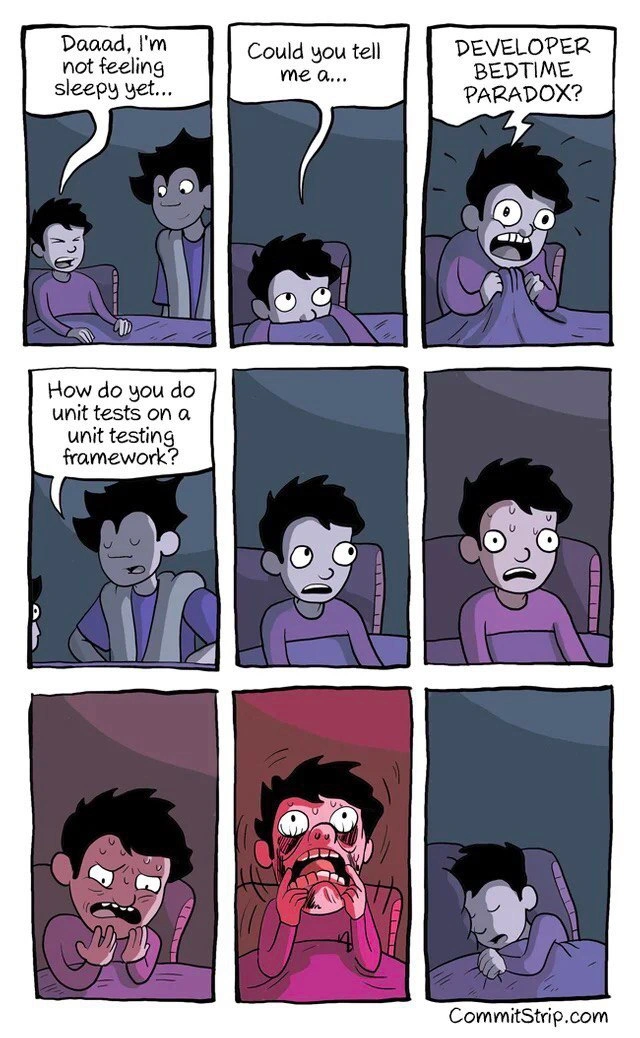
A dad's job at bedtime is usually to chase the monsters away. This dad instead asks his kid a question with no bottom: imagine your teacher grades your homework, but who grades the teacher? Another teacher? Okay — who grades that teacher? And who grades the one who grades her? The kid's brain spins around and around like a hamster wheel going faster and faster until — flop — he's out cold from sheer exhaustion. That's the whole joke: some questions don't have an answer, just an exit, and the fastest way to put a curious mind to sleep is to hand it a puzzle that never stops asking itself.
Level 2: Unpacking the Bedtime Question
- Unit test: a small automated check verifying one piece of code in isolation — "calling
add(2, 2)returns4." You run hundreds of them after every change. - Unit testing framework: the tool that discovers your tests, runs them, and reports green/red — JUnit (Java), pytest (Python), Jest (JavaScript). Your tests are only meaningful if it works: if the framework wrongly reports "all passed," every test you wrote is decorative.
- The paradox: to test the framework you'd naturally... write unit tests. Which need a framework. Maybe the same one. If it's broken, it might cheerfully report that it's fine — like asking a suspect to investigate himself.
- Bootstrapping: solving chicken-and-egg problems by starting from a tiny trusted seed and building upward — how compilers, operating systems, and yes, test frameworks actually come to exist.
Junior-career connection: the first time a test passes when you know the code is broken, you'll discover the test itself had a bug — an assertion that never ran, a mock that swallowed the failure. That day, this comic stops being abstract. The lesson isn't paranoia; it's the habit of occasionally making a test fail on purpose to prove it can.
Level 3: The Paradox as a Tucking-In Service
The CommitStrip setup is perfect parenting jiu-jitsu. The kid stalls — "Daaad, I'm not feeling sleepy yet... Could you tell me a..." — and dad, lit like a horror-movie narrator, strikes first: "DEVELOPER BEDTIME PARADOX?" Then the payload:
How do you do unit tests on a unit testing framework?
What follows is the strip's real punchline: three rows of escalating cognitive load rendered on the kid's face — darting eyes, sweat, a full red-shifted scream panel — terminating in collapse. The child doesn't fall asleep because he's calm; he falls asleep because his stack overflowed. Recursion without a base case, resolved by resource exhaustion. Any engineer who has lain awake at 2 AM mentally re-deriving whether their mocking library could itself be lying knows this exact arc, minus the parental supervision.
The reason the question lands with working developers is that it's not rhetorical. JUnit, pytest, Jest — all of them ship with test suites, and those suites largely run on the framework under test. The practical escape hatches are well known and each slightly unsatisfying: test the framework with an older, trusted version of itself (bootstrapping); test it with a different framework (now who tests that one?); write framework tests so primitive — raw assert, exit codes, golden output files — that they sit below the abstraction being verified. The industry's honest answer is layered confidence rather than certainty, which is also why the strip is secretly about TDD culture: we preach that untested code can't be trusted, while the entire trust chain bottoms out in code that, by construction, couldn't be tested the same way. The green checkmark at the top of your CI run rests on a foundation of "eh, it's probably fine," and almost nobody looks down.
Level 4: Turtles, Trust, and Trusting Trust
The kid's terror is philosophically well-founded. "Who tests the test framework?" is a software instance of a genuinely deep problem: the regress of verification. Any tool you use to establish confidence in software is itself software, so its own correctness needs establishing — by what? Another tool? Now recurse. This is the engineering cousin of quis custodiet ipsos custodes, and it surfaces all over computer science. Compilers face it as the bootstrapping problem: a self-hosting compiler (GCC compiling GCC, Rust's rustc written in Rust) must be born from an earlier compiler, tracing an unbroken ancestry back to hand-assembled machine code. Ken Thompson's Turing Award lecture Reflections on Trusting Trust weaponized exactly this regress, showing a compiler could inject a backdoor into programs it compiles — including into new versions of itself — leaving no trace in any source code you could ever read. His conclusion: you cannot fully trust code you did not totally create, and you didn't totally create any of it.
Formal methods push the regress down rather than eliminating it. A proof assistant like Coq verifies proofs with a deliberately tiny trusted kernel — small enough for humans to audit — so the unverifiable base is minimized, not removed. Gödel hovers nearby too: sufficiently powerful consistent systems cannot prove their own consistency, so a test framework "fully validating itself" is structurally suspect in the same way. In practice the regress terminates not in logic but in diversity and convergence: independent implementations, independent reviewers, and the brute empirical fact that millions of users would have noticed if assertEquals(2+2, 4) lied. The foundation isn't proof — it's a sediment of cross-checks. Which is exactly the kind of answer that lets adults sleep and keeps thoughtful children awake.
Description
A nine-panel comic strip from 'CommitStrip.com' illustrating a conversation between a father and his son at bedtime. In the first panel, the son says, 'Daaad, I'm not feeling sleepy yet...'. He then asks for a 'DEVELOPER BEDTIME PARADOX?'. The father obliges, asking, 'How do you do unit tests on a unit testing framework?'. The subsequent panels show the son's escalating horror and existential crisis as he contemplates this recursive problem. His eyes widen, he starts to sweat, and his face contorts in anguish. The final panel shows him sound asleep, his mind presumably exhausted by the paradoxical thought. The humor stems from the classic software engineering dilemma of 'testing the tester.' It's a philosophical, recursive problem about how to verify the correctness of the very tools used for verification, a concept that is both deeply nerdy and amusing to experienced developers who appreciate the logical loops inherent in their craft
Comments
8Comment deleted
How do you test a testing framework? You write a second, buggier testing framework to test the first one, then use the first one to find the bugs in the second. If they both report success, you have a problem
Realising you need tests for your test runner is the moment you learn recursion has a bedtime story of its own
The same existential dread you get when you realize your test coverage metrics are at 100% but production is still on fire because nobody tested the assumptions your tests were testing
You test the test framework with the test framework, trust the green checkmark, and never ask who asserted the assert - turtles all the way down, and every turtle reports 100% coverage
The real answer? You write tests for your testing framework using... another testing framework. Then you test that framework with yet another one. Eventually you reach the primordial testing framework written in the 1970s that everyone just trusts because the alternative is an infinite stack of test runners, and nobody has time for that kind of yak shaving. It's turtles all the way down, except the bottom turtle is held up by collective faith and a really old Makefile
Unit‑testing the test framework starts with a failing fixture, detours into a meta‑runner and property checks, and ends with you accidentally writing a tiny proof assistant at 2 a.m
Bootstrapping a test framework: the only chicken-egg problem where both explode if wrong
You test a testing framework like a compiler: cross-check an independent implementation, add property-based and metamorphic checks for the assertions, unleash mutation testing - congrats, the kid sleeps and your team doesn’t