Skip to content
DevMeme
When Your Passion Becomes Your Job
MentalHealth Post #79, on Feb 8, 2019 in TG

When Your Passion Becomes Your Job

Why is this MentalHealth meme funny?

Level 1: The Cake Decorator Who Hates Cake

Imagine a kid who loves drawing so much that they draw every single day, just for fun. Then someone says: "Great news! Drawing is now your chore. You must draw these exact pictures, by Friday, the way we tell you, forever." Pretty soon the kid doesn't doodle anymore — the fun part wasn't just the drawing, it was getting to choose. The comic shows two monsters sad about exactly this, and the joke is that it doesn't matter what the job is — pick either door, the story ends the same way: at a bar, with a sigh, missing the days when it was just for fun.

Level 2: Terms for the Barstool

  • Burnout: chronic workplace exhaustion — not "tired this week" but a depleted relationship with the work itself. Common enough in software that conference talks about it sell out.
  • Intrinsic vs. extrinsic motivation: doing something because it's fun versus doing it for rewards or to avoid punishment. Research consistently shows extrinsic rewards can crowd out intrinsic joy — the academic core of this meme.
  • Passion-driven hiring: the industry norm of treating after-hours coding as a hiring signal. It works as a filter, but it preselects exactly the people most exposed to this comic's trajectory.
  • Side project: the thing developers build at home to remember why they liked this. Healthy in moderation; a warning sign when it becomes a second backlog.

The early-career version of this arc is recognizable: in school, coding meant building whatever you wanted — a game, a bot, a tool for your friends. Your first job replaces that with someone else's priorities, someone else's codebase, and meetings about both. Most developers eventually negotiate a truce: keep one corner of programming purely for joy, never monetize it, never put it on a résumé. The monsters at the bar are what happens when you don't.

Level 3: The Interchangeable Punchline Problem

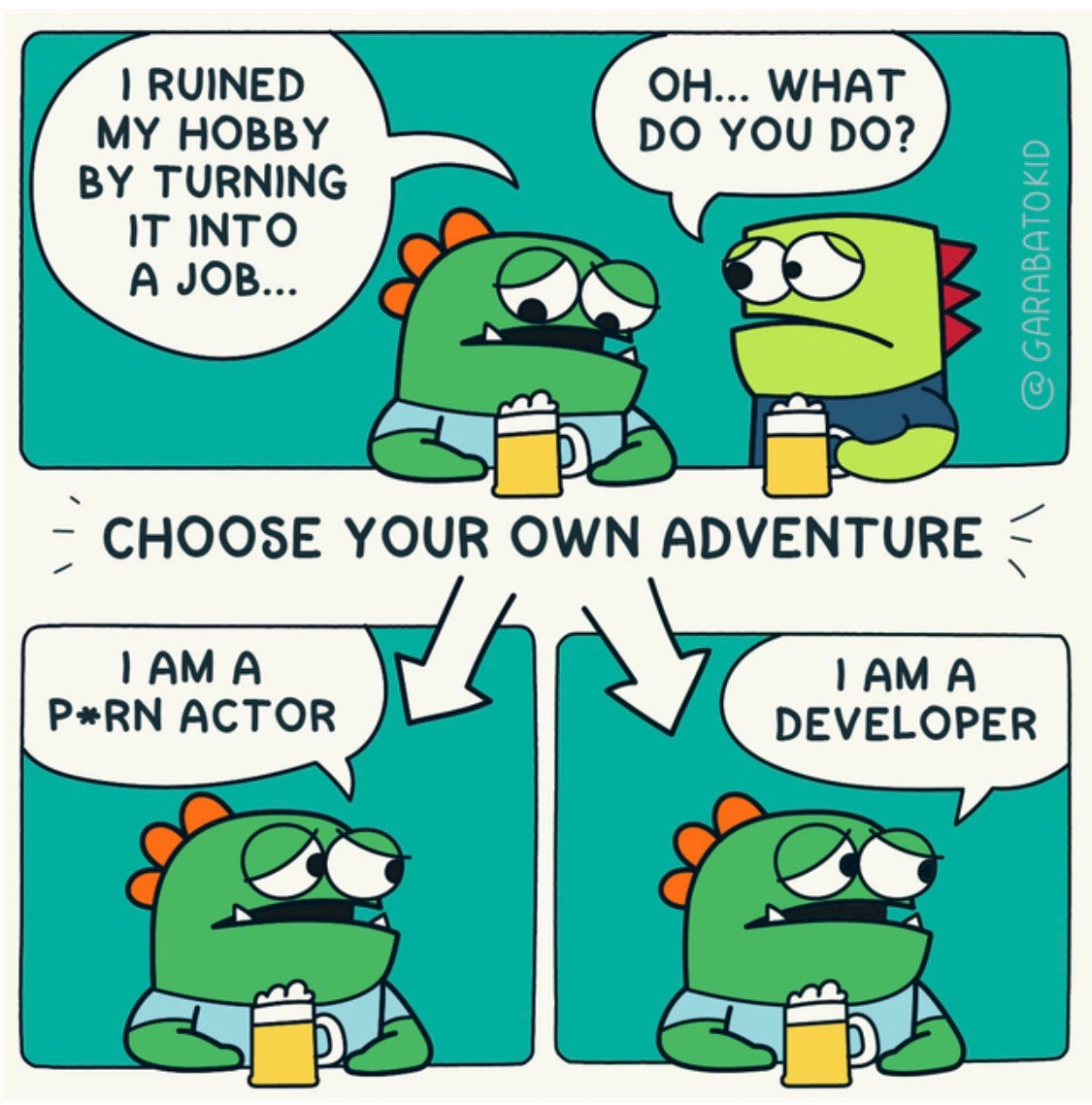
Two cartoon monsters nurse beers at a bar. The sad green one confesses:

I RUINED MY HOBBY BY TURNING IT INTO A JOB...

His friend asks the obvious follow-up — "OH... WHAT DO YOU DO?" — and then the Garabato Kid comic pulls its structural trick: a "CHOOSE YOUR OWN ADVENTURE" banner forks into two alternate final panels. Left branch: "I AM A P*RN ACTOR." Right branch: "I AM A DEVELOPER." Identical weary face in both. That equivalence — drawn, not stated — is the entire thesis: the punchline is substitutable, and the substitution is unflattering in both directions.

The mechanism being satirized is well documented far beyond comics. Psychology calls it the overjustification effect: when an activity you did for intrinsic joy starts being driven by external rewards — salary, deadlines, performance reviews — the intrinsic motivation measurably erodes. Programming is uniquely vulnerable because the industry actively recruits on passion. Job listings want people who "live and breathe code"; interviews quietly reward a GitHub profile that proves you also code on weekends. The deal sounds perfect: get paid for the thing you'd do for free. Then the thing you'd do for free becomes Jira tickets, sprint estimates revised mid-sprint, code review nitpicks about bracket placement, a legacy codebase nobody chose, and an on-call pager. The activity survives; the autonomy dies — and autonomy, it turns out, was the part you actually loved. You used to decide what to build, how to build it, and when to walk away. Now all three decisions belong to a roadmap.

The choose-your-own-adventure framing adds a second blade. By making the developer ending swappable with the adult-film ending, the comic implies the failure mode is universal across passion industries — musicians, chefs, game devs, and yes, that other profession all converge on the same barstool. Game development is the canonical tech example: the industry runs on people who loved games enough to accept crunch and lower pay, and burns through them. The shared expression in both endings is the comic's quiet punch: it doesn't matter which branch you chose. The adventure was choosing; the destination was never in question. Meanwhile the hobby-shaped hole gets backfilled with side projects that somehow turn into portfolio maintenance — unpaid overtime with better architecture.

Description

A three-panel comic strip by artist @GARABATOKID, set against a teal background, featuring two cartoonish green dinosaurs. In the first panel, two dinosaurs are sitting at a table with mugs of beer. One, with orange spikes, looks dejected and says, 'I RUINED MY HOBBY BY TURNING IT INTO A JOB...'. The other asks, 'OH... WHAT DO YOU DO?'. The middle of the comic presents a choice with the text 'CHOOSE YOUR OWN ADVENTURE' and two arrows pointing down. The bottom section is split into two panels, presenting the punchline. In the left panel, the sad dinosaur says, 'I AM A P*RN ACTOR'. In the right panel, the same dinosaur says, 'I AM A DEVELOPER'. The joke lies in the cynical equivalence of these two professions as ways to ruin a passion. For many in tech, coding begins as a beloved hobby. The comic suggests that the pressures of professional software development - deadlines, bureaucracy, burnout, and technical debt - can drain the joy from this hobby, making it feel like a soul-crushing job, a sentiment that resonates deeply with experienced developers who have witnessed or experienced this disillusionment firsthand
Comments

8
Anonymous ★ Top Pick Some hobbies are ruined by turning them into a job. With development, the job is ruined by turning it into a hobby of fixing production at 3 AM
  1. Anonymous ★ Top Pick

    Some hobbies are ruined by turning them into a job. With development, the job is ruined by turning it into a hobby of fixing production at 3 AM

  2. Anonymous

    Remember when coding was a ‘weekend side quest’ and not a prod-impacting KPI? Pepperidge Farm’s audit logs remember

  3. Anonymous

    Remember when you used to stay up all night coding because you wanted to, not because someone scheduled a production deployment at 3am and the rollback plan is "pray the previous version still works"?

  4. Anonymous

    The hobby died the day 'I love building things' became 'story points'. Now your side projects are just unpaid overtime with better architecture

  5. Anonymous

    The real joke here is that both career paths involve getting repeatedly screwed while pretending to enjoy it, dealing with unrealistic performance expectations, and having strangers constantly critique your work - though at least the porn actor doesn't have to attend daily standups to explain why yesterday's performance metrics were suboptimal

  6. Anonymous

    When your hobby compiles into a career, the only branch left to choose is OKR‑driven burnout or pager‑driven burnout

  7. Anonymous

    Nothing kills a hobby faster than wrapping it in OKRs, a Jira board, and an on-call rotation - suddenly ‘fun project’ has SLAs and postmortems

  8. Anonymous

    Both promise creative freedom, but deliver script-driven drudgery where 'the director' rewrites your masterpiece mid-scene

Use J and K for navigation