The Microservices Onboarding Experience
Why is this DesignPatterns Architecture meme funny?
Level 1: Big Promise, Boring Place
Imagine your friend excitedly says, "I’m taking you to the coolest, most fun place ever!" You think you’re going to a theme park with roller coasters and games. But instead, they take you to a quiet library or a dull office. You’d feel pretty let down, right? They promised something super exciting, but gave you something super boring. That’s the joke of this meme. The job ad used big exciting words to get someone hyped about a new job, but the actual workplace turned out to be just a plain gray cubicle (the typical little office space with high walls). It’s funny in the same way as if someone said “Here’s a yummy huge ice cream sundae!” and then handed you a bowl of plain oatmeal. The big promise and the boring reality are so far apart that it makes people laugh – because we all know how disappointing (and silly) that kind of switch can be.
Level 2: Decoding the Hype
For those newer to the tech world, let’s break down what’s going on here. The meme shows a big difference between what a job ad says and what you actually get at the job. The top text is quoting a typical job advertisement line: "Must be willing to work in a high paced and exciting environment." This is a fancy way companies try to make a job sound thrilling and action-packed. It’s part of the common buzzword language you’ll see in many listings. “High-paced environment” basically means the workplace can get very busy or hectic. Maybe there are frequent deadlines, or projects move quickly, so you have to be on your toes. They throw in “exciting” because, of course, they want you to think you won’t be bored – that you’ll be building cool things non-stop in a vibrant atmosphere. This kind of phrasing is almost a default in tech job postings; it’s rare to see a listing proudly say “join our slow, boring office.” Everyone wants to claim their work environment is awesome. That’s why we call it high_paced_environment_hype – it’s hype that may or may not match reality.
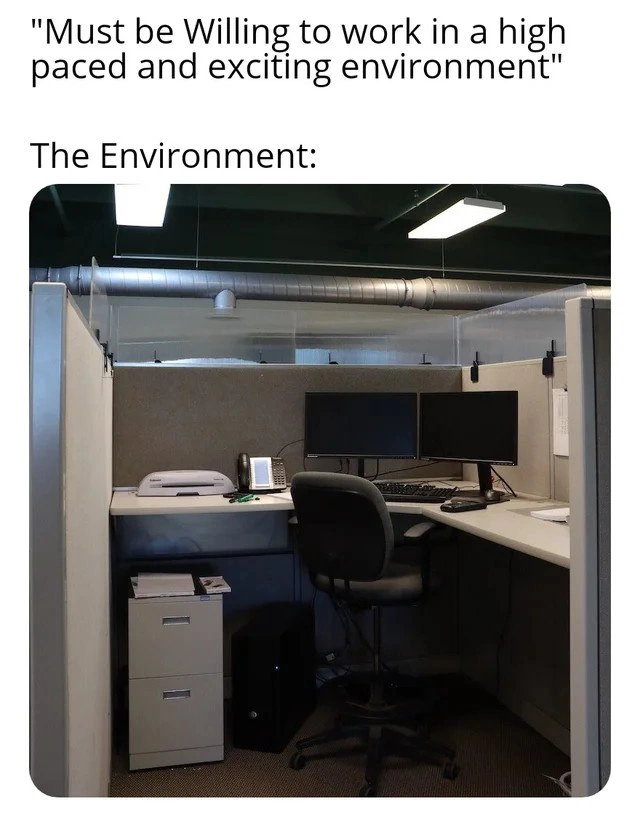
Now, the meme’s bottom part, labeled “The Environment:”, shows a photograph of the actual work setting being offered. And it’s… well, pretty bland. We see a small office cubicle. A cubicle is a little enclosed desk area, separated by partition walls from other employees’ areas. They’re usually neutral-colored (gray or beige, like in the pic) and just big enough for a desk and a chair. When you have lots of them in an office, people humorously call it a cubicle farm – imagine rows of cubicles as like fields of square pods in a big room. It’s a very common layout in older or more traditional companies for giving employees a semi-private workspace. Not super glamorous, but functional.
Inside this particular cubicle, you’ve got what looks like a standard developer setup. There are dual monitors – two screens side by side. Many programmers use two (or more) monitors to have code on one screen and maybe the application or documentation on the other. It helps with multitasking and is pretty routine, so nothing especially “exciting” there (it’s almost expected equipment). The keyboard is a regular office keyboard (likely a simple, squishy membrane keyboard, not one of those fancy mechanical ones with clicky keys that some devs love). There’s a regular mouse, a common black office chair on wheels, and interestingly, a desk telephone and a small printer. The presence of a telephone on the desk tells you this company still uses landlines or VoIP phones for calls – maybe for conference calls or to talk to clients. It’s kind of old-school for tech these days (many modern offices just use chat apps or laptop audio), but plenty of places still have a phone at every desk. The little printer is probably a laser printer meant for personal use. That suggests that the person in this cubicle prints documents frequently (perhaps reports, specs, or forms to sign). Alongside the printer is a beige two-drawer filing cabinet stuffed with papers, meaning they keep physical copies of files or documents. So this is not exactly a paper-free, all-digital office – they still shuffle paperwork around. Overhead, you can see the fluorescent lights (those long white tube lights in the ceiling fixture) which give everything a bit of a harsh, white glare. And above the cubicle walls, you can see the big silver ventilation duct – that’s part of the building’s HVAC (heating, ventilation, air conditioning) system. Many offices have an open ceiling like that where you can see the ducts; it can give an industrial vibe, but combined with everything else here, it doesn’t magically create an “exciting” feel.
When the job ad said “high paced and exciting”, a newcomer might imagine a Google-like space: bright colors, open collaborative areas, people zipping around brainstorming, maybe a game room or fancy tech labs. Instead, the environment shown is the opposite of high-energy. It’s quiet, plain, and isolated – you can almost hear the soft hum of a computer and the distant click of someone typing. There’s no crowd of energized colleagues brainstorming on a whiteboard; it’s just a solitary workstation. The meme is making a joke by putting these two things together: the extravagant promise and the underwhelming reality. This contrast is something many people find humorous because it happens a lot. It’s not just in jobs – it’s like any time you see an advertisement making something sound amazing and then the real thing is pretty ordinary.
To a junior developer or someone job hunting for the first time, the meme is a bit of friendly advice wrapped in humor: don’t take every glowing job description at face value. Companies aren’t usually trying to lie, but they do like to put a positive spin on everything. It’s polished language. So, “fast-paced” could mean “we have a lot of projects and sometimes it gets chaotic.” “Exciting” could just mean “we think our product is important, even if the day-to-day work isn’t thrilling every second.” It’s good to ask questions when you’re interviewing or look for clues about the company’s actual culture. For instance, if during an interview you get a tour and see an office exactly like the meme’s photo, you’ll know the vibe is more conventional and calm, not the high-octane creative studio you might have imagined from the ad. That doesn’t mean the job is bad at all – lots of developers do great work and have fulfilling careers in cubicles just like that. It’s just about expectations vs. reality. You adjust your expectations so you won’t be disappointed by the lack of a promised “thrill”.
This meme falls under WorkplaceHumor and specifically HiringHumor because it playfully jabs at the way companies recruit. It resonates with a lot of people because plenty of us have felt that tiny sting of “Oh… this is it?” when walking into an office that we were told was next-level exciting. The image of the bland cubicle is almost universally understood – even if you haven’t worked in one, you’ve seen it in movies or TV (think of the office in the movie Office Space or scenes in shows like The Office). It represents routine and monotony. By contrast, the words “high paced and exciting” represent thrill and speed. Putting them together is like saying “we have a super fast sports car!” and then revealing a trusty old family minivan. It’s the exaggeration and contrast that make the humor click. Even a junior developer can appreciate that joke once it’s pointed out: flashy words don’t always match the truth.
In summary, the meme is decoding a little truth about tech jobs: the way they’re sold to you can be very different from what you’ll actually experience. It encourages a healthy bit of skepticism (with a chuckle) when reading those buzzword-filled job ads. The next time you see a posting that sounds unbelievably exciting, you might remember this meme and think, “Alright, but what’s the office really like?” It’s a lighthearted lesson from the tech community’s collective experience.
Level 3: Buzzwords vs Beige
The meme highlights a classic disconnect in tech CorporateCulture: the glossy language of a job listing versus the dull reality of an actual workplace. The top caption – "Must be Willing to work in a high paced and exciting environment" – drips with buzzword_job_posting hype. Seasoned engineers have seen this line a hundred times in Career_HR emails and know it often signals more smoke than fire. In fact, the inconsistent capitalization of "Must be Willing" is a red flag that it's boilerplate HR jargon. It’s almost a running joke, a square on the corporate_buzzword_bingo card. A senior developer reading that phrase might roll their eyes, translating high_paced_environment_hype as “expect long hours and constant priority shifts” and exciting as “we'll call even our legacy maintenance exciting if it gets you in the door.”
Then comes the punchline: “The Environment:” with a photo revealing what that exciting environment actually looks like. The Environment in question is a drab, gray cubicle farm straight out of a 1990s office satire. Two modest 24-inch monitors sit on the desk (standard issue, nothing futuristic), attached to a typical black docking station. There's a plain old membrane keyboard and basic mouse – not exactly the trappings of a cutting-edge tech playground. A lonely desk telephone and even a little laser printer_on_developer_desk hint that this company might still be shuffling paper and putting people on hold, not exactly living the cloud-powered future. The cubicle itself, with its beige fabric walls and metal dividers, is utterly generic. Overhead, fluorescent lights cast a cold white glare, and an exposed ventilation duct snakes along the ceiling. It’s the kind of low-energy, generic office WorkplaceCulture that screams “budget cuts” more than “breakneck innovation.” In other words, the environment is about as exciting as watching paint dry on those beige office walls.
Why is this funny to those of us in the industry? Because it's HiringHumor 101: companies love to promise the world in their buzzword-laden job ads, but veterans know how often those promises fall flat. The meme perfectly captures that expectation vs. reality gap. We chuckle (or maybe groan) remembering our own experiences of eagerly joining a team promised to be “dynamic and fast-paced,” only to find ourselves squinting under harsh lights in a silent cube, dealing with ticket backlogs all day. It’s a shared joke, a bit of CareerHumor born from collective experience. The job_description_vs_reality contrast is exaggerated here for effect: the caption hypes up an “exciting environment,” and then the image delivers the most mundane setup imaginable. The humor lives in that exaggeration – it’s practically sarcasm in picture form.
For senior developers, this meme also nods to a form of gallows humor about workplace truth-in-advertising. We’ve all learned to read between the lines of a job listing. "Fast-paced environment" often translates to “constant firefighting because everything is last-minute.” **"Exciting projects"* might mean “old systems in dire need of updates, but hey, you'll own that thrilling migration to Java 8.” It’s a cynical view, sure, but it’s grounded in the reality that companies rarely advertise the boring or stressful parts of a job. Instead, they sprinkle adjectives like an icing on a stale cake. The meme’s dull cubicle photo is that stale cake – no amount of icing words can hide it. It even has a beige two-drawer filing cabinet stuffed with paperwork, as if to hammer home that this isn’t some futuristic dev pod with standing desks and VR headsets; it’s an OfficeHumor cliché. One can almost hear the buzz of the fluorescent light ballast and feel the slight wobble of that rolling chair. Exciting, indeed.
There’s also an element of “we’ve been here before” that senior folks appreciate. This meme could be set in 2021, 2011, or 2001 – and that’s the point. Decades pass, technologies change, but the corporate habit of overselling a job in the posting stays the same. It’s practically timeless in tech lore. The WorkplaceHumor comes from recognizing that disconnect and surviving it with a sense of irony intact. In a way, memes like this are a coping mechanism. They let developers vent about the little lies or exaggerations we encounter in the working world. By laughing at the absurdity (like calling a cubicle maze a “high paced and exciting environment”), we take back a bit of control and camaraderie. A cynical veteran might quip, “The only thing high-paced here is how fast I looked for the exit.” It’s darkly funny because it rings true.
Finally, on a more thoughtful note, this meme pokes at a real issue in hiring and WorkplaceCulture: the misalignment of expectations. Companies risk demoralizing new hires when the reality doesn’t match the pitch. And developers, especially those of us who’ve been around the block, get a little more jaded each time we walk into an office that was sold as Google-esque only to find something closer to a DMV office. Yet we laugh, share the meme, and get back to coding under those fluorescent lights, muttering “must be willing to work in an exciting environment, huh… they got jokes.” It’s our way of saying “we see through it,” bonding over the common experience. In short, the meme is funny because it’s painfully true: in tech, as in life, if something sounds too exciting to be true, it probably comes with a beige cubicle attached.
Description
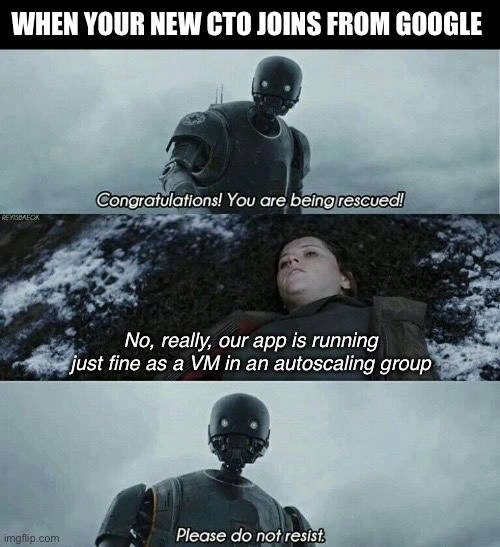
A two-panel meme contrasting the theoretical complexity of microservices with their messy reality. The top panel, captioned 'Juniors trying to understand the 7 microservices talking to each other,' shows a character from a movie looking overwhelmed by a complex diagram on a futuristic screen. The bottom panel, captioned 'The 7 microservices,' provides the punchline with a photo of a chaotic, tangled mess of power cables, adapters, and extension cords behind a piece of furniture. The joke lies in the analogy: the elegant concept of independent services often devolves into a messy, hard-to-trace, and tightly-coupled nightmare in practice, much like a rat's nest of wires. This is a common pain point for both new and senior engineers dealing with the operational reality of poorly implemented distributed systems
Comments
12Comment deleted
The junior is confused because they're looking for the service mesh, but it's just a bunch of daisy-chained cron jobs and a single EC2 instance running everything
“Turns out ‘high-velocity, cutting-edge environment’ means two 1080p panels, a beige filing cabinet, and a desk printer that only speaks PCL - our sprint velocity is literally measured in pages per minute.”
The "high-paced" part is your CI/CD pipeline failing every 20 minutes, and the "exciting" part is discovering the previous architect stored secrets in plaintext comments because "the repo was private anyway."
When the job posting promises a 'high-paced and exciting environment,' they're technically correct - the pace is high because you're context-switching between three legacy systems with zero documentation, and it's exciting in the same way production outages at 3 AM are exciting. The exposed ductwork is just honest architecture: no false ceilings to hide the technical debt above
High-paced alright - where the real CAP theorem tradeoff is Consistency of your sanity versus Availability of the exit door
“Fast-paced, exciting environment” - translation: a cube with dual monitors, a desk phone, and a printer because our CI/CD is literally “print the CAB form and wait.”
Recruiter set ENV=FAST_PACED; Group Policy overrides at runtime to ENV=cubicle_gray with fluorescent jitter and a locked-down Windows image
what a nice chair you have there Comment deleted
hope ur back won't hurt Comment deleted
Thomas Anderson's place 20 years later if he'd taken the blue pill Comment deleted
damn the resemblance is uncanny Comment deleted
if u only knew that i extremely hate openspaces Comment deleted