Skip to content
DevMeme
6667 of 7435
Dev Meme Telegram Channel Language Statistics Pie Chart
DevCommunities Post #7306, on Oct 20, 2025 in TG

Dev Meme Telegram Channel Language Statistics Pie Chart

Why is this DevCommunities meme funny?

Level 1: Unexpected Guests

Imagine you threw a party and only set out snacks and signs in English because you expected only your English-speaking friends. But surprise – people from six other countries showed up to your party! Suddenly, you have guests speaking Russian, Chinese, Spanish, German, Italian… and you only know English. 😅 You walk into the living room and it’s full of small groups chatting in languages you don’t understand. That pie chart in the meme is just like that scene. The big blue slice is your English friends (still the largest group, phew), but the rest of the pie – those other colored slices – are all the unexpected guests from other places. They’re having fun, but some are looking at you like, “Hey, we can’t read the party game instructions or the menu!”

In everyday terms, the meme is poking fun at a developer who made an app (hosted a “party”) thinking only one language would be needed (only local friends). But lots of people from around the world came to try the app (crashed the party). The “hidden i18n debt” is a fancy way of saying the host wasn’t prepared to cater to all these languages – like a party host who has to scramble to find a translation book or use Google Translate just to talk to their guests. It’s funny because it’s a bit like a comedy scene: the developer is running around saying “Oh no, I only know English! How do I say ‘Welcome’ in Russian? In Chinese?” They have to quickly put up new signs and get help so everyone can enjoy. The core of the joke is that feeling of unexpected popularity mixed with panic – it’s great that people from everywhere showed up, but now you have to serve everyone, and that means speaking their language. The meme’s message in simple terms: “Your little party just went global, buddy. Time to find some multilingual menus!”

Level 2: Internationalization 101

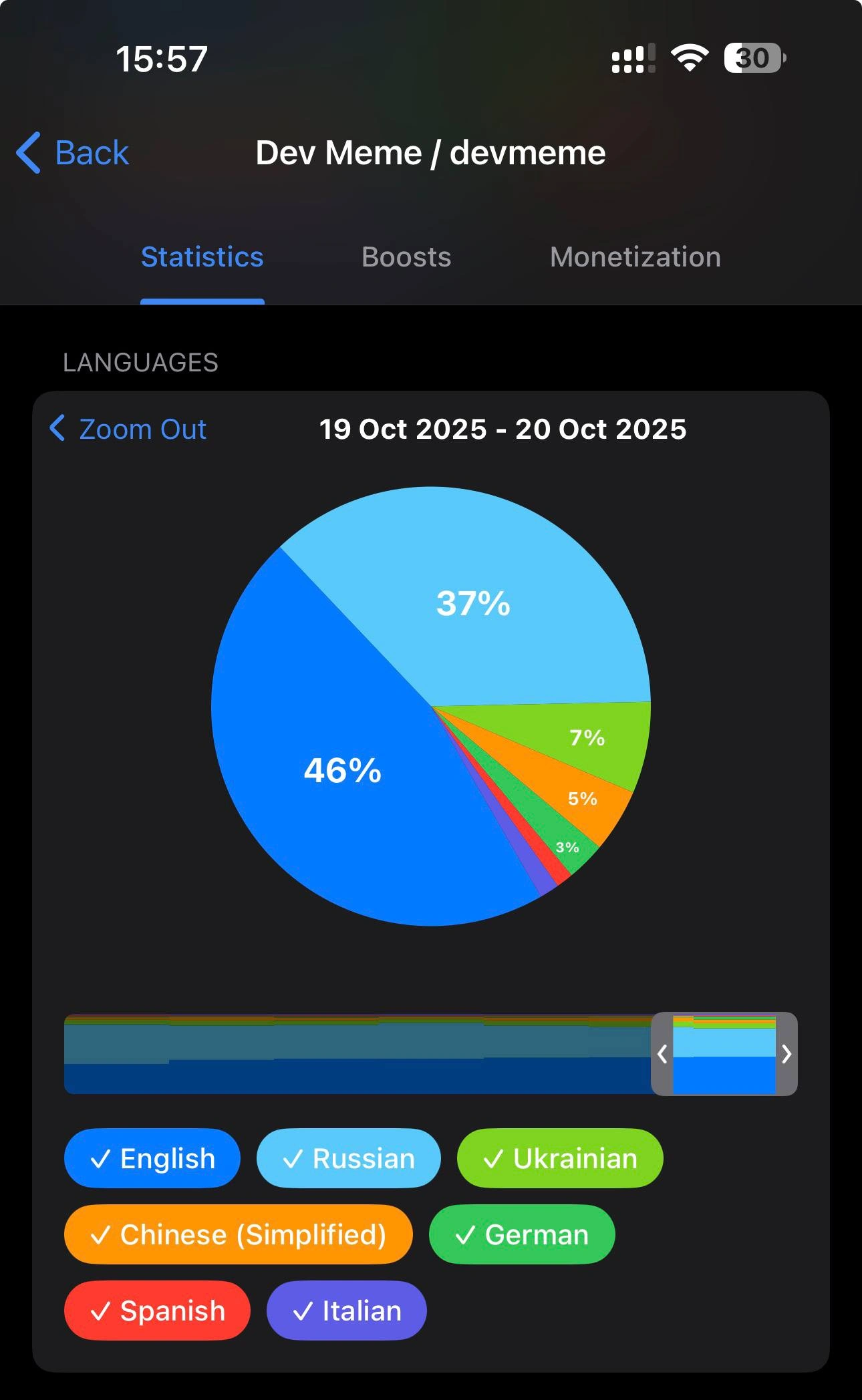
Let’s break down what’s happening in this meme in simpler terms. The image is a dashboard from a mobile app (dark-themed, looks pretty slick) showing a pie chart of languages used over a two-day period (Oct 19-20, 2025). Each colored slice of the pie chart represents a different language that users of the app prefer or are using. For example, the big blue slice labeled “46%” corresponds to English, and the light-blue “37%” is Russian. The smaller green slice (“7%”) is Ukrainian, orange (“5%”) is Chinese (Simplified), then a red slice (“3%”) for German, and tiny slivers for Spanish and Italian (so small they barely register a percentage). Below the pie chart, there’s a color legend with checkmarks next to each language, confirming which color corresponds to which language. So basically, this app has users from multiple language backgrounds, and the pie chart is visualizing the proportion of users (or content, or activity) per language in that short time frame.

Now, the title says this two-day language pie chart "exposes hidden i18n debt". What does that mean? Internationalization (often written as i18n because there are 18 letters between the “i” and “n” in the word) is the process of designing software so it can be easily adapted to different languages and regions. When the meme says “debt”, it’s referring to technical debt – which is a metaphor in software development for work you delayed or shortcuts you took that you’ll have to pay back later with extra effort. So i18n debt means the app was built without properly supporting multiple languages, and now that debt is coming due. In other words, the developers didn’t invest time initially to make the app multi-lingual (maybe they launched only in English), and now they discover many users speak other languages. The “debt” is all the catch-up work they must do: translating the interface, handling different alphabets, possibly fixing code that assumed text would always be English.

This is a common scenario when a new app (often called an MVP – Minimum Viable Product) grows quickly. Early on, the team might say, “Let’s just launch in English to test the waters.” They might hard-code text in English, and not set up any system for translations or localization (which is the actual adaptation of the product to a specific locale/language, often abbreviated l10n). Localization includes translating text, but also things like using the right date formats, number formats, even colors or symbols that make sense in different cultures. Because the app in the meme likely didn’t do this from the start, we call that a backlog or debt: there’s now a bunch of work piled up to support those other languages (Russian, Ukrainian, Chinese, etc.). The pie chart “exposed” it because it made the issue very obvious to everyone. It’s like a big graphic saying, “Hey, nearly half your users aren’t English speakers – time to do something!”

Let’s define a few things from the tags and context to make sure it’s clear:

  • Data visualization: This is a prime example – using a chart (a pie chart here) to communicate data. The data is languages used, and visualization makes it easy to see the big picture (English and Russian are huge chunks, others are smaller slices).
  • Dashboard: A screen in an app or website that shows important metrics or stats. Here, the “Statistics” tab is a dashboard for the Dev Meme app, showing various analytics. The Languages section is one part of that dashboard, likely alongside others like “Boosts” and “Monetization”.
  • Developer community: The meme likely comes from a community of developers. Developer communities are very global – coders from all over the world share memes and tools. So it’s not surprising that an app for devs (if “Dev Meme” is exactly that) quickly drew an international crowd.
  • Multi-language statistics / audience segmentation: These are fancy ways to say “breaking down your users by language (or other criteria)”. The pie chart is doing audience segmentation by language – showing the mix of languages in the audience.
  • MVP without i18n: This means the app’s first version didn’t include internationalization. It was probably a quick, rough version just to get things running. Many startups do this to test an idea quickly. They often leave things like multi-language support for later, assuming early adopters will manage with English.
  • Unicode: You might have heard of UTF-8 or seen weird characters in text before. Unicode is the standard way computers represent text from any language. If a system isn’t using Unicode properly, characters from other languages can end up as question marks or boxes. The tag “unicode_everything” is like a rallying cry: use Unicode for everything to handle all languages characters. Modern languages and databases typically default to Unicode (like UTF-8 encoding) nowadays, but older systems or naive setups might not.
  • Localization backlog / translation pipeline: Once you realize you need other languages, you create tasks (a backlog) to translate all your app’s text and maybe hire translators or integrate a translation service (that’s the pipeline – how you’ll get translations done and into the app). It might involve creating files for each language, like en.json, ru.json, etc., with all the text. For example:
// en.json (English strings)
{
  "welcome_message": "Welcome to DevMeme!"
}
// ru.json (Russian strings)
{
  "welcome_message": "Добро пожаловать в DevMeme!"
}

The code would then load the right file based on the user’s language. If none exists, it might default to English – which is likely what's happening now (everyone sees English because there are no Russian or Chinese translation files yet).

  • Push notification languages: This refers to the messages you get on your phone from the app. If the app only sends English notifications, users who don’t read English might ignore them or get less value. Now that the team knows they have lots of Russian-speaking users, they might plan to send Russian notifications to those users – again, something that goes into that i18n backlog.

In short, for a junior developer or someone new: this meme is a lesson in why you shouldn’t ignore internationalization. It’s showing a real-world example (through a funny pie chart picture) of an app that thought it could get away with one language, but the users had other ideas. The surprise is that even in just two days, the app attracted a multilingual user base. And the joke is that the developers now have a lot of work to do to catch up – translating the app, fixing any bugs with non-English text, and basically learning to communicate with a global audience. It’s equal parts funny and educational: funny because the pie chart is a bit of a “gotcha!” for the devs, and educational because it highlights the importance of thinking about other languages early in development (especially if your users might come from all over the world).

Level 3: Babel Backlog

That pie chart is a visual punch in the gut for any senior developer who’s rushed a product out the door. We see a data visualization of languages over just two days, and already English is only 46% of usage. A whopping 37% is Russian, 7% Ukrainian, plus slivers of Chinese, German, Spanish, Italian – this app’s audience segmentation spans continents! The humor (tinged with panic) comes from how internationalization debt sneaks up. The devs probably launched an MVP without i18n – a Minimum Viable Product focusing on core features, assuming “we’ll add other languages later.” Well, “later” is now staring them in the face as a big blue and light-blue pie chart. It’s like shipping a product with only one language checkbox checked in the settings, and then your product analytics v2 dashboard says half your users are checking boxes you didn’t even put in the UI. Oops.

This scenario is painfully common in dev communities. Early on, everyone’s heads-down building features; localization (translating and adapting the app for each locale) is kicked down the road. After all, the initial user base might be English-speaking… until it isn’t. The meme captures that “oh no” moment: a classic dashboard showing multi-language statistics that reveal a localization backlog a mile long. Now those neglected i18n Jira tickets (“Add Russian translations”, “Support Chinese text input”, “Properly format German dates”) are no longer optional – they’re on the critical path. A senior dev knows that retrofitting i18n is tedious: you have to comb through code for hard-coded strings, replace them with keys, create resource files for each language, and ensure every piece of text is externalized. All those print("Hello, world!") calls littered around now need to become something like print(translations["hello_world"][lang]). The debt metaphor is apt: skipping i18n was like taking a shortcut “loan”, and now the “interest” is the extra work (and possible bugs) required to internationalize after the fact.

Why is this funny? Because it’s too real. Every experienced dev has seen a project treat English as the only language until usage proves otherwise. Suddenly the developer community in, say, Eastern Europe latches onto your app (here we see Russian and Ukrainian representing nearly 44% combined – not exactly a niche!). The team can’t ignore it – especially if those users start requesting features in their own languages or reporting that “some text is not readable.” It highlights a gap between best practices and reality: best practice says plan for i18n from day one, but reality often says “ship it now, we’ll deal with translations when we have users”. Now you have users, and indeed, you have to deal with it. Senior engineers also recognize the organizational dynamics here: PMs and execs get excited seeing global growth (“We’re big in Russia!”) and then immediately turn to engineering: “So, we need Russian language support ASAP, right?”. Cue the engineering team sigh – time to integrate a translation pipeline on short notice. Perhaps they’ll scramble to use a third-party service or start emailing bilingual friends.

There’s another layer of irony in the communication aspect: an app meant for a broad developer community (maybe a dev meme platform, given the title “Dev Meme/devmeme”) ended up with an audience that speaks many tongues, yet the app likely “speaks” only English. That’s a techie version of standing on stage telling jokes and realizing half the audience doesn’t understand your language. Even the dashboard itself is an example of a data visualization and analytics tool exposing uncomfortable truth. The pie_chart_overload of many slices hints that usage is fragmented across locales – a nightmare for a product that assumed one locale. A pie chart with two big slices (English and one other) might be simple, but here we have at least seven slices and a scrollbar for the legend! If anything screams “your user base is more diverse than you thought,” it’s needing a scrollbar for languages after just 48 hours of data.

In practice, this means new engineering tasks beyond just text translation. Those push notifications you set up? They’re probably going out in English – which many users might ignore or find off-putting if they can’t read them. So now you need segmented push notification languages or multiple message templates. The support emails and documentation? Better start writing them in other languages or prepping a multilingual FAQ. A senior dev also worries: have we been storing user-generated content in a safe way? (If not using Unicode, a simple Russian “Привет” in a comment might be stored as ????? in the database… not good.) The meme hits home because it encapsulates that simultaneous pride and dread – pride that your product reached far-flung communities, dread that your backlog just exploded with translation tasks, encoding fixes, and one very large “i18n epic” for the next sprint. It’s a gentle roast of the all-too-familiar startup habit: build fast, ignore global users… until the audience segmentation charts shame you into action. In short, the pie chart is both a celebration (look, we’re global!) and a roast (look, you weren’t ready for global!). Experienced devs are laughing (and maybe groaning) because they know this slice of reality all too well.

Level 4: The Polyglot Predicament

At the deepest technical layer, this meme hints at the fundamental challenges of software internationalization. In computing’s early days, systems like ASCII and code pages could only handle a limited set of characters – basically English and a few friends. Fast-forward to today: Unicode (often via UTF-8 encoding) is the de facto standard that can represent text in any language. If your app isn't using Unicode everywhere (databases, APIs, UI), those Russian and Chinese characters can turn into garbled nonsense (the dreaded mojibake, where Привет might look like Привет). Under the hood, text isn’t just text – it’s bytes and code points. A Cyrillic letter or a Chinese ideogram uses multiple bytes in UTF-8, and if the system expects single-byte ASCII, data gets misinterpreted.

Beyond just encoding, truly internationalized software must handle varied alphabets, writing directions, and even grammar rules. For example, pluralization isn’t one-size-fits-all – English adds “s” for plurals, but Russian has complex rules, and Chinese doesn’t change words at all. Frameworks like ICU (International Components for Unicode) or language-specific i18n libraries are the unsung heroes here: they provide locale-aware functions for everything from date formats to sorting algorithms. Without them, a seemingly simple thing like alphabetizing usernames becomes a puzzle when Ukrainian and German names get mixed in (different alphabets, different sorting rules). And let’s not forget font rendering – those pretty custom fonts in your app might lack glyphs for Кириллица (Cyrillic) or 汉字 (Chinese characters), causing missing or tofu □□□ characters. Essentially, the meme’s pie chart is a tip-of-the-iceberg view of a polyglot predicament: supporting all those human languages involves deep changes in how text is stored, displayed, and processed. It’s a reminder that beneath the colorful slices lies serious computer science – from Unicode everything to internals of locale-aware computations – all necessary to avoid an encoding meltdown when your app goes global.

Description

A screenshot from Telegram's channel statistics page for 'Dev Meme / devmeme' showing the LANGUAGES breakdown for 19 Oct 2025 - 20 Oct 2025. A pie chart displays audience language distribution: 46% English (dark blue), 37% Russian (light blue), 7% Ukrainian (green), 5% Chinese Simplified (orange), 3% German (red/pink), and smaller segments for Spanish and Italian. Below the chart, language filter buttons are shown: English, Russian, Ukrainian, Chinese (Simplified), German, Spanish, and Italian, all checked. The phone status bar shows 15:57 and 30% battery

Comments

40
Anonymous ★ Top Pick When your dev meme channel has better internationalization than most production apps -- 7 languages supported with zero i18n library overhead
  1. Anonymous ★ Top Pick

    When your dev meme channel has better internationalization than most production apps -- 7 languages supported with zero i18n library overhead

  2. Anonymous

    Our audience is so diverse, the analytics dashboard looks like the dependency list for a UN side-project. Resolving version conflicts takes on a whole new meaning here

  3. Anonymous

    PM: “Let’s postpone i18n until after MVP.” Analytics two days later: 46 % users reading Cyrillic, 37 % déjà-vu Latin - better start grepping for hard-coded strings before gettext files declare a production outage

  4. Anonymous

    The real surprise isn't that 46% of dev meme viewers speak English - it's that we finally found a pie chart where the percentages actually add up to 100% without floating point errors

  5. Anonymous

    When your dev meme platform's analytics show 46% English but you still need to support 6 other languages - because apparently 'Hello World' isn't universal enough, and technical debt comes in every spoken language too

  6. Anonymous

    English at 46% market share - just like Java, comfortably ahead but forever glancing at the rising challengers

  7. Anonymous

    That pie chart is the moment your switch(locale) MVP with two cases meets CLDR plural rules - suddenly “we’ll add i18n later” becomes a seven‑language sprint and a NotImplementedError in prod

  8. Deleted Account 8mo

    what about iranian dude?

    1. @crysknight 8mo

      chetori, Masih-jun

    2. @crysknight 8mo

      mazerat mikhoam for the bigots in this chat

      1. Deleted Account 8mo

        nice to meet you, where are u from?

        1. @crysknight 8mo

          It's difficult, I'm from Russia originally, but lived for 1.5 years in Armenia. Now, I'm in Germany

  9. Deleted Account 8mo

    we are sucks

    1. @flopflopflopflopflop 8mo

      Yes

      1. Deleted Account 8mo

        our telegram is english 😐 but not live in english lang countries

      2. @f0cu53d 8mo

        Ahahah

    2. Deleted Account 8mo

      Yes

  10. Deleted Account 8mo

    ?

  11. Deleted Account 8mo

    ?

  12. dev_meme 8mo

    There only limit to 10 countries per one thing like this Next time maybe we will have it differently I mainly afraid of spam bot using fake phones for account creation following channel

    1. Deleted Account 8mo

      its truely okey! nice shot!

    2. @NaNmber 8mo

      Most popular big tech messaging app having a whitelist but not a blacklist in 2k25 smh

    3. @ramillimar 8mo

      What use would be a chance of premium for a botted account? It is not like you are giving away stars or something bot could make use of

      1. @NaNmber 8mo

        premium bots get less spam blocks and restrictions when you have couple k of bot accs it's just a passive free upgrade for the farm

        1. @ramillimar 8mo

          Yea, sounds reasonable then

    4. @curutob 8mo

      what about Tajiks dude?

      1. Deleted Account 8mo

        can i have 2 shawarmas please

      2. Deleted Account 8mo

        are u from tajikestan?

  13. @ramillimar 8mo

    No China😭 -50 social score, no rice for admin

    1. Deleted Account 8mo

      😂😂iran is going to be a small china -500 social credits

  14. Deleted Account 8mo

    lan izvini

    1. Deleted Account 8mo

      Osuzhdayu.

  15. @curutob 8mo

    pidaraz

  16. @curutob 8mo

    melki

    1. Deleted Account 8mo

      tish

  17. Deleted Account 8mo

    eto ne ya na ave anyway

  18. dev_meme 8mo

    ROFL

  19. dev_meme 8mo

    @iismoilov7 @BaRRaKudaRain @weebucks Only English, you have been warned

    1. Deleted Account 8mo

      Very sorry!

      1. Deleted Account 8mo

        it's okeeeey i said it because meme :D

Use J and K for navigation