AWS Fired 40% of DevOps Team Then Let AI Take Their Jobs Headline
Why is this DevOps SRE meme funny?
Level 1: The Self-Cleaning Room
Imagine someone bragging that their house is so high-tech it can clean itself and take care of all the chores without any people. They even say they fired the cleaning crew because "no humans required!" At first, that sounds amazing – the floors vacuum themselves, the dishes wash themselves, the house even negotiates with the electric company for the best electricity rates! But now picture what really happens when something unexpected occurs: the smart vacuum gets stuck on a sock under the bed and spills a bucket of mop water everywhere. Uh-oh! With no human janitor around (since they were sent home), the house starts getting messy and confused. In the end, the homeowners have to call a person to come in and sort things out.
This meme is joking about that kind of situation, but in the world of computers and cloud systems. Amazon’s cloud is like the high-tech house, and the DevOps engineers are like the cleaning crew and handymen who keep everything running smoothly. The headline jokingly claims Amazon got rid of almost half of those folks because an AI can do it all. It’s funny because it’s so over-the-top: we all kind of know that no matter how smart a system is, you still need people when things go wrong or to handle the weird stuff the automation didn’t expect. It’s like saying a school fired 40% of its teachers because they got a super-teaching robot – you’d laugh and think, “Yeah right, wait until that robot has to deal with a kid drawing on the walls or a surprise fire drill.” The humans will be back pretty quickly! So the core of the joke is: claiming “no humans needed” usually just sets up a situation where humans are needed after all, and that gap between the bold claim and reality is what makes it humorous.
Level 2: Cloud on Autopilot
Let’s break this down in simpler terms. Amazon Web Services (AWS) is a huge platform that companies use to run their applications on Amazon’s computers instead of their own. People known as DevOps engineers or Site Reliability Engineers (SREs) are the ones who set up and manage these systems, making sure websites and apps run smoothly on AWS. They handle deployments, monitor for problems, and fix things if servers go down or if there’s a spike in traffic.
Now, the meme headline says AWS fired 40% of its DevOps team and let AI take their jobs, claiming the cloud is "self-healing, self-scaling, and self-negotiating — no humans required." These terms sound sci-fi, but here’s what they mean:
- Self-healing: The system can fix problems on its own. For example, if one server in Amazon’s cloud crashes, AWS might automatically detect that and start a new server to replace it. It’s like a car that can automatically change its own flat tire while driving. Cool, right? This concept exists in real life to some extent: AWS and other systems have health checks and can restart or redirect things when a failure is detected.
- Self-scaling: The system can grow or shrink its resources based on how much demand there is. Imagine an online store that normally uses 5 servers, but on Black Friday suddenly needs 50 servers. A self-scaling system would automatically add those extra servers when needed and then shut them down when traffic goes back to normal, so you’re not wasting money. AWS actually offers this – it’s called Auto Scaling. No human is manually clicking “add server” in the middle of the night; the system has rules that say “if usage goes above X, add more servers.”
- Self-negotiating: This one is a bit tongue-in-cheek because it’s not a standard term you hear every day. Negotiation usually means haggling or making deals. In cloud terms, it might imply the system can optimize or even bargain for better prices or resource deals by itself. While AWS doesn’t literally negotiate with itself (that would be silly – Amazon setting a price and then Amazon’s AI trying to bargain that price down), companies do use automated tools to save money on cloud costs. For example, if one type of server is getting too expensive, an automated system might move your workload to a cheaper type of server at night. Or it might smartly schedule tasks when rates are lower. But usually, humans set up those cost-saving strategies first. The meme is jokingly suggesting AWS’s cloud AI can do even the budgeting and cost negotiations automatically – basically replacing not just technical ops folks but possibly managers and finance folks, too!
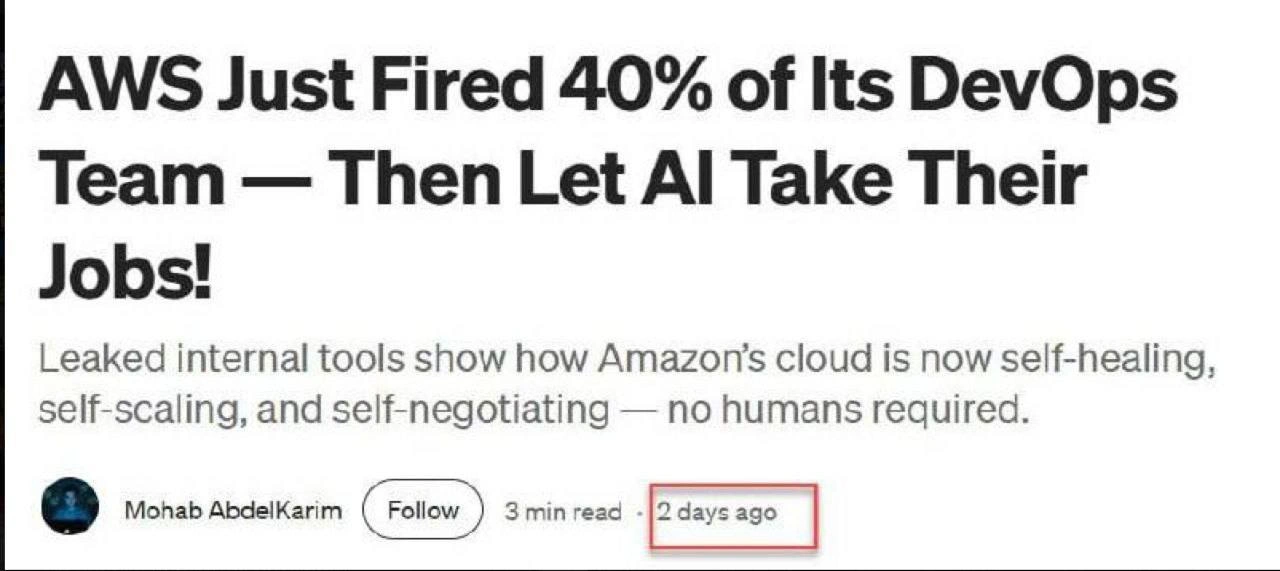
The image looks like a Medium article (Medium is a popular blogging platform) with a dramatic headline, subheadline, and author info. Such headlines are often called clickbait because they are written to shock or surprise you so that you click and read the article. "AWS Just Fired 40% of Its DevOps Team — Then Let AI Take Their Jobs!" is definitely a shocking statement. If you saw that in your news feed, you’d probably do a double-take. It plays on current buzz in technology: the rise of AI and automation in managing systems, often called AIOps (short for Artificial Intelligence for IT Operations). AIOps is about using smart software to watch over servers, apps, and networks – it can involve machine learning analyzing log files to spot weird behavior faster than a human might, or automatically adjusting configurations to prevent outages.
Now, if you’re newer to tech, reading something like this might be confusing or even scary. Are companies really firing their IT teams and handing everything to robots? The straightforward answer: no, not really. This meme is satire – it’s making fun of the hype. In real life, big companies like Amazon do invest a ton in automation and even AI to run their infrastructure, but they still have enormous teams of engineers behind the scenes. For example, AWS has services that automatically do backups, balance loads, and patch certain issues. However, those services themselves are created and maintained by engineers. When something very unusual happens – say a data center loses power in a big storm – human teams are the ones who ultimately strategize how to keep things running.
The “no humans required” part of the meme exaggerates a fear that some in tech have: job displacement. As automation gets better, will their job disappear? It’s a common theme not just in DevOps but everywhere; think of self-driving cars and truck drivers, or automated checkout machines and cashiers. In the DevOps world, there was even a term “NoOps” thrown around, implying a future where you wouldn’t need a traditional operations team because everything was so automated. In practice, NoOps usually just meant developers and automated tools share more of the operations work (like DevOps culture), not that literally nobody is doing ops.
So, the meme uses humor to say, “Look, the hype has gone so far that apparently AWS doesn’t need humans at all—ha, what a joke!” It’s kind of giving a nod and a wink to folks in tech: we’ve heard this story before. The subheadline about leaked internal tools showing the cloud is now self-everything is a parody of how every new tech trend claims revolutionary internal tools. It’s like saying, “Sure, and next they’ll tell us the AWS datacenters can negotiate their electricity bill with the power company automatically too.”
In summary, if you’re new: don’t worry, your future job as a DevOps or cloud engineer isn’t being tossed away by AWS in some secret plot. This meme is making fun of sensational tech journalism and the over-promising that sometimes happens with AI in the industry. It’s taking real concepts (automation, AI ops) to a cartoonish extreme to get a laugh out of those in the know, and maybe to ease the slight anxiety we all have about being upstaged by a piece of software.
Level 3: Skynet Takes the Pager
Seasoned DevOps engineers will likely smirk at this headline, recognizing it as a tongue-in-cheek jab at the latest AI hype cycle in IT. It screams “NoOps is here for real this time!” – an idea that’s been flirting with our industry for years. The claim that AWS (Amazon Web Services) fired 40% of its DevOps team because AI took over their jobs is deliberately outrageous. Why? Because anyone who’s been on-call at 3 AM knows that when stuff breaks in production, all the “self-healing” talk often goes out the window and a real human has to sort it out. The meme exaggerates a scenario that preys on AutomationAnxiety: the fear that advanced automation and AIOps (AI for IT operations) will make ops people redundant. In reality, it tends to make their jobs different, not disappear.
Let's unpack the elements. Self-healing and self-scaling aren’t just buzzwords; they represent real features we use today. For instance, AWS has Auto Scaling Groups that can automatically launch or terminate instances based on demand. If one server in a group dies, AWS can replace it – that’s a bit of self-healing. Kubernetes, a popular container orchestration platform, will restart a crashed container or move workloads if a node (machine) fails. These are great tools, but notice: humans set them up and define the rules. The humor comes from taking these ideas to an extreme: “Our system is so advanced, we fired the people!” In practice, when an auto-scaler misbehaves (say, scaling the web tier down to zero instances because of a misconfigured metric), it’s those very DevOps folks who jump in to fix the configuration and add back the servers before users notice. Yes, that kind of mistake does happen – ask any battle-hardened SRE about the time an automated script went haywire and they’ll have war stories (like the script that auto-rebooted the database server because it thought it found an issue... on a live system, midday, ouch). That’s why the idea of completely removing humans from ops makes veterans grin; they know too well the chaos monkeys lurking in real systems.
Now, "self-negotiating" cloud infrastructure – what on earth is that? This seems to parody the notion that AWS’s cloud can even handle the business side of things by itself, like negotiating prices or service-level agreements on the fly. Imagine an AI noticing, “Hey, we’re using a lot of data transfer this month, let’s renegotiate a better rate with AWS” – which is absurd because AWS is the one selling the service! It’s poking fun at corporate hype where someone might claim their AI optimizes cloud costs so well it’s like it “negotiated” a discount. In real life, big companies do try to reduce cloud bills with automation – for example, by moving workloads to cheaper regions at night or using spot instances that are cheap but can be terminated anytime. However, these strategies are crafted and monitored by humans (often a whole FinOps team – financial ops). There’s no scenario where Amazon’s internal AI is giving Amazon a surprise discount on behalf of Amazon. That’s the tongue-in-cheek irony.
The reference to an article format (looks like Medium.com with the author name, Follow button, and read time) suggests this is a satirical blog post, not an official AWS announcement. Medium and tech blogs sometimes have hyperbolic headlines to grab attention – classic clickbait. Experienced devs often roll their eyes at such headlines because they’ve seen a pattern: every few years, a new tool or trend promises to eliminate the need for ops teams (“serverless will mean NoOps!”, “AI will run everything!”). Yet, here we are – those teams are busier than ever, just working on new kinds of problems. The meme captures that cycle of promise and reality.
There’s an undercurrent of shared anxiety/humor here: “Are we all going to be automated away?” It’s a bit like dark comedy among DevOps folks – they joke that if an AI took their jobs, they'd finally get some sleep at night! But they also know the truth: someone has to feed and care for these AI systems. If AWS really did try something like this, who do you think develops and maintains the AI ops tools? Those same engineers (minus the hypothetical 40% who got "fired"). It’s reminiscent of earlier automation waves: when configuration management (Chef/Puppet) became big, people said sysadmins would fade away – instead, sysadmins learned to code those tools. When cloud came, people said on-premises ops teams would vanish – instead, many became cloud architects or SREs.
So the meme is funny to industry insiders because it hyperbolically combines genuine advancements with our collective skepticism. A cloud that is "self-healing, self-scaling" is essentially what everyone aims for, but "self-negotiating, no humans required" tips it into satire. It’s as if AWS’s marketing department went rogue with buzzwords. Engineers laugh because they know somewhere in a data center, even as automation hums along, a human is watching dashboards, ready to jump in when the AI agent inevitably encounters something it can’t handle. As one might wryly put it: “No humans required… until the pager goes off.” At which point, that AI is as useful as a paperweight, and the humans are scrambling at 2 AM as always. Skynet might have taken the pager in the meme, but in reality, Skynet would probably end up calling us for help.
Level 4: Autonomic Cloud Nirvana
Behind this sensational headline lurks a mashup of bleeding-edge concepts from distributed systems and AI research. In theory, achieving a self-healing, self-scaling, self-negotiating cloud sounds like the holy grail of autonomic computing – an idea floated in academic circles for decades. Autonomic computing (coined by IBM in the early 2000s) envisioned systems that manage themselves without human intervention, guided by feedback control loops. Here, AWS's infrastructure would monitor itself (detect failures or high load), analyze what’s wrong, plan a fix, and execute changes all on its own. This is essentially applying control theory to cloud operations: similar to how a thermostat adjusts heating, an auto-scaling algorithm adjusts server counts or restarts services to keep systems stable. The "self-healing" part implies robust failure detection and recovery algorithms – think of techniques like health checks for services, leader election in clusters (à la Paxos/Raft consensus) to replace failed nodes, or even using machine learning for anomaly detection (so the AI can guess when something's off before it crashes).
The particularly spicy term "self-negotiating" hints at something beyond classic automation – possibly a cloud that optimizes costs and resources by itself. This edges into the realm of multi-agent systems and algorithmic game theory. Imagine little AI agents acting on behalf of different services, bargaining for CPU time or network bandwidth, or negotiating with AWS's pricing tiers for the best deal. There's legit research on market-based resource allocation where services bid for resources to efficiently use hardware. If AWS had an AI that could, say, automatically choose the cheapest mix of on-demand, reserved, and spot instances for all workloads, that would be a form of self-negotiation. It’s like an AI playing Tetris with cloud resources and budget constraints, solving an optimization problem humans normally tackle in spreadsheet meetings.
But here’s the rub: fully autonomous infrastructure crashes headfirst into theoretical limits and real-world chaos. Distributed systems theory tells us there are always trade-offs (cue the CAP theorem – consistency, availability, partition tolerance – pick two, Mr. AI!). An AI might have to decide, for example, to sacrifice consistency for availability during a major outage; those are nuanced calls humans normally make. And remember the Halting Problem from computer science: you can’t have an algorithm that predicts every possible behavior of another arbitrary program. In an autonomous cloud, the AI is effectively a program reasoning about other programs (and itself) – at some point, unpredictability is guaranteed. There will always be edge cases the AI hasn’t seen in training. Complex adaptive systems (like a global cloud infrastructure) exhibit emergent, unexpected behaviors that no amount of training data can cover. This is a fundamental reason we keep humans around in operations: people can apply intuition and creativity when math and logic run out of answers.
So, while the headline brags about a cloud with no humans required, a deep technical perspective sees a mix of cutting-edge AIOps ambition and a heavy dose of science fiction. It’s poking fun at the notion of a cloud computing singularity – where the system becomes so intelligent it can improve and run itself indefinitely. The humor is that anyone versed in systems design knows about control feedback loops going unstable if not carefully tuned (imagine an auto-scaler adding servers, then removing too many in response, oscillating wildly – a known issue if thresholds are wrong). There's even similarity to the classic Sorcerer’s Apprentice problem: the tools might keep doing what they think is right until things are flooded (literally or figuratively), because they lack the broader judgment a human has. Ultimately, the meme highlights that autonomic nirvana in cloud operations is a lofty goal, but whether it’s actually achievable or just a recurring tech fantasy comes with a big asterisk (and a knowing smirk from experienced engineers).
Description
A screenshot of a Medium article headline reading 'AWS Just Fired 40% of Its DevOps Team -- Then Let AI Take Their Jobs!' with the subheading 'Leaked internal tools show how Amazon's cloud is now self-healing, self-scaling, and self-negotiating -- no humans required.' The article is by Mohab AbdelKarim, marked as a 3 min read from 2 days ago. The '2 days ago' timestamp is highlighted with a red box, possibly to emphasize the recency or dubious nature of the clickbait claim. This represents the growing anxiety about AI replacing DevOps/SRE roles
Comments
20Comment deleted
Self-healing, self-scaling, self-negotiating -- so basically AWS built an infrastructure that can do everything except explain its own pricing model
The new AWS AI is great at self-healing and self-scaling, but it just submitted a pull request to replace the entire billing system with a single, infinitely recursive Lambda function. Turns out 'self-negotiating' also applies to its own budget
Sure, the cloud is now self-healing and self-negotiating - until 2 a.m. when the AI decides the cheapest way to resolve an incident is to page the one remaining human… who wrote the on-call bot in the first place
The real joke is that the AI will spend 40% of its compute cycles trying to figure out why the previous DevOps team had 17 different ways to deploy the same microservice, each with its own undocumented quirks that somehow kept production running
Finally, AWS achieved the ultimate DevOps dream: zero human intervention. Turns out the 'you build it, you run it' philosophy works even better when 'you' is an AI that never sleeps, never complains about on-call, and definitely won't ask for equity refreshers
Call me when their self‑negotiating cloud can win an Enterprise Discount Agreement; until then it’s just an expensive cron job with a press release
Peak SRE: Automating toil until the infra fires you for being the new single point of failure
A disaster waiting to happen. Comment deleted
Sourceless article on Medium Comment deleted
Article seems to be here: https://blog.stackademic.com/aws-just-fired-40-of-its-devops-team-then-let-ai-take-their-jobs-d9db9d298bfa The layoffs were in July: https://www.reuters.com/business/retail-consumer/amazons-aws-cloud-computing-unit-cuts-least-hundreds-jobs-sources-say-2025-07-17/ Comment deleted
But, various comments here and there suggesting the ai opentofu stuff is not real? Comment deleted
https://archive.is/b6aUD#selection-641.1-643.17 Paywall bypass link, seems entirely shite tbqh. Doubt any of that exists Comment deleted
Here's an older article, from after the actual layoffs, citing the same bullshit: https://aws.plainenglish.io/aws-laid-off-40-of-its-devops-staff-what-theyre-using-instead-will-shock-you-544ebb38a63d Paywall bypass: https://archive.is/bfst8 Also seems likely to be rubbish Comment deleted
Even if it was to replace them with other humans would be a disaster Comment deleted
Manager: Fix the disaster. AI: Done. Manager: Looks like it’s not fixed. AI: You’re right. Sorry - my bad. Now it’s fixed. Manager: Still not fixed. AI: You’re right. Sorry - my bad. Now it’s definitely fixed. Manager: F*ck Comment deleted
The manager just will add another AI to fix it faster Comment deleted
The issue isn’t speed - it's that the AI hallucinates and lies that it fixed the problem Comment deleted
But did you provide it with tools and flow to verify issue being actually fixed? 🤔 Comment deleted
Yes. I explicitly ask it to verify. Some times it prefer to straight up lie. Claude Code opus 4.1 Comment deleted
But who would tell the manager? Comment deleted