Quitting $200K Job for B2B SaaS Making $100 MRR Dave Ramsey Disapproves
Why is this Entrepreneurship meme funny?
Level 1: Lemonade Stand Leap
Imagine you have a really good weekly allowance – say your parents give you $20 every week because you do all your chores. That’s your steady, reliable income as a kid. Now picture one day you decide to stop doing your chores (so no more $20/week!) because you want to start your own little business: a lemonade stand. You love the idea of having your own stand, being your own boss, and maybe making money from selling lemonade to neighbors. But here’s the thing: right now your lemonade stand only makes about $1 a week. It’s super small – just a couple of quarters from one or two customers.
Now, your friend (or maybe a wise adult like a teacher) hears about this and asks, “So let me get this straight: you gave up your $20 allowance… to run a lemonade stand that makes $1 a week? Is that right?” And you calmly say, “Yep, that’s right.” Can you picture the look on their face? They’d probably be like, “Wait, what?!” 😅 They’re shocked because it sounds like you traded something big for something teeny-tiny.
This is exactly what’s happening in the meme. The grown-up in the picture (Dave) is like the shocked friend, and the developer is like you with the lemonade stand. It’s funny because the trade sounds so unreasonable: who gives up a lot of guaranteed money for a little bit of maybe money? But the person who started the lemonade stand (or the small business) is really hopeful. They’re thinking, “Sure, I only have $1 now, but someday my lemonade will be super popular and I’ll make much more than $20 a week!” It’s a big dream.
So the meme makes us laugh because we all understand the feeling: it’s as if someone left a suuuuper comfy situation to chase a dream that’s just starting out. It’s a brave thing to do, but also a bit like a kid trading a full cookie jar for one little cookie hoping the jar will refill itself later. The humor is in that wide-eyed confidence versus the logical reaction of “Um… that doesn’t seem wise…”. In simple terms: the founder in the meme basically did a lemonade stand leap — giving up something guaranteed and big for something really small but personally exciting. The funny picture shows how puzzled everyone else is about that choice, and that puzzlement is what makes it humorous and relatable, even if you’re not a tech expert.
Level 2: SaaS vs Salary Showdown
Let’s break down what’s happening in simpler terms. We have a developer who quit a job paying $200,000 per year to work full-time on a small tech business. That business is a B2B SaaS, which stands for Business-to-Business Software-as-a-Service. SaaS means they offer software (like a web app) that customers subscribe to, usually paying a fee every month. And B2B means their customers are other companies (as opposed to individual consumers). Now, this SaaS is making $100 MRR, meaning it brings in $100 of recurring revenue each month from subscriptions. Monthly Recurring Revenue is a key metric for any subscription-based startup — it’s basically the predictable income you get each month from subscribers. So $100 MRR equates to only $1,200 per year. That’s tiny. It’s the kind of money a small side-project might make to cover your coffee budget, not what you'd normally live on if you leave a big job.
Meanwhile, a $200k/year job is what we call a six-figure salary (because it’s a number with six digits). For a software developer, especially in places like Silicon Valley or at big tech companies, $200k/year isn’t unheard of for a senior or specialized role. It usually comes with nice benefits, maybe stock options, health insurance — overall, a comfortable life. Quitting that job means giving up a monthly paycheck of roughly $16,000 (before taxes). So our founder left earning around $16,000 each month to now make $100 a month from their own venture. 😬
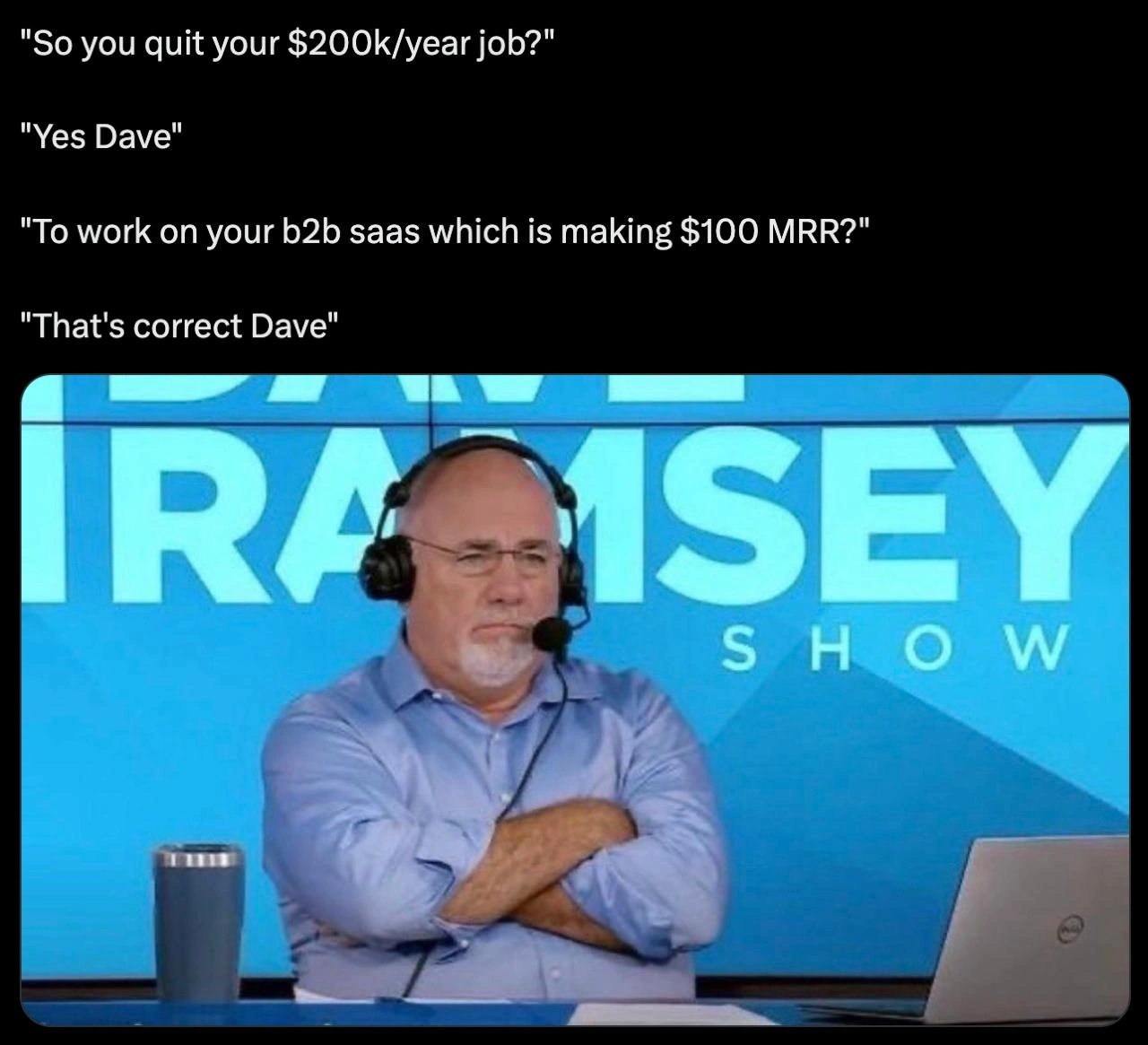
That difference is why the meme is funny and shocking. The text in the meme is a mock conversation likely referencing Dave Ramsey, a well-known personal finance guru famous for advising people to be financially conservative (pay off debt, avoid risky moves). In the image, Dave’s arms are crossed and he looks deeply unimpressed. The conversation goes: “So you quit your $200k/year job? …To work on your B2B SaaS making $100 MRR? …That’s correct, Dave.” The founder confirms the situation very plainly, almost too casually. Dave (and the audience) are left thinking, “Is this guy serious?” It’s as if someone said, “I stopped picking up a paycheck of $1,000 to focus on something that earns $1.” It sounds backward because usually you’d want the new thing to make more money, not 100× less money.
Now, let’s explain some terms and context:
Opportunity cost: This is an economics term, but it’s easy to understand. It means what you miss out on by choosing one option over another. Here, the opportunity cost of working on the startup is the $200k salary the developer is no longer getting. In other words, by focusing on a $100 MRR SaaS, they “miss out” on the big salary they could have earned in that time. Every month working on the startup, they could have been banking a lot of money at a job. That foregone money is the cost of chasing the startup dream.
Burn rate: This phrase is common in startups. If a business (or a person) isn’t breaking even yet, they’ll be spending more money than they earn. Burn rate is how much money you’re “burning” through (from savings or investment) each month to keep going. If our founder only makes $100 but needs, say, $5,000 a month to pay rent, bills, and maybe a server or two for the SaaS, then the burn rate is roughly $4,900 per month. They’d better have savings or funding, because at that rate, money will run out fast.
Runway: This goes hand-in-hand with burn rate. Runway is how many months you can keep operating before the money runs out, given your burn rate. Imagine the founder saved up $50,000 from that old job. With a $4.9k monthly deficit, $50k savings gives about 10 months of runway before he’s broke. Runway is basically a countdown clock for startups: you either start making more money before it hits zero, or you have to quit/get additional funding. Seeing $100 MRR, you can guess the runway might be short unless that revenue grows or the founder has a lot of savings.
Founder optimism: Many people who start companies are optimists at heart. They have to be! They believe their idea will work out, even if the current numbers look bad. This optimism is what makes someone think “Sure, I only have $100 in sales now, but give me a year and this will be $10k MRR!” It might sound naïve or overly hopeful to outsiders, but a bit of almost-delusional confidence is common in startup culture. It’s what keeps founders going through tough times. Our meme’s founder saying “That’s correct, Dave” without flinching is a portrayal of that unwavering self-belief — he isn’t even bothered by how silly it sounds because he’s convinced in the long run it’s going to pay off.
Bootstrapper life: The term bootstrapping means building a business without outside investment, using only your own money or the revenue the business generates. A bootstrapped B2B SaaS is typically a small operation, maybe a solo developer or a tiny team, who funds everything themselves. They might work from home, keep expenses super low, and grow gradually. It’s the opposite of taking millions in venture capital where you can pay yourself a salary and hire people rapidly. Bootstrappers often start as a side project while still working a job. Only when it seems somewhat promising (or they just get tired of the day job grind) do they take the leap to go full-time on the side project. In this meme, the founder has done exactly that leap, perhaps a bit earlier than most would dare (since $100/month revenue is very low to live on). It shows the extreme end of bootstrapper enthusiasm.
MRR vs Salary: It’s worth noting these aren’t apples-to-apples. A salary is personal income that goes straight to the individual. MRR is business revenue. That $100 MRR might not even all be take-home profit — some might go towards business costs (hosting, tools, taxes). But even if it were mostly profit, it’s still extremely small compared to a $16k monthly paycheck. So the lifestyle change is huge. The founder likely went from a relatively lavish lifestyle (or at least financial peace of mind) to frugality overnight.
The meme resonates with developers, especially those familiar with startup culture, because it’s a scenario we hear about a lot. From a junior developer’s perspective, it might be baffling: “Why would anyone leave such a high-paying job for something that pays basically nothing?” The answer lies in the dream of startup success and personal passion. The founder is essentially betting on himself. He would say that by focusing 100% on his SaaS, he can grow that $100 MRR into something much, much bigger — potentially even into a business that pays far more than $200k/year, if all goes well. It’s a high-risk, high-reward move. Many tech entrepreneurs have done similar things: some succeed (and we celebrate them as visionaries), and many fail (and we rarely hear about those in the news).
In the image, using Dave Ramsey amplifies the comedy because Dave is all about practical, safe financial choices. He often tells callers to stick with stable jobs, get out of debt, and avoid get-rich-quick schemes. To him, quitting a great job for what sounds like a money-losing hobby would be almost absurd. That’s why his expression is so disapproving. For a junior person, imagine a very strict, sensible uncle figure hearing that you gave up something great for something currently worthless — his face in the meme is exactly that vibe.
So, on this level, the meme is teaching a mini-lesson: be aware of the trade-offs. It introduces the idea of opportunity cost in a memorable way. It also gives a peek into startup life realities: Monthly Recurring Revenue is a big deal, every fledgling startup tracks it religiously, and $100/month means you’re at a very early stage. The humor works because it’s true to life — people really do make this choice! And depending on who you ask, it’s either inspiring or insane. For a new developer or someone early in their career, it’s a relatable cautionary tale: before you jump ship to chase a dream, do the math (and maybe don’t do that math unless you have a solid plan). But it’s also a nod to the passion that drives innovation — after all, every big tech company started somewhere small. This meme just highlights an extreme example of starting really small and betting big on oneself.
Level 3: The $200k-for-$100 Gambit
At first glance, this meme spotlights a seasoned developer making what looks like a ludicrous trade-off: giving up a $200k/year engineering job to go all-in on a B2B SaaS that currently earns only $100 MRR (Monthly Recurring Revenue). The dialogue is delivered with deadpan certainty:
Dave: "So you quit your $200k/year job?"
Founder: "Yes Dave."
Dave: "To work on your B2B SaaS which is making $100 MRR?"
Founder: "That's correct Dave."
The humor here comes from the stark contrast in those numbers and the founder’s unwavering calm. A $200k salary translates to roughly $16,600 per month, whereas $100 MRR is, well, $100 per month. To any rational observer (embodied by Dave Ramsey’s incredulous posture in the photo), this exchange sounds like a comically bad deal. Dave Ramsey—famous for no-nonsense financial advice—is implicitly flabbergasted. His arms are crossed, brow furrowed, as if he's mentally calculating the opportunity cost and wanting to yell, "What kind of math is that, my friend?" Meanwhile, the founder’s short, almost stoic replies ("Yes Dave", "That's correct Dave") show absolute conviction, as if quitting a cushy tech job for a trickle of revenue is the most natural thing in the world. This mismatch—incredulity vs. certainty—is the punchline. It nails a familiar tech-world absurdity: an engineer willingly trading immediate financial security for a dream that currently pays in coffee money.
Why would a sane, senior developer do this? Enter the twisted logic of founder math. 😏 It’s a blend of optimism, ambition, and a dash of delusion that many entrepreneurs share. The founder is likely thinking: “Sure, it’s $100 MRR now, but if I grow 20% every month, I’ll replace my old salary in no time!” In their mind, $100/month isn’t the endpoint; it’s just the baby step of a hockey-stick growth curve that leads to startup glory. Founders often perform this mental calculus: today’s pittance × massive future growth = tomorrow’s fortune. It’s almost a rite of passage in StartupCulture to believe your tiny bootstrapper project can metamorphose into the next Salesforce or Slack. This exuberant founder optimism is both admired and ridiculed across the tech community. The meme expertly captures that duality: one voice representing cold financial logic and the other voice embodying visionary faith.
From an experienced developer’s perspective, this scenario triggers equal parts respect and facepalm. On one hand, there’s admiration for the courage: walking away from a high-paying job means the founder truly believes in their product and wants to own their own stack and destiny. It’s the “I want to be my own boss” itch that many senior engineers feel after years in big companies. They dream of building something without red tape, choosing the tech stack (#include <own_rules.h>) and calling the shots. In startup lore, this bold move is romanticized as “burning the boats” — eliminating the safe fallback (the corporate job) so there’s no choice but to make the startup succeed. The founder’s calm replies in the meme convey exactly that burn-the-boats certainty.
On the other hand, seasoned folks can’t help but cringe at the opportunity cost and runway risk. Opportunity cost is essentially the price of the road not taken. Here, the road not taken (staying in the job) is worth $200k a year. That’s the implicit cost the founder “pays” to chase the startup. In a purely financial equation, giving up $200k for $1.2k/year (that’s what $100 MRR yields annually) is a monumental loss. For this gamble to make sense, the startup’s future value must far exceed what the dev left on the table. The founder’s inner spreadsheet is probably forecasting things like: “If I can grow MRR from $100 to $50,000 in three years, I’ll have a $600k/year business – totally worth it!” But every senior dev knows these projections are written in sand Python more often than in stone.
Then there’s the burn rate concern. With only $100 coming in each month, how is our brave founder paying rent or buying groceries? Likely they’ve saved a chunk from that six-figure salary or they have investors, but the meme implies a bootstrapped scenario (no big VC funding, just self-funded). Burn rate is how fast you spend your savings. If their monthly expenses are, say, $5000 and income is $100, their burn rate is -$4900/month. This gives them a limited runway (months before money runs out). Every experienced engineer-turned-founder lies awake calculating this runway, balancing development speed against bank balance. It’s a nerve-racking equation: Can I get this SaaS to profitability before I go broke? The meme’s dark comedy is that $100 MRR doesn’t extend the runway much at all — it’s like putting a Dixie cup under Niagara Falls. No wonder Dave Ramsey looks ready to pop a vein.
Yet, in tech circles, this exact story is relatable humor. We all know someone (or are someone) who’s toyed with quitting a stable job to hack on a passion project. It’s practically a genre on developer forums: “I quit my $X job to focus on my SaaS”. Sometimes it ends in glorious success (unicorn startup, early retirement), but often it ends with a LinkedIn update quietly announcing a return to full-time employment. The meme winks at that collective experience. Notice the Dell laptop and cluttered desk in the image: it’s the ordinary corporate world intruding into Dave’s radio studio, symbolizing the desk job our founder left behind. Dave Ramsey’s nationally syndicated show backdrop adds to the absurdity — the founder isn’t just defending their choice to a friend, but to the ultimate voice of financial reason. The whole scene screams: “This is financially nuts!”, and that’s exactly why it’s funny. Seasoned devs chuckle because they’ve done the founder math too — maybe not as dramatically, but they’ve run those back-of-the-napkin equations fueled by late-night coffee and startup dreams. This meme is a cathartic nod to all the big dreamers and the bemused onlookers who question them. It’s basically a snapshot of the perpetual tension between TechCareer pragmatism (steady job, healthy 401k) and StartupLife idealism (be your own boss, change the world, hope the money follows). In short, the $200k-for-$100 gambit is the ultimate high-risk coding adventure, one that elicits both “You’re crazy, dude” and “You’ve got guts” from the developer community.
Description
A meme using the Dave Ramsey Show format where Dave Ramsey sits with arms crossed, wearing a headset, looking disappointed. The text reads: '"So you quit your $200k/year job?" "Yes Dave" "To work on your b2b saas which is making $100 MRR?" "That's correct Dave"'. The Dave Ramsey Show logo is visible in the background with Dave's characteristically judgmental expression, perfectly capturing the financial absurdity of leaving a stable high-paying tech job for a barely-revenue side project
Comments
8Comment deleted
The real MRR here is Monthly Reality Reckoning -- when your burn rate is your former salary and your revenue wouldn't cover a single AWS Lambda invocation
My burn rate is my savings account, my runway is until my partner finds out, and my valuation is based on a Twitter poll. Any other questions, Dave?
Relax, Dave - once churn drops below 5% and the Stripe webhooks stop timing out, we’ll be ramen-profitable before the next sprint retro
The real Dave Ramsey advice would be to keep the $200k job, live on $50k, and use the other $150k to acquire 1,500 more SaaS products at the same valuation multiple - because apparently in this market, $100 MRR is worth exactly one senior engineer
When your SaaS MRR is 0.05% of your former salary but your conviction is at 200% - that's the founder's arbitrage opportunity VCs don't want you to know about
Founder math: trading a deterministic $200k cashflow for $100 MRR projected at 20% MoM with 0% churn and an SLA on optimism
Trading $200k salary ARR for $1.2k SaaS ARR: the ultimate architectural trade-off where scalability meets ramen
sAss Comment deleted