Bad data in, “infallible” results out: the deep-learning iceberg meme
Why is this AI ML meme funny?
Level 1: The Magic Soup Machine
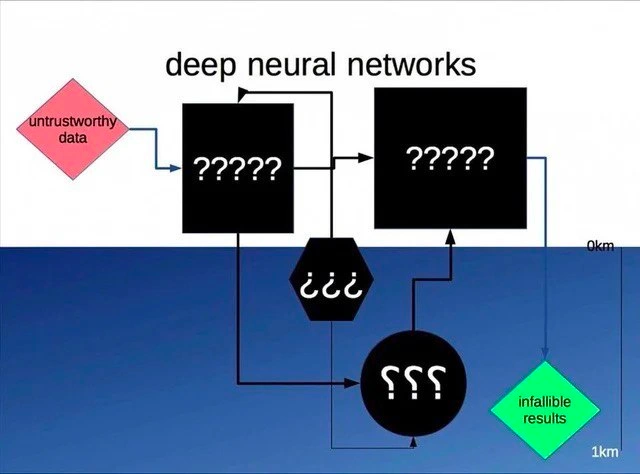
Imagine a machine where you toss in mystery ingredients you found at the back of the fridge — nobody checked if they're still good. Inside, the machine is just sealed black boxes with question marks painted on them; not even the people who built it know what happens in there. And out the other end comes a bowl of soup with a fancy label that says "PERFECT SOUP, GUARANTEED." Everyone cheers and eats it, no questions asked. The joke is that grown-up engineers really do build machines like this with computer math, and the funniest, scariest part is the label: we don't know what's in the boxes, but we printed "guaranteed" anyway.
Level 2: What the Shapes Stand For
- Neural network — a function built from layers of simple weighted units; "deep" just means many layers stacked. Data goes in one end, predictions come out the other, and training adjusts millions of internal numbers (weights) until outputs look right on examples.
- Black box — a system you can use but not meaningfully look inside. You can read every weight of a trained network, but the numbers don't explain themselves — hence drawing the layers as black shapes full of
?????. - Training data — the examples the model learns from. If they're wrong, biased, or sloppy ("untrustworthy data"), the model learns wrong, biased, sloppy patterns — confidently.
- Flowchart shapes — in classic diagrams, diamonds mean decisions/IO and rectangles mean processes. The meme mimics that visual language to look official, then fills every process with question marks.
A typical first-job version of this lesson: you train a model that hits 99% accuracy and feel like a wizard — until you discover the dataset leaked the answer into a feature, or all the positive cases came from one hospital's camera. The model wasn't smart; the data was contaminated. Learning to mistrust the green diamond is the actual graduation.
Level 3: Garbage In, Gospel Out
The diagram's anatomy is a precision strike on machine-learning culture. A pink diamond labeled "untrustworthy data" flows into a pipeline of solid black shapes — two big squares stamped ?????, a hexagon of inverted ¿¿¿, a circle of upside-down ??? — wired together with arrows that loop back on themselves, before emerging as a serene green diamond: "infallible results." Even the background participates: the shapes sink from sky into ocean past depth markers reading 0km and 1km, because these are deep neural networks. The pun is doing structural load-bearing.
The satire lands because each absurdity is a documented failure mode wearing a flowchart costume. Start with the input: most real-world models are trained on scraped, mislabeled, biased, or duplicated data, and the field's founding curse — garbage in, garbage out — was supposed to apply. Instead, deep learning's cultural innovation was laundering the garbage through enough matrix multiplications that the output acquires authority. The black boxes with question marks aren't lazy drawing; they're the honest rendering of interpretability's central embarrassment: we can inspect every one of millions of weights and still be unable to say why the model called the X-ray malignant or the loan application risky. Practitioners themselves describe their craft as alchemy half-jokingly — hyperparameters tuned by folklore, architectures chosen because they won a benchmark once.
The cruelest accuracy is the green diamond. The technical community knows outputs are probabilistic and calibration is shaky; the organizational layer does not. A number that says 0.947 travels up the management chain shedding its error bars at every step, arriving in the boardroom as truth. That asymmetry — engineers shipping ?????, stakeholders receiving "infallible" — is exactly where AI hype damage happens: automated hiring filters, recidivism scores, content moderation. The loops between shapes even capture feedback contamination, where a model's own outputs leak into next year's training data. The diagram is a joke; it is also, structurally, more honest than most slide decks pitching the same pipeline.
Description
The image is a satirical diagram titled "deep neural networks" showing a pipeline that turns a pink diamond labeled "untrustworthy data" into a green diamond labeled "infallible results." Two large black rectangles above a horizontal waterline marked "0km," each filled with "??????," represent opaque processing stages. Below the waterline, a small hexagon with "¿¿?" and a large circle with "???" descend to a depth marker of "1km," exaggerating the hidden complexity like an iceberg. Arrows connect each mystery box, illustrating how inscrutable layers transform dubious input into supposedly perfect output. The meme humorously critiques the black-box nature, explainability gap, and hype surrounding deep learning models that confidently output results despite questionable training data

Comments
7Comment deleted
Deep learning in prod: funnel legacy CSVs labeled by interns through 40 GB of opaque PyTorch checkpoints, and voilà - marketing calls the logits “ground truth” while we pray the drift metric never surfaces
The only architecture diagram where "it works on my GPU cluster" is considered a valid explanation for why the model thinks your cat is a school bus with 97% confidence
We replaced 'garbage in, garbage out' with 'garbage in, 94.7% confidence out' - and the stakeholders only heard the second half
Ah yes, the classic ML pipeline: feed in your messiest, most biased training data, let it marinate through a few dozen inscrutable layers of matrix multiplications that would make a PhD thesis weep, burn enough GPU cycles to power a small nation (hence the '$$$'), and voilà - out comes a model with 99.9% confidence in its predictions. When stakeholders ask 'but how does it work?', just gesture vaguely at the diagram and mutter something about 'learned representations in latent space.' The real magic isn't the neural network - it's convincing everyone that the green diamond at the end somehow validates the red diamond at the start
DNNs: Submerging untrustworthy data to 1km depths until it purifies into infallible results - because true depth drowns out the need for explanations
Garbage-in, gospel-out: after 300M parameters and zero model cards, the only thing calibrated is the 'infallible' label in the exec deck
Deep learning: untrustworthy data in, a kilometer of question marks later we get “infallible results” - the only explainable layer is the green one, aka SHAP-for-executives: Marketing