Coding Priorities: The Star Pattern Before the Date
Why is this Languages meme funny?
Level 1: Toy Over Friend
Imagine you invite a friend over to play, but as soon as they arrive, you get caught up in a new toy and totally ignore your friend. For example, a kid asks a friend to come play, but then the kid starts building a cool Lego tower or playing a video game all by himself, not letting the friend join in. The friend just sits there on the side of the room, feeling sad and left out because they were expecting to spend time together. In the end, the kid is super happy that he finished his fun little project (he built his Lego tower perfectly), and he even leaves the house proudly showing it off, but the friend is disappointed watching him go. The funny (and a bit sad) part of this situation is how mixed up the kid’s priorities were: he cared more about his toy than his friend. This meme is like that, but with a grown-up writing computer code instead of a kid with a toy. It’s amusing because we know spending time with people is important, yet the guy in the story treats his coding project like it’s more important than his guest. It’s a silly reminder that sometimes people can get so caught up in their hobbies that they forget about others around them.
Level 2: Star Pattern Priorities
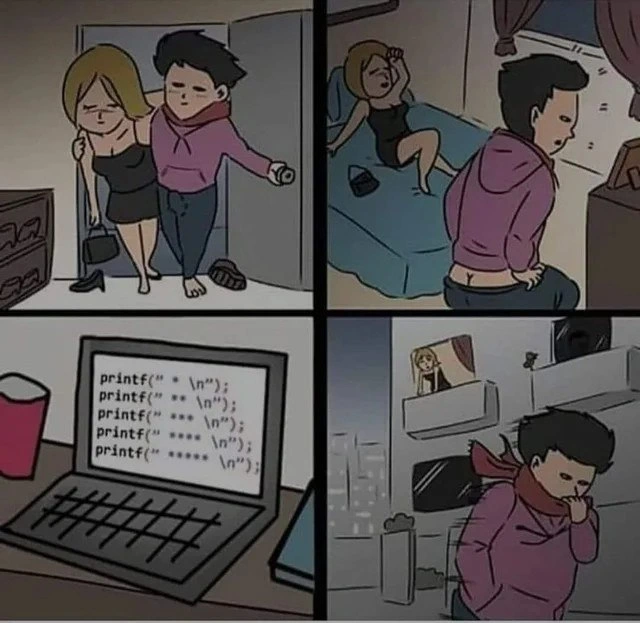
Let’s break down what’s happening in this cartoon from a junior developer’s perspective. The guy in the hoodie is a programmer who just couldn’t resist writing a quick C program, even at a very inopportune moment. On his laptop screen we see multiple calls to printf like printf("* \n"); and printf("** \n"); and so on. printf is a function in the C programming language (and other C family languages like C++ and even used similarly in languages like Java’s printing, though Java would use System.out.println). It prints text to the console. Here, each printf is printing a line of stars (*) followed by a newline \n. What he’s coding is a triangle pattern made of asterisks: the first printf prints 1 star, the next prints 2 stars, then 3, 4, and 5, creating a little right-aligned triangle shape on the screen. This is essentially making a tiny piece of ASCII art (pictures or designs made out of text characters). Printing a star triangle pattern is a super common beginner’s coding exercise. If you’ve ever taken an intro to programming course, you probably had an assignment to output a triangle or pyramid of * characters using loops. For example, the task might be:
// A more typical way to print a triangle of stars in C:
for (int row = 1; row <= 5; ++row) {
// print 'row' number of stars for this line
for (int col = 1; col <= row; ++col) {
printf("*");
}
printf("\n"); // move to the next line after printing stars
}
This little program would output:
*
**
***
****
*****
the same pattern shown in the meme. In the meme though, instead of using loops, it looks like he’s so impatient or simplistic about it that he just wrote five separate printf statements, one for each line. That hints he might be a total beginner at coding (since a more experienced coder would likely use a loop to avoid repetitive code). But it might also mean he’s in a hurry or just hacking it together at 3 AM for fun. The specifics of the code are a nod to programming 101 tasks – it’s the kind of thing you do when you’re just learning and it makes you absurdly proud to see the shape appear perfectly in the console.
Now consider the real-world context: he invited her over presumably for a date or at least to hang out. She’s dressed up, they come stumbling through the door looking tired (maybe from a night out or a party). One would expect they’d spend time together now. But he sits at his desk, halfway through taking off his hoodie, and gets absorbed in the computer. The phrase “his real date was a printf star pattern” sums it up: he’s effectively dating his code instead of the person who actually came to see him. This scenario is exaggerating something that junior devs might jokingly relate to: getting so focused on coding that you ignore everything else. Maybe you’ve experienced working on a fun coding project or debugging something and not noticing your friend or family trying to talk to you. It can happen easily because coding often requires deep concentration and can be oddly engrossing, like a puzzle. Here it’s taken to an extreme — he ignores a romantic opportunity to satisfy the urge to code a silly star-print program. That’s why we call it a work-life balance fail; work (or a coding hobby in this case) completely overtook life (socializing, relationships). It’s played for laughs, but it reflects a real pitfall many developers face if they’re not careful. When you’re new to coding, it’s especially easy to fall into this trap because every success, even a tiny star pattern, feels huge and exciting.
The meme’s last panel, where the woman watches sadly from the window as he leaves with a smug look, illustrates the fallout of such priorities. She’s clearly disappointed — she thought they’d spend the night together, and instead he literally just dropped in to code and then left. Meanwhile, he looks oddly proud and content (with that scarf heroically around his neck) as if he accomplished something grand. This contrast is the heart of the joke. In a developer’s mind, finishing a coding challenge can feel very rewarding (you might have a mini celebration after solving a problem), but from an outside perspective, it can seem ridiculous or insensitive if it comes at the cost of basic social courtesy. It’s like those stories you hear about someone forgetting to eat or sleep because they were glued to the computer — here it’s forgetting to pay attention to a person who came over to be with you! The meme speaks to developer lifestyle quirks: late-night coding sessions, the almost romantic attraction to solving problems, and sometimes misaligned priorities because of that. For a junior developer, it’s a funny cautionary tale: yes, coding is awesome and addictive, but don’t let it make you that person who neglects friends or loved ones. Real productivity isn’t just about writing code; it’s also about knowing when to step away from the keyboard. This meme hilariously dramatizes a failure to step away, and that’s why it resonates in the DeveloperHumor community.
Level 3: printf Over Passion
In this meme’s late-night scenario, a developer’s obsession with code upstages a romantic evening, creating humor through an extreme contrast of priorities. The man has literally chosen code over romance – specifically, he’s fixated on printing a simple triangle of asterisks on his laptop. To an experienced developer, the code on screen is instantly recognizable as a trivial printf loop output — a classic ASCII art beginner's exercise where each line has one more * than the last. He wasn’t debugging a mission-critical system or writing an algorithmic masterpiece; he was enthralled by a few lines of C code producing a star pattern. This ridiculously mundane task (a printf triangle pattern of all things!) is drawn as being more alluring to him than the actual human date he invited over. The absurdity is what makes it funny: it flips normal priorities upside-down in a way only a developer culture joke can.
For seasoned coders, there’s a ring of truth beneath the punchline. Many of us recall moments of developer obsession — when we got so “in the zone” with a coding problem that hours flew by and outside world fell away. It’s the siren song of code: even a minor problem like formatting output with printf can sink its hooks in, especially at 2 AM during a late-night coding session. The meme exaggerates this tendency to a comical extreme: ditching a willing romantic partner to wrestle with printing stars. It satirizes the work-life balance fail often joked about in tech circles. In real life, healthy developers strive for balance, but the culture (DeveloperLifestyle) sometimes idolizes all-nighters and singular focus. We laugh at this cartoon because it captures an open secret among programmers: the pull of a coding challenge can be absurdly strong, even when the challenge is as petty as aligning asterisks into a triangle.
The visual storytelling amplifies the joke with delightful details. In panel 2, the woman poses on the bed in expectation, while the man, still half in his hoodie, turns away towards his computer. That image screams the familiar scenario of a coder unable to disconnect from the screen. Panel 3 zooms in on the laptop showing raw C code calling printf repeatedly to print each line of the triangle. Any C veteran might chuckle at the brute-force approach (printf("* \n"); printf("** \n"); ...) – it’s the kind of quick-and-dirty output you write when you’re a beginner or when you just want to see the result immediately, without bothering to write a proper loop. It’s both endearing and pathetic: endearing because we’ve all been newbies delighted by printing shapes, and pathetic (in a jokey way) because that is what he deemed more important than his date. The CFamilyLanguages vibe (using C’s printf function and escape sequences like \n) gives it an old-school programming feel, triggering nostalgia for many senior devs who remember writing their first star pattern in school.
Finally, panel 4 delivers the exaggerated climax: the man strides triumphantly into the night, a scarf billowing like a superhero’s cape, while the bewildered, disappointed woman watches from the window. This parody of a victorious exit pokes fun at how accomplishing a coding task can make a dev feel like a hero, completely oblivious to the real-world consequences. It’s dramatizing that post-coding high – he nailed that triangle-print program and walks out self-satisfied, leaving everything (and everyone) else behind. The humor lies in the relatable irrationality: logically, most people wouldn’t consider printing "*" a grand achievement or worth sabotaging a date. But to developers (especially when we were new to coding), even tiny wins like getting the output just right at 3 AM can feel euphoric. We’ve all had that nerdy rush of pride after solving something small. This meme playfully ribs that part of programmer mentality. It also carries a gentle warning: if you routinely prioritize a computer over people, you might end up alone with your code – funny in a cartoon, though in real life not exactly a happy ending. The shared laughter here comes from recognition: it’s an absurd scenario, yes, but one that echoes real tendencies in tech culture that every developer secretly understands.
Description
A four-panel comic strip depicting a programmer's skewed priorities. In the first panel, a young man in a pink hoodie brings an interested woman home. In the second panel, she waits for him suggestively on the bed while he sits at his desk, turned away from her. The third panel reveals what has captured his full attention: a laptop screen displaying five lines of C code using the `printf` function to manually create a right-angled triangle pattern of asterisks, a classic beginner's coding exercise. The final panel shows the man dejected and alone, walking outside in the cold, while the woman looks down at him from the window. The meme humorously illustrates the stereotype of a programmer so engrossed in solving even the most trivial coding problem that they neglect a romantic opportunity, ultimately leading to their rejection
Comments
26Comment deleted
His romance algorithm had a fatal flaw: it was single-threaded and the 'print pattern' process had higher priority, leading to a relationship deadlock
When you bail on a date to hand-craft a star pyramid with five hard-coded printf’s, it’s not a work-life balance problem - it’s a red flag that your logging strategy still thinks stdout is a database
She left because I told her my debugging strategy was "eventually consistent" - just like our relationship status across different microservices
The real tragedy here isn't the relationship ending - it's that he's using printf() for pattern generation instead of a proper nested loop with string multiplication. At least his code has better error handling than his personal life: it terminates gracefully with '\n' while his relationship just segfaulted
print('girlfriend') # ; // TODO: post-bugfix
The only five stars tonight were hard-coded with printf; I bailed - if we’re still shipping literals instead of a loop, this relationship isn’t going to scale
Hand‑unrolled the star pyramid with five printf calls - constant-time runtime, linear LOC, and unbounded relationship debt
С++ sucks or what?😅 I don't get it;( Comment deleted
no, but it's a horrendous printing style. Comment deleted
and thats C Comment deleted
not necessarily. C++ can use C functions as well. Comment deleted
I think he's pissed that she didn't do it in a loop like normal people should 😔 Comment deleted
not necessarily. C++ can use C functions as well. Comment deleted
Guys, I wrote several thousands lines in c++ and https://www.programiz.com/cpp-programming/library-function/cstdio/printf Comment deleted
and what? Comment deleted
I don't care about c and c++... Comment deleted
c++ standard library is a combination of C standard library and C++ stuff Comment deleted
what are you trying to prove?😅 Comment deleted
i thought i ment that this is not C but C++ Comment deleted
и шо? о_О Чел, они одинаковые в этой ситуации, как ты можешь доказывать что это С, а не С++? о_О Comment deleted
std:: Comment deleted
можно спихнуть на using namespace std; Comment deleted
лучше не надо Comment deleted
это понятно Comment deleted
ну вообще они не могут быть одинаковыми, это разные япы и я не доказывал, что это именно C, а не C++ Comment deleted
That is c code c++ we normally use cout Comment deleted