Skip to content
DevMeme
5657 of 7435
Debugging Double Standards
Bugs Post #6207, on Aug 31, 2024 in TG

Debugging Double Standards

Why is this Bugs meme funny?

Level 1: Two Kinds Of Mess

It is like helping a friend clean up spilled juice and saying, "No problem, accidents happen," then spilling your own juice and calling yourself an idiot. The spill is the same; the joke is how much meaner we are when the mess is ours.

Level 2: Debugging Yourself

Debugging means finding and fixing the reason software behaves incorrectly. It can involve reading logs, reproducing the bug, adding tests, stepping through code, checking assumptions, and changing the implementation without breaking something else.

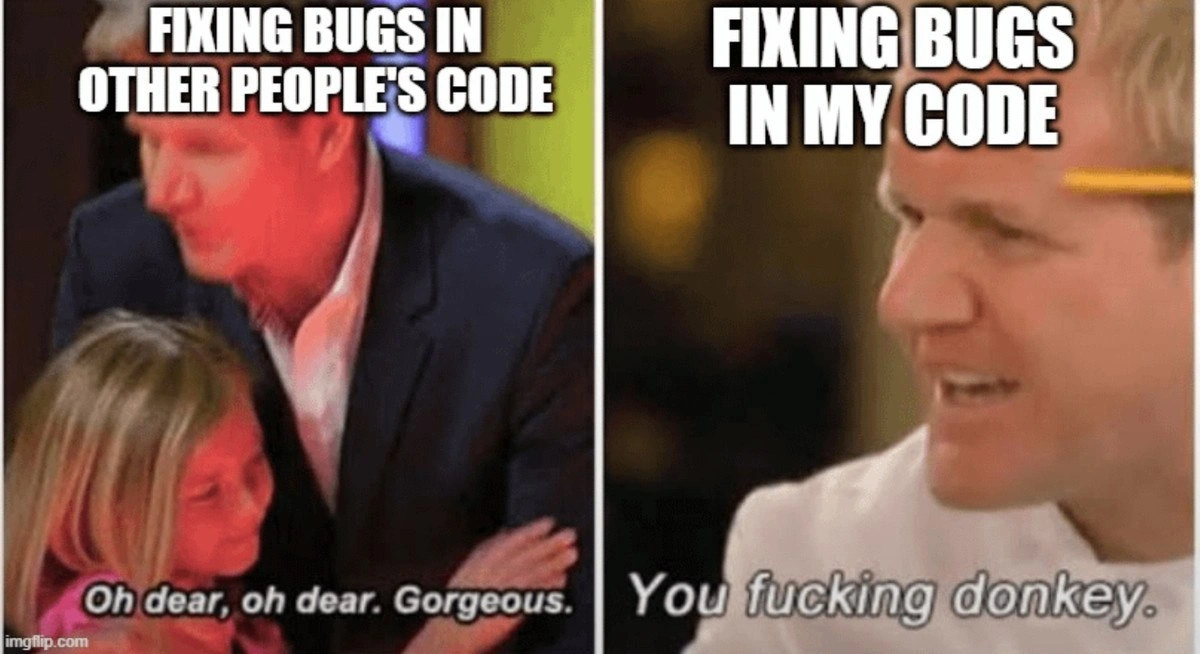
The left panel shows how developers often treat someone else's mistake: with patience. Other people's code comes with mystery, so you naturally ask questions. The right panel shows how developers treat their own mistake: with embarrassment and anger. Your own code feels like it should have been obvious, even when you wrote it under pressure, with incomplete information, months ago.

This connects to code ownership and code review. Healthy teams try to make bugs easier to understand, not easier to shame. Tests, clear names, small changes, good commit messages, and calm reviews all help future developers fix problems without turning every mistake into a personal insult.

Level 3: Blame Has Scope

The meme splits developer empathy across a single ownership boundary. On the left, FIXING BUGS IN OTHER PEOPLE'S CODE gets Gordon Ramsay gently saying, Oh dear, oh dear. Gorgeous. On the right, FIXING BUGS IN MY CODE gets the full blast: You fucking donkey. The same technical activity, debugging, produces two completely different emotional responses depending on whether git blame points at someone else or at your past self.

That is why the joke works so well for Bugs, Debugging_Troubleshooting, and CodeQuality. When another developer wrote the bug, experienced engineers often become careful historians: maybe requirements changed, maybe the deadline was impossible, maybe the framework behaved differently then, maybe the code survived three product pivots and two managers with opinions. When the bug is yours, all that nuance evaporates and the internal code review becomes a sentencing hearing.

There is a real engineering lesson underneath the self-abuse. Bugs are usually systems events, not moral failures. A null check was missing because an invariant was unclear. A race condition escaped because the test environment was too polite. A bad abstraction persisted because nobody had the time or authority to replace it. The meme is funny because developers know this intellectually and then immediately ignore it when the bad line has their name on it. We are all very progressive about legacy code until we discover we are the legacy.

Description

A two-panel Gordon Ramsay meme compares two debugging situations. The left panel is labeled "FIXING BUGS IN OTHER PEOPLE'S CODE" and shows Ramsay comforting a child with the subtitle "Oh dear, oh dear. Gorgeous." The right panel is labeled "FIXING BUGS IN MY CODE" and shows Ramsay angrily saying "You fucking donkey." The joke captures the familiar developer bias of being charitable toward inherited messes while judging one's own mistakes with maximum contempt.

Comments

4
Anonymous ★ Top Pick Empathy for legacy code has a very strict ownership filter: it stops matching the moment `git blame` returns your name.
  1. Anonymous ★ Top Pick

    Empathy for legacy code has a very strict ownership filter: it stops matching the moment `git blame` returns your name.

  2. @Vanilla_Danette 1y

    Why do I feel like it's the other way around for me?

  3. @ifuncuran 1y

    Наоборот (🔄)

  4. @loves_frogjs 1y

    It's donkey both ways

Use J and K for navigation