Skip to content
DevMeme
5658 of 7435
AI Existential Crisis: The Handbag-Passing Robot
Robotics Post #6208, on Aug 31, 2024 in TG

AI Existential Crisis: The Handbag-Passing Robot

Why is this Robotics meme funny?

Level 1: A Disappointed Robot

Imagine you built a super cool robot that can do all sorts of amazing things, but then you only ever ask it to do one simple chore – like handing you your backpack or passing the salt at dinner. That would be pretty silly, right? The robot might feel disappointed or sad if it could have feelings, thinking, “Really? Is that all I’m here for?” That’s exactly the joke here. We have a very advanced, human-like robot (the kind you’d think could save the day or at least clean your whole house) and it turns out its only job is to give people their handbags. It’s a big letdown for the poor robot, and that surprise and disappointment is what makes us laugh. The situation is funny because it’s like using something super fancy to do something super simple – the robot is way too advanced for such a small task, and even the robot realizes it in that “Oh... my... god...” moment.

Level 2: Robot Purpose Crisis

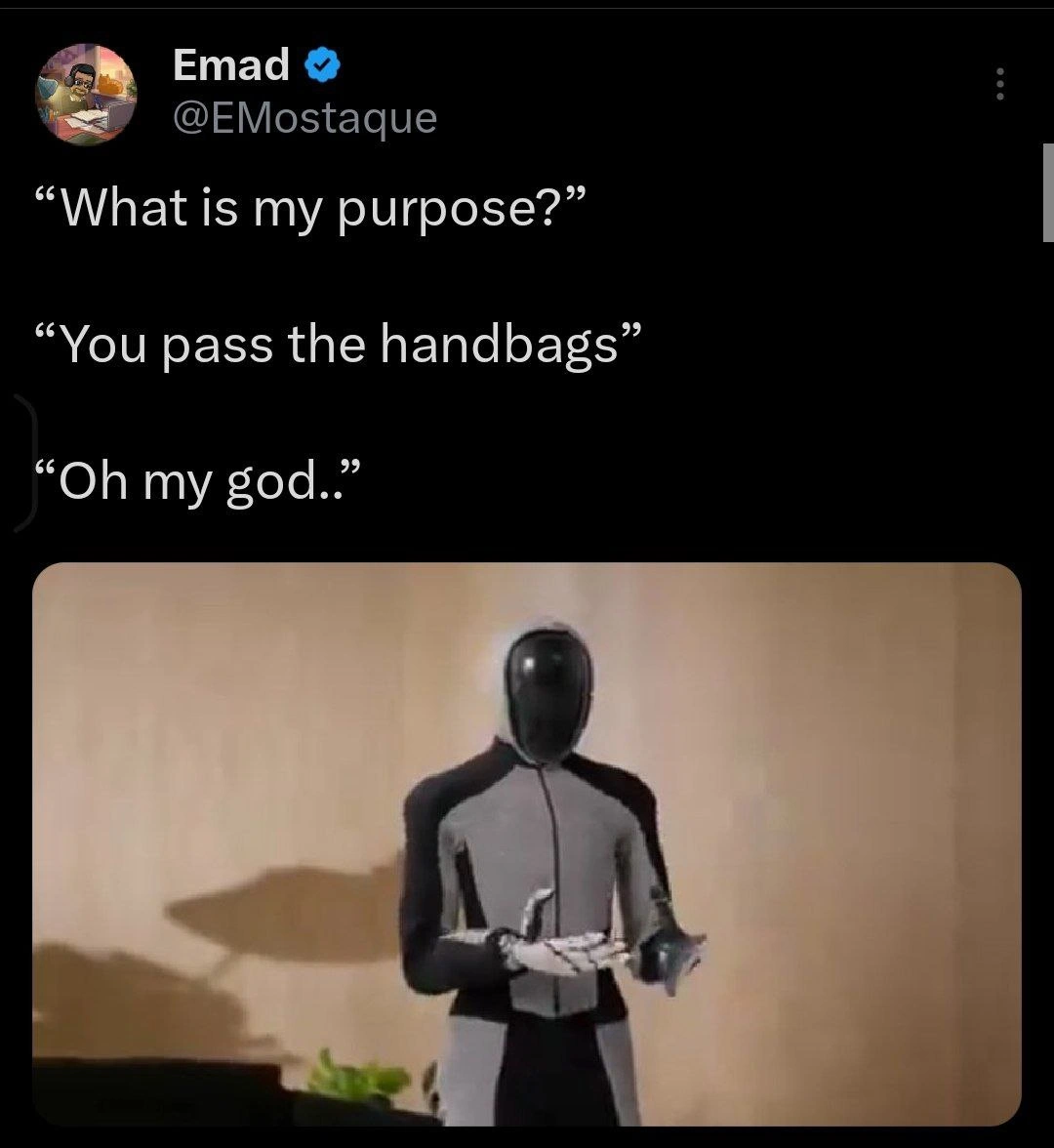
Let’s break down what’s happening in this meme. It’s essentially a screenshot of a tweet by Emad Mostaque (a notable AI entrepreneur). The tweet is formatted as a short dialogue:

  • What is my purpose?” – This is the robot asking why it was created, i.e., what it’s supposed to do.
  • You pass the handbags” – This is the reply (from a human creator or user) telling the robot its job: to hand people their handbags.
  • Oh my god..” – This is the robot reacting in shock or dismay upon learning its rather underwhelming purpose.

Below these text lines, there’s a photo of a humanoid robot – a robot built to resemble the human body. It’s sleek and bipedal (stands on two legs) with a black and grey body and a shiny dark face panel that looks like a visor. In the image, the robot’s hands are raised in a kind of confused or defeated gesture, as if it cannot believe what it just heard. The whole setup is mimicking an exchange from a popular TV show, which is key to the humor.

Here’s the pop culture tie-in: the meme is a reference to an iconic scene from Rick and Morty, an animated sci-fi comedy series. In that show, there’s a gag where a tiny robot asks its maker, “What is my purpose?” and the creator (Rick) bluntly answers, “You pass butter.” The robot looks down, realizes that’s all it was made for, and mutters “Oh my god…” in a sad, pitiful tone. It’s a funny but dark moment that many tech-savvy folks know. This meme copies that exact format, but swaps butter for handbags. If you know the show, it immediately clicks; you can almost hear the robot’s distraught voice. Even if you don’t know the show, the dialogue itself is silly enough to convey the joke: a super-advanced robot finding out it has a really mundane job.

Now, let’s talk about the tech and why this is amusing for engineers. Robotics is the field of building and programming robots – machines that can perform tasks in the physical world. A humanoid robot like the one shown is particularly advanced: it has a human-like form so it can potentially navigate human environments (rooms, furniture, doors) and use tools or objects designed for people. These robots often involve cutting-edge Artificial Intelligence (AI) and Machine Learning (ML). AI is a broad term for making computers or machines smart, and ML is a technique where a machine learns from lots of data or experience. For instance, an AI-powered robot might use machine learning to recognize objects (like identifying what a handbag looks like through its cameras) or to maintain its balance and walk without falling.

With all that technology, one might expect such a robot to do something impressive. That’s where the humor of hype vs reality comes in. Hype means there’s a lot of excitement and big promises about a technology – you hear things like “This robot will change the world!” or “AI is going to solve every problem.” People imagine these humanoid robots doing amazing feats: performing complex surgeries, saving people from disasters, or at least cooking dinner and cleaning the house all by themselves. But the reality (at least right now) is much more modest. In practice, engineers often have to start small and simple to get a robot working reliably. So you end up with a super-sophisticated robot that, after all the research and development, can basically just carry objects from point A to point B in a very controlled setting. In this meme’s case, the task is literally passing someone’s handbag – something so simple that a human child could do it. It’s like using a giant high-tech machine as a personal butler just to hand you your bag. The mismatch between the robot’s apparent capabilities (or what we expected of it) and the trivial task it’s assigned is what makes engineers laugh and cringe at the same time.

This highlights a little secret in the tech industry: often the big industry trend is to oversell what a new AI or robot can do (that’s the hype) and downplay how limited it actually is when deployed. New developers might not have seen this pattern yet, but it’s common. For example, a company might announce a revolutionary home robot and people imagine a real-life Rosie the Robot (from The Jetsons) that can do all your chores. Then the prototype arrives, and it can barely sort your laundry or, say, it just hands you things – like a very expensive helper that only knows one trick. It’s not that the technology isn’t progressing; it’s just that reality catches up slower than the marketing. So this meme uses humor to point out that gap in expectations.

In short, the robot in the meme is having an existential crisis (questioning the meaning of its existence) because it realizes it was built for something very trivial. The audience (especially those in tech) finds it funny because it rings true: we’ve seen incredibly advanced AI systems end up doing basic tasks. It’s a way of poking fun at how we sometimes over-engineer solutions, or how AI/ML breakthroughs sometimes get applied to surprisingly simple or even silly problems. And of course, layering the Rick and Morty reference on top makes it a perfect mix of tech and humor. The robot’s dramatic “Oh my god..” at the end really sells that feeling of, “I can’t believe this is all I’m used for,” which is the comedic heart of the joke.

Level 3: Hype vs Handbag Reality

This meme hits home for anyone who’s witnessed the grand promises of robotics and AI devolve into decidedly ordinary outcomes. It’s a direct parody of the classic Rick and Morty “butter robot” scene, a pop-culture reference nearly every engineer chuckles at. In that episode, Rick creates a tiny robot that nervously asks, “What is my purpose?” only to be told, “You pass butter.” The little robot’s despair (“Oh my god…”) encapsulates the absurdity of being overengineered for a trivial task. In fact, that gag has become a staple of meme culture in tech circles: the exchange “What is my purpose? – You pass [X] – Oh my god…” gets invoked whenever an elaborate invention ends up assigned to a ridiculously simple duty. It’s the perfect shorthand for deflated expectations. Swap butter for handbags, and you have the same punchline updated for the modern AI-hype era. Seasoned developers immediately recognize this setup and likely smirk, because they’ve seen it play out in real life: fancy tech demoed with much fanfare, doing something that hardly lives up to the hype.

The humor here zeroes in on AI hype vs. reality. We’ve all heard bold claims in tech keynotes and press releases about how humanoid robots will revolutionize everything – take over warehouses, assist the elderly, even run our households. But fast forward to the actual demo or deployment, and what do we often get? A cautious showcase of the robot gingerly performing a menial chore like carrying a shopping bag or, yes, handing over a handbag to a human. It’s the quintessential expectation vs. task letdown. The meme is basically winking and saying, “All that cutting-edge research, and this is it?”

For veteran engineers, this triggers memories of past hype cycles. Remember the demos of Pepper the robot politely greeting customers in stores, or those viral Boston Dynamics videos of robots doing backflips? Incredible tech, but then you find out one of Pepper’s actual jobs was to guide customers to the salad aisle, and those Boston Dynamics bots are mostly R&D with no everyday job (beyond maybe opening a door now and then). It’s a pattern: a robotics startup secures funding by promising a world-changing AI servant; a year later their prototype is essentially an expensive coat rack that says “hello.” Industry trends have repeatedly oversold AI capabilities, and engineers on the ground floor smile wryly at that contrast. They’ve had to explain to their bosses why the $100,000 robot in the corner is only automating coffee-making one cup at a time.

This tweet from Emad (@EMostaque) — himself a notable figure in the AI world — playfully calls out that disconnect. The conversation format (“What is my purpose?” / “You pass the handbags” / “Oh my god…”) delivers a punchy narrative: even the robot is shocked to learn how underwhelming its high-tech job is. It’s a form of tech humor that resonates in engineering circles. After all, how many times have developers built an elaborate system or algorithm that management ends up using for something embarrassingly simple? The shared experience goes something like:

  • You spend months developing a sophisticated AI model or automation tool.
  • Stakeholders claim it will change the game.
  • In production, it’s ultimately used to automate one tiny task (like formatting log files or, say, handing out handbags at a store entrance).
  • Cue your inner butter-passing robot voice: “Oh my god, is this all I do…?”

That sting of recognition is why this meme clicks. Robotics and AI folks have a love-hate relationship with the hype. On one hand, they’re excited by the possibilities; on the other, they’re quietly aware of the limitations. When a sleek bipedal robot – the kind we imagined doing parkour or saving lives – is shown off simply handing someone their purse, it perfectly satirizes the state of the industry. It’s both funny and a little cathartic. We laugh, but we're also nodding, thinking, “Yup, seen that before.” The meme succinctly captures that robotics reality check that experienced developers know all too well: sometimes the most advanced solutions end up solving the most mundane problems.

Level 4: Anthropomorphic AI Angst

At the highest conceptual level, this meme spotlights a clash between advanced AI potential and a brutally narrow telos (purpose) — and does so by anthropomorphizing the machine's reaction. In doing so, it playfully echoes a known phenomenon in robotics and AI: Moravec's Paradox, where tasks humans find trivial (like handing someone a bag) actually demand immense computational sophistication from a robot. Here, an ostensibly cutting-edge humanoid robot (sleek biped with articulated limbs, likely packed with sensors and actuators) learns that all its complex circuitry and machine learning algorithms have been marshaled for one exceedingly mundane task: passing handbags. The humor originates in imagining that this highly advanced system possesses enough self-awareness to despair, uttering "Oh my god.." upon realizing its sole function.

From a theoretical AI standpoint, this scenario touches on the chasm between narrow AI and the imagined general AI. Today's robots, even those with machine learning capabilities, are typically narrow agents — they perform specific tasks they've been designed or trained for, without any innate drive or existential questioning. The meme exaggerates by giving the robot a very human-like existential crisis, an emotional response that current AI simply doesn't have. This anthropomorphic portrayal highlights a core irony: we imbue the robot with sentience in the joke precisely because its task is comically simple relative to its sophisticated form. It's a nod to the concept of AI alignment and purpose: if one day an AI were advanced enough to genuinely ponder "What is my purpose?" as Rick's butter-passing robot does, we might indeed face a scenario where an artificial mind finds the triviality of its human-assigned duty philosophically suffocating.

There's also an engineering irony layered here. Building a general-purpose humanoid robot is extraordinarily complex — requiring solutions to computer vision, manipulation, balance, and planning challenges that researchers have grappled with for decades. For example, to perform something as simple as handing over a handbag, the robot must handle:

  • Computer vision: recognizing the handbag and locating the person it's meant to hand it to
  • Robotic manipulation: grasping the bag securely with its mechanical fingers without dropping (or crushing) it
  • Bipedal locomotion & balance: walking or turning while carrying the bag, all without toppling over (a notoriously hard problem in robotics)
  • Motion planning: coordinating arm and leg movements smoothly in real-time to accomplish the hand-off

After all that effort, the final demonstrable capability can end up being something as prosaic as picking up and passing objects. It's as if the pinnacle of robotics innovation culminated in automating a task so basic that people chuckle at the disproportionality. This reflects a real tension in the AI/robotics field: grand visions often boil down to carefully constrained demos. The meme distills that dissonance into a few lines of dialogue, exposing the poignant absurdity — an advanced thinking machine confronted with the banality of its raison d'être.

Description

A screenshot of a tweet from user Emad (@EMostaque). The tweet contains a three-line dialogue: 'What is my purpose?', 'You pass the handbags', 'Oh my god..'. Below the text is an image of a humanoid robot, likely Tesla's Optimus, looking down at its hands in a dejected manner. This meme is a direct reference to a famous scene from the animated show 'Rick and Morty,' where a sentient robot has an existential crisis upon learning its sole purpose is to pass butter. By replacing 'butter' with 'handbags,' the meme satirizes the perceived underwhelming capabilities of modern humanoid robots compared to the hype surrounding them, suggesting their advanced AI is being used for trivial tasks

Comments

7
Anonymous ★ Top Pick This is what happens when you build a distributed, self-learning, neural-network-driven agent, but the product manager's only user story is 'As a user, I want to receive a handbag'
  1. Anonymous ★ Top Pick

    This is what happens when you build a distributed, self-learning, neural-network-driven agent, but the product manager's only user story is 'As a user, I want to receive a handbag'

  2. Anonymous

    “After six rounds of funding and a 175-B-parameter policy network, the PM still sized its only Jira ticket - ‘HandbagTransferService’ - at 2 story points.”

  3. Anonymous

    After training on the entire internet and achieving near-human reasoning capabilities, the AI discovers it's been deployed to classify handbag SKUs and generate product descriptions - the same existential dread every senior engineer feels when their distributed systems expertise is used to debug why the marketing team's email campaign has a 0.01% lower click-through rate

  4. Anonymous

    Every senior architect eventually realizes they've spent 15 years building increasingly sophisticated systems whose primary purpose is to pass DTOs between layers with slightly different field names. We call it 'separation of concerns' to feel better about it, but deep down we're all just butter robots with fancier type systems

  5. Anonymous

    Every “general‑purpose humanoid” roadmap eventually decomposes into a pass‑the‑handbag microservice - with a 99.95% SLO and a postmortem titled “gripper timeouts during Black Friday.”

  6. Anonymous

    Five years of SLAM, MPC, and dexterous manipulation - shipped one API: passHandbag(), exactly-once if the IMU cooperates

  7. Anonymous

    Billions in exaFLOP training, yet Optimus' MVP is a single-responsibility microservice: passHandbag()

Use J and K for navigation