Skip to content
DevMeme
5673 of 7435
DDIA Gets a Chianti Pairing
DataEngineering Post #6224, on Sep 3, 2024 in TG

DDIA Gets a Chianti Pairing

Why is this DataEngineering meme funny?

Level 1: Fancy Study Snack

Imagine someone studying a very hard book and choosing a drink because the picture on the drink matches the picture on the book. It is like saying, "This dinosaur notebook goes with my dinosaur juice box." The meme is funny because developers can turn even studying databases into a serious little ritual, and the matching boars make it look perfectly planned.

Level 2: Database Dinner Pairing

Designing Data-Intensive Applications is a book about building software that stores, moves, and processes large amounts of data. Reliable means the system keeps working when parts fail. Scalable means it can handle more users, more requests, or more data without collapsing. Maintainable means future developers can still understand and change it without needing a séance.

The categories fit because Databases store information, DataStreaming moves information continuously, and SystemArchitecture is the overall plan for how pieces communicate. In a small app, one database may be enough. In a larger system, data might be copied to search indexes, caches, analytics pipelines, message queues, and backup systems. Each copy introduces questions: Which one is current? What happens if the network fails? Can we replay old events? Who owns the schema?

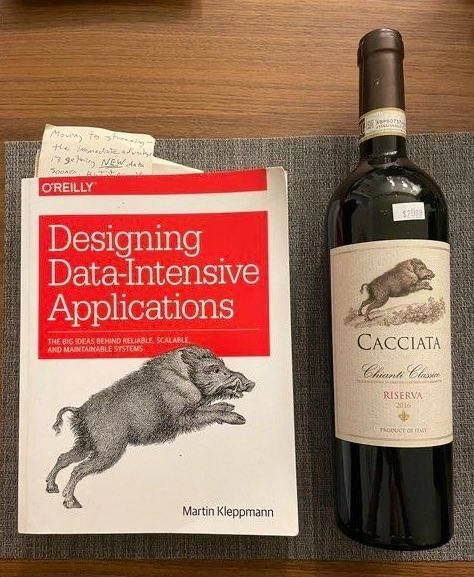
The picture makes those heavy topics approachable by using a visual pun. The book has a boar on the cover. The wine label also has a boar. So the image treats a serious engineering book like a fancy meal that needs the right bottle. The funny part is that the "taste" being paired is not pasta or steak; it is database theory.

Level 3: The O'Reilly Sommelier

For senior engineers, the humor is the oddly refined intimacy of the setup. The book is not a beginner tutorial or a hype-driven framework guide. It is Designing Data-Intensive Applications by Martin Kleppmann, a canonical text for people who need to understand why real systems fail at the boundaries between databases, services, queues, and humans with deadlines. Putting that book beside a bottle of Chianti Classico Riserva 2016 turns system design study into a ritual, almost like a wine tasting for architectural trade-offs.

That is why the post message, Keep your learning well-organized, works. The organization here is absurdly literal: matching boar to boar. But it also hints at the serious side of DataEngineering. Good data systems are about organizing change. Records change. Schemas change. Query patterns change. Teams change. The worst production incidents often come from assuming one of those things was stable because the diagram looked tidy.

The meme also pokes at the culture around serious engineering books. Everyone says they want reliable, scalable, maintainable systems. Then the backlog asks for a rushed feature, the database becomes an integration bus, analytics wants real-time dashboards, and the architecture decision record is written after the incident review. DDIA sits there like a calm professor explaining trade-offs while the organization asks whether consistency can be done by Friday.

The wine gives the image a dry little wink: this material is rewarding, but it is not light reading. Distributed systems turn reasonable adults into people who argue about clocks, message ordering, and whether a retry created a duplicate order. A glass of red beside the book says, "I am studying," but also, "I have seen a Kafka consumer group rebalance during a deploy."

Level 4: Consistency With Tannins

This image is funnier if Designing Data-Intensive Applications is already filed in your brain under "the book that explains why the database is lying, but usually for good reasons." The visible cover subtitle says:

THE BIG IDEAS BEHIND RELIABLE, SCALABLE, AND MAINTAINABLE SYSTEMS

Those big ideas are the ones that make DistributedSystems painful: replication, partition tolerance, ordering, consensus, transactions, logs, streams, schema evolution, and the miserable difference between "the write succeeded" and "every reader can now observe the write." The wine bottle next to the book turns those ideas into a pairing joke. A Chianti has vintage, origin, aging, and label semantics; a distributed data system has versions, provenance, retention, and consistency semantics. Both punish people who pretend the label tells the whole story.

The handwritten note partly visible above the book appears to include Moving to streaming, which quietly raises the technical difficulty. Batch data processing is already full of compromises, but streaming introduces event time, processing time, backpressure, replay, late-arriving events, idempotency, exactly-once claims, and the eternal question of whether "exactly once" means exactly once in the marketing deck or exactly once in the failure model. A log-based system can look elegant until a consumer restarts, a partition is reassigned, and someone discovers that their deduplication key was only unique during a demo.

The boar visual rhyme matters because O'Reilly animal covers are iconic in technical publishing. Here, the animal on the DDIA cover and the boar on the Cacciata wine label make the technical reference feel deliberately curated. The joke is not just "a book and alcohol." It is "a data engineer has found the only acceptable beverage pairing for reading about DataReplication and DataConsistency." If the wine is robust enough, perhaps it can tolerate network partitions. If not, at least it has a better rollback story than last quarter's event schema migration.

Description

The photo shows Martin Kleppmann's O'Reilly book "Designing Data-Intensive Applications" lying on a table beside a bottle of red wine. The book cover text includes "O'REILLY", "Designing Data-Intensive Applications", "The Big Ideas Behind Reliable, Scalable, and Maintainable Systems", and "Martin Kleppmann", with the familiar black-and-white boar illustration; a partially visible handwritten note peeks out above the book, with only fragments such as "Moving to streaming" clearly legible. The wine bottle label also features a boar and reads "Cacciata", "Chianti Classico", "Riserva", "2016", and "Product of Italy", creating a visual rhyme with the book cover. The meme works because DDIA is a canonical distributed-systems text, and the matching boar label turns it into the kind of pairing only a database engineer would find romantic.

Comments

8
Anonymous ★ Top Pick Perfect pairing: eventually consistent tannins, strong partition tolerance, and a replication factor you only notice tomorrow.
  1. Anonymous ★ Top Pick

    Perfect pairing: eventually consistent tannins, strong partition tolerance, and a replication factor you only notice tomorrow.

  2. @vladyslav_google 1y

    Reading this book rn xD

  3. @FirokOtaku 1y

    reading this too

  4. @Sp1cyP3pp3r 1y

    What about this one

    1. @callofvoid0 1y

      I knew it, my cat helps me write regexp

  5. @SimpleJacky 1y

    Only wine is missing

  6. @ercolebellucci 1y

    multitasking, learning language+book

    1. @FirokOtaku 1y

      yes. without dictionary app i cant read many words in this book

Use J and K for navigation