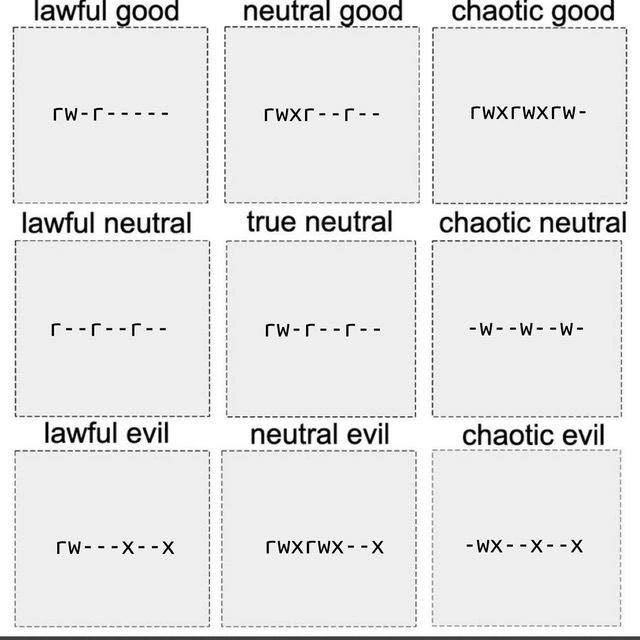
D&D alignment chart reimagined with classic Unix file-permission strings
Why is this OperatingSystems meme funny?
Level 1: Who’s Allowed In?
Imagine you have a special toy box, and you get to decide who can do what with it. There are three groups of people in this scenario: you (the owner of the box), your friends (a group you choose), and everyone else (strangers). Now, you have three keys for the box:
- One key lets a person open the box and look inside (that’s like read permission).
- Another key lets a person put things in or take things out of the box (that’s like write permission).
- The third key lets a person run the toy box as a machine or gadget if it were that kind of box (that’s like execute permission – think of it like allowing someone to turn on a toy or use it).
In the meme, each square in the grid is saying what keys are given out to whom, and it gives that choice a funny personality. For example, one square is labeled “lawful good” and shows rw-r-----. That basically means: you (the owner) can use the first two keys (open/look r, and put things in w), your friends get only the first key (they can open and look r), and strangers get no keys at all (---). This is like a very good and responsible friend – you share the toy with your friends so they can see it, but you don’t let random strangers mess with it. You’re following common sense rules (so that’s lawful) and being kind to your buddies (that’s good).
On the other end, there’s a “chaotic evil” square with -wx--x--x. That one is wild: it means you as the owner are not even allowed to just peek inside your own box (you gave yourself no read key!), but you can still put things in or take out (write) and use the toy (execute). Meanwhile, friends and strangers get only the “use it” key (execute) and nothing else. This is like a really crazy and mean situation: you invite everyone to press the on-button of your toy machine, but nobody, not even you, is allowed to simply open the box and see how it works. It’s chaotic and evil because it’s confusing and pretty unfair – people can only interact in a very limited, sneaky way. It’s as if a mischievous kid said, “Sure, you can all play with my toy, but you can’t look at it or change anything. Even I won’t look at it! Mwahaha!” It doesn’t make a lot of sense, which is why it’s funny.
The whole chart is just different versions of how much sharing is happening, with funny labels:
- A good label (like good or neutral good) usually means you’re being more sharing and kind with your toy/box. For example, neutral good
rwxr--r--means you let yourself do anything (it’s your toy after all), and you even let strangers and friends at least peek inside (read) so they can enjoy looking at it. That’s friendly. - An evil label means you’re being unsharing or tricky. For instance, lawful evil
rw---x--xmeans you let others only use the toy in a very specific way (like “you can push the button, but you can’t see inside or change it”), which feels like you’re up to no good. Not very nice! - Lawful means you’re following a strict rule or pattern. Lawful neutral
r--r--r--is the same rule for everyone: “Nobody can mess it up; you can only look, and that’s it.” It’s fair in a way, but very strict because not even you allow yourself to add new things once it’s set. - Chaotic means you’re doing something unexpected or without a clear rule. Chaotic good
rwxrwxrw-is super generous (almost anyone can play and even make changes!) but it’s a bit all over the place – it might even be too messy because if everyone can change the toy, who knows what will happen to it? It’s good-hearted but a little crazy.
In simple terms, this meme is funny because it’s treating a computer file like a toy or treasure that someone can choose to share or hide, and it labels those choices as if the person sharing was a character in a story with a moral alignment. You normally wouldn’t think of giving someone permission to read a file as “good” or “evil” – it’s just a technical choice. But here we pretend it’s a moral choice, which is silly and cute. It’s like a little chart of different kinds of toy owners: the one who shares nicely, the one who shares with only best friends, the one who lets everyone do anything (even scribble on it!), or the one who is super stingy or even mischievous about it. If you know a bit about both computers and fantasy games, you see the joke: it’s mixing two very different things to make us laugh at how giving out keys (permissions) could reflect someone’s “personality.” Even if you don’t catch all the details, you can imagine: who gets to come play and who has to stay out? The various answers to that are dressed up as heroes and villains, which makes a nerdy topic feel like a playful story.
Level 2: Role-Playing Permissions
So what’s actually going on in this meme? It’s using a D&D alignment chart (a 3x3 grid from Dungeons & Dragons that labels characters as lawful/neutral/chaotic vs good/neutral/evil) and filling each slot with a Unix file permission string like rwxr--r--. In plain terms, it’s comparing how file permissions are set to different “personality alignments.” To appreciate the joke, you need to know a bit about Linux/Unix file permissions and how the D&D alignment system works.
First, let’s decode those funny strings like rwxrwxrw-. When you run the command ls -l on a Unix-like system (Linux, macOS Terminal, etc.), the output shows file details. For example:
$ ls -l example.txt
-rw-r--r-- 1 alice devs 1024 Jun 1 12:34 example.txt
The part -rw-r--r-- at the beginning is the file’s permission string. It’s 10 characters long: the very first character (- in this case) indicates the type of item (e.g., - for a regular file, d for directory). The remaining nine characters represent permissions, in three groups of three:
- Owner permissions (first 3 characters): what the file’s owner can do.
- Group permissions (next 3): what members of the file’s group can do.
- Others permissions (last 3): what everyone else (all other users) can do.
Within each trio, the characters stand for:
- r = read permission
- w = write permission
- x = execute permission
- If a character is
-instead of a letter, it means that permission is denied.
So rw- means read + write allowed, but no execute. r-- means read-only. -w- means write-only (no read or execute), and so on. It’s a concise way for an operating system to show who can do what with a file.
For instance, take the “true neutral” example from the meme: rw-r--r--. Breaking it down:
- Owner:
rw-= owner can read and write the file. - Group:
r--= group can read the file (but not write or execute). - Others:
r--= others can read the file as well. This is one of the most common permission sets out there – in numeric form it’s 644. In fact, when you create a new text file on Linux, it often ends up withrw-r--r--by default (thanks to a typical umask setting). It’s a very balanced setting: the file’s creator can edit it, and everyone else can at least view it. No one except the owner can modify it, which prevents random users from messing it up. The meme calls this true neutral because it’s smack in the middle – not too restrictive, not too permissive, just the standard “fair” default.
Now, the alignment chart is a fun framework from role-playing games:
- Lawful means you follow rules or a consistent code,
- Neutral is in-between or balanced,
- Chaotic means you’re unpredictable or break rules. And separately,
- Good means benevolent or generous,
- Neutral (on the good-evil axis) is again in the middle (not particularly selfless or malicious),
- Evil means selfish or harmful.
The meme assigns each permission scenario an alignment label. This works because setting file permissions can feel like choosing a stance: Are you being generous with access (good) or stingy (evil)? Are you applying a strict policy (lawful) or a wild one (chaotic)? It’s a playful analogy.
Let’s explore a couple more examples from the grid:
- “Lawful good”: The string is
rw-r-----. Owner has read/write (rw-), group has read (r--), others have no access (---). In numeric terms, that’s 640. This is a bit more restrictive than the true neutral 644 we just discussed: here “others” (the world) can’t even read the file. It’s lawful (a conservative rule: only trusted users can see it) but still good because at least the owner’s group (say your team or department) is allowed to read it. Think of a config file that only the app team should see – the sysadmin who set it to 640 is following security best practices (lawful) while still being helpful to the right people (good). - “Chaotic good”: The string given is
rwxrwxrw-which is 776 in octal. Owner:rwx(full rights), group:rwx(full rights), others:rw-(read and write, but no execute). Wow, that’s very open! Essentially, any user on the system could modify the file’s content (others havew), which is risky, but presumably done with good intentions (maybe to let everyone collaborate or get access to information). Why chaotic? Because in practice, giving write access to the entire world is pretty uncontrolled – you’re trusting everyone, and that can lead to chaos if someone writes something bad. It’s the equivalent of saying “anyone can come into my file and change things if they want.” Often, only very “free” environments or inexperienced users do something like that. A system administrator who’s more cautious (and sober) would rarely make a file world-writable unless absolutely necessary. But a chaotic good character might prioritize sharing over order, so in the meme’s logic, 776 fits that bill – trying to do something beneficial (good) in a reckless, unruley way (chaotic). - “Lawful neutral”:
r--r--r--is 444. This means nobody can modify the file (nowanywhere); everyone – owner, group, others – only has read access. That’s an extremely orderly setting: it applies uniformly to all (very fair and law-like) and doesn’t favor the owner with extra privileges beyond everyone else. It’s neutral on good/evil because it’s not really about being generous or malicious; it’s more about strictly enforcing consistency. In real life, you might see 444 on a file that should never be changed by anyone except perhaps the system itself – for example, a default configuration or a public key file distributed to all users. Setting your file to read-only for all is basically saying “look, but don’t touch” to the entire world. It’s neither friendly nor cruel – just very strict. - “Chaotic neutral”: This one,
-w--w--w-(numeric 222), tends to raise eyebrows! Here, no one has read permission (the first character in each trio is-for owner/group/others), everyone has write permission (win the second spot of each trio), and no one has execute. So literally any user can write data to the file (technically they can truncate it, append to it, etc.), but even the owner cannot simply read what’s in the file. This is a strange scenario, but it’s possible. It’s neutral on the good/evil scale because it’s not clearly to anyone’s benefit or detriment – it’s just odd. And it’s chaotic because it breaks the usual rule of “owners can always read their own files.” Why would someone do this? Rarely on purpose! It could be a mis-set permission, or a very special-case like a drop-box file where multiple processes dump data blindly. The meme calling this “chaotic neutral” pokes fun at how nonsensical it is – a very unpredictable, offbeat configuration that doesn’t clearly help or harm, it just exists in defiance of normal logic. In a D&D sense, chaotic neutral characters do unpredictable things for their own reasons, and this permission fits that vibe: “I don’t know why it’s like this, but hey, it’s what I felt like doing.” - “Neutral evil”:
rwxrwx--x(octal 771). Now this one is interesting: Owner and group haverwx(all powers), but others have only--x(just the execute bit). So the general public can run or execute the file, but cannot read its contents or modify it. It’s labeled evil because it’s somewhat sinister: it lets others trigger whatever the file does, without letting them inspect it first. Imagine an executable script or program – you can execute it, but you can’t open it to see the code or log output, etc., unless you’re in the privileged group. That’s like giving someone a mysterious box with a button: “You may press it, but you have no idea what it will do and you aren’t allowed to peek inside.” It’s neutral on the lawful/chaotic scale because it’s not completely insane (the owner and team still retain full control; it’s a permissible pattern under normal rules), but it’s definitely not kind or ethical – it’s more like an evil mastermind situation where only the inner circle knows the plan, and outsiders are kept in the dark yet used as trigger-pullers. In real sysadmin terms, you might see something a bit like this with certain shared executables where maintainers want to hide implementation details (though usually they’d just not give execute to others either). It’s more of a theoretical “mwahaha” permission set. - “Chaotic evil”:
-wx--x--x(octal 311). This one takes the cake for craziness. The owner lacks read permission (-wxfor owner, nor), meaning even the owner can’t open the file to see what’s inside. The owner can write and execute it though. Group and others have--x(only execute). So others can run this file blindly, and the owner can also run it or even modify it, but the owner cannot directly read it. This is almost never intentional in real life – it’s like someone went out of their way to create maximum confusion. Fittingly, this is dubbed chaotic evil: it’s harmful (nobody except maybe a program with special privileges can read the content) and it’s inconsistent with any sane policy. If lawful evil was a calculated trap, chaotic evil is a trap even its creator might fall into because they’ve lost the key to their own safe! In system terms, this could happen if, say, an admin removes read permission on a script for security, but still wants it to run. They might not realize they’ve also prevented themselves from easily viewing or debugging that script later. It’s a recipe for self-inflicted pain, which has a dark humor of its own.
By drawing these analogies, the meme is essentially a piece of Sysadmin humor or Security humor. It tickles the part of a techie brain that deals with permissions daily by saying, “Hey, what if setting permissions was like deciding your moral alignment?” For those familiar with the command line interface (CLI), the chmod command is how you change these permissions on Unix/Linux. For example, chmod 640 file.txt would make a file lawful good as per the meme (owner rw, group r, others none). Likewise, chmod 444 file.txt would impose a lawful neutral read-only policy on everyone. System administrators often juggle these numbers and strings to ensure the right people have access and the wrong ones don’t. It’s a fundamental part of operating systems security and multi-user environment management.
What makes this funny is that it’s an unexpected crossover: the concept of alignment comes from fantasy role-playing games, where you describe character behavior, while file permissions are a dry technical setting describing access control. Mixing them yields absurd mental images: imagine a paladin sysadmin (lawful good) carefully crafting permissions so as to do the most good within the rules, versus a rogue-ish admin (chaotic neutral) randomly flipping bits because “why not?”, or an evil overlord CIO (lawful evil) decree that employees can execute company code but never see its source. It’s tongue-in-cheek, of course. In reality, there isn’t a “good” or “evil” file mode – they’re just appropriate or inappropriate for the situation. But by pretending there’s a moral dimension to chmod, the meme gives us a laugh.
For a newer developer or someone just learning Linux, this meme also inadvertently serves as a teaching tool: you get to see nine different permission combinations and think about what they mean! Some of them are common sense (like rw-r--r-- being a normal case), while others (-w--w--w- or -wx--x--x) might prompt you to ask, “Wait, can you really have a file that you can write to but not read from?” (Answer: yes, you can set it that way, though it’s unusual!). So, the meme expects you to know or learn the basics of Unix permissions: it’s almost a quiz of “do you know what each of these strings allows?” and then a joke about “what kind of person would set it like that.”
Furthermore, the alignment aspect expects some cultural knowledge of D&D or at least the meme tradition of the 3x3 alignment chart. These alignment chart memes have been popular on the internet for categorizing all sorts of things – from characters in a TV show, to text editor preferences (vi vs emacs as lawful vs chaotic, for example), to programming languages (some call Python lawful good and JavaScript chaotic neutral, etc.). Here it’s classic Unix commands being given alignment values, which is both geeky and imaginative. If you’re “in the know,” you get a double dose of satisfaction: “Ha! I recognize those chmod strings and I get the D&D joke.”
In summary, at this intermediate understanding level: The meme is comparing file permission settings to D&D moral alignments. Each permission string (like rwxrwx--x) indicates who can read/write/execute a file for owner, group, and others. And each alignment term (like neutral evil or chaotic good) humorously describes the “philosophy” of giving out those permissions:
- Good = giving more access to others (friendly permissions),
- Evil = giving little or only tricky access (selfish or deceptive permissions),
- Lawful = done in a consistent, rule-abiding way,
- Chaotic = done in a wild, unorthodox way.
To fully get it, you need to know how to read permission bits and have a sense of what each alignment means. But once you do, it’s a fun mash-up that makes you think of a sysadmin’s job as if it were an RPG character deciding whether to be generous or cruel with file access. And let’s be honest, if you’ve ever had to chmod a file at 2 AM to fix a bug, thinking of it as casting a spell or choosing an alignment for your file adds a little whimsy to an otherwise routine task!
Level 3: POSIX Morality Bits
At the highest geek level, this meme collides two beloved nerd domains: classic D&D alignments and Unix file permissions. The humor emerges from mapping moral alignment archetypes to file access settings – a clever cross-reference only a seasoned sysadmin or tabletop dungeon master could dream up. Each nine-character string like rw-r----- is a Unix permission bitmask expressed in human-readable form. In Unix-like operating systems (think Linux), every file has three categories of users – owner, group, and others – and three types of rights – read, write, and execute (often abbreviated as r, w, x). The meme’s 3×3 grid labels each permission string with Dungeons & Dragons alignment terms: lawful good, neutral good, chaotic good, etc. This juxtaposition tickles experienced developers because it anthropomorphizes system security settings as if they were ethical stances or personality types.
Why is that so amusing to a veteran engineer? Consider the lawful vs. chaotic axis as representing how consistent or extreme the permission policy is, and the good vs. evil axis as how generous or restrictive the access is from the perspective of other users. For example, “lawful good” corresponds to rw-r----- (in numeric form, that’s 640). This is a pretty strict setting: the owner can read/write, the owner’s group can read, and nobody else can touch the file. It’s lawful because it follows the principle of least privilege by the book (no random permissions), and good because it still grants necessary access to colleagues (group members) who might need to read the file – a benevolent sysadmin sharing info with the right people. Compare that to “chaotic good”, rwxrwxrw- (numeric 776): here the owner and group have full control (rwx), and even others get read/write! This is nearly a full open door – practically everyone can read or modify the file – except a lone withheld privilege (others don’t get execute rights). It’s good in the sense of being generous (everyone can share the data), but chaotic because giving world-write access is dangerously permissive in practice. A chaotic good developer might be that well-intentioned colleague who, frustrated by permission errors, shouts “Just chmod it to 777 so everyone can use it!” – genuinely trying to help, but maybe introducing a touch of madness into system security.
Now look at the “evil” side for some dark sysadmin humor. “Lawful evil” is rw---x--x (numeric 611). The owner gets read/write, but everyone else gets only the execute bit and no read access at all. That’s a deviously strict scenario: you let others run the program or script, but they can’t see what it does (no read) or alter it (no write). It’s like handing out a mysterious binary and saying, “Go ahead and run it – but its code is my secret.” This alignment is lawful because it’s a very deliberate, rule-governed setup (perhaps enforcing a company policy: e.g., a team can execute deployment scripts but not inspect or modify them). Yet it’s evil because it withholds transparency – a sysadmin could use such permissions to hide nefarious code that others can unknowingly execute. Then there’s “chaotic evil”: -wx--x--x (numeric 311). This one’s hilariously bizarre – the owner can’t even read their own file (no r for owner), but can write to it and execute it. The group and others get only execute rights, nothing else. This setting is so impractical it basically never occurs unless by accident or mischief. It’s chaotic to the core: permissions that make no sense operationally, almost like the sysadmin rolled a D20 and applied a random chmod. And it’s evil in that it’s user-hostile: nobody (not even the owner) is allowed to just read the file’s contents. A chaotic evil admin might do this purely to sow confusion: “I can run this program and change it, but neither I nor anyone else can simply read it? Muahaha!” – an act of permission sabotage fitting of a villain (and indeed, likely to end in disaster at 3 AM).
Between those extremes lies the humor of neutral alignments. “True neutral” is given as rw-r--r-- (the classic 644). Ah yes, the default, “umask 022”-typical permission that every seasoned Unix user has seen thousands of times. Owner can read/write, everyone else can read, but only the owner can modify. It’s the perfectly balanced, neutral setup – no special strictness, no wild openness, just the standard fare that works on most machines™. Labeling this as true neutral is perfect: it’s the impartial baseline of file permissions, not trying to be especially generous or harsh. “Lawful neutral” (r--r--r--, numeric 444) is pure rule-abiding fairness: absolutely no writing by anyone (not even the owner has w), but everyone across the board can read. It’s as if the sysadmin said, “This file is sacred; no one shall alter a byte, but all may view it.” This could be a public document or a config file meant to never change during operation. It’s neutral (neither favoring just the owner nor others – all are equal), and lawful in its rigidity (a single unbending rule: read-only for all, period). On the flip side, “chaotic neutral” (-w--w--w-, numeric 222) is a truly wacky one: it grants only write permission to everyone, with no reads or executes. That’s basically the digital equivalent of a blind drop box: anyone can toss data in, but no one (not even the owner) can look at what’s inside once it’s there! This might actually have a narrow real-world use (imagine a mailbox file where users append messages but can’t read others’), but it’s mostly known as a prank or mistake – for instance, a newbie sysadmin intending to open up write access might accidentally remove read rights and leave a file in this confusing state. It’s chaotic because it defies normal expectations (who makes a file that even its owner can’t read?), yet neutral as it’s not outright malicious – just unconventional.
The brilliance here is how file permission combos take on personalities in this chart. Seasoned devs and admins will recognize these permission strings at a glance: they’ve probably set them or encountered them during bug hunts. Seeing them sorted into a D&D alignment grid triggers an instant “aha!” – it’s funny because the comparisons oddly fit. Veterans have seen coworkers who are “lawful good” types about security (careful, by-the-book permission setting to protect data, but in a helpful way). They’ve also dealt with “chaotic good” folks who, in the name of quick solutions or open collaboration, might do wild things like chmod -R 777 / (the infamous “give everyone all access” move that can wreak havoc – chaotic good intentions, questionable results!). And who hasn’t cursed a “lawful evil” sysadmin at least once – the person who locks down a production server so tightly (no access unless you’re root and even then with multi-factor) that getting anything done feels like solving a cryptogram? They mean well for security compliance, but the experience can feel evil to developers needing to run a simple log query. This meme captures those archetypes tongue-in-cheek.
From an operating systems standpoint, it’s also a light satire on how simple the Unix security model was in the early days (just these rwx bits) and how we’ve anthropomorphized it. Modern systems have extended ACLs and SELinux contexts (far more granular controls), but this meme sticks to the classic chmod worldview. That simplicity makes it easy to imagine “ethical” stances: you either give or restrict the triad of rights in various combinations, akin to moral choices. It playfully implies there’s a philosophy behind permission sets – as if a sysadmin setting permissions is choosing to be noble or evil. In reality, of course, it’s usually about practical security vs. usability trade-offs, not morality. But treating it like an alignment chart is hilarious because it frames those everyday chmod decisions as an epic role-playing game of governance over files. A senior engineer will appreciate the layered joke: it’s simultaneously a quick primer on file permission minutiae (only someone who knows the difference between 644 and 640 can fully appreciate “lawful good” vs “true neutral”), and a cultural reference to the alignment memes we’ve seen applied to everything from coding styles to programming languages. It’s a nod to shared geek culture – if you laugh, you’ve unlocked the dual achievement of Linux file guru and D&D lorekeeper. In summary, the meme tickles that senior-dev sweet spot: deep knowledge meets whimsical comparison, producing an “I see what you did there” grin.
Description
The meme is a 3×3 grid that mimics the familiar Dungeons & Dragons alignment chart. Across the top row are the captions "lawful good", "neutral good", and "chaotic good", the middle row reads "lawful neutral", "true neutral", "chaotic neutral", and the bottom row shows "lawful evil", "neutral evil", "chaotic evil" - all in lowercase black text above dashed-border grey squares. Centered in each square is a different nine-character Unix permission string: lawful good "rw-r-----", neutral good "rwxr--r--", chaotic good "rwxrwxrw-"; lawful neutral "r--r--r--", true neutral "rw-r--r--", chaotic neutral "-w--w--w-"; lawful evil "rw---x--x", neutral evil "rwxrwx--x", chaotic evil "-wx--x--x". The joke maps how much access each role gets to the D&D morality spectrum, poking fun at sysadmins’ ethical choices when running the chmod command. It relies on command-line, Linux/Unix, and systems-administration knowledge for full comedic effect
Comments
6Comment deleted
Chmod debugging lifecycle: start at lawful-neutral 444, bump to 644, rage-escalate to 664, and when the build still fails you cast “chmod -R 777 .”, proudly achieving Chaotic Good - and scheduling a future audit boss fight
The chaotic neutral "-w--w--w-" is what happens when you let the intern write the Terraform module for S3 bucket policies - everyone can upload their incident reports but nobody can read why production went down
The 'chaotic evil' -wx--x--x permission set is the digital equivalent of letting someone modify your production config files while blindfolded - they can write and execute, but can't read what they're destroying. It's the permission scheme that makes even chmod 777 look responsible, and perfectly captures that one contractor who 'fixed' the deployment script at 2 AM without being able to verify what they changed
644 is true neutral until product calls it “blocking velocity” and someone ships 776 to prod; the alignment change is automatically recorded by PagerDuty
Chaotic neutral -w-w-w-: overwrite prod configs blindly, never cat what you just nuked
We preach umask 022 and least privilege, but the second an NFS mount breaks a deploy, "chmod -R 777" gets relabeled as chaotic good