The Young L5 Engineer Starterpack: Docs, Unicorn Hype, No Terminal, Existential Dread
Why is this CorporateCulture meme funny?
Level 1: Fancy Toys, Empty Joy
Imagine a kid in school who always got gold stars and A+ grades and felt really proud when the teacher praised him. 🏅 One day, he skips to a new, bigger school because he thinks it will be more exciting, like joining a famous big team. But at the new school, things are not what he expected. Instead of doing fun science projects like he used to (like coding and building things), he spends all day writing a big plan for a project. He writes and writes, pages and pages (kind of like a long homework assignment), but then… none of his classmates or teachers bother to read it. He feels ignored and wonders if he did something wrong.
Since no one is giving him gold stars anymore, he starts feeling a bit lost and sad – kind of like a kid who’s used to applause but now hears crickets. To feel better, he tries a bunch of things. First, he says, “I’m going to get super strong now!” and he goes to the gym. But he can only lift very light weights, about as heavy as a big textbook, and he’s huffing and puffing. Still, he tells everyone he’s really into fitness now, hoping they’ll be impressed. Then, he decides to treat himself with his savings: he buys a really fancy watch with a cool design. It looks sleek on his wrist, and he’s a bit happy because it’s expensive and unique – but it’s not like a famous collectible toy, it’s just something pretty he likes (and if he tried to trade it, no other kids really want it).
He also spends money on a special friendship app (like a premium club) to meet new friends or maybe a girlfriend. He’s so sure paying for the premium feature will introduce him to great people. But uh-oh! He gets a few messages and they all turn out to be fake people (robots or scammers pretending to be real). No real new friends, just disappointment – he basically paid for fancy nothing. Now he’s working long hours on the computer every day – imagine him at his desk from morning to night. His back starts hurting from sitting so much. So he thinks, “Maybe if I get the best chair in the world, my back will stop hurting!” He buys a super expensive ergonomic chair (the kind you see in fancy offices). It’s comfy for sure, but after weeks in front of the screen, he still aches. It’s like putting a cushy band-aid on a big bruise; it helps a little but doesn’t fix the fact he’s sitting too long.
Meanwhile, he realizes he hardly plays with his coding programs (like a kid not playing with his favorite toy) anymore. The “terminal” – which is like the special toolbox on his computer for coding – has dust on it because he hasn’t opened it in months. That was something he used to love, and now it’s just sitting unused, and that makes him feel even more disconnected from what made him happy at work. To fill that gap, he dives into other hobbies: he becomes super picky about coffee and beer. It’s like a kid suddenly only wanting the fanciest hot cocoa or collecting rare sodas – he’ll only drink this special kind of coffee from a certain shop, and he talks about coffee beans the way he used to talk about code. Or he goes on and on about craft root beer flavors. It’s a bit random, but it gives him something fun to focus on for a while, even if no one else quite gets why he’s so into it.
Finally, feeling stressed and not sure who he is anymore, he decides to go on a big trip far away to a quiet camp where people meditate (you know, sit quietly, breathe, and clear their minds). Think of it like he flew to a peaceful mountain retreat to learn how to relax and be mindful. He’s hoping that maybe by meditating in a beautiful place, he’ll figure out why he’s unhappy and how to feel better.
In the end, this whole situation is a bit funny and a bit sad at the same time. It’s funny because the kid (our young engineer) is doing all these fancy, grown-up things he thinks will solve his problems – buying expensive stuff, paying for special services, bragging about new habits – but none of it is really addressing the simple issue that he’s not doing what he truly enjoys (like building things and feeling appreciated). He got all these “fancy toys” and changes in his life (the big job, the watch, the chair, the premium app, the coffee hobby) expecting they’d make him happy or successful, but he ended up with “empty joy” – he’s still unsatisfied and a bit lonely. He chased all the shiny things and forgot the basics that used to make him smile. That’s why we laugh at this story: we recognize the character is trying so hard to find happiness in all the wrong places, and it’s relatable. Sometimes, grown-ups (and even kids!) focus on collecting cool new things or titles but miss the simple joys that truly made them love what they do. So this meme is like a cartoonish checklist of those misadventures, and it’s amusing because we see a little bit of truth in it about how people can get sidetracked when they’re unsure about their path.
Level 2: L5 Lifestyle 101
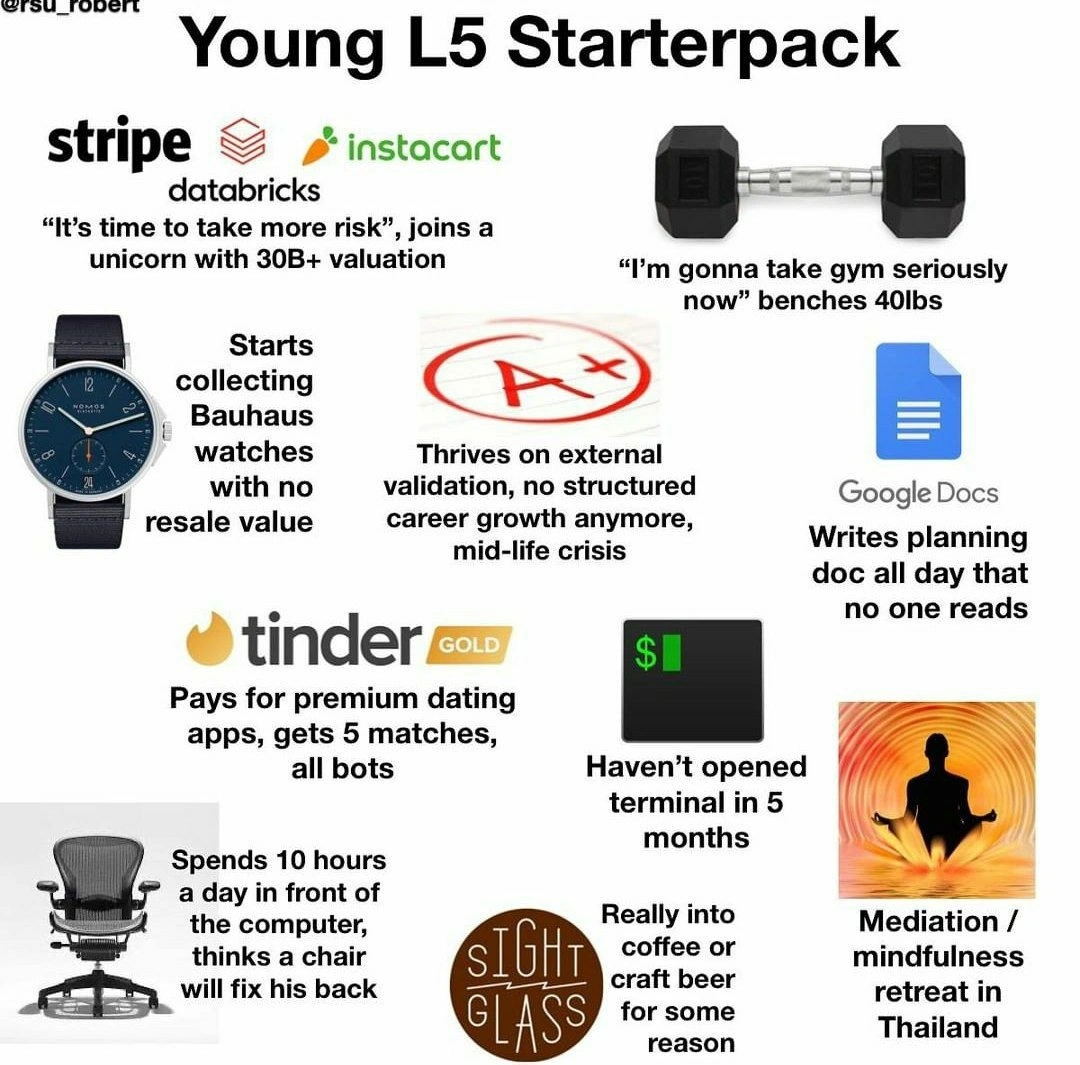
Let’s break down this meme in simpler terms and explain what’s going on for those newer to tech or unfamiliar with the references. The meme is a “starterpack”, meaning it’s a collection of images and captions that collectively describe a typical person or stereotype – in this case, a “Young L5 Engineer.” Imagine a bunch of items laid out that you’d give someone to become this person. Each item in the image corresponds to a habit or situation common for this stereotype. Now, who or what is a Young L5 Engineer?
L5 is a term used in companies like Google to denote a level of seniority. Google (and similar big tech firms) have a leveling system for roles. For engineers, new grads might start at L3 (entry-level), L4 is mid-level, and L5 is considered a Senior Software Engineer. Reaching L5 means you’ve got significant experience (often ~5-8 years in) and are trusted with bigger projects. Being a “young” L5 implies this person got promoted quickly – they’re relatively young for a senior position. That often comes with a change in the kind of work you do: less day-to-day coding and more planning, leading, and coordinating.
Now, why is this a starterpack meme? Because it’s highlighting how many young senior engineers end up with a similar set of behaviors and interests, almost comically so. Let’s go through each component:
Joins a “unicorn” startup valued at $30B+ – A “unicorn” in the tech world is a private startup company valued at over $1 billion (implying it’s rare, like a unicorn). The meme specifically shows logos of Stripe, Databricks, Instacart – all companies that, at one point, had huge valuations (tens of billions). So, our engineer decides to leave their current job (maybe at a big company) because they say “It’s time to take more risk.” That phrase suggests they feel their current job is too safe or boring, and they want adventure or a bigger payoff. Joining a $30B startup is seen as “risky” in their mind. The joke, however, is that a $30B startup is not really a scrappy risky venture – it’s already very large and richly valued! It’s like someone saying they want a thrill and then hopping on a merry-go-round instead of a roller coaster. So this shows a bit of a disconnect. The engineer thinks they’re being bold and entrepreneurial, but really they’re going to a well-established (perhaps even over-hyped) company. This element pokes fun at how mid-career tech folks often hop between companies chasing the next big thing (maybe for more stock options or a feeling of being more “startup-y”), even if the “startup” is basically a big corporation itself. There’s also an undertone that many people made this move especially around 2020-2021 when startups had sky-high valuations and it felt like easy money; by mid-2022 (when this meme was posted), that trend was being questioned because some valuations were imploding.
“I’m gonna take gym seriously now” (benches 40 lbs) – This is showcasing a common personal goal: getting in shape. A lot of developers in early career might neglect exercise due to long work hours or just focusing on coding marathons over physical fitness. At some point (often as they get a bit older or after a health scare), they decide to start working out again. Our meme character has declared he’s serious about the gym now. But the detail “benches 40 lbs” highlights that he’s essentially a beginner at weightlifting. Bench pressing 40 lbs is very light – perhaps just starting out or not making much progress. Usually, gym enthusiasts talk in plates of 45 lbs on each side; here 40 lbs total is almost symbolic of someone who just started. The humor is that he’s talking big about commitment, but the actual numbers show he’s still in the newbie stage. Many can relate: how many times have we told ourselves (or seen friends say) “This year I’ll get fit!” then only manage a couple of tentative sessions? For a new developer, it’s useful to know this is a typical scenario – balancing tech work and health is a challenge. The meme gently teases the idea that simply declaring a fitness goal is different from actually making major gains. It’s a slice of DeveloperLifestyle humor: brain gets strong, body… not so much, until you make an effort.
Collecting Bauhaus watches (no resale value) – Here we venture into hobbies. “Bauhaus watches” refer to watches designed with a Bauhaus aesthetic – very minimal, elegant, usually from specific brands (like Nomos, which is known among watch enthusiasts in tech). The key point is he’s started collecting these watches. For context, watches can be a hobby where people collect expensive timepieces. Some watches (like certain Swiss luxury brands) can be resold or even appreciate in value. But Bauhaus-style watches, while pricey, aren’t typically investment pieces – they’re more niche and personal taste-driven. Saying “with no resale value” means if he buys one for $2000 and later tries to sell it, he might get only $700, for example – so it’s not a financially savvy collection, it’s just for his own gratification. Why is this in the meme? It’s illustrating the pattern of newly affluent or bored engineers picking up an expensive obscure hobby. He might have extra cash from his high salary or stock, and instead of, say, buying practical things, he’s indulging in a form of luxury that not everyone even appreciates. It’s also a status or identity hobby: he can talk about his designer watch and feel a bit special. For a junior dev, it might seem odd – why watches? But if you hang around senior engineers, you might notice many have at least one quirky high-end hobby (be it mechanical keyboards, photography gear, rare collectibles, etc.). It’s both a way to enjoy their income and a way to have an interest outside of code. The meme highlights “no resale value” to emphasize that this hobby is purely for show or self-satisfaction, not something practical. It’s a subtle nod to the fact that maybe he’s trying to buy happiness or a sense of sophistication, but it’s not really going to yield anything except a drawer full of watches.
“Thrives on external validation, no structured career growth anymore, mid-life crisis” (A+ graphic) – This is describing his psychological state. “External validation” means he relies on praise, awards, or outside feedback to feel good about himself. In a structured environment like a big company, he might get that validation through promotions, bonuses, high performance reviews, or even just constant feedback from a manager. That’s the “structured career growth” part – at companies like Google, you have a well-defined ladder. Every couple of years you aim for the next level (L6, L7, etc.), and there are processes that guide you (and also pats on the back when you succeed). Now that he’s left for a startup, especially a large unicorn, the structure might be a lot less clear. There might not be a clear promotion path or it might be a flat org, or they might say “we don’t believe in titles here.” Suddenly he’s not getting those regular gold stars or clear milestones. The result? He’s having a mid-life crisis – which in this context is more of a career crisis or identity crisis, possibly in his early 30s. He’s questioning “What am I doing? Am I still succeeding or am I stuck?” The A+ stamp image is symbolic: he used to be the A+ student or worker, always winning. Now there’s no one giving out A+ grades, and he’s panicking internally. This resonates in tech because many of us grew up as high achievers in school and early career, used to constant success metrics. Hit a certain point and those clear markers fade away – it can cause a freak-out, genuinely. So the meme is calling that out. For an up-and-coming developer, it’s a hint: be prepared that your motivation needs to become more internal as you advance; you won’t always get instant feedback that you’re doing a good job. The phrase “mid-life crisis” is usually used for people in their 40s-50s who suddenly buy a sports car or something because they feel old. Here it’s used tongue-in-cheek for a 30-ish engineer who feels lost without a promotion roadmap. It’s exaggerated, yes, but not uncommon in feeling.
Google Docs icon + “Writes planning doc all day that no one reads.” If you’ve ever heard engineers groan about “meetings and paperwork,” this is exactly that. In big tech companies (and well-established startups), engineers don’t just code; they often have to write planning documents. These can be design documents for a system, project plans for the next quarter, or proposals to convince leadership of an idea. Writing such docs can literally take up days or weeks. Ideally, the team reads and discusses them. However, reality often is: people are too busy, or the doc is too long, so few actually read it thoroughly. The meme bluntly says no one reads his planning doc. It’s a humorous exaggeration of a real frustration – spending a lot of time on documentation that seems to disappear into a void. Many junior devs might not have experienced this yet, since early in your career you’re mostly coding based on others’ plans. But by the time you’re senior, you might be the one creating those plans. And guess what? You might pour your heart into a 20-page plan only to get maybe one comment like “LGTM” (Looks Good To Me) or even radio silence. It can be demoralizing. The meme includes this to show how our L5’s daily work life has shifted: he’s no longer building things as much as talking about building things in docs. And he’s feeling the futility of it when nobody engages. It’s also poking at corporate bureaucracy: sometimes there are too many documents, or communication isn’t effective, so documents are written just to satisfy process but not actually utilized. If you’re a new developer, this might be a glimpse of what can happen later – documentation is important, but in excess or if poorly timed, it can become like shouting into the wind. The Google Docs logo is immediately recognizable, since that’s a primary tool in many tech companies for specs and plans. So the meme is essentially saying: our hero spends all day in Google Docs drafting plans that end up being ignored. This is both a jab at how he’s using his time (not coding) and at how corporate culture can sometimes make efforts feel wasted.
Tinder Gold logo + “Pays for premium dating apps, gets 5 matches, all bots.” Moving to his personal life, this is pretty straightforward. Tinder Gold is a paid tier of the Tinder dating app. He’s paying for it hoping it will improve his dating prospects (for example, Tinder Gold lets you see who already liked you, which could save time, or it might boost your profile visibility, etc.). The meme jokes that even after paying, he only got 5 matches (which is not many), and worse, all 5 were bots – meaning fake profiles, likely automated or scammers, not real people genuinely interested in him. This is comedic hyperbole about how bleak or comically bad app dating can feel. Many people in tech heavy cities sometimes joke that dating apps have a lot of fake profiles or that it’s hard to get matches unless you’re constantly swiping. So our L5 is experiencing that. It’s a little sad-funny: here’s a guy successful in his career, willing to spend money for an edge in dating, and it’s just not working out. For a younger dev or student, think of it like paying for a VIP upgrade in a game and still not winning any levels – it’s both frustrating and a bit embarrassing. This also highlights maybe he’s not great at the social side or too busy to meet people normally, hence relying on apps. And spending money on Tinder implies a kind of optimizing mindset (“I’ll pay to maximize my love life results!”), which is a very engineer-like approach. The pun here is on developer reality outside of work: not everything can be hacked or bought, including romance. This item humanizes him – showing that professionally he might be doing okay (on paper), but personally he’s feeling the struggle many do. It’s included in the starterpack presumably because a lot of folks in similar positions have a similar story: long work hours, a bit of social awkwardness or limited time, leading to using dating apps heavily, perhaps with meh results. All bots basically means he’s striking out so badly that even the matches aren’t real people! That’s a funny way to say he’s got zero actual dates from it.
Terminal icon + “Haven’t opened terminal in 5 months.” The terminal (the little green and black icon with a $) is a symbol for coding and working directly with computers via text commands. Not opening the terminal in 5 months is basically saying he hasn’t written code or done any hands-on technical work for a very long time – five months could be nearly half a year! For any active software engineer, that’s a sizable gap. If you’re a programmer, you typically use the terminal or coding environment almost daily (especially for backend, data engineering, etc.). So for him to not touch it suggests his role has become very non-coding. Maybe he’s been solely writing docs and attending meetings, or maybe he moved to more of a product or managerial position without realizing it. This is likely a reality check kind of joke: sometimes when engineers climb the ranks, they stop coding regularly. New developers might find that shocking (“Isn’t coding the whole point of being an engineer?”). But indeed, many senior engineers spend a lot more time reviewing others’ code, planning, coordinating, and less time writing code themselves. The meme underscores this as a sort of unfortunate milestone – measure by months, he’s completely lost in the management sauce, as one might say. It’s funny because it’s exaggerated (“not even once in 5 months?!”), yet it’s a tiny bit plausible for someone who got really sucked into other duties. There’s also an implied sense of loss: he likely became an engineer because he loved coding, and now he doesn’t even open the tool needed to code. It contributes to that existential crisis theme. If you imagine a painter who hasn’t touched a brush in months because they got promoted to “art director” – they might feel uneasy about losing their craft. That’s what’s going on here. So the meme is highlighting one big difference between being a mid-level dev and a senior sometimes: seniors might do more architecture and documentation, juniors do more coding and technical grunt work. It’s a bit of role reversal from what you expect. For completeness: the terminal icon with $ specifically evokes the Unix/Linux command line, which is ubiquitous in software development for building and deploying software. Him not opening it implies he’s not even running a build or checking logs. Possibly someone else is doing that for him or he’s just detached from the development process.
Herman Miller Aeron chair + “Spends 10 hours a day in front of the computer, thinks a chair will fix his back.” This is about ergonomics and the toll of sedentary work. The Herman Miller Aeron is a famous, top-of-the-line office chair that many tech companies provide to employees or techies buy for their home offices. It’s known for its mesh design and great back support. It became a symbol of dot-com era and beyond for a “techie’s throne.” So our guy presumably purchased or is using an Aeron chair. Why? Because his back hurts from sitting 10 hours a day, and he believes a high-end ergonomic chair will solve that. The meme is poking fun at the naïveté that just a chair can solve back pain if you’re sitting for such long periods. Yes, a good chair helps, but it’s not a magical cure. If you sit all day, every day, you may still have posture issues or muscle strain. The phrase “thinks a chair will fix his back” is a lighthearted jab at the tech habit of buying gadget solutions for lifestyle problems. Instead of maybe working fewer hours or doing stretches, he throws money at an expensive chair, hoping it’ll compensate. This is very relatable in developer culture: we spend so much time at the computer that we obsess over getting the perfect chair, desk, keyboard, mouse, etc., to make it less painful. It’s a rational thing to do, but the meme highlights it because it’s such a common and almost stereotypical move. If you walk into any serious coder’s home office, you’ll often see something like an Aeron or a gaming chair – it’s like part of the uniform. For a younger person just entering the field, the takeaway is: yes, these chairs are great and many swear by them, but also realize the underlying joke – maybe think about standing up and taking breaks too! It also connects to that idea that he’s at the computer 10 hours a day – that’s a lot, hinting he’s possibly overworking or at least glued to the screen all day (be it coding, meetings, or writing docs). Not uncommon in high-pressure tech jobs, but definitely not healthy without precautions. So this item in the starterpack adds to the profile of our L5: heavy work hours, some physical toll, and a techie solution (fancy chair purchase) applied somewhat hopefully.
Sightglass Coffee logo + “Really into coffee or craft beer for some reason.” Here we see a lifestyle hobby. Sightglass Coffee is a well-known coffee roaster in San Francisco – basically a brand that symbolizes high-end, artisanal coffee. If someone is “really into coffee,” it means they’ve gone beyond just drinking a morning cup; they might be grinding their own beans, using a pour-over or espresso machine, sampling single-origin beans, etc. Similarly, being into craft beer means they’re not just having any beer; they might be seeking out local microbrews, talking about hops and IBUs, maybe even homebrewing. The meme says “for some reason” which adds a playful shrug, like it’s a somewhat inexplicable new passion. The reason this is funny is that a lot of tech folks suddenly develop one of these gourmet hobbies as they progress in their career. Perhaps it’s a way to have a personality outside of work or a hobby to destress. Or maybe the environment influences it – e.g., SF and Silicon Valley culture is big on fancy coffee and craft breweries. After all, those are common social lubricants in tech: coffee for daytime (you’ll hear debates about the best coffee makers in the office) and craft beer for after work (tech meetups often serve craft beer). So our L5 either now roasts his own coffee beans or he has a beer fridge with limited-release IPAs. The “for some reason” suggests even he might not know why he’s so into it; it just kind of happened, possibly because peers are into it or he needed something to fill weekends. For a junior dev, it might be interesting to note – as people spend more time in a demanding career, they often latch onto somewhat niche hobbies to have a sense of enjoyment or expertise in something non-tech. Coffee and beer are two very common ones (others might be whiskey, wine, or even gaming or cycling, but coffee/beer are almost clichés in tech now). The meme is basically rounding out the character: not only is he doing all this work stuff, he’s also now self-identifying as a coffee geek or beer snob “for some reason.” In simple terms, he’s trying to be fancy with his taste, maybe because he’s bored or needs a new interest. And Sightglass Coffee being named is just a wink to those in the know – it’s like saying “yep, that kind of coffee, the fancy stuff at Sightglass.”
Meditation/mindfulness retreat in Thailand – Finally, we have the silhouette of someone meditating with caption about a retreat in Thailand. This indicates that our L5 is so stressed or in search of meaning that he’s even gone on a meditation retreat. Thailand is used as an example probably because it’s common for Westerners to go to Buddhist meditation retreats there, or yoga retreats, etc., especially people from the tech world looking to unplug. This shows he’s trying to practice mindfulness or find inner peace. It might have been triggered by his existential crisis we discussed earlier – when external validation disappeared, he started searching within. In the tech industry, mindfulness and meditation have become very popular as remedies for burnout and stress. Companies offer meditation classes, apps like Headspace or Calm are widely used, and some folks take it further by doing multi-week retreats where you might even stay silent for days, focusing on meditation. So the meme is adding this to illustrate just how much our guy is doing to cope or to “find balance.” It’s kind of humorous because it’s yet another almost stereotypical tech mid-career move: “I’m going to Southeast Asia to meditate and figure out my life.” There’s a bit of gentle ribbing here – as serious and beneficial as meditation is, it’s become a trend among tech workers, so adding it to the starterpack makes the character even more complete. For someone not familiar with this, think of it like when people go on a yoga retreat or a spa week to destress, but in this case it’s more austere, possibly involving waking up at 5am to chant or sitting cross-legged for hours. The image of meditating at sunrise gives a vibe of “seeking enlightenment.” It’s the furthest possible thing from writing code; he’s literally trying to disconnect from all that mental chatter. We can almost imagine he told his boss he needed a few weeks off, or maybe between leaving Google and joining the unicorn he took a trip to Thailand to “reset.” The inclusion of this element suggests that the culmination of all these frustrations (no validation, no coding, questionable life choices) drove him to attempt a spiritual solution. It’s a bit facetious – like, our starterpack engineer has basically ticked all the boxes: even the “go find yourself on a mountain” box.
When you look at all these pieces together, you get a clear picture of the narrative: A young, ambitious software engineer zooms up the corporate ladder (becomes L5), then suddenly feels restless or disillusioned. He jumps to a hyped startup for a change, but finds himself doing less of what he loves (coding) and more bureaucratic stuff (docs, meetings). He realizes he’s not getting that pat on the back anymore and freaks out a little internally. To compensate, he tries to improve himself: hits the gym (barely), buys nice things (fancy watch, chair), splurges on life’s finer things (craft coffee/beer), and even tries to hack his personal life (online dating, meditation retreats). And yet, he’s still kind of unhappy or not much better off – which is what makes it funny and a tad dark.
For a junior engineer or someone outside this world, this meme is highlighting a specific mid-career tech lifestyle that might seem absurd. But each element is rooted in something real people do experience. The humor comes from recognition – those in the industry see a bit of themselves or their coworkers in this. It’s basically a checklist of “Oh yeah, I know someone who did that after 5-10 years in tech.”
To decode some tags cited:
- google_l5: refers to this concept of being an L5 at Google (or similarly leveled at other big tech), which frames the context of the person’s career stage.
- starterpack_meme: identifies the format of the meme, as we described – a bunch of representative bits that together define a stereotype.
- planning_docs_overload: references the situation where one spends too much time on planning documents – we saw that “writes planning doc all day that no one reads” – definitely an overload!
- terminal_abstinence: a playful way to say “not using the terminal,” i.e., not coding – exactly the “Haven’t opened terminal in 5 months” part.
- unicorn_startup_hopping: refers to the trend of jumping from established companies to unicorn startups frequently, chasing the next big thing – our guy did that, leaving for a $30B startup claiming it’s taking a risk.
- midlife_crisis_in_tech: encapsulates the whole existential dread and sudden lifestyle changes happening to someone in their 30s in the tech field – clearly the meme’s core theme.
- bauhaus_watch_collection: directly about the fancy watch hobby he’s picked up.
- tinder_gold_disappointment: describes, with a bit of humor, the outcome of paying for Tinder Gold and being let down (all matches are bots).
- craft_coffee_obsession: points to him getting really into artisan coffee (or craft beer), an obsession many in tech share “for some reason” as the meme notes.
- herman_miller_aeron_faith: nicely sums up the belief that buying an expensive Herman Miller Aeron chair will ward off back pain and make sitting long hours okay – basically, treating the chair like a savior.
All these pieces are delivered in a tongue-in-cheek way. The meme isn’t saying every L5 does this, but it’s combining common stereotypes to create a caricature that feels true enough to be funny. If you are earlier in your career, it’s both a humorous heads-up and a set of references you’ll likely understand more and more as you navigate the tech industry. It’s also a bit of a cultural roast – by seeing this, you get insight into what can happen to folks when they get comfortable in the industry: the priorities and quirks that emerge.
In short, a starterpack meme like this uses familiar symbols (logos, icons, common phrases) to tell a story. The story here: an early senior engineer with a mix of ambition, burnout, and an identity crisis, trying a bunch of typical “tech world” solutions to find satisfaction. And every experienced dev who’s seen colleagues announce “I’m off to meditate in Asia” or “Just bought a standing desk and a Peloton for my health” will recognize the pattern and likely smirk in agreement.
Level 3: Docs Over Code Dilemma
At Google (and many big tech companies), L5 denotes a Senior Software Engineer. Reaching L5 at a young age means you’ve climbed the ladder fast – you’re an experienced individual contributor (IC) possibly still in your late 20s or early 30s. But with that seniority comes an awkward reality: you often spend more time in Google Docs than in code, more time in meetings than in terminals. This meme’s "Young L5 Starterpack" brilliantly satirizes that exact mid-career paradox and the associated existential dread. It’s a collage of ten stereotypical elements painting a picture of an ambitious engineer drifting from hands-on development into a mid-life (or at least mid-career) crisis. Each piece of this starterpack highlights a different facet of CorporateCulture and personal lifestyle tweaks that many in tech will recognize (some with a cringe, some with a laugh):
“It’s time to take more risk,” joins a unicorn with 30B+ valuation: Our protagonist decides to leave the comfortable bosom of Big Tech for a unicorn startup (a private company worth over $1B, in this case a whopping $30B+). Logos of Stripe, Databricks, and Instacart are shown – all real examples of late-stage unicorns around that valuation. The caption drips with irony: joining a $30B company is hardly a garage startup risk – it’s more like switching to a different well-funded rocketship (with maybe a leaky fuel tank). CareerGrowth angle: At Google, promotions (like L5 to L6) are structured and somewhat guaranteed if you perform. But at a startup, especially a large unicorn, growth paths are hazy. The meme mocks the trendy narrative of “taking risks” in your career: this engineer imagines himself a daring adventurer, but really he’s hopping onto a unicorn already the size of a rhinoceros. The veteran cynic in me chuckles because I’ve seen this before – engineers hoping for a bigger equity payday or more excitement leave BigCo for StartupLand. They announce, “I want to have more impact at a smaller company,” but end up at a company with 3000 employees and its own bureaucracy. The unicorn_startup_hopping is real: in boom times, everyone thinks they’ll join the next pre-IPO darling, get a title bump and stock options, and #YOLO their way to financial freedom. But joining a $30B unicorn in 2022 is like boarding the Titanic after it hit the iceberg – you’re not early, and the glory days (easy hypergrowth, sky-high valuations) might be behind you. Indeed, many of those valuations (Instacart, for one) were slashed later on. So much for “taking more risk” – the meme wryly implies he’s late to the party, convincing himself he’s bold while actually playing it safe(ish) in a hype-driven way. It’s CorporateCulture satire at its finest: chasing the illusion of risk and innovation at a massive startup that’s arguably as corporate as the place he left.
“I’m gonna take gym seriously now,” benches 40 lbs: Ah yes, the perennial New Year’s resolution energy. This square shows a small dumbbell and the text about bench pressing 40 lbs. For reference, 40 lbs on a bench press is extremely light – the standard Olympic bar itself weighs 45 lbs empty. So either he’s bragging about lifting a bar with no plates (😅) or maybe he’s using two 20 lb dumbbells. In gym parlance, that’s rookie numbers. The humor here lies in the disparity between the declaration and the reality: “taking the gym seriously” vs. barely lifting what many would consider a warm-up weight. It’s poking fun at the stereotypical sedentary developer who suddenly, around age 30, realizes sedentary lifestyle != healthy lifestyle. Maybe a doctor or a mirror convinced him it’s time to get fit. So he swaggers in saying, “Bro, I’m bulking up now,” but he’s essentially benching less than the average high schooler. The deeper commentary: tech folks often neglect health in early career while grinding on code, then hit a point (often when minor back pain or doctor warnings start) where they attempt a fitness routine. But being analytical creatures, they might overestimate their initial prowess or treat it as another box to tick. The meme exaggerates it for comedy: our L5 is so out-of-touch with physical fitness that a 40 lb bench feels like an accomplishment to him. For a Cynical Veteran who’s seen countless colleagues sign up for CrossFit or gym memberships only to quit in weeks, this is darkly humorous. At least he’s trying, one might say – but the veteran voice might add, “Trust me kid, it’ll take more than a month of benching the weight of a small corgi to undo years of bad posture.” In the context of the DeveloperLifestyle, this gym attempt is part of the mid-career self-improvement kick – trying to patch the physical side of a heavily digital life, albeit a bit half-heartedly.
Starts collecting Bauhaus watches with no resale value: Here we have a minimalist wristwatch image with a Bauhaus design (clean, minimal, geometric dial – likely a Nomos or similar brand). Tech workers often develop expensive hobbies once the six-figure salary and RSUs start piling up. One common trope: getting into mechanical watches, especially niche design-y ones. Bauhaus refers to the famous German design school known for minimalistic, functional aesthetics – many modern watches (like Nomos, Junghans, etc.) have Bauhaus-inspired looks. These aren’t your blingy Rolexes; they’re subtle, design-conscious pieces that geeks love to geek out about. The meme quip “with no resale value” is key: unlike a Rolex or Patek, which might hold or increase value, these Bauhaus boutique watches depreciate the moment you buy them. It’s a tongue-in-cheek jab at how our L5 is investing time and money into a hobby that, financially speaking, is a one-way street. Why is this funny to devs? Because it’s so specific yet so true. Many engineers I know suddenly dive into some niche collectibles – be it watches, hi-fi audio gear, custom keyboards, or rare whiskey – not so much for investment, but for taste and bragging rights. It’s a form of external validation and self-identity: “I’m not just a code monkey, I have refined hobbies!” Our young L5 may be telling himself that a $2000 minimalist watch makes him cultured. The veteran perspective: It’s harmless fun, but also a bit emblematic of a tech mid-life crisis. Instead of the stereotypical Porsche purchase, the engineer’s equivalent might be a collection of impractical designer watches. And no resale value? That’s the meme slapping him with reality: he’s sinking money into things that won't appreciate – much like perhaps his decision to join a questionably valued unicorn. The subtext is a critique of how senior devs sometimes handle stress or CareerHumor by dumping disposable income into quirky hobbies that don’t really solve anything (but make for good Twitter photos). It’s also a status symbol thing: in certain circles of tech, knowing about Bauhaus designs or indie watch brands is a flex – it says “I have taste more esoteric than Apple Watch.” But ultimately, it’s just another form of seeking distinction (and maybe distraction) as one grapples with deeper career/life questions.
Thrives on external validation, no structured career growth anymore, mid-life crisis (A+ stamp image): This is the centerpiece of the meme (literally in the center): a big red A+ stamp, symbolizing top grades or stellar performance. It’s labeled with the crux of the issue: our hero needs external validation to feel okay. In a company like Google, the environment is full of structured feedback: performance reviews, promotion packets, levels, ladders – basically a continuation of school-like gold stars and A+ report cards. If you “thrived on external validation,” it means you were motivated by praise, awards, promotions, and the feeling of being the smartest one in the room. Now, after leaving for this unicorn startup, that structure evaporates. Startups (especially later-stage ones) might not have a clear promotion path or formal reviews – it can be ambiguous what success even looks like. This scenario often triggers a midlife_crisis_in_tech, even if the person is only ~30. The meme explicitly calls it a mid-life crisis and cites “no structured career growth anymore” – he’s essentially untethered, with no one to tell him “You’re doing great!” every 6 months. That can wreak havoc on someone who’s always chased external validation. The result? Existential dread. He’s asking, “Am I still good at what I do? Does anyone care about my work? Who am I if I’m not climbing a ladder?” It’s comical in the meme because they frame it dramatically (mid-life crisis with an A+), but many developers relate deeply. We laugh, perhaps a bit nervously, because a lot of us have felt that void when the easy carrots (like promotions or grades) disappear. It highlights an emotional aspect of CareerGrowth: the transition from structured environments (school, big company) to unstructured ones (startups, or even just plateauing in a role) forces you to find internal motivation – and not everyone handles that gracefully. The veteran take: I’ve seen highly talented engineers suddenly flounder when they stop getting constant praise or when their project isn’t the shiny focus anymore. It does feel like a crisis of identity. Hence this guy compensates with everything else in the starterpack (fancy job change, fancy hobbies, look-at-me gym posts, etc.) as ways to fill that validation void. The A+ student mentality carried into adult life is being skewered here. It’s CareerHumor with a dark twist: in the tech industry, you can be 30 and facing what feels like a mid-life crisis because the WorkplaceCulture hype of constant achievement eventually hits a wall. The meme message: getting that A+ all the time was unsustainable, and now our friend is freaking out.
Google Docs icon + “Writes planning doc all day that no one reads.” Perhaps the most painfully relatable piece for many senior engineers and tech leads. At big tech companies (Google, Amazon, Facebook, etc.), planning_docs_overload is a real phenomenon. When you reach a certain level or tech lead position, you’re expected to craft design docs, strategy docs, project plans, OKR documents, you name it. In theory, these documents align teams and record decisions. In practice? They often become long-winded, jargon-laden tomes that few people actually read in detail. The meme explicitly says he writes planning docs all day that no one reads – highlighting the farcical side of corporate bureaucracy. Why is this funny? Because it’s true: countless hours are spent by highly paid engineers writing things in Google Docs or Confluence, only for stakeholders to skim the first page (if that) or for requirements to change next week, rendering the doc obsolete. It’s a classic DeveloperProductivity sinkhole. Our L5 might spend days perfecting a “Q3 Roadmap Planning” doc, meticulously bulleting out features and timelines, channeling all his experience – and then it just... sits in a shared drive, collecting digital dust. The Cynical Veteran inside me has written those docs, shared them in a flurry of Google Doc invites, and watched the viewer count peak at 2 (including myself). So the humor has a bite: this engineer left a place with structure, went somewhere presumably more agile, and still ended up in planning paralysis where his output is a PDF no one cares about. There’s also an implicit critique of CorporateCulture: sometimes companies push planning and documentation as a substitute for actual execution. It’s a form of CYA (Cover Your Ass): if you document everything, you can’t be blamed because “it was in the doc!” The meme is winking at us: He’s basically a tech writer now, not a coder. A further layer: If he indeed hasn’t opened a terminal in 5 months (another part of the meme), writing docs might be all he’s doing, which might make him question his identity as an engineer. Many devs fear becoming what we jokingly call “PowerPoint Architects” or in Google’s case “Google Docs Architects” – people who only draw diagrams or write strategy but never code. This meme nails that fear in comedic fashion. It’s the DeveloperReality for some senior folks: the job becomes 90% communication, 10% coding. And that “no one reads” stinger? It’s the perfect final twist of the knife: not only is he not coding, but all his painstaking writing might be for naught. For an early-career dev reading this, it’s a cautionary chuckle – beware the day you spend more time in Google Docs than in VS Code.
Tinder Gold logo + “Pays for premium dating apps, gets 5 matches, all bots.” Now we venture into his personal life. After work, our Young L5 seeks companionship – but in true modern techie fashion, he outsources this to technology: dating apps. Tinder Gold is the paid subscription tier of Tinder that promises perks like seeing who liked you, unlimited swipes, and so on. The meme’s joke: despite paying for these “premium” features, our guy only got 5 matches, and all of them turned out to be bots. This is a hilarious (and somewhat tragic) commentary on a few things:
- Engineer mindset meets dating: Many developers approach dating like a problem to optimize. If the free app isn’t yielding results, surely the paid version with an algorithm boost will? It’s like A/B testing your love life. So he invests money (which he now has plenty of, as an L5) into Tinder Gold expecting better ROI on dates. The outcome, however, is comically awful: instead of finding a real connection, he’s basically catfished by AI chatbots or spam accounts.
- Isolation and desperation: Getting only 5 matches suggests maybe he’s not exactly a Casanova, and the fact they’re bots means even those few were fake. It paints a picture of a somewhat lonely guy putting faith in tech to solve a deeply human problem — and tech letting him down. This resonates in tech humor because many in the industry have experienced the weird, demoralizing world of online dating in big cities. The ratio or dynamics might not be in their favor, or they might be too busy working 10-hour days (as noted elsewhere in the meme) to socialize naturally. So they pin hopes on apps, which often leads to more frustration.
- Trust in products/marketing: Tinder Gold is marketed as “get better results!” and our L5 bought into it, much like he did with the unicorn hype. The meme implicitly compares that gullibility: believing the unicorn hype = believing Tinder Gold will solve dating. Both have the undertone of believing in marketed solutions for complex problems. The result? 5 matches, all bots – essentially zero real progress, just like maybe his 5 months at the unicorn might yield little real advancement.
For the experienced crowd, this is darkly comic. We’ve seen colleagues or ourselves joking about the futility of these apps (“It’s all bots and scammers!” is a common gripe). It’s also a nod to how even being a well-paid, successful engineer doesn’t guarantee success in personal life – social apps don’t care that you’re L5 at Google. The DeveloperHumor here is the contrast between his technical success and his romantic faceplants. We laugh because it’s a humbling reminder that you can’t just debug your love life with money or code. And maybe there’s a wink in the direction of AI and bots: the one place he doesn’t want to see automation is in his dating pool, yet there it is. In short, this line of the starterpack highlights a DeveloperReality: all the money in the world (well, all the Tinder Gold you can buy) doesn’t secure human connection. A sobering gag hidden in a meme about an engineer who thought premium features would guarantee a girlfriend like an API call guarantees a response.
Green-on-black Terminal icon + “Haven’t opened terminal in 5 months.” To a programmer, terminal abstinence is a dramatic confession. The terminal (command line interface) is where you run builds, manage servers,
git pushcode, tail logs – basically do the gritty work of software development or ops. Saying you haven’t opened it in 5 months means you’ve completely stepped away from hands-on programming and debugging for a long time. For an engineer, that’s like a pilot saying they haven’t touched the cockpit and just file flight plans all day. The meme hits this point to underscore how far our L5 has drifted from actual coding. Why five months? Perhaps that’s how long he’s been at the new unicorn job, meaning since he joined, he’s been mired in onboarding, planning, meetings, PowerPoints – anything but coding. Alternatively, it’s just a general statement that as he became more “senior,” he gradually moved away from the terminal. The humor has a tinge of horror for devs: it’s both funny and unsettling to imagine losing your coding chops. There’s an inside joke here: at big companies, sometimes engineers joke about becoming “slide deck engineers” or “Google Docs engineers” as they get more senior. Here it’s literal: dude doesn’t even run alscommand anymore.
The DeveloperExperience_DX commentary: Despite all the talk about developer productivity and staying technical, the reality is many roles push you toward project coordination over implementation. Maybe our guy became a pseudo-Tech Lead/Manager where he supervises others writing code but doesn’t do it himself. He might be delegating any command-line tasks to newer engineers or relying on fully managed internal tools/UI for everything. There’s also a possible dig at certain modern workflows: maybe he’s in a cloud environment with everything click-button, or he’s just not deploying anything himself. Regardless, an old-school engineer (like our cynical narrator) sees this as borderline sacrilege. “Haven’t touched a terminal? Are you even an engineer anymore?” – that’s the subtext. It taps into a common anxiety: if you step away from coding too long, you lose credibility or skill. Shared experience: plenty of us have gone on vacation or been stuck in meetings so long that when we finally pop open a shell, we feel rusty. This meme amplifies it to 5 months for comic effect. And yes, that number is chosen to be absurd yet plausible – I know architects and managers who literally cannot remember the last time they wrote a line of code or ran a program locally. Some might say they don’t even have their dev environment set up on their new laptop. It’s simultaneously funny and a bit sad if you love coding.
For the WorkplaceCulture angle: not using the terminal implies a culture where perhaps coding isn’t your main job, which is true as you climb. The meme is essentially shouting, “This guy has become so enterprisey or managerial that he’s completely lost touch with the technical craft.” It’s a warning wrapped in a joke: be careful chasing titles and unicorns, or you might wake up one day realizing you haven’t coded in half a year and wonder, do I still got it? The context tag terminal_abstinence is perfectly captured here – abstaining from the terminal like it’s a vice. The irony, of course, is that most of us got into this industry because we love coding and tinkering. The meme’s comedic tragedy is that climbing the ladder can take you away from what you love, leaving you writing docs and attending mindfulness retreats instead of hacking in a dark terminal with a coffee.Herman Miller Aeron chair + “Spends 10 hours a day in front of the computer, thinks a chair will fix his back.” Here we see the famous Herman Miller Aeron office chair – an icon of tech office luxury and ergonomics. These chairs are expensive (often over $1000 new) and were once so synonymous with dot-com startups that during the 2000 bust, used Aerons flooded Craigslist from all the failed companies. The meme’s caption is gold: he sits for 10 hours straight every day (not unusual in coding or in marathon planning sessions), and his solution to chronic back pain is buying a fancy chair. The faith in the chair is almost touching – hence the tag herman_miller_aeron_faith. It’s a pointed jab at how tech workers often seek gadgety solutions for problems of lifestyle. Instead of, say, working fewer hours, taking breaks, or exercising to strengthen his back, our L5 just drops a grand on the most high-end chair believing it’ll be a magic fix. As a cynical veteran, I smirk because I’ve done the same dance: “My neck hurts. Maybe a monitor arm and a new chair will solve it.” Spoiler: if you’re sitting like a pretzel and grinding 70-hour weeks, even the throne of England won’t save your spine.
The DeveloperProductivity angle: companies invest in ergonomic gear to keep developers productive (and to signal “we care about you!”), which is good. But some devs put almost superstitious faith in equipment. Aeron chairs in particular have a cult following: they are well-engineered with mesh support and adjustable everything, beloved in the industry since the 90s. The meme implies our guy bought one (if he’s at a unicorn, maybe he got it as part of the office or WFH setup stipend) and is thinking, “Now my back won’t hurt even if I sit all day.” The dryness here is that he’s ignoring the root cause: 10 hours a day in front of the computer. The chair might delay the inevitable, but it won’t fix the back pain if he doesn’t change his routine. It parallels how he’s trying quick fixes in other areas too (premium app for dating, expensive hobby for fulfillment, retreat for stress) without addressing underlying issues (lack of balance, identity issues, burnout). This particular item also resonates because back pain is exceedingly common among developers (we joke about our posture being terrible, with memes about coding hunched over). So the Aeron is almost a rite of passage purchase when you hit that point of “ouch, my body is complaining.” It’s both practical and comical: practical because a good chair does help reduce strain, comical because many devs half-believe it’s a silver bullet. The meme’s phrasing “thinks a chair will fix his back” hints that this poor soul might soon find out it’s not that simple. A veteran developer reading that line might recall the pile of ergonomic equipment they amassed over the years (vertical mouse, standing desk, wrist rests, fancy chair…) and nod knowingly that none of it entirely fixes the toll of long hours – only moderation and exercise truly can. In essence, this part of the starterpack lampoons the DeveloperLifestyle fix of choice for physical woes: throw money at an ergonomic gadget. It’s a coping mechanism that addresses symptoms, much like everything else this L5 is doing.Sightglass Coffee logo + “Really into coffee or craft beer for some reason.” Now we peek into the quirky hobby territory. Sightglass Coffee is a trendy coffee roaster based in San Francisco, smack in the middle of startup land. If you’ve ever stepped into a hip café in SF or seen tech workers nerd out over coffee brewing methods, you’ll get this. The meme says he’s “really into coffee or craft beer for some reason.” The phrasing “for some reason” is key comedic effect: it implies even the meme’s narrator finds it oddly random that one day this guy just became a coffee geek or a craft beer aficionado. But this is a well-observed tech culture pattern: many developers channel their obsessive tendencies into artisan beverages. Why beverages? Possibly because coffee = fuel for coding, and craft beer = the de facto social drink in tech meetups. It gives them something sophisticated (or pretentious, depending whom you ask) to focus on beyond work. I’ve known coders who can’t write a line until they’ve weighed out 18 grams of single-origin Ethiopian beans for their V60 pour-over at precisely 204°F. It’s coffee as ritual and identity. Similarly, others transform into craft beer snobs, chasing limited-release IPAs like they’re Pokémon.
The cynic explanation: He’s lacking fulfillment at work, so he seeks it in hobbies that offer deep rabbit holes of knowledge and connoisseurship. Coffee and beer both have near-infinite complexity – beans, roast levels, brewing techniques; or hops, IBUs, fermentation styles. An engineer’s analytical mind finds solace diving into these details. It’s also a social crutch: outside of coding, what’s he going to talk about? Well, now he can bore, er, enthuse to his friends about the notes of guava in his Panama Gesha coffee or the double dry-hopping in his hazy IPA. It’s comical because it’s so stereotypical that every mid-level dev seems to suddenly become either a third-wave coffee devotee or a craft beer homebrewer. The meme is basically checking that box. From a WorkplaceCulture standpoint, tech companies even encourage this – offices have fancy coffee machines, kegerators with craft beer on tap for Friday socials, etc. So the environment is primed for one to get really into these things. And the “for some reason” adds that subtle humor that even he might not know why he’s into it – it just kind of happened, part of the persona he’s slid into. For younger devs reading: this is something you might not have encountered yet, but give it a few years – you might be surprised when you find yourself arguing pour-over vs Aeropress with colleagues 😜. The meme’s gentle jab is that being super into coffee/beer has basically become a personality replacement for “I have other interests besides coding,” especially when work itself isn’t delivering joy. It’s a DeveloperLifestyle cliché, but one grounded in truth. The Sightglass logo is a nice specific touch – Bay Area engineers will recognize it and smirk because Sightglass is exactly the kind of hip coffee joint you’d find a startup crew having “walking meetings” at, each with a $7 single-origin latte in hand.Meditation/mindfulness retreat in Thailand (silhouette image): Finally, the spiritual icing on this cake of angst. We see a serene figure meditating at sunrise, labeled with a trip to Thailand for a mindfulness retreat. This screams “tech bro seeks enlightenment.” After trying all the external stuff – new job, new toys, new hobbies – he’s now turning inward (albeit in a very external way by literally flying to a retreat). The choice of Thailand is telling: Thailand (along with Bali, India, etc.) is known for meditation retreats and Buddhist monasteries where Westerners go to practice mindfulness, often as part of a sabbatical or career break. In tech circles, it’s become almost a trope. People burn out, then announce, “I’m taking a month off to do a meditation retreat in Chiang Mai.” It’s both sincere and a bit of a stereotype at this point. The meme lampshades this as part of the starterpack as if to say, “Yup, he’s even doing the spiritual journey bit.”
From the cynical veteran perspective, it’s a mix of empathy and eye-rolling humor. On one hand, mindfulness and meditation are genuinely helpful practices, and taking a break to reset is something I’d never knock – many devs I know came back happier and healthier. On the other hand, when it becomes the thing every disillusioned tech worker does, you start to spot a pattern and chuckle at how predictable it is. It’s like, “Of course he’s going to Thailand to find himself – what else do disenchanted coders do these days?” The meme plays it for laughs by making it part of the uniform set of behaviors of this archetype. He went from chasing money and status to chasing inner peace, possibly after everything else didn’t fill the void. The midlife_crisis_in_tech theme comes full circle here: from external validation (A+), he’s now searching for internal validation (mindfulness). It’s almost poetic: the A+ stamp vs. the meditating silhouette are two ends of a spectrum.
This is also a commentary on the wellness trend in the tech industry. Companies roll out mindfulness apps, yoga sessions, “mindfulness meetings”, etc., and individuals take it further with actual retreats. It’s a constructive response to stress and burnout, but the meme implies it’s become a cliché solution, almost a checkbox like everything else. The underlying humor: He’s flown halfway across the world to sit still and breathe, because his life of constant hustling left him so frazzled that doing nothing is now an exotic vacation. The veteran in me can’t help but smirk – I recall one colleague who quit to “go find himself in an ashram,” and indeed, a year later he was back in tech, just a bit more chill. We’ve seen this movie before. So while we genuinely hope our Young L5 finds some peace in Thailand, the meme invites us to laugh at how formulaic this quest has become among techies. In a way, it’s the final admission that he’s in a full-blown crisis/overhaul mode – when an engineer starts burning incense and chanting in a Thai monastery, you know the system has officially crashed and is attempting a hard reboot.
In summary, the Young L5 Engineer Starterpack meme lands so well with developers because it compiles a bunch of very specific, very pointed observations about tech career and lifestyle into one package. Each item individually is a familiar joke: the over-hyped unicorn, the sudden gym enthusiasm, the bougie hobby, the need for validation, the pointless docs, the sad dating life, the lost coding skills, the ergonomic obsession, the hipster coffee habit, and the mindfulness retreat. But all together in one person’s “starter kit,” it paints a hysterically (and uncomfortably) recognizable portrait of that engineer we either know, are, or might fear becoming. It’s satire that bites because it’s built on truths of WorkplaceCulture and the DeveloperReality. The humor works on multiple levels: literal sight gags (dumbbell, Tinder Gold logo); irony (calls leaving for a $30B company “taking more risk”); and relatable pain points (no one reading your docs, ouch!). Seasoned devs laugh and maybe sigh, remembering their own quarter-life crises or watching younger colleagues go through these motions. Newer devs might chuckle and take notes on what not to do (or realize, inevitably, many of us fall into some of these traps anyway). The meme ultimately is a form of community catharsis – by laughing at this exaggerated starterpack, we acknowledge the absurdity in our industry’s culture: chasing success, then questioning it; having every comfort, yet courting burnout; being logical engineers, yet behaving quite irrationally when life/career gets confusing. In classic starterpack fashion, it says: “Here are all the ingredients of a Young L5’s life; if you have 80% of these, you might be one – and maybe, just maybe, reconsider a few choices (or at least laugh at yourself).”
Description
Image is a collage titled “Young L5 Starterpack.” Top-left shows the logos of Stripe, Databricks, and Instacart with the caption: “It’s time to take more risk, joins a unicorn with 30B+ valuation.” Top-right is a small dumbbell and text: “I’m gonna take gym seriously now, benches 40 lbs.” Center-left is a minimalist Bauhaus wristwatch captioned: “Starts collecting Bauhaus watches with no resale value.” Center image is an oversized red ‘A+’ stamp with the line: “Thrives on external validation, no structured career growth anymore, mid-life crisis.” Center-right displays the Google Docs icon and text: “Writes planning doc all day that no one reads.” Lower-left shows the Tinder Gold logo with: “Pays for premium dating apps, gets 5 matches, all bots.” Lower-center is a green-on-black terminal icon captioned: “Haven’t opened terminal in 5 months.” Lower-left corner depicts an Aeron office chair with: “Spends 10 hours a day in front of the computer, thinks a chair will fix his back.” Bottom-center has the Sightglass Coffee logo and note: “Really into coffee or craft beer for some reason.” Bottom-right shows a silhouette meditating at sunrise labelled: “Meditation / mindfulness retreat in Thailand.” The meme humorously critiques mid-level (L5) big-tech engineers who drift toward corporate planning, late-stage startup hopping, lifestyle purchases, and minimal hands-on coding
Comments
6Comment deleted
Modern L5 risk profile: leave BigTech for a $30B “startup,” replace bash history with Google Docs version history, and call it system design when you re-indent a Heading 2
The L5 who hasn't touched code in months is now architecting a "distributed monolith" because someone needs to justify why we have 47 microservices that all call each other synchronously
The real tragedy isn't that they haven't opened a terminal in 5 months - it's that they're now the person who schedules meetings to discuss the planning doc that outlines the roadmap for the strategy deck. They've achieved the ultimate senior engineer paradox: making $400k+ to perfect their Notion workspace aesthetics while their last meaningful git commit was a README typo fix. The Herman Miller chair won't fix their back, but at least it matches their existential dread about whether 'impact' and 'influence' are just corporate euphemisms for 'you don't ship code anymore.'
At L5, “taking risks” means joining a $30B startup and replacing grep with Slack search; haven’t opened a terminal in months, but you’re A/B testing Google Doc headings and shipping Aeron chairs to prod
Modern L5 optimization: trade O(1) git pushes for O(n) stakeholder pings - 97% docs cache miss, 0% terminal cache hit, but hey, the unicorn equity compiles
Masters 30B+ Spark joins on Databricks, but his spine's the real distributed system in need of sharding