Skip to content
DevMeme
989 of 7435
Oracle and MSSQL brag, PostgreSQL stunned: database licensing cost showdown meme
Databases Post #1112, on Mar 6, 2020 in TG

Oracle and MSSQL brag, PostgreSQL stunned: database licensing cost showdown meme

Why is this Databases meme funny?

Level 1: You Guys Are Getting Paid?

Imagine a family where each kid helps with chores. One older brother brags, “Dad gave me $50 for mowing the lawn.” A sister says, “Well, I got $15 for washing the car.” Even the little brother pipes up, “I got $1 for picking up my toys.” Now imagine you also spent all day helping out, but nobody told you about any allowance. You did it for free. You’d probably look around in disbelief and ask, “Wait… you guys are getting paid?!” It’s funny and a bit unfair – you thought everyone was volunteering like you, but it turns out they were all getting something. That feeling of surprise is exactly the joke here: the free helper (PostgreSQL) just found out the others (Oracle, SQL Server, etc.) were being paid a lot the whole time.

Level 2: Database Pricing 101

Let’s break down what each panel of this meme is referencing in simpler terms:

  • Oracle Database – A powerful, enterprise-grade relational database system from Oracle Corporation. Companies use Oracle to store and manage huge amounts of critical data. However, it’s proprietary software, which means it isn’t free – you have to buy a license to use it. Oracle’s licenses are famously expensive. “$47K per core” means if your server has a single CPU core, an Oracle license for that core costs about $47,000. If the server has 8 cores, you’d multiply that by 8! Oracle is known for this per-core licensing model and high price, which only big corporations usually pay. It’s like the luxury sports car of databases – very powerful, with a price tag to match.

  • Microsoft SQL Server (MSSQL) – Another popular enterprise database system, this one made by Microsoft. It also uses SQL (Structured Query Language) for managing data. MSSQL is also proprietary and requires buying licenses. Microsoft’s pricing is typically a bit friendlier than Oracle’s, but it’s still expensive for large deployments. The meme says “$14K per core” for MSSQL, indicating that to use SQL Server on one CPU core might cost around $14,000 in licensing. This number can vary depending on edition (Standard vs. Enterprise) and volume deals, but it shows that SQL Server is also a high-end product. Think of it as a luxury SUV compared to Oracle’s supercar – still pricey, but somewhat less so in context.

  • Microsoft Access – Unlike Oracle and SQL Server, Access is a lightweight database tool that comes with Microsoft Office (or can be bought standalone). It’s often used for small projects, like a single-user inventory or a simple form application, usually within a small business or even by individuals. Access is not meant for huge enterprise systems; it’s more like a stepping stone to databases. The cost is roughly ~$100 (often it’s included in an Office package). So when the meme says “$100 per install”, that’s the approximate one-time cost for one user’s copy. This is orders of magnitude cheaper than Oracle or MSSQL. However, Access has limitations (in capacity, speed, multi-user capabilities), so it’s in a different category. Here the meme includes Access just to show even a tiny database product has a small fee, making the gap to Postgres even funnier.

  • PostgreSQL – A popular open-source relational database system. “Open-source” means the software’s source code is openly available for anyone to inspect, modify, and use. Crucially, it means you can use PostgreSQL for free – there’s no licensing fee. PostgreSQL (often just called “Postgres”) is used in production by many companies and has features on par with Oracle and MSSQL in many areas. Because it’s developed by a community (not owned by one big company), it doesn’t cost money to install or run. You can download Postgres on a server with 1 core or 64 cores and the cost is still $0. Some companies do pay for support services for Postgres (from third-party firms), but the database software itself has no price tag. In the meme, Postgres is the character looking confused and asking "You guys are getting paid?" – which is funny because it truly doesn’t get paid license fees. PostgreSQL is essentially saying, “Wait, you all charge money just to use a database? I had no idea!”

Now, what’s the big picture joke? The meme is comparing how much money each of these databases “earns” from licensing:

  • Oracle and MSSQL are shown almost bragging about their high prices (even though they phrase it as “I only get $X”, as if they expected more).
  • MS Access chimes in with a much smaller amount, $100, highlighting how tiny that is next to the others.
  • PostgreSQL then delivers the punchline, being genuinely surprised that the others make any money at all from licenses, since Postgres is free.

For a new developer or someone early in their career, this highlights a real-world scenario in a funny way. You might have learned databases using free tools like MySQL, SQLite, or PostgreSQL during school or personal projects, where cost isn’t an issue. It can be surprising to discover that in industry, database software can cost tens of thousands of dollars just to use legally. Companies pay these fees for the performance, features, and support that enterprise products like Oracle and MSSQL offer. But there’s a growing trend to use open-source databases to save on those costs. The meme captures that moment of surprise and the stark contrast: “Wait, we could pay $47k per core for a database license… or use something like Postgres for free?”

This is also about vendor lock-in in simpler terms: if you build your product on a proprietary database that charges money, you’re kind of locked into that vendor. They might increase prices later or you have to keep paying every year, which can feel like a trap. Open-source databases avoid that because no single company owns PostgreSQL – you’re free to use it without being tied into a contract. Early-career developers might not deal with the budgeting directly, but they will hear senior engineers and managers discuss these trade-offs. It’s a common consideration: do we go with the tried-and-true commercial solution (and pay for it), or do we go with the free open-source solution (and maybe put in a bit more effort for support ourselves)?

In summary, the meme uses a funny movie reference to teach a quick lesson:
Proprietary databases (Oracle, MSSQL, even Access) come with licensing fees, sometimes unbelievably high ones. Open-source databases like PostgreSQL don’t charge you to use the software. When PostgreSQL says, “You guys are getting paid?”, it’s poking fun at that difference. It’s as if a volunteer found out others were getting a big salary for the same job – a humorous way to highlight how different the cost models are.

Level 3: The Price of Proprietary

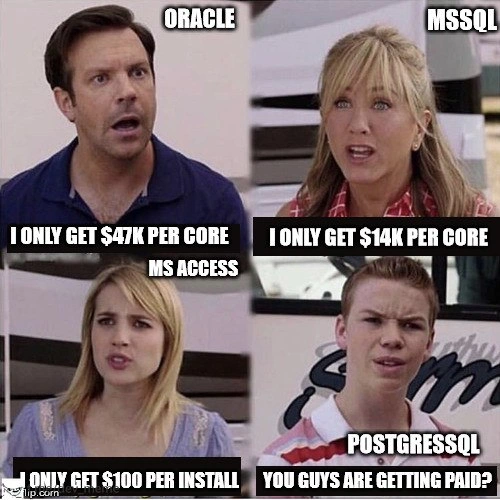
The meme playfully highlights a massive cost disparity in the database world by using the "We're the Millers" format. In the top panels, Oracle and Microsoft SQL Server (MSSQL) brag about their sky-high per-core licensing fees—Oracle exclaims "I only get $47K per core", and MSSQL claims "I only get $14K per core". Meanwhile, the bottom panels show Microsoft Access saying "I only get $100 per install", and an astonished PostgreSQL asking "You guys are getting paid?". This juxtaposition lampoons how proprietary databases command enormous licensing costs, whereas a free open-source database like PostgreSQL doesn’t charge anything for use. It’s a humorous take on enterprise vendor pricing models, where companies pay eye-watering sums for commercial database software while open-source alternatives operate on a completely different (no-cost) model.

In enterprise IT environments, database licensing often works on a per-core basis: you pay a fee for each CPU core the database server uses. Oracle Database is notorious for its premium pricing—on the order of ~$47,000 per CPU core for its flagship Enterprise Edition. This means a high-end 16-core server could incur licensing costs in the hundreds of thousands of dollars, just to run Oracle’s software (support contracts often cost extra on top of that!). Oracle’s licensing model has a reputation for being complex and strict, sometimes auditing customers to ensure they paid for every core in use. The meme’s "I only get $47K per core" line is dripping with irony: Oracle’s proprietary product brings in a fortune per core, yet here “he” says it like it’s a humble complaint. Seasoned architects and DBAs recognize this dark humor—the “sticker shock” of Oracle licenses is a well-known headache when budgeting for infrastructure. It’s one big reason companies fear vendor lock-in: once your data and systems are deeply tied into Oracle’s ecosystem (e.g. using Oracle-specific SQL extensions, PL/SQL stored procedures, etc.), switching to another database is extremely painful. Oracle can practically tollbooth your data by raising prices, knowing it’s cheaper to pay them than to migrate everything. This meme gleefully calls out that gold-plated business model.

Microsoft SQL Server (the meme’s "MSSQL") isn’t cheap either. Its Enterprise Edition runs about $14,000 per core, significantly less than Oracle but still a hefty five-figure sum for each CPU’s capacity. Microsoft historically offered different licensing schemes (like per-server plus client-access licenses), but in modern versions the per-core licensing is common for big deployments. When the MSSQL panel says "I only get $14K per core", it's mimicking the same faux-complaint tone: compared to Oracle’s $47K, $14K might sound modest, but it’s obviously still a huge licensing cost. The humor here is that both proprietary databases are boasting about how expensive they are as if it’s their salary. Industry veterans recognize that Microsoft positioned SQL Server as a slightly more affordable (yet still enterprise-grade) alternative to Oracle. Many organizations chose MSSQL to save money on licensing, but they’re still paying a serious price. It’s a classic enterprise vs FOSS showdown: the enterprise vendors make big money off each installation, whereas the open-source solution doesn’t. The panels effectively turn these databases into characters comparing paychecks: Oracle’s bragging he gets the biggest paycheck from customers’ budgets, and MSSQL grumbles that he “only” gets 14K which is still quite rich.

The inclusion of MS Access in the third panel adds an extra punchline for those who know their databases. Microsoft Access is a lightweight desktop database system—often used for small-scale projects or by non-developers for simple data storage—with a one-time cost roughly in the ~$100 range (often just part of an Office suite). It’s not even in the same league as Oracle or SQL Server. By saying "I only get $100 per install", Access sounds like the inexperienced little sibling in this conversation. In reality, nobody licenses Access by counting CPU cores; it’s typically licensed per user or per PC (as software). $100 is pocket change in enterprise IT—so this line parodies how trivial Access’s cost is next to the giants. It’s like Access is complaining, "I only get a measly hundred bucks", which is a fraction of the others’ haul. This exaggeration makes the contrast even funnier. For senior engineers, it also evokes real scenarios: maybe a small department builds a quick solution in Access because they can’t afford a full SQL Server instance. The meme humorously acknowledges this wide spectrum of database "tiers" — from high-end enterprise systems down to office tools — each with their own pricing model.

Finally, PostgreSQL appears as the naive character delivering the punch-line: "You guys are getting paid?". PostgreSQL is a powerful relational database that’s completely open source and free to use. It doesn’t require any licensing fees per core, per user, or per installation. You can download Postgres and run it on as many cores, servers, or containers as you want, and it costs $0 in license fees. So from Postgres’s point of view, databases don’t get a paycheck at all — it’s doing the job for free. The joke lands because PostgreSQL is portrayed as genuinely surprised to learn that the other databases make money from licensing. This riffs on a popular meme line meaning "I wasn’t even aware there was money to be had here!". For seasoned developers, there’s a deeper nod: many open-source maintainers and projects (like Postgres) are not directly paid by end users, especially compared to how Oracle and Microsoft monetize their products. Yet Postgres often competes head-to-head on performance and features with those pricey databases. The meme thus underscores a real industry trend: companies are increasingly adopting Postgres (and other open-source databases like MySQL) to avoid exorbitant license fees and vendor lock-in. It’s a win for budget-conscious architecture planning — though it also raises the question of how open-source projects sustain themselves. The humor comes full circle with that punchline, as every experienced dev knows: if a technology is free (as in beer), someone will quip "you guys are getting paid?" to poke fun at the situation.

To put the cost differences in perspective, here’s an approximate comparison of these databases’ licensing models:

Database Approx. License Cost License Model
Oracle (Enterprise) ~$47,500 per CPU core Proprietary, per-core licensing
MS SQL Server (Ent) ~$14,000 per CPU core Proprietary, per-core licensing
MS Access ~$100 per install/user Proprietary, per user or device
PostgreSQL $0 (Free) Open-source, no license fee

Table: Rough indications of database licensing costs (per core or per install). Actual prices vary by edition and agreements, but the magnitude of difference is clear.

This enormous gap shows why the meme’s scenario is so absurd and funny. It’s essentially a licensing cost comparison turned into a comedy sketch. The enterprise databases are portrayed as bragging about how costly they are (which in a literal sense is bragging about how much money they extract from users). Then the free open source database walks in utterly baffled that any money is involved at all. For developers and architects, it’s a tongue-in-cheek reminder that sometimes the best solution doesn’t come with a huge price tag. And if you’ve ever sat in budgeting meetings evaluating database options, the meme likely hits close to home.

Description

Four-panel “We’re the Millers” reaction meme with faces blurred for privacy. Top-left panel is captioned “ORACLE” and includes white bold text “I ONLY GET $47K PER CORE.” Top-right panel reads “MSSQL” with text “I ONLY GET $14K PER CORE.” Bottom-left shows “MS ACCESS” above the line “I ONLY GET $100 PER INSTALL.” Bottom-right displays “POSTGRESQL” atop the punch-line “YOU GUYS ARE GETTING PAID?”. Characters stand outside next to a white RV, daylight background, standard Impact-style font across all panels. Technically, the meme lampoons dramatic cost differences between proprietary per-core database licensing and free open-source PostgreSQL, a common consideration for architects managing infrastructure budgets and avoiding vendor lock-in
Comments

6
Anonymous ★ Top Pick Postgres: $0 per core - mostly because nobody has to bankroll the Ferrari-jacket salesman warning of a “30 % true-up” if we don’t sign by Friday
  1. Anonymous ★ Top Pick

    Postgres: $0 per core - mostly because nobody has to bankroll the Ferrari-jacket salesman warning of a “30 % true-up” if we don’t sign by Friday

  2. Anonymous

    The real enterprise horror story isn't debugging a race condition in production at 3am - it's explaining to the CFO why your Oracle True-Up audit just found 47 'unlicensed' cores that were spun up for 10 minutes during that Kubernetes autoscaling event last quarter

  3. Anonymous

    This perfectly captures the moment when your startup CTO realizes that 'enterprise-ready' is just vendor-speak for 'we charge enough per core to fund a small nation's GDP' - meanwhile PostgreSQL is over here like 'I've been ACID-compliant and handling your petabyte-scale workloads for free this whole time, but sure, pay Oracle enough to buy a yacht because they have a sales team.'

  4. Anonymous

    Oracle per-core pricing: scaling your cluster just means scaling your next audit nightmare

  5. Anonymous

    Enterprise DB strategy: Oracle bills per core, SQL Server bills at true-up, Access bills your dignity, and Postgres bills in engineers - still cheaper than the audit

  6. Anonymous

    Per-core licensing: the only metric where a 1-vCPU VM costs like the whole cluster, while Postgres invoices you in pull requests

Use J and K for navigation