Hunting the bug where faucet code inexplicably triggers the garage door
Why is this Bugs meme funny?
Level 1: Crossed Wires
Imagine you live in a very wacky house. You turn on the kitchen faucet to wash your hands, but suddenly the garage door starts opening! 😮 That’s totally not supposed to happen, right? It sounds silly and impossible, like a cartoon. This meme is joking that sometimes a computer program can feel like that kind of mixed-up house. One thing you do in the program (turning on the faucet) accidentally makes a completely different thing happen (the garage door opens). It’s funny because it’s so absurd – in real life or in software, those things should not be connected. The programmer is basically saying, “My code is acting crazy and it’s driving me nuts!” Anyone can laugh at the idea because it’s like someone crossed the wires: the controls are all mixed up. The feeling behind it is part frustration (because it’s a headache to fix) and part humor (because it’s just so ridiculous). Even if you’re not a coder, you get the picture: something is very wrong, and it’s kind of hilariously wrong.
Level 2: Crosswired Code
In this meme, a developer in a chat says their current bug is like “turning on your kitchen faucet and it opens your garage door.” They’re using this funny real-world image to explain how illogical and frustrating the bug is. Let’s break down what that means in software. A bug is a mistake or error in a program that causes it to act in ways it shouldn’t. Debugging (which falls under Debugging & Troubleshooting) is the process of finding and fixing that mistake. Here, the developer is debugging a particularly unusual bug: two parts of the program that should have nothing to do with each other are somehow linked. One feature (the faucet) triggers another feature (the garage door) by accident. That’s not normal – it’s as if the code’s “wires” got crossed. The phrase “crosswired” is perfect: in an electrical sense, it’s when wires from different circuits are mistakenly connected. In code, we’d say the components are coupled in a hidden way. This is unexpected because in a well-designed system, turning on the faucet should only affect the faucet, and the garage door should only respond to its own controls. If the garage door opens, it ought to be because its own code ran, not something in the kitchen module. So this chat message is basically the programmer throwing up their hands and saying, “My software is acting as crazy as a house where the plumbing controls the garage!” – a classic case of DebuggingHeadaches.
For a newer developer, how could such a thing even happen? One likely cause is a shared global state or variable. A global variable is a value in code that any part of the program can access. If two different features accidentally use the same global variable or identifier, changing it in one place might affect the other. For example, imagine if the programmer wrongly used one flag to mean two things:
# Example of a shared state causing trouble
garage_door_open = False # This variable is used for the garage door
def turn_on_faucet():
global garage_door_open
garage_door_open = True # Oops, this faucet function mistakenly alters the garage door state
In this pseudo-code, calling turn_on_faucet() sets garage_door_open to True – an unintended side effect that would indeed open the garage door. This is a very simplified illustration, but it shows how a coding mistake can link unrelated actions. Another way this happens is through events or signals: suppose both “faucet on” and “garage open” are events on a common message system. If someone coded the subscriptions wrong, the garage might be listening for the faucet’s event. Then whenever the faucet turns on, the garage door handler also runs. It’s like sending a message to the wrong address – the garage door gets a message that was meant for a water valve! These kinds of mix-ups can occur when the codebase is complex or when a programmer reuses something they shouldn’t. A junior dev might accidentally copy-paste code or use a variable name that’s already in use elsewhere, causing weird interactions. Unexpected component coupling is just a fancy term for saying “two parts of the program got tied together by mistake.”
Now, what’s it like trying to fix this? Troubleshooting such a bug can be confusing. The developer likely first noticed, “Hey, every time I do X, Y happens… that makes no sense.” They might not even believe it at first. In real life, if you saw your garage door open when you ran the faucet, you’d check the wires in your house or think you have a prankster in the attic. In code, you start searching through the codebase for any connection between these features. You’d look for any common variables, functions, or events. Maybe add print statements or use a debugger to trace what’s happening step by step. It’s a bit like detective work: follow the clues to find where the two lines got crossed. For many newer developers, the first time they encounter such a bug, it’s a real aha! moment (and a lesson in how unpredictable BugsInSoftware can be). You learn the hard way why we prefer to decouple systems – meaning, make each part independent. The meme’s absurd example sticks in your mind: if you don’t keep your code organized, you might end up with “faucet opens garage door” situations. It’s equal parts funny and terrifying to imagine. The good news is, once you find the glitch – say, that one stray global variable or that wrong event subscription – you can fix it and untangle those wires. And you better believe you’ll remember to avoid that mistake in the future! This kind of developer humor is very relatable because it exaggerates a real feeling: the DebuggingFrustration of a bug that seems to defy logic until you uncover the hidden link.
Level 3: Spooky Action at a Distance
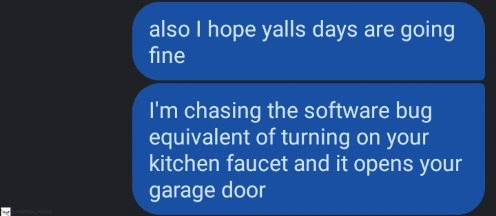
"I'm chasing the software bug equivalent of turning on your kitchen faucet and it opens your garage door."
This meme highlights an infamous code smell: action at a distance. In other words, one part of the system is mysteriously affecting another, completely unrelated part. Seasoned developers immediately recognize the humor and horror here: it implies some latent coupling deep in the code. The developer’s chat message paints a vivid picture of a bug so bizarre that turning on a kitchen faucet somehow triggers a garage door. It’s a dramatic metaphor for an unexpected component coupling. In software terms, something in Feature A (the “faucet” code) is inadvertently tied to Feature B (the “garage door” functionality) when it absolutely shouldn’t be. This kind of chaotic system behavior usually means the system’s internal wiring (pun intended) is horribly tangled. Spooky indeed – it’s the programming equivalent of a haunted house where flipping a light switch also creaks open a secret door in the attic.
From a senior engineer’s perspective, this suggests a hidden shared state or a global side-effect lurking in the codebase. Perhaps there’s a stray global variable or an event handler that both the faucet and garage modules use. Imagine a poorly designed home automation system: if both the kitchen faucet and the garage door subscribe to the same event (say, “water flow started”), a bug in the event dispatch could send the faucet’s event to the garage door’s logic. Suddenly, turning on the sink might emit an event that the garage listens to, and voilà, your garage door opens undesirably. This isn’t a deliberate feature – it’s a mystery state mutation where one action unknowingly flips a switch elsewhere. It’s as if the software’s plumbing and wiring got cross-connected behind the walls. A senior dev might smirk and say, “Yep, sounds like someone left a booby trap global flag in the code.” In complex legacy systems (think big ball-of-mud monoliths), it’s disturbingly easy for an innocuous change in one module to have a side-effect in another because everything is intertwined. Bugs in software like this are the stuff of legend in debugging war stories.
The humor here also lies in the shared trauma: most experienced developers have chased a WTF-bug like this at least once. It’s Developer Humor born from real pain. We chuckle because we’ve been that person tearing through thousands of lines of code at 2 AM, muttering “How on earth is this even possible?!” The meme exaggerates it with a crazy real-world analogy, but the core scenario is painfully familiar. Such DebuggingFrustration usually traces back to a design flaw: perhaps a forgotten integration, an ID collision, or a copy-paste error linking two unrelated components. It’s a reminder of why we preach loose coupling and separation of concerns. When those principles are violated, you get these spooky bugs. Fixing it is no small feat either – you have to spelunk through the system to find where the wires crossed. Is it a shared config value? A misrouted message on the event bus? A static class that both components modify? Hunting this bug is like chasing a ghost in the machine, requiring intuition, lots of logging, and a dash of black magic. In the end, the meme is cathartic: it pokes fun at the absurdity of such UnusualBugs, giving all the battle-scarred devs out there a reason to laugh instead of cry.
Description
The image is a dark-mode chat screenshot with two rounded blue message bubbles containing white text. The first bubble reads, “also I hope yalls days are going fine”. The second, longer bubble says, “I'm chasing the software bug equivalent of turning on your kitchen faucet and it opens your garage door”. No avatars or timestamps are visible; the focus is solely on the humorous text. The scene captures a developer describing an absurd cross-feature defect, conveying the chaos of debugging when unrelated components interact, a situation senior engineers liken to latent coupling and mysterious side-effects in complex systems
Comments
6Comment deleted
Debugged why turning on the faucet opens the garage: someone reused the same Kafka topic for waterFlow and doorToggle - turns out our “event-driven” architecture is just global state with better latency
After 20 years in this industry, I've learned that every sufficiently complex system eventually develops quantum entanglement between its components - where observing the state of your logging framework somehow collapses the wave function of your payment gateway
Ah yes, the dreaded 'action at a distance' bug - where your HTTP request somehow triggers a database migration, your cache invalidation reboots the load balancer, and flushing stdout inexplicably sends a Slack notification to #general. This is what happens when that 'temporary' event bus you added three years ago has metastasized into a distributed system held together by global state, implicit dependencies, and the tears of every engineer who's touched the codebase. The real kicker? It only happens in production, disappears when you add logging, and the original developer who understood the coupling left two years ago. Time to break out the distributed tracing tools and pray the correlation IDs actually propagate
When your event emitter is so loosely coupled, kitchen sinks subscribe to garage doors
Root cause: a wildcard fanout on the event bus - water.flow and garage.open both matched */open in prod, courtesy of a 2017 quick fix
Debugging the faucet that opens the garage - turns out both microservices subscribe to a global “Open” event on Kafka because we skipped bounded contexts. Ops calls it home automation; I call it accidental architecture