Broken Sign, Production Approved
Why is this Bugs meme funny?
Level 1: Good Enough From Far Away
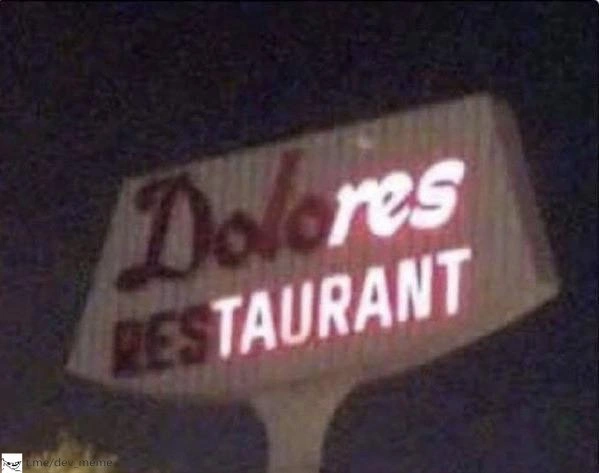
This is like a store sign with missing letters where people can still guess the store name. It is funny because someone looks at a clearly broken thing and says, “Close enough.” Programmers laugh because code often gets shipped the same way: not perfect, just understandable enough to get away with it.
Level 2: Broken But Usable
In software, a bug is behavior that does not match what users or developers expect. Deployment means releasing code into an environment where people can use it, often production. Technical debt is the future cost created when a team chooses a quick or imperfect solution now instead of a cleaner one.
The sign in the image is a visual version of a buggy feature. It is damaged, but it is not completely useless. A person can still infer that it is a restaurant sign. That maps to code that has rough edges but still completes the main task: a button works but looks wrong, a report loads but slowly, an error message is confusing but not fatal, or a feature handles common cases while ignoring messy edge cases.
The joke is that developers often hear pressure to ship something as soon as it appears usable. Sometimes that is the right pragmatic choice, especially for small defects. But if every “works anyway” issue is deployed and never cleaned up, the product becomes harder to change and easier to break.
Level 3: Ship The Sign
Code works anyway, deploy it
The night photo shows a restaurant sign with several dead or dark letters. Enough of the intended name still survives to imply something like “Dolores,” while res and the large RESTAURANT remain bright enough to communicate the business. That partial readability is the whole software joke: the thing is obviously broken, but it still conveys just enough information for someone to declare it functional.
This is the ancient engineering loophole behind “production ready.” If the acceptance criterion is only “users can probably figure it out,” then a missing validation state, ugly layout, flaky retry, silent fallback, or half-finished migration can all become shippable. The code works in the same way the sign works: not correctly, not gracefully, not maintainably, but plausibly enough for someone under deadline pressure to point at the result and say the magic words.
The senior-level sting is that these compromises are rarely made by fools. They are made by tired teams balancing revenue dates, customer promises, executive pressure, incident fatigue, and the crushing knowledge that “just one more fix” can turn into two more weeks. Technical debt often starts as a rational tradeoff. The problem is that nobody schedules the cleanup when the emergency passes, so the dark letters stay dark, future work routes around them, and eventually the workaround becomes architecture.
The image also satirizes how organizations measure quality. A product manager may see the restaurant sign and say customers still know where to eat. A designer may see brand damage. An engineer may see deferred maintenance, failing components, and a risk that more letters will go out. All of them are partly right. The deployment question is not merely “does it work?” It is “what kind of failure are we accepting, who pays for it later, and did we write that down anywhere besides a ticket doomed to the backlog?”
Description
A grainy night photo shows a tall restaurant sign with several burned-out or dark letters. The sign appears to be for "Dolores RESTAURANT," but only fragments such as "Dolo," a bright "res," and the large word "RESTAURANT" remain readable. With the post caption "Code works anyway, deploy it," the image becomes a visual metaphor for software that is visibly broken or ugly but still satisfies the narrow acceptance criterion of being understandable enough to ship.
Comments
1Comment deleted
Acceptance criteria said users could infer the intent, which is how half the industry accidentally defines production readiness.