Skip to content
DevMeme
2424 of 7435
Data Science's Most Common Performance Issue
DataScience Post #2694, on Jan 28, 2021 in TG

Data Science's Most Common Performance Issue

Why is this DataScience meme funny?

Level 1: Don’t Frost the Cake Before It’s Baked

Imagine you want to bake a cake for a competition. You have all these ideas for fancy decorations – sprinkles, frosting flowers, maybe a multi-tier design. You’re so excited that you start planning how to decorate it before you’ve even mixed the batter. That’s a bit silly, right? If the cake itself isn’t baked well or doesn’t taste good, all those fancy decorations won’t help you win. In fact, they might even hide the fact that the cake is half-baked or dry.

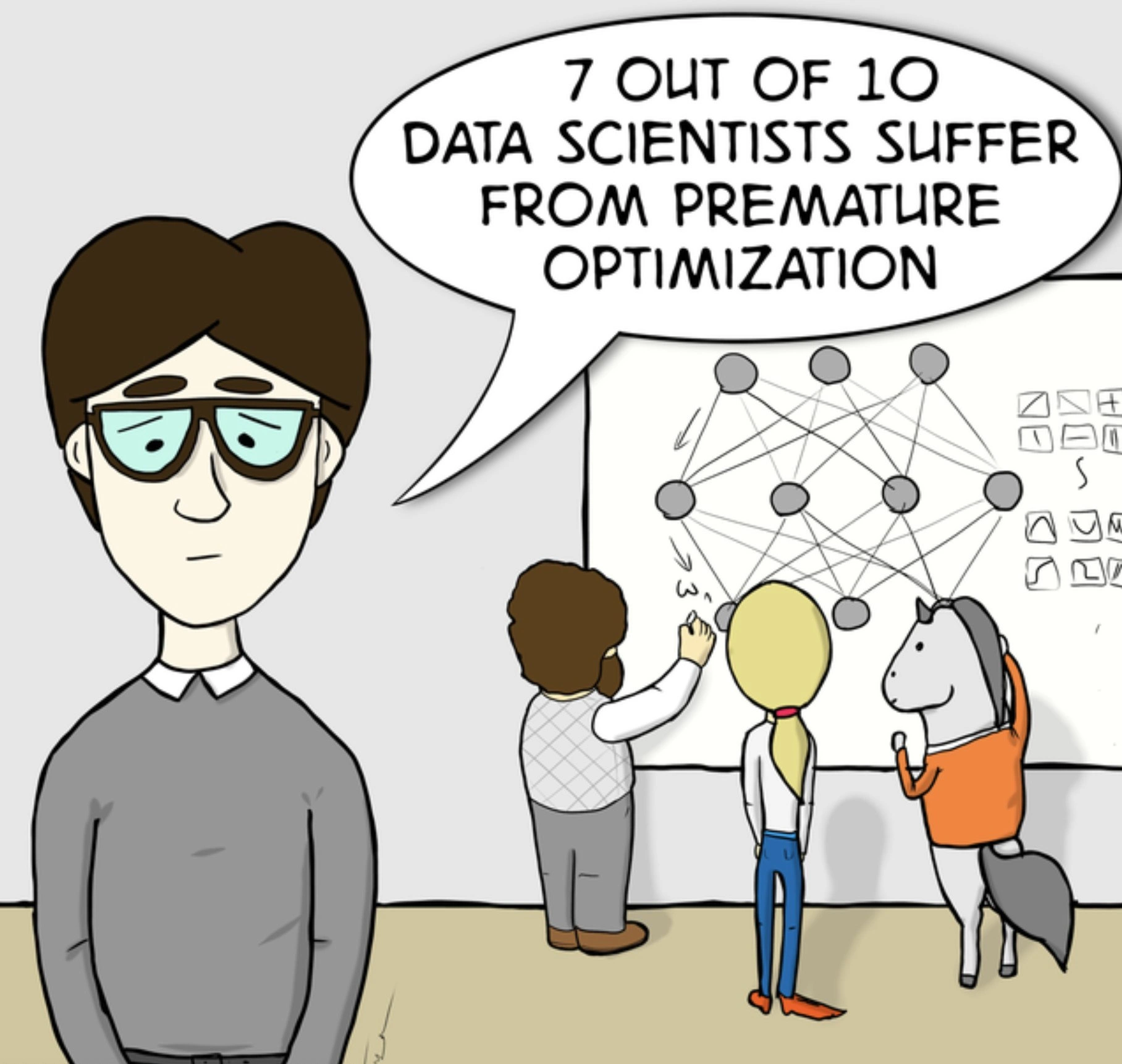
This meme is joking about a similar situation, but with people who build smart computer programs (data scientists). It says “7 out of 10 data scientists suffer from premature optimization,” which is a funny way of saying a lot of them try to make things perfect too early. It’s like they’re trying to put the icing on a cake that isn’t cooked yet. We find it funny because we’ve all seen someone do this (or done it ourselves!) and it usually doesn’t end well. The basic message: first get the basic cake right, then worry about the fancy icing. In other words, make sure your simple solution works before you spend extra time making it super fancy. The cartoon shows this by having those scientists (and even a little horse friend!) drawing an overly complicated plan on the board right away. It makes us smile and shake our heads, just like we would at the eager baker decorating a not-yet-baked cake.

Level 2: Baseline Basics Before Big Models

Let’s break down what’s happening for those newer to DataScience or MachineLearning. The phrase “premature optimization” refers to trying to make something (like code or a model) super efficient or super accurate too early, instead of first getting it to simply work correctly. In software, it’s like obsessing over making a function run fast before you even know if the program as a whole meets the requirements. In data science and AI, it can mean tweaking and tuning a complex NeuralNetwork model’s parameters right away, instead of first building a simpler model to see how the problem behaves.

In the image, three data scientists (well, two humans and one very studious little horse!) are at a whiteboard drawing a complicated neural network diagram. A neural network is a series of connected layers of nodes (those grey circles) that transmit signals — loosely inspired by how brain neurons work. It’s a powerful machine learning model, especially for complex tasks like image recognition or language translation. However, they can become overly complex very quickly: dozens of layers, millions of parameters, and tons of connections. The folks on the whiteboard seem to be sketching such a network, complete with many interconnecting lines (which indicate lots of weights or connections). To the right, the grid of tiny square plots might represent little graphs or results from experiments (maybe how different settings – called hyperparameters – affect performance). It’s basically the team diving deep into model architecture and performance tuning, which is something you usually do in later stages of a project.

Meanwhile, the big speech bubble in the meme says, “7 OUT OF 10 DATA SCIENTISTS SUFFER FROM PREMATURE OPTIMIZATION.” This is a humorous, made-up statistic meant to poke fun at how common this habit is. There isn’t a real survey; it’s modeled after joke formats (like “9 out of 10 dentists recommend…”). It implies that a majority of data scientists have this problem where they try to optimize their models or code too soon. For a junior developer or beginner in ML: imagine being so worried about making your solution perfect that you start polishing it before you have the first draft. It’s like a student who starts fine-tuning the formatting and fanciness of their essay before actually finishing all the paragraphs – chances are, the content might still need a lot of work, but they’re already fussing over details.

Donald Knuth’s advice (referenced by the meme) is a classic rule taught in computer science: “premature optimization is the root of all evil.” In simpler terms, it means don’t try to make your program ultra-efficient until you are sure which parts need it. First, make sure your solution is correct and you have a clear baseline to compare against. In data science, a baseline is usually the result from a simple, basic method that you use as a reference point. For example, if you’re building a model to predict something, your baseline could be as simple as “always predict the average” or “use a basic linear regression and see how it does.” That baseline might only give, say, 70% accuracy on your task. Now, if your fancy neural network eventually gets 95%, great – you know the complexity was worth it because it clearly beat the baseline. But if your fancy model gets 72% after tons of work, and a quick baseline was 70%, you’d probably realize it wasn’t worth the trouble, or that something is fundamentally off (maybe the data or approach needs rethinking).

The characters in the meme are effectively skipping that important step. They’re already in deep, discussing the nitty-gritty of a neural network – that’s like skipping straight to a championship chess match without learning basic strategies first. The PerformanceOptimization angle here is: yes, optimizing performance (whether it’s making a model more accurate or code run faster) is a good thing at the right time. But doing it too early can lead to wasted effort. Often, especially for newbies, it’s tempting to use the coolest, most powerful tool right away. Data scientists might think, “I should use a deep neural network with complex layers for this problem because that’s the state-of-the-art!” – without considering if a simpler approach might work nearly as well with far less complexity. Part of learning is realizing when to use the big guns and when a pea shooter will do the job just fine.

Let’s define a few terms from the meme and tags:

  • MachineLearning: A field of AI where programs improve at tasks as they get more data. Instead of being explicitly programmed step-by-step, they find patterns and make predictions. Neural networks are one type of machine learning model.
  • NeuralNetworks: As mentioned, these are models inspired by the brain. They consist of layers of nodes (neurons) that transform input data in successive steps, “learning” by adjusting the connection strengths (weights) during training (often via an algorithm called backpropagation). They can model very complex relationships but can be computationally heavy and need a lot of data.
  • DataScience: A broader term for using data to extract knowledge or build models, often involving statistics, visualization, and machine learning. A Data Scientist might explore data, clean it, try different models, and iterate to solve a problem.
  • Hyperparameters: Settings for a learning algorithm that aren’t learned from the data directly but set by the experimenter (like how many layers in a neural net, what the learning rate is, etc.). Tuning hyperparameters is often what we do to optimize model performance after we have a working model.
  • OptimizationTradeoffs: This refers to the idea that improving one aspect (like accuracy or speed) can often make something else worse (like making the model slower, or the system harder to maintain). It’s a balancing act. For instance, a more complex model might be more accurate but will be slower to run and harder to interpret. Choosing where to optimize involves trade-offs.

In the context of the meme, the trade-off is between spending time on performance tuning versus getting the fundamentals right. The joke is that these data scientists (and their pony pal) are spending a lot of energy on presumably squeezing out extra performance from an already complex model, instead of doing something like verifying if the data is good or if a simple method has been tried. For someone new, the lesson is: always start simple, then gradually increase complexity. It’s much easier to understand and debug a basic model. Once you’ve got that baseline, you can say, “Okay, the basic model gave us 70% accuracy. The complex model gives 90%. That improvement of 20% is because of the added complexity, so it was worth it.” If you never calculate the 70% baseline first, you might end up doing a lot of work for an unknown gain.

So, the meme is both a joke and a gentle teaching: don’t put the cart before the horse. (Here, we literally have a horse in the scene for emphasis!). The horse in the orange hoodie might just be there for silliness, but you can also interpret it as a visual pun on that saying. In projects, “cart before the horse” means you’re doing things out of order – exactly what premature optimization is. The data_scientists_in_meetings tag hints that this kind of over-zealous optimization talk often happens in meetings or brainstorming, when everyone is excited about shiny techniques and forgets the basics.

Level 3: Tuning Trauma in Tech

This meme hits senior engineers and data scientists right in the guts with its truth. The humor comes from a well-known industry pain point: teams often over-engineer solutions before verifying basics. The speech bubble proclaims “7 OUT OF 10 DATA SCIENTISTS SUFFER FROM PREMATURE OPTIMIZATION” — a comedic, faux-statistic that parodies those “X out of Y experts agree” advertisements. It exaggerates a real tendency in data science culture: jumping into hyper-detailed performance tuning or complex models without establishing a clear baseline. Seasoned engineers have seen this scenario countless times. It’s that meeting where someone excitedly sketches a convolutional neural net with 15 layers or proposes a complicated ensemble of models before even checking if a simple regression or decision tree works decently on the problem. The meme’s whiteboard is cluttered with a spiderweb of nodes and connections, plus a grid of tiny plots (perhaps representing validation curves or hyperparameter search results). It perfectly caricatures those brainstorming sessions where the focus veers into excessive complexity.

Why is this funny to us in the know? Because it’s too real. We’ve watched junior colleagues (and sometimes entire research teams) pour weeks into tuning a deep learning model – adjusting learning rates, experimenting with exotic activation functions, adding extra layers – only to discover later that a straightforward approach or better data would have given the same (or better) results in a fraction of the time. There’s shared trauma in recalling, say, that one project where we meticulously optimized an algorithm that ended up solving the wrong problem or shaving off mere milliseconds that users never noticed. The phrase “premature optimization” is basically shorthand for “wasted effort on the wrong thing.” It’s a polite way of saying “you’re solving problems we don’t even know we have.” In data science, this often translates to “you’re fine-tuning the model’s 5th decimal of accuracy when you haven’t nailed down the basic accuracy to within 20% yet.”

The presence of Donald Knuth’s advice here isn’t just academic name-dropping – it’s a reminder that this wisdom has been around since the 1970s, and yet the hype of modern AI sometimes makes people forget it. Knuth, a legendary computer scientist, warned developers decades ago not to obsess over micro-optimizations early on. In real-world software engineering, we interpret that as: get a prototype working, measure its performance or accuracy, identify the true bottlenecks or largest errors, and then optimize or refine. In a data science workflow, this means start with a baseline model (e.g. a simple logistic regression or even just predicting the average outcome) to see how the simplest solution performs. Only after that should you venture into elaborate neural networks or fancy algorithms if the baseline isn’t sufficient. The meme jokes that a whopping 70% of data scientists ignore this step, diving headlong into deep learning wizardry (perhaps because it’s more exciting or resume-friendly), effectively putting the cart before the horse.

Speaking of horses — yes, there’s literally a small horse in an orange hoodie at that whiteboard! This absurd detail adds to the satire. It implies that in these over-optimization frenzies, sometimes the scenarios get so ridiculous that even a horse could be part of the data science team, nodding along as everyone overcomplicates things. It’s a playful jab: data science discussions can get so esoteric and divorced from practical reality that they might as well have a random hoofed colleague contributing. (Also, horsepower pun intended: throwing more “horsepower” at a problem via bigger models, instead of checking if you’re pulling in the right direction to begin with.)

The “7 out of 10” statistic format is another layer of humor. It mimics those survey results or medical stats, implying this problem is practically an epidemic. It’s funny because no, there wasn’t an actual survey of data scientists; instead, it’s a tongue-in-cheek way to say “lots of data scientists do this, more than are willing to admit.” It resonates with performance-minded engineers and ML practitioners who’ve been in performance review meetings thinking, “We haven’t even fixed the obvious issues, why are we fine-tuning GPU ops already?” The PerformanceOptimization tag and OptimizationTradeoffs come into play here: everything in engineering is a trade-off. By focusing on optimization too early, you trade away simplicity, time, and sometimes clarity, in exchange for theoretical performance that might not even matter. Veterans have learned the hard way that every extra layer or tweak can introduce new bugs, training instability, or maintenance headaches. In the meme, the drawn neural net’s criss-crossing lines hint at a spaghetti code equivalent in model design – hard to follow and likely fragile. It’s an allusion to how premature optimization can create convoluted solutions that are difficult to debug or iterate on.

To sum up the senior perspective: the meme is funny because it’s a caricature of a real systemic issue. It lampoons how data_scientists_in_meetings sometimes get carried away with the latest AI techniques (like drawing an excessively complex neural network diagram) when they haven’t done the groundwork. It satirizes that performance anxiety in code/modeling – the fear that the solution won’t be good enough, leading folks to overcompensate with early tweaks. And it reminds the experienced folks of the timeless mantra: first, make it work; then, make it right; only then, make it fast. Here, “making it right” includes verifying you have a solid model and clean data before going for that last drop of accuracy. The shared laughter is a knowing one: we laugh because we’ve been that optimizer-happy person at one point, and we’ve also shaken our heads seeing it happen again in new guises (even with all our modern AI advancements).

Knuth’s Law in ML: “Measure twice, optimize once… maybe.” In practice, that means figure out your baseline metrics before you spend 10x effort on a complex model. This meme nails that message with a dash of sarcasm and a talking horse for good measure.

Optimization Overkill Example: Here’s how effort vs payoff often looks in such scenarios:

Approach Complexity & Effort Resulting Performance (Accuracy)
Baseline simple model (e.g. logistic regression) Low complexity, ~1 day to implement 80% (baseline accuracy)
Premature fancy model (deep neural network, no baseline) Very high complexity, weeks of tuning ~82% (marginal improvement)
Data cleaning & feature fixes (often overlooked) Moderate effort, a few days 90% (huge jump after fixing fundamentals)

Table: An illustrative comparison showing how a straightforward baseline vs. a prematurely complex model vs. focusing on fundamentals can impact accuracy. The complex neural net gave only a tiny gain over baseline after weeks, whereas addressing basic data issues gave a much bigger boost.

The table above captures the core joke in a pragmatic way: The team in the meme went for the “premature fancy model” path – lots of sweat for little reward – whereas a bit of basic work first could yield better results. Performance optimization isn’t evil on its own; it’s when and where you do it that matters. A seasoned developer or data scientist reading this meme chuckles because they recognize that truth immediately.

Level 4: Backprop Before Basics

At the cutting edge of Machine Learning research, there’s an ironic truth: even with ultra-complex models and advanced math, the old wisdom about optimization holds strong. Donald Knuth’s famous admonition “premature optimization is the root of all evil” was originally about low-level code, but it applies eerily well to modern Neural Networks and AI workflows. In theory, an algorithm’s efficiency should only be refined after you’ve confirmed the approach works. Otherwise, you risk locking in suboptimal design choices. This meme highlights how even PhD-level Data Scientists can fall prey to that trap by obsessing over a fancy architecture or micro-tuning parameters before nailing down a baseline solution.

In deep learning terms, think of the bias-variance trade-off and overfitting. A highly complex neural network (with many layers and parameters) can memorize quirks of the training data (high variance) if you push it too far without proper validation. It’s like chasing a local minimum on the error surface: you might “optimize” your model’s loss on one dataset beyond reason, only to discover later it doesn’t generalize. The meme’s hand-drawn web of nodes and connections lampoons this — it looks like an over-engineered network planned on the whiteboard. There’s a whiff of the No Free Lunch Theorem here too: no single model or optimization strategy universally wins. By prematurely committing to one exotic architecture, the team in the cartoon implicitly bets that this complex approach will beat all others, which theory tells us isn’t guaranteed without evidence. They’re effectively ignoring the meta-lesson that sometimes simpler models or algorithms might perform just as well for a given problem domain until proven otherwise.

From a performance theory perspective, Amdahl’s Law whispers a caution: optimizing a tiny part of the system yields negligible overall improvement. In code, that might mean micro-optimizing a function that isn’t the bottleneck; in machine learning, it could mean spending huge effort to get a 0.1% accuracy boost with exotic tuning, while the major error sources (like poor data quality or wrong features) remain unaddressed. The tangled neural network on the board satirically represents that overkill: the team is adding layers upon layers (increasing complexity) hoping for marginal gains. Meanwhile, a simpler model or a quick profiling of errors might reveal that the real performance limit isn’t the model complexity at all. By evoking Knuth’s principle in an AI context, the meme underscores a deep, almost mathematical inevitability: focusing on optimizations or fine-tuning too early can lead to wasted effort and a model that’s elegantly optimized for the wrong problem.

Description

A single-panel cartoon meme featuring a sad-looking man with glasses in the foreground. A large speech bubble above him reads, '7 OUT OF 10 DATA SCIENTISTS SUFFER FROM PREMATURE OPTIMIZATION.' In the background, a diverse group, including a man, a woman, and an anthropomorphic horse in an orange sweater, are collaboratively drawing a neural network diagram on a whiteboard. The humor is a sophisticated pun, blending a core software engineering principle with the phrasing of a public health awareness statistic. 'Premature optimization,' the act of optimizing code or systems before it's known to be necessary, is framed as a common ailment. This resonates with senior engineers and data scientists who understand the temptation and folly of tweaking models and algorithms for marginal gains before establishing a robust baseline or even validating the problem statement

Comments

7
Anonymous ★ Top Pick The other 3 out of 10 data scientists are still waiting for their Jupyter notebook to load the full dataset before they can even think about optimizing
  1. Anonymous ★ Top Pick

    The other 3 out of 10 data scientists are still waiting for their Jupyter notebook to load the full dataset before they can even think about optimizing

  2. Anonymous

    They fused CUDA kernels for a 5 µs speedup, then loaded the training set from an Excel sheet on SharePoint - premature optimization isn’t a bug, it’s their feature store

  3. Anonymous

    The irony of using a complex neural network visualization to discuss premature optimization is like deploying Kubernetes to serve a static landing page - we've become so good at building sophisticated solutions that we've forgotten sometimes a simple linear regression beats a 50-layer transformer model that takes three weeks to converge

  4. Anonymous

    The real joke is that they probably ran a hyperparameter-tuned ensemble model with cross-validation to arrive at that '7 out of 10' statistic, when a simple survey would have sufficed. Classic case of using a neural network to predict whether you need a neural network

  5. Anonymous

    They Ray-tune distributed gradients on Airflow before realizing the label drift turns gold into fool's NaN

  6. Anonymous

    Premature optimization in ML is quantizing weights and fusing CUDA kernels while the feature pipeline still has target leakage - 10x faster wrong answers

  7. Anonymous

    If you’re debating fused kernels and INT8 quantization before a baseline F1, that’s not MLOps - it’s performance theater

Use J and K for navigation