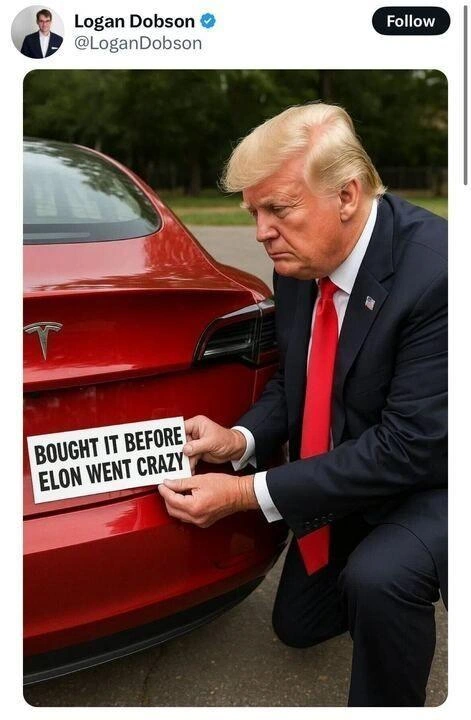
When your Tesla predates the commit where Elon refactored to chaos mode
Why is this IndustryTrends Hype meme funny?
Level 1: Before It Went Crazy
Imagine you had a favorite toy or game that was really awesome when you got it, but later the person who made it started acting very strange and changed the toy in ways you don’t like. You still love the toy as it was originally, but you’re not so happy about what the creator is doing now. This meme is like a kid putting a sign on their toy that says, “I got this before it went bad!” so everyone knows they aren’t approving of the new, crazy stuff happening with it.
In the picture, a man is sticking a bumper sticker on his Tesla car that says he bought it before the boss went crazy. Tesla is an electric car, and Elon Musk is the famous boss of the company. Elon Musk used to be seen as a really cool, smart guy who made neat electric cars and rockets. Some time later, he started doing and saying things that a lot of people find odd or upsetting (that’s the “went crazy” part, said in a funny, exaggerated way). The car owner in the meme wants everyone who sees his car to know, “Hey, I got this car back when the company and its leader were normal and cool. I’m not supporting the wild stuff that happened after.”
It’s funny because normally people don’t put a note on their car explaining when or why they bought it. It’s like if you had a video game that was great at first, but a new update made it really bad, and you taped a sign to the game box saying, “I only play the good old version!” The humor comes from the idea of treating a car (or anything in real life) kind of like a software version – saying the car is from an earlier, better “version” of the company. Basically, the person loves the car but wants to make sure everyone knows they’re not crazy – the owner bought it when things were still good. It’s a playful way to deal with feeling a bit embarrassed by something you used to be super proud of. Everyone can laugh because we all know the feeling of liking something before it changed for the worse, and wishing we could let others know, “I liked it back when it wasn’t so crazy!”
Level 2: Pinning to Stability
Let’s break down the tech analogies in this meme. The key phrase is about a commit where Elon “refactored to chaos mode.” In software development, a commit is a recorded change in a code repository (like using Git). Every commit has an identifier (often a hash) and usually a message describing the change. For example, a commit message might say “Fix login bug” or “Update UI library.” Here they’re joking that at some point Elon Musk made a big change (like a commit in personality or behavior) described humorously as “refactored to chaos mode.”
Now, refactoring in coding means restructuring existing code without changing its external behavior, usually to improve clarity or design. It’s something engineers do to make code cleaner and more maintainable (like reorganizing the internals of a program but keeping what it does the same). So saying Elon refactored to chaos mode is ironic – normally refactoring aims to make things better, but this implies he reorganized things and made them way more chaotic. It’s like if a programmer said “I refactored the app,” but after the change nothing works as expected. Chaos mode suggests unpredictability, as if Elon’s leadership has become erratic and turbulent (the opposite of stable or predictable behavior one would hope from a leader).
The car owner in the image is putting a bumper sticker on his Tesla Model 3 that reads “BOUGHT IT BEFORE ELON WENT CRAZY.” This is essentially a real-life version of a developer pinning a dependency. In programming, “pinning a dependency” means locking the version of a software package or library your project uses, so it doesn’t automatically update to a newer (and possibly problematic) version. For instance, instead of saying “use the latest version,” you’d specify exactly the version that you know works (the last known-good version). Developers do this when a newer release of a library introduces bugs or unwanted changes. By pinning, they ensure stability — their code keeps using the proven version until they’re ready to deal with the changes in a newer one.
In the context of the meme, Elon Musk (the CEO of Tesla) is being treated as part of the product’s “dependency tree.” The owner is effectively saying: “I got my Tesla when the company (and its CEO) was still in a good state. I’m not ‘updating’ my endorsement of the brand to the current crazy state of affairs.” It’s a tongue-in-cheek way to distance himself from any negative actions or statements Elon has made after he bought the car. Just as a developer might clarify “We’re using version 1.2.3 of that library because version 2.0 broke everything,” this Tesla owner is clarifying “I bought this car under Tesla version when Elon was sane, not whatever this is now.” It’s both TechIndustryHumor and a bit of real-world truth: tech products often carry the image of their creators. When those creators do something controversial, early adopters can feel a bit awkward or even betrayed.
This meme is also showcasing IndustrySatire and CorporateCulture commentary. Tesla became a hype symbol in the tech world – owning one meant you were part of the future-forward, electric vehicle revolution led by a bold, eccentric CEO. That’s the TechHypeCycle: at first, everyone is excited (peak hype), and early adopters are proud. But then, if the leader’s behavior or the product’s direction goes awry, public sentiment can shift into a trough of disappointment or embarrassment. Elon’s very public antics on Twitter (now X) and in the news – like making erratic statements, engaging in online spats, or drastic corporate moves – have caused some fans and customers to cringe. The meme shows a customer responding to that shift in customer sentiment with humor. The bumper_sticker_meme format literally spells out what a developer or engineer might otherwise say in a chat: “I was on board when things made sense, not after the crazy update.”
For a junior developer or someone newer to tech, there’s a lesson in here about how closely a tech product can be tied to its founder’s or leader’s image. It’s like how an app or platform can be awesome, but if the company’s CEO starts acting controversial, users might reconsider how they feel about using it. In extreme cases, people actually do what’s joked about here: they’ll publicly note they’re using an earlier version or they joined before things went bad. It’s both a meme and a reflection of reality in today’s tech culture. This tweet screenshot by Logan Dobson captures that blend of programmer humor and social commentary perfectly – using our familiar developer lingo (commit, refactor, version) to lampoon an IndustryTrend in real life: distancing oneself from a once-hyped brand when its figurehead goes off the rails.
Level 3: Refactor to Chaos Mode
In version control parlance, this meme treats Elon Musk’s behavior like a codebase that had a bad commit. The bumper sticker reading “BOUGHT IT BEFORE ELON WENT CRAZY” is essentially the car owner pinning their Tesla to the last known-good commit of Elon’s leadership. It’s as if the Tesla is running on Elon v1.x (stable), and the owner wants no part of the v2.0 “Chaos Mode” update. In software terms, we’ve all seen a disastrous commit – imagine a maintainer pushing a change titled “Refactor everything to chaos mode” that breaks all the tests and deploys to production on a Friday. 😅 Here, Elon’s unpredictable antics are that chaotic refactor, and the Tesla owner is proudly stuck on the earlier, stable branch of the “Elon” project.
From a seasoned developer’s perspective, the humor comes from treating a tech industry hype problem with a dev ops solution. Early Tesla adopters once flaunted their Model 3 like a shiny new framework that everyone envied. But when the TechIndustryHumor turned against Elon’s erratic decisions (call them “production incidents” on the social layer), these same folks now scramble to mitigate the brand fallout. The sticker is a hotfix: it explicitly disassociates the car from the current head of the repo. It’s like adding a comment in code, // using Tesla commit pre-chaos, to clarify you’re running a safe older version. This is IndustrySatire at its finest – engineers laughing at how we treat CEOs like package versions. After all, experienced devs know the drill: when a new version goes haywire, you rollback or pin the dependency. This Tesla owner basically did a git checkout to the pre-crazy Elon commit and slapped a label on it for everyone to see.
The shared context here is rich with CorporateCulture parody. We’ve seen similar patterns in tech: a beloved library maintainer adds a wild breaking change or a famous founder “goes rogue,” and suddenly the community scrambles to freeze at the last stable release. (Remember that NPM package fiasco where everyone locked their version after the maintainer went crazy and deleted it? Classic.) The meme plays on that trauma: the Tesla is the project, Elon is the volatile dependency. Veterans chuckle because they’ve lived through the hype cycle turning to headache. They know that feeling when you have to explain, “Yes, we use that tech, but we’re on the good version from before things went off the rails.” It’s a darkly funny reflection on customer_sentiment_shift – the Tesla owner is effectively doing code triage on their personal reputation. In true cynical veteran fashion, the scene says: “I committed to this tech before it all blew up, so don’t page me about the current issues.” The humor lands because it’s RelatableHumor in the dev world – when a once-genius project lead (or CEO) starts force-pushing nonsense to main, the only sane response is to pin to sanity and document it (even if that means literally bumper-sticker documentation).
Description
Screenshot of a tweet by the verified account "Logan Dobson" (@LoganDobson) with a "Follow" button. The embedded photo shows a well-dressed, blond-haired man in a dark navy suit and bright red tie (face intentionally blurred) crouching at the rear of a shiny red Tesla Model 3. He is carefully applying a white rectangular bumper sticker that reads in bold black capitals: "BOUGHT IT BEFORE ELON WENT CRAZY." The Tesla emblem and sleek taillight are clearly visible, and the car is parked on asphalt with blurred greenery in the background. Technically, the meme riffs on brand perception drift: engineers who once boasted about early-adopter hardware now feel compelled to distance themselves from a CEO’s unpredictable "production incidents" on the social layer, much like pinning a dependency to the last known-good commit
Comments
6Comment deleted
Proof that even hardware needs a `git revert` when the maintainer starts force-pushing to the timeline
It's like proudly displaying your git commits from before the lead architect force-pushed to main, deleted the tests, and renamed everything to single letters - you want credit for the early work but zero association with the current architectural decisions
The classic technical debt scenario: you invested early in a promising platform with solid fundamentals and innovative architecture, only to watch the new maintainer introduce breaking changes to the social contract, deprecate community trust, and push controversial commits to production without proper review. Now you're stuck with a perfectly functional product that's become a liability in your personal brand's dependency tree - and the migration path is expensive
The automotive equivalent of pinning [email protected] - your lockfile dodges breaking changes, not founder-driven chaos
That sticker is just procurement's version of a README comment: 'Picked this platform before the CEO started doing continuous delivery on hot takes - vendor lock-in is the long-term support.'
Dev equivalent: Built that Twitter bot before Elon hiked API prices and killed it overnight