Skip to content
DevMeme
3479 of 7435
Danger Due To Danger
Documentation Post #3814, on Oct 13, 2021 in TG

Danger Due To Danger

Why is this Documentation meme funny?

Level 1: A Bad Warning

This is funny because it is like asking why you should be careful and someone answers, "Because careful." The warning sounds official, but it does not tell you what is wrong, so it is not very helpful.

Level 2: Explain the Reason

An inline comment is a small note written next to code. It should help future readers understand something the code does not make obvious. Good comments explain intent, warnings, unusual decisions, or business rules.

A bad comment repeats the code. For example:

# set user_name to user.name
user_name = user.name

That does not help much because the code already says the same thing. A better comment might explain why the name is copied instead of referenced directly:

# Snapshot the display name so later profile edits do not change old invoices.
user_name = user.name

Now the comment teaches something useful. It explains a business rule and protects a future developer from "simplifying" the code into a bug.

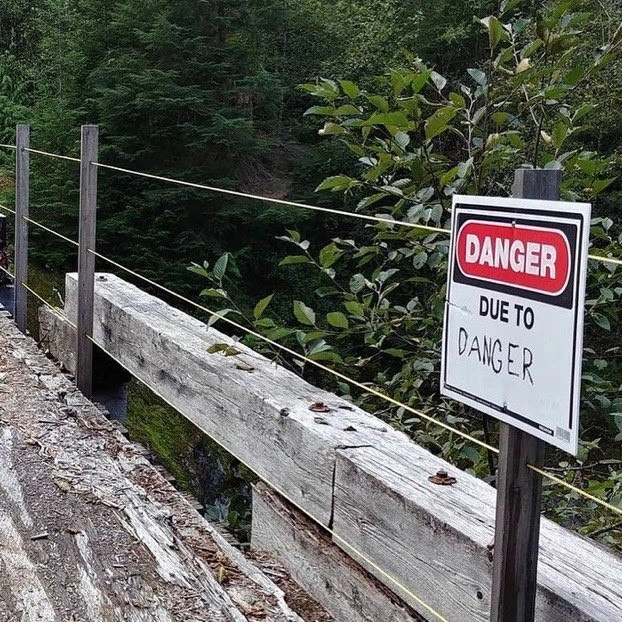
The sign in the image is funny because it gives the shape of a warning without the substance of one. Many code comments do the same thing: they look responsible, but when you need real information, they just point back at the thing you were already looking at.

Level 3: Comment Says Comment

The image shows a weathered bridge or walkway in the woods with a warning sign that reads:

DANGER
DUE TO
DANGER

The post caption, "Inline comments be like," turns that sign into a precise joke about bad documentation. The sign does technically communicate risk, but it adds no useful information beyond repeating itself. That is exactly what weak inline comments do in code: they restate what the syntax already says while failing to explain the reason anyone would need the comment in the first place.

In real code, the equivalent is something like:

// increment count
count++;

That comment is the software version of "danger due to danger." It consumes attention without adding context. A useful comment would explain why the count must change there, what invariant is being preserved, what external system depends on that behavior, or why the obvious-looking alternative is wrong.

The senior pain point is that poor comments actively damage CodeReadability. Developers do not read code linearly like a novel; they scan for structure, assumptions, and traps. A comment is a signpost saying, "This part deserves attention." When that signpost contains only a rephrased variable name, it trains readers to ignore comments. Then, one day, a genuinely critical note about transaction ordering, timezone semantics, or a vendor API bug sits unread because the codebase has taught everyone that comments are mostly decorative gravel.

This is why the meme fits Documentation, DocumentationQuality, and CleanCodePrinciples. Clean code does not mean "never comment." That slogan gets repeated by people who have not yet met enough legacy systems. Good code minimizes unnecessary comments by making names and structure clear, but it still uses comments for intent, constraints, trade-offs, history, and non-obvious danger. The bridge sign would be useful if it said "bridge planks unstable," "load limit exceeded," or "trail closed after flood damage." Instead, it warns of danger by citing danger as the cause. Beautiful. Useless. Somehow still in production.

Description

A photo shows a weathered wooden bridge or walkway in a forest, with a warning sign posted beside it. The sign reads "DANGER" in a red header and below it says "DUE TO DANGER," with the second "DANGER" handwritten in black marker. The meme caption from the post is "Inline comments be like," comparing the redundant sign to comments that restate code without explaining intent, invariants, or risk.

Comments

1
Anonymous ★ Top Pick A comment should explain the invariant, not ship a second copy of the variable name wearing a hard hat.
  1. Anonymous ★ Top Pick

    A comment should explain the invariant, not ship a second copy of the variable name wearing a hard hat.

Use J and K for navigation