Curl CVE Countdown Anxiety
Why is this Security meme funny?
Level 1: The Important Tool Is Sick
Imagine the whole neighborhood uses the same ladder, and the person who takes care of it says, "Tomorrow I will explain a serious problem with this ladder. Please get ready." Nobody knows yet whose roof job is dangerous, but everyone suddenly has to check. That is why the screenshot is funny: the message is calm, but the people who depend on that tool know their day just got much busier.
Level 2: CVEs and Curl
A CVE is a public identifier for a known security vulnerability. It gives people a shared name for a bug so vendors, security teams, scanners, and patch notes can all talk about the same issue.
curl is a command-line tool for making network requests, often used like this:
curl --head "$SERVICE_STATUS_ENDPOINT"
libcurl is the reusable library behind curl. Other programs can include it so they do not have to implement network transfers from scratch. That is why the screenshot separates "the curl tool" from libcurl: one is the program people run directly, and the other may be hidden inside bigger software.
The screenshot lists two issues:
CVE-2023-38545, markedseverity HIGH, affecting bothlibcurland the curl tool.CVE-2023-38546, markedseverity LOW, affectinglibcurlonly.
For an early-career developer, the practical lesson is that dependencies are part of your application even when you did not write them. If your server image, build pipeline, installer, monitoring agent, or application library includes a vulnerable version, you may have work to do. Security patching is not just "update the package"; it is also finding where the package exists, checking whether the vulnerable feature is used, rebuilding images, redeploying, and proving the fix actually landed.
The joke is the professional dread of seeing a foundational tool announce a serious flaw in advance. Everyone appreciates the warning. Everyone also knows their dependency map is about to become a treasure hunt, except the treasure is an urgent patch window.
Level 3: Plan Accordingly
The screenshot's humor is not loud. There is no reaction image, no screaming mascot, no "we are doomed" overlay. It is just a GitHub discussion from bagder, marked Maintainer, announcing a high-severity security issue in one of the internet's load-bearing tools. That restraint is the punchline. Anyone who has handled production security patches can hear the silence after that message.
The visible post was made right before the planned October 11 release, and the surrounding post message says "Tomorrow." That timing matters: at that moment, teams could see the severity, the affected components, and the release date, but not all the public technical detail yet. That creates a very specific form of security anxiety: enough information to know you need to act, not enough information to know exactly how bad your Tuesday is about to become.
curl is everywhere because it solves a boring problem extremely well: moving data over network protocols. Developers use it in shell scripts, CI jobs, Dockerfiles, health checks, installers, monitoring probes, and quick "just test the endpoint" commands. libcurl goes even deeper, living inside applications and tools that want HTTP, FTP, proxy support, TLS integration, redirects, and decades of compatibility without rewriting all of that themselves.
That is why the line:
CVE-2023-38545: severity HIGH (affects both libcurl and the curl tool)
is funnier than it should be. It tells security engineers, SREs, distro maintainers, container-image owners, language package maintainers, appliance vendors, and that one team with a shell script named deploy-final-final.sh to start inventorying immediately. The sentence is short because the blast radius is not.
The meme captures the gap between open-source maintenance and enterprise dependency reality. A maintainer can responsibly pre-announce, coordinate, publish fixed versions, and document impact. Meanwhile, companies discover that their asset inventory is aspirational, their base images are stale, and nobody knows who owns the AMI that Jenkins is still using. "Plan accordingly" is polite maintainer language for "you may now begin finding every place your organization forgot software exists."
Level 4: Slow SOCKS, Fast Panic
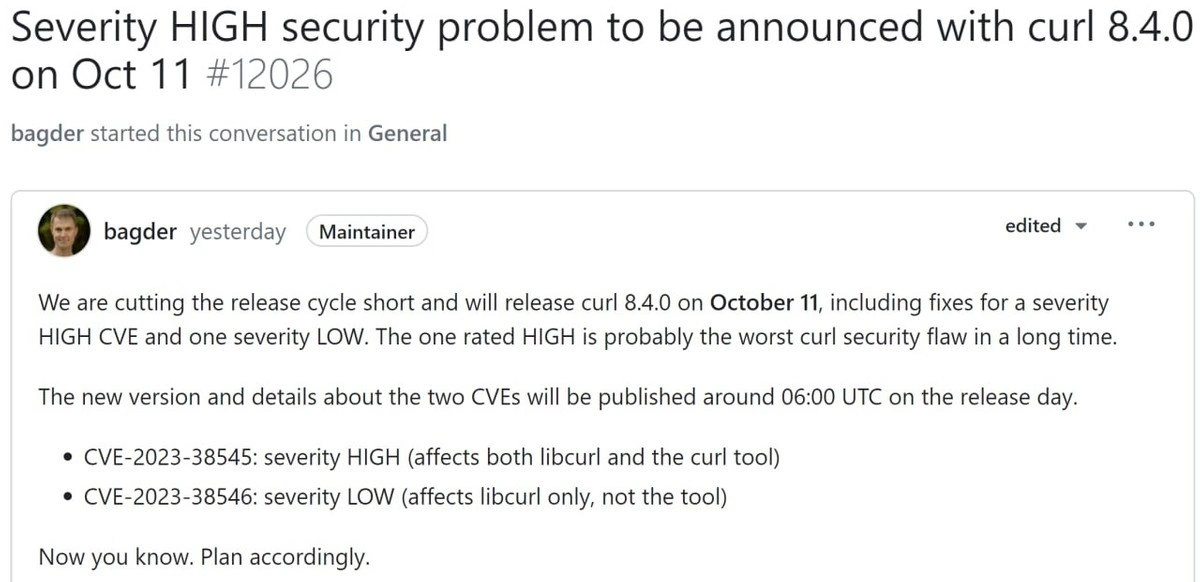
The screenshot is funny because it shows the calmest possible wording for a deeply uncomfortable supply-chain moment. The title says:
Severity HIGH security problem to be announced with curl 8.4.0 on Oct 11 #12026
The visible maintainer post says curl 8.4.0 will be released on October 11, with fixes for CVE-2023-38545 and CVE-2023-38546, and then drops the tiny operational grenade:
Now you know. Plan accordingly.
The truly sharp technical edge is CVE-2023-38545. After disclosure, it turned out to involve a heap buffer overflow in curl's handling of a SOCKS5 proxy handshake when remote hostname resolution was requested. In practical terms, curl can be told to let the proxy resolve the hostname rather than resolving it locally. The dangerous zone involved long hostnames, buffer sizing, and a state-machine bug in the SOCKS5 negotiation path. That is exactly the sort of bug that keeps old network-client code interesting in the same way unexploded construction ordnance is interesting.
The word heap matters. A heap buffer is dynamically allocated memory; writing past its intended boundary can corrupt adjacent memory. In C, that can range from a crash to a possible exploit path, depending on allocator behavior, platform mitigations, controllable input, and whether the overwritten bytes can influence execution. curl and libcurl are written in C because they are portable, fast, and old enough to have survived several eras of software fashion. The bill comes due when tiny state inconsistencies meet hostile input.
The painful architecture lesson is that network protocol implementations are rarely just "parse a thing and send a thing." They are timeout-aware, proxy-aware, redirect-aware, async-capable state machines that have to preserve invariants across partial progress. A variable that means "the proxy should resolve this hostname" sounds harmless until it is stale, flipped at the wrong moment, or used after the code has moved to a different state. Then a hostname length rule stops being validation and becomes decor.
CVE-2023-38546, the visible low-severity companion, affected libcurl rather than the standalone tool. That distinction is also important: the curl command is what developers type, but libcurl is the library quietly embedded inside countless applications. A vulnerability in the library can matter even when nobody in the organization believes they "use curl." They do. It came free with the dependency graph, like a complimentary incident review.
Description
The image is a GitHub discussion screenshot titled "Severity HIGH security problem to be announced with curl 8.4.0 on Oct 11 #12026." It shows bagder, marked as a maintainer, saying curl 8.4.0 will be released on October 11 with fixes for a severity HIGH CVE and one severity LOW CVE, describing the high issue as probably the worst curl security flaw in a long time. The visible bullets list "CVE-2023-38545: severity HIGH (affects both libcurl and the curl tool)" and "CVE-2023-38546: severity LOW (affects libcurl only, not the tool)," followed by "Now you know. Plan accordingly." The humor is the quiet panic of a foundational open-source dependency announcing a serious vulnerability window before details are public.
Comments
9Comment deleted
Every org discovered exactly how many critical paths were one shell script away from `curl | bash` becoming an incident response plan.
C:\>curl -V curl 8.0.1 (Windows) libcurl/8.0.1 Schannel WinIDN Comment deleted
A reminder that Shellshock was out in the wild for 25 years Comment deleted
Memes are supposed to be fun. This one is not. Comment deleted
The problem is not the problem. The problem is your attitude to the problem. Savvy? Comment deleted
I think he meant it in a humoristic way Comment deleted
Luckily for me, I am not an administrator, devops, developer or security specialist. So I may just laugh at this "yet another doomsday vulnerability". But I can almost feel the pain of all those unlucky people that may have to take urgent measures today. Comment deleted
.sh curl -V TGPy> curl 8.3.0 (x86_64-pc-linux-gnu) libcurl/8.3.0 OpenSSL/3.1.3 zlib/1.3 brotli/1.1.0 zstd/1.5.5 libidn2/2.3.4 libpsl/0.21.2 (+libidn2/2.3.4) libssh2/1.11.0 nghttp2/1.56.0 Release-Date: 2023-09-13 Protocols: dict file ftp ftps gopher gophers http https imap imaps mqtt pop3 pop3s rtsp scp sftp smb smbs smtp smtps telnet tftp Features: alt-svc AsynchDNS brotli GSS-API HSTS HTTP2 HTTPS-proxy IDN IPv6 Kerberos Largefile libz NTLM NTLM_WB PSL SPNEGO SSL threadsafe TLS-SRP UnixSockets zstd Comment deleted
lmao Comment deleted