Skip to content
DevMeme
2138 of 7435
Linux, Efficiency, and Child Labor
OperatingSystems Post #2388, on Nov 29, 2020 in TG

Linux, Efficiency, and Child Labor

Why is this OperatingSystems meme funny?

Level 1: Kids Doing Chores

Imagine you have a big task to do, like cleaning up your whole house. Instead of doing it all by yourself, suppose you could magically create a bunch of little helpers (like your own children or clones of yourself) to tackle each room at the same time. One kid cleans the kitchen, another kid vacuums the living room, another takes out the trash – all working in parallel. You, the parent, started all this work, and now all your “children” are busy helping. Everything gets done faster because everyone is working together. In the end, you’ve used a bit of “child labor” to get the job done efficiently (in a tongue-in-cheek sense).

Linux does something similar inside your computer! The “parent” in this case is a program that needs to do some work, and it can create child processes – which are like little helper programs – to do parts of the work simultaneously. This makes the computer very efficient, because it’s as if many hands are working at once on different tasks. The meme jokes about this by literally calling it “child labor,” as if the computer is making its children do all the work. The first astronaut (the student) is just realizing, “Wait a minute, the reason Linux is so fast is because it’s making all these child processes do stuff – that’s like child labor!” And the second astronaut (the experienced programmer) says “Always has been,” meaning “Yes, that’s how it’s always worked.” The joke is funny because it mixes a serious real-world term child labor with a nerdy computer concept child processes. Don’t worry, no actual children are harmed – these “children” are just programs helping out their parent program. And Linux has been using this teamwork approach from the very beginning, which is why the second astronaut isn’t surprised at all.

Level 2: Parenting in Linux

Let’s break down the joke in simpler terms. First, some definitions: Linux is an operating system, the core software that manages your computer’s hardware and runs programs. In Linux (and other Unix-like systems), a process is basically a running program – think of it as an instance of an application that the OS is managing. For example, if you open Chrome and Spotify at the same time, those are two separate processes. Now, Linux has a particular way of creating new processes. It uses a function (a system call) named fork(). The name is actually pretty descriptive: to “fork” means to split into two paths. When a program calls fork(), it asks the OS to create a new process that starts as a copy of the current one. The original is then the parent process, and the new one is the child process.

So why do this? Well, creating a new process by copying an existing one turned out to be a simple and flexible way to start up new tasks. The child process can either continue running the same code as the parent or replace itself with another program (commonly by calling an exec() function to load a new program into itself). Either way, now you have two processes where before there was one, and they can work in parallel. This is key to multitasking. For instance, when you type ls in a Linux terminal, the shell (your command-line program) will use fork() to create a child. That child process will then exec() the ls program to run it and list your directory. Meanwhile, the parent shell waits. When ls (the child) finishes, it reports back and terminates, and the shell (parent) continues on, ready for the next command. All of this happens in a flash. Essentially, every time you run a command or launch a program, some parent process is forking off a child process to do the job.

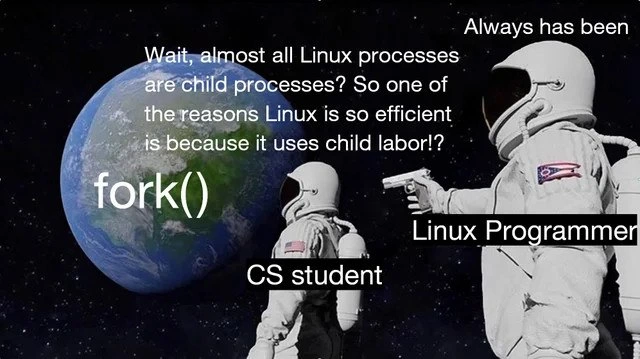
Now, the meme takes this technical idea and makes a pun out of it. It’s using the popular “Always Has Been” astronaut meme template. In the image, we have two astronauts in space. The one in front (labeled “CS student”) is looking at Earth, which has the text “fork()” written on it. This is the big revelation: the student has realized something about fork(). The student’s dialogue says:

CS student: “Wait, almost all Linux processes are child processes? So one of the reasons Linux is so efficient is because it uses child labor?”

Above and behind him, the second astronaut (labeled “Linux Programmer”) is pointing a gun at the first (don’t worry, it’s just meme logic!). The second astronaut delivers the punchline with the caption “Always has been.” This format is a way of saying the first person has discovered a shocking fact, and the second person is like “Yep, surprise, this has always been true.” It’s an absurd (and darkly funny) exaggeration that the experienced Linux programmer might forcefully enlighten the student with this truth. In real life, of course, no one’s holding a gun to make you learn about operating systems – the meme is just using a bit of TechHumor hyperbole for effect.

So what’s the truth that’s being revealed here? “Almost all Linux processes are child processes.” This is basically true! Aside from the first process that the kernel starts when the system boots (often called init, with process ID 1), every other process in a Linux system is created by some form of fork/clone by an existing process. It’s like a big family: one process (the shell, or a service, or any running program) can create a new one. Over time you get a whole tree of processes. If you’ve ever used the command ps -ef or pstree on Linux, you can actually see this parent-child relationship listed out as a tree. Linux child processes are everywhere. Your web browser might spawn child processes for each tab. Your VS Code editor might start a few child processes for language servers or plugins. It’s all children being spawned to get work done concurrently.

Now the funny part of the student’s line: “So one of the reasons Linux is so efficient is because it uses child labor?” Here the student is making a cheeky pun. Child labor in the real world means underage kids being forced to work – a bad and illegal thing. But the student is likening Linux’s use of many child processes (lots of little helper programs working under bigger programs) to having lots of children doing work. It’s a play on words: “child processes” sounds like “child workers” if you think of the OS as an employer. We know Linux isn’t literally abusing children (they’re not real kids, they’re just computer processes), but the joke is that Linux happily makes these child processes do a ton of work – hence “child labor.” The phrasing is deliberately outrageous for comedic effect.

The second astronaut responds with “Always has been,” confirming the student’s realization. In plainer terms, the experienced Linux programmer is saying, “Yes, that’s basically how Linux (and Unix) have worked all along.” The meme is pointing out that this concept – that processes come from other processes – is nothing new, even though it might blow a student’s mind when they first learn it. It’s as if the student looked at the system and suddenly saw the truth written on Earth (literally written as fork() in the image) and made the child labor connection, and the mentor figure goes, “You’re not wrong, and it’s always been that way.”

To avoid any confusion, let’s be clear: when we say Linux “uses child labor” as a joke, we’re talking about child processes doing tasks under parent processes. This actually makes Linux (and other OSes) efficient because it allows work to be split into multiple parallel activities. If one process could only do one thing at a time, you’d never be able to, say, download a file while watching a video or have multiple browser tabs open. By having many child processes (and threads, which are like lightweight processes) running, the OS can keep all your CPU cores busy and handle lots of tasks at once. So yes, many hands (or processes) make light work! The meme just anthropomorphizes those processes as “children” working, which is funny because of the double meaning.

Let’s look at a tiny code example to cement this idea of parent and child processes:

#include <sys/types.h>
#include <unistd.h>
#include <stdio.h>

int main() {
    pid_t pid = fork();  // create a new process by cloning this one
    if (pid == 0) {
        // This block runs in the child process
        printf("Child process here! I have my own copy of everything.\n");
    } else if (pid > 0) {
        // This block runs in the parent process
        printf("Parent process here! I just spawned a child with PID %d.\n", pid);
    } else {
        perror("fork failed");
    }
    return 0;
}

In this C code (typical in systems programming), when fork() is called, the running program splits into two. Both the parent and child will execute the next lines, but fork() returns a different value in each: it returns 0 in the child (so we know “this is the child branch” in the code), and it returns the child’s new process ID (a positive number) in the parent. If something went wrong, it returns -1 in the parent and no child is created. In our example, if fork() succeeds, we get two printouts: one from the parent and one from the child. The parent knows the child’s PID and could, for example, wait for it or send it a signal, etc. The child has an independent existence – it’s a copy that can go on to do something else. This is exactly how, say, the shell forks and then the child process runs ls: two processes each executing their own tasks.

So, tying it back to the meme: The CS student in the meme effectively just learned about this fork() mechanism and realized the whole Linux OS is built on processes creating processes — a big family of parent and child tasks. And the Linux programmer is basically saying, “Yes, that’s the fundamental design.” It’s a classic case of a newbie catching on to an old concept and making a goofy tech joke about it. Developer humor often involves these kinds of puns and metaphors, because we deal with terms like “child processes” all the time. We normally don’t think of actual children, but when someone does, it creates a funny mental image. The meme exaggerates the scenario by framing it as an astronaut epiphany under duress, which just makes it even more memorable. In summary, understanding this meme requires knowing that fork() creates child processes, and that Linux relies on this for efficiency. Once you know that, the phrase “child labor” suddenly becomes a humorous way to describe Linux’s whole approach to multitasking. And yes, it’s been that way from the start — always has been.

Level 3: Always Has Been

Seasoned developers can’t help but smirk at this meme because it encapsulates a classic “Well, yes… that’s how it’s always worked” moment. The image is an astronaut meme template where one character is shocked by a revelation and the other is about to enlighten them (at gunpoint) with the truth. Here the CS student astronaut stares at Earth (labeled fork()), realizing with astonishment that “almost all Linux processes are child processes.” In other words, the student has just put together that every running program (process) on a Linux system (except the very first one) was created by another process. The humorous leap is calling this mechanism “child labor”, as if the operating system’s efficiency comes from exploiting an army of children. The Linux programmer astronaut (the one holding the proverbial gun of truth) replies, “Always has been,” indicating that this fact was true all along and any experienced Linux user or systems programmer could have told you that. It’s a tongue-in-cheek way of saying “Yep, that’s the fundamental design, kiddo.”

Why does this tickle developers? For one, it’s poking fun at the jargon. In the Unix/Linux world, we genuinely use family terms: parent processes, child processes, even orphan and zombie processes! A child process is just the new process spawned by a parent via fork(). An orphan process is one whose parent terminated (don’t worry, the grandparent init usually adopts it). A zombie process is a child that has finished execution but still lingers in the process table because the parent hasn’t reaped it (collected its exit status). So the operating system already sounds like a dysfunctional family drama at times. Calling it “child labor” humorously extends this metaphor — as if these child processes are underage workers sweating away in the CPU mines. It’s DeveloperHumor: taking a technical term literally to make a joke. No developer actually thinks of processes as real children, but the pun is just too perfect to resist.

There’s also a shared experience being referenced. Every computer science student in an Operating Systems class eventually writes a little program with fork() and gets that mind-bending moment: “Wait, I just cloned my program at runtime. Now I have two processes running the same code!” Maybe they see output printed twice and realize the code is running in parallel in parent and child. It’s a rite of passage in SystemsProgramming. Later, as seasoned developers, we use these concepts without a second thought — whether it’s a server forking worker processes or the shell forking to launch each command you type. So when a newbie finally connects the dots (“So Linux’s efficiency is because it uses a bunch of child processes doing work in parallel?”), veterans chuckle. It’s like watching someone discover an open secret. The meme dramatizes this with the iconic “Always has been.” The experienced Linux programmer is effectively saying, “Yes, and welcome to the club — this is how multitasking works in Unix-land, and has for decades.”

The humor also carries a whiff of dark irony. In real life, child labor is a serious wrongdoing, something we ban with laws. But in the OS world, spawning child processes to do work is not only normal, it’s desirable and efficient. We want lots of child processes crunching away. A grizzled Unix greybeard might joke, “Better let the children do all the work!” This meme captures that exact sarcastic sentiment. It’s funny because it mashes together two very different contexts: the wholesome (or not-so-wholesome) idea of kids doing work, and the cold technical reality that every Linux process (the “child”) is created to get stuff done for its parent. We laugh because the juxtaposition is absurd, yet underneath, it’s poking fun at a real design choice.

For senior devs, there’s also an appreciation of history here. The “Always has been” line nods to the fact that from the earliest Unix systems in the ’70s to modern Linux, this parent-child process model hasn’t changed. The very first edition of Unix introduced fork() as the way to create new processes, and that DNA lives on in Linux today. Over time, improvements like copy-on-write made it more efficient, but the core idea is identical. Veterans know that alternatives exist (for example, Windows took a different approach with CreateProcess that doesn’t clone the parent), but the Unix approach brought simplicity and power: any process can become a factory that spawns another process. This has enabled convenient patterns, like a shell spawning a new process for each command or a web server spawning workers to handle multiple connections. We’ve leaned on this design pattern for reliability too — if one child process crashes, the parent can usually keep running or fork a replacement, much like a boss hiring a new worker if one quits. It’s a pragmatic way to compartmentalize work. Over the years, countless bugs, toolchains, and frameworks have assumed fork() is there — it’s a cornerstone of systems programming on Linux. So when the meme says “Always has been,” it’s not just the experienced astronaut speaking — it’s 50+ years of Unix heritage asserting that this is how we do things around here.

And let’s not ignore the meme execution itself, because that’s part of why it resonates. The “Always Has Been” astronaut meme format is typically used for comedic revelations. In this space-themed panel, the CS student is basically voicing the punchline question: “So one reason Linux is so efficient is because it uses child labor?” — you can almost hear the mix of dawning realization and “is this okay?” in their voice. The second astronaut with the gun, labeled Linux Programmer, delivers the laconic confirmation: “Always has been.” It’s the perfect deadpan response that a weary expert might give after hearing a naive observation. In the developer community, this exact call-and-response happens a lot, albeit metaphorically. A junior engineer or student discovers something fundamental yet surprising about the system, and the senior engineer just grins and says, “Yep. That’s how it’s always worked.” The gun in the meme is over-the-top hyperbole (no, seniors don’t actually threaten juniors… usually 😜), which adds to the humor by implying “There’s no escape from this truth.”

Ultimately, this meme hits home for anyone who’s gone through that learning curve. It wraps a bit of tech history, a fundamental OS concept, and a dash of dark humor into one scene. It’s a nod-and-wink among Linux users: Linux has always run on armies of child processes. We don’t call it “child labor” in textbooks, but seeing it phrased that way in a joke makes us chuckle and maybe even admire a little how literal the “children” metaphor can be in computing. After all, the kernel is a proud parent of a very large family, and those kids have been doing a great job keeping the system running smoothly since forever.

Level 4: Copy-On-Write Clones

In Linux (and other Unix-like systems), every new program you run is created using the fork() system call. At a deep Operating Systems level, fork() is an efficient way to spawn a new process by literally cloning the current process. When a process calls fork(), the kernel creates a child process that is almost an exact duplicate of the parent process. But here’s the clever bit: Linux uses a technique called copy-on-write for the process’s memory. This means the parent and child initially share the same memory pages, and actual copying happens only if either process tries to modify those pages. As a result, making a new process is super fast and doesn’t immediately double the memory usage. The child gets its own identity (a unique process ID, registers, etc.), but it inherits the parent’s memory, code, and open files until it needs to diverge. It’s like the kernel saying, “I’ll give you your own workspace, but you can borrow all of mom or dad’s stuff until you actually need to change it.” This LowLevelProgramming trick significantly reduces overhead and is one reason Unix/Linux can efficiently juggle many processes at once.

From a systems perspective, all of these processes form a giant family tree. In fact, on a running Linux system, if you trace the parent process of each process, you’ll find that almost every process is a child or further descendant of the very first user-space process (historically init, now often systemd with PID 1). The kernel itself starts that first process at boot, and “always has” only that one direct child; every other user process comes from that lineage. In essence, the Linux kernel employs a forking strategy to populate the system with processes — a bit like a tree branching new limbs. This design has been around since the early days of Unix in the 1970s and remains fundamental in modern SystemsProgramming. The efficiency comes from how elegantly simple and powerful fork() is: by reusing the running process's context, the OS avoids heavy setup from scratch. The humor of the meme plays on this very literal process hierarchy: Linux is “efficient” because it can rapidly create helpers (child processes) to do work, which cheekily parallels the idea of having a bunch of kids do labor. Of course, in computing, there are strict absolutely no child labor laws in the kernel — spawning new helper processes is not only allowed, it’s the normal way things get done.

Deep down, this is a celebration of how robust Linux’s process model is. Creating processes with fork() is so optimized that even high-performance servers and tools take advantage of it. For example, a web server might prefork a bunch of child worker processes to handle incoming requests in parallel. Thanks to copy-on-write and efficient scheduling, having many child processes (a whole workforce of them) doesn’t bog Linux down. If you peek into the kernel’s internals, fork() is actually implemented via a lower-level call (clone() in Linux) that can selectively share or duplicate resources. This is powerful: it’s how Linux implements threads as well — by “forking” with shared memory. But the default fork() gives the new process its own separate memory space, ensuring the child can run independently without stepping on the parent’s toes.

In short, the literal child-process “labor force” that Linux employs is a direct result of elegant OS design. The meme exaggerates it as child labor for comic effect, but it’s pointing to a real and brilliant mechanism: every process (besides the initial ones) owes its existence to the fork() family tree. Linux didn’t become a multitasking powerhouse by accident — it’s always been using this clone-and-go strategy to get stuff done quickly. And as any OS veteran will tell you, it works so well that we barely think about it... until a meme reminds us with a dark pun that those children are doing a lot of work behind the scenes.

Description

A popular two-astronaut meme format ('always has been') set in space with the Earth in the background. One astronaut, labeled 'CS student', looks back in dawning horror at another, labeled 'Linux Programmer', who is pointing a pistol at them. The student says, 'Wait, almost all Linux processes are child processes? So one of the reasons Linux is so efficient is because it uses child labor!?' Over the Earth is the word 'fork()'. The armed astronaut, who has an Ohio flag patch, replies, 'Always has been'. This meme is a classic dark humor joke for developers familiar with operating systems concepts. It plays on the literal interpretation of 'child process,' a fundamental concept in Unix/Linux where the fork() system call creates new processes. For senior developers, it's a nostalgic joke reminiscent of their early 'aha' moments in a university OS course

Comments

8
Anonymous ★ Top Pick Some say the init process is the parent of all processes. Others know it's just the overwhelmed supervisor of a massive, unpaid intern program
  1. Anonymous ★ Top Pick

    Some say the init process is the parent of all processes. Others know it's just the overwhelmed supervisor of a massive, unpaid intern program

  2. Anonymous

    Unix parenting: fork a kid, let copy-on-write handle the diapers, then pray systemd adopts the zombie before HR files a child-labor ticket

  3. Anonymous

    Wait until they discover that orphaned children get adopted by init, making systemd literally the world's largest foster care system

  4. Anonymous

    The real efficiency gain isn't from child labor - it's from copy-on-write semantics. Though explaining to HR why your process tree has thousands of orphaned children might require similar mental gymnastics to this meme's logic

  5. Anonymous

    Fork(): billions of lightweight clones grinding away via COW, no HR complaints since they're reparented to init on exit

  6. Anonymous

    Linux efficiency isn’t “child labor” - it’s copy-on-write: fork() the work, exec() the real task, forget to wait() and your new KPI is zombies per node while PID 1 handles the adoptions

  7. Anonymous

    Linux doesn’t run on child labor - it runs on fork() + COW + execve; CFS handles the daycare

  8. @Ash4010 5y

    lol

Use J and K for navigation