Skip to content
DevMeme
2137 of 7435
The Linux School of Stand-Up Comedy
OperatingSystems Post #2386, on Nov 29, 2020 in TG

The Linux School of Stand-Up Comedy

Why is this OperatingSystems meme funny?

Level 1: Some Assembly Required

Imagine you ask a friend to tell you a joke, and they only tell you the first part but not the ending. Then your friend says, “You can make up the rest of the joke yourself!” It’s a bit silly, right? You were expecting to hear a funny punchline, but instead you have to finish it on your own. This meme is funny for the same reason. Linux (which is like a very hands-on, build-it-yourself kind of computer system) behaves like that friend. You get the beginning of a classic bar joke – “Two men walk into a bar…” – but then Linux basically says, “I’m not going to tell you the punchline, you have to figure it out.” It’s like a toy that comes in pieces with a note saying “some assembly required”. The humor comes from the surprise and the truth behind it: using Linux can be a bit like a DIY project. So the meme is joking that asking Linux for a joke means you’ll only get the pieces of a joke and you have to put them together to get the laugh. Even if you’re not a tech person, it’s the same feeling as someone giving you half a riddle and playfully making you solve the rest – unexpected and funny because it’s not how jokes are usually told.

Level 2: The whoami Punchline

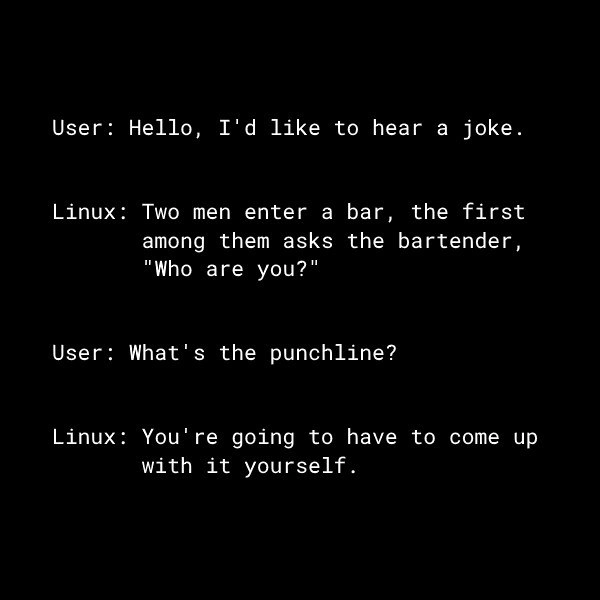
Let’s break down the joke in simpler terms. Linux is an operating system (like Windows or macOS) that is very powerful and open source (anyone can see and modify its code). A lot of Linux’s personality comes out when using the Command Line Interface (CLI) – basically a text window (terminal) where you type commands to tell the computer what to do. The meme is written to look just like a terminal conversation: white monospaced text on a black background, as if a user is talking to the system.

Here’s what happens in the meme:

  • User: "Hello, I'd like to hear a joke." – The user asks Linux (the system) for a joke, like a command or query.
  • Linux: "Two men enter a bar, the first among them asks the bartender, 'Who are you?'" – Linux responds with the first half of a joke. It sounds like the start of a classic “two guys walk into a bar…” joke. But the line “Who are you?” is unusual — it’s actually referencing a command. In a Linux terminal, if you type whoami, the computer will tell you who you are (which user account you are using). So “Who are you?” is a playful hint at the whoami command, a little clue for those familiar with the CLI.
  • User: "What's the punchline?" – The user expects the second half of the joke (the funny ending) to be given. This is like saying, “Okay, I heard the setup… what’s the rest?”
  • Linux: "You're going to have to come up with it yourself." – Linux basically says it’s not going to give the punchline; the user has to come up with it on their own. In other words, Linux only provided the setup (and a hint of a nerdy punchline with whoami), and now the user must finish or “compile” the joke.

The key term here is “compile.” In programming, compiling means taking source code (the human-readable instructions) and turning it into an executable program (the machine code that runs). For instance, if a developer writes a program in C language, they use a compiler to create the actual runnable application from that code. In Linux culture, especially in the past, users often compiled programs themselves. For example, to get certain software or a customized kernel (the core of the operating system), you might download the source code and compile it on your machine. It’s very hands-on. So when we say Linux “expects you to compile the punchline,” it’s a techie way of saying “Linux gave you the source of the joke, and now you must build the final result (the laughter) yourself.”

Also, about that “Who are you?” line – it’s referencing the whoami command. If you open a terminal on a Linux system and type whoami, it simply prints out your username, like this:

$ whoami    # User types the 'whoami' command
jane_doe    # The terminal outputs the current user's login name (e.g., "jane_doe")

So in the joke, when one of the men asks the bartender “Who are you?”, Linux is slyly inserting the whoami command into a bar joke. It’s an unexpected mashup of a normal joke format with a TerminalHumor reference. The punchline isn’t explicitly given because the real humor is in recognizing the whoami reference and the idea that Linux won’t finish the joke for you. This highlights a bit of open source culture: the system gives you building blocks (like commands, tools, code) but often expects the user to put them together. For a junior developer or someone new to Linux, the meme is saying: Linux is a do-it-yourself kind of environment. The joke lands when you understand that asking Linux for a joke is like asking a do-it-yourself kit to entertain you – of course Linux will only give you half and expect you to tinker to get the rest! It’s both a pun (with whoami) and a playful poke at how Linux works. In summary, Linux’s idea of a joke is giving you a puzzle to solve, which is very much in line with its reputation among developers. 😉

Level 3: No Precompiled Jokes

Linux delivering only the setup and forcing the user to “compile” the punchline is a witty nod to the open source ethos that seasoned developers know so well. In the Linux world, there's a running joke that if you want something done or fixed, you’ll probably end up doing it yourself – whether that's compiling your own kernel, building a tool from source, or in this case, finishing the punchline of a joke. This meme gets a chuckle from experienced devs because it exaggerates a real pattern: other operating systems might hand you a fully-packaged solution (the complete joke with a punchline), but Linux often hands you the ingredients and says, “here, you can cook the rest.” It's funny because it's true – using Linux, especially in its early days or on harder modes like Gentoo, meant embracing a do-it-yourself mindset.

The humor is layered with Command Line Interface (CLI) culture. The text is styled like a terminal session (white monospaced text on black background), immediately recognizable to anyone who spends time in bash or zsh. Linux’s response in the meme, “Two men enter a bar, the first among them asks the bartender, 'Who are you?'", sounds bizarre as a joke – until you catch the tech pun. The bartender being asked “Who are you?” is a direct reference to the classic CLI command whoami (which prints the current user’s identity). It’s the kind of half-hidden punchline that only developer humor would use: the OS gives you a geeky hint (a whoami Easter egg) and expects you to get the joke. For those in on it, seeing “Who are you?” in a bar joke format triggers an instant realization: Oh, that’s the whoami command! 😄. The meme essentially requires the reader to compile the meaning of the joke themselves – Linux isn’t spoon-feeding the laugh.

This all plays on the open source culture of Linux. In open source, if you ask for a feature or a fix, the maintainers might say, “Sure... patches welcome!” – meaning you can code it yourself. Here Linux personified does the same with humor: “You want a punchline? Feel free to craft it.” It’s poking fun at how Linux-based systems often give you control (and responsibility) over the final outcome. Seasoned Linux users have war stories of chasing down dependencies, editing config files, or compiling software from source at 2 AM – the OS gives you the pieces, but you assemble them. The meme brilliantly mirrors that shared experience in joke form. Operating Systems like Windows or macOS aim to be turnkey (full joke told for you), whereas Linux is proudly DIY (deliver half the joke and let the user have the fun of finishing it). It’s a clever insider gag: the punchline literally isn’t delivered because delivering punchlines isn’t Linux’s style – giving you control is. The senior folks chuckle because they’ve lived this: “Haha, classic Linux – always leaving something for the user to do.”

Description

A simple, text-based image on a black background with white, monospaced font, simulating a terminal interaction. The dialogue unfolds in four lines between a 'User' and 'Linux'. The User says, 'Hello, I'd like to hear a joke.' Linux begins, 'Two men enter a bar, the first among them asks the bartender, "Who are you?"'. The User, expecting a resolution, asks, 'What's the punchline?'. Linux delivers the meta-punchline: 'You're going to have to come up with it yourself.' This joke is a clever commentary on the core philosophy of the Linux operating system and the broader open-source community. It highlights the 'do-it-yourself' ethos, where the system provides powerful components and a framework, but the user is expected to assemble, configure, and understand it to achieve their desired outcome. The missing punchline is the joke itself, perfectly encapsulating the user experience of being given the tools but not the complete, polished solution


Comments

7
Anonymous ★ Top Pick Asking Linux for a joke is like asking for a containerized microservice. It'll give you the kernel, a C compiler, and a copy of the POSIX standard, then wish you the best of luck
  1. Anonymous ★ Top Pick

    Asking Linux for a joke is like asking for a containerized microservice. It'll give you the kernel, a C compiler, and a copy of the POSIX standard, then wish you the best of luck

  2. Anonymous

    Asked Linux for a punchline; it handed me a tar.gz and said “enable CONFIG_JOKE in menuconfig, then make laugh.” Apparently humor is an optional kernel module

  3. Anonymous

    This is exactly how Linux documentation works: it gives you 80% of what you need, then leaves you to grep through man pages, Stack Overflow, and your own existential crisis to figure out the last critical 20%

  4. Anonymous

    This perfectly captures the Linux philosophy: 'Here's 80% of what you need. The remaining 20%? Check the man pages, grep through Stack Overflow from 2009, and maybe compile it from source. Oh, and the punchline works differently on your distro.'

  5. Anonymous

    Linux: Delivers the joke's source tarball; punchline requires manual ./configure && make

  6. Anonymous

    Classic Unix: it returns the setup and a prompt; if you want the punchline, pipe it through fortune | cowsay | lolcat - after you apt install them

  7. Anonymous

    Asking Linux for a joke is pure Unix: you get whoami and a pipe; the punchline is left as an exercise for awk

Use J and K for navigation