Pandemic alert: Object-oriented languages banned to stop virus on “objects”
Why is this Languages meme funny?
Level 1: No Touching Objects
Imagine you hear a safety warning that says, “Germs can stick to mice, so be careful!” They’re talking about the little furry animals, right? Now picture someone misunderstanding that and exclaiming: “Oh no, we must stop using all our computer mice!” 🖱️ That sounds pretty silly, doesn’t it? We know a computer mouse (the thing you use to move the cursor) is completely different from a real mouse that might carry germs. The only connection is the word “mouse.”
The meme’s joke works the same way. During COVID-19, people said the virus could live on objects (like toys, phones, or doorknobs). A programmer took that serious idea and pretended it also meant “no objects in programming.” In coding, “objects” are just a nerdy term for pieces of a program, not physical things. So saying “ban object-oriented languages” is like saying “don’t use that style of coding because of the virus” – it mixes up two unrelated meanings of the word object. It’s a bit like thinking you could catch a cold from a Java program or a Python script, which is a crazy idea.
In very simple terms: the meme is funny because it’s a play on words. It’s taking a serious rule about not touching things (to avoid germs) and joking that it also means not using “things” in code. Of course, a virus can’t actually travel through computer code like that! It’s just a goofy pretend rule that makes us laugh. Even if you don’t know much about coding, you can chuckle at the thought of programmers staying “safe” by avoiding something called “objects” in their software – it sounds so absurd. It’s like saying “Since cookies can have germs, we must delete all our internet cookies!” 😂 It doesn’t really make sense, and that silliness is exactly why it’s funny.
Level 2: Social Distancing from OOP
Let’s break down the joke in simpler terms. The meme uses a play on the word “object.” In everyday English, an “object” just means a physical thing – like a book, a phone, or a door handle. During the COVID-19 outbreak, people were warned that the coronavirus could live on surfaces (objects) for a long time. For example, if someone with the virus touched a doorknob, the virus might stay on that object and possibly infect another person who touches it later. So as a real safety guideline, health experts in early 2020 said “the virus can survive quite long on objects” and advised cleaning things and avoiding touching stuff unnecessarily. There was a lot of talk about sanitizing groceries, wiping down packages, and basically treating every physical object as potentially “infected” for a while.
Now, in the programming world, the word “object” means something completely different. An object is a fundamental concept in Object-Oriented Programming, often shortened to OOP. If you’re new to programming: think of an object as a bundle of data and behaviors. We often create objects in code to model things from the real world or abstract ideas. For instance, in a simple game program you might have an object for a Player that holds properties like score or name and has functions (called methods) like jump() or move(). Many popular programming languages are object-oriented, meaning they are designed around using these objects. Examples include Java, C++, C#, and Python. In OOP, you usually define a blueprint called a class (e.g., a Car class) and then you create instances of that class (each instance is an object, like myCar or yourCar in the program). It’s a bit like designing a cookie-cutter shape (the class) and then stamping out actual cookies (the objects) with it. Each cookie can have its own flavor or decoration (its own data values), but they all share the same basic shape defined by the cookie cutter.
So we have two meanings of “object” here:
- Object (real world): a physical item, like a surface or thing you can touch.
- Object (programming): a construct in code that holds data and functions, used as a building block in OOP languages.
The meme jokingly combines these two meanings. It says, since Corona (the coronavirus) can survive on objects (physical surfaces), using object-oriented programming languages is “forbidden for now.” Of course, in reality nobody banned any programming languages during the pandemic – that would be ridiculous. This is a form of wordplay (specifically a pun) where the same word is used in two different contexts to create a silly misunderstanding. It’s as if the person reading the health advice about objects got comically confused and thought it applied to programming objects too. It’s like a geeky twist on “no touching objects” turned into “no using objects in code.”
For a newcomer, it helps to clarify why this is a joke and not a serious statement:
- Software objects aren’t physical. They live in a computer’s memory and have no physical form. A virus like SARS-CoV-2 can’t literally cling to a Python object or a Java object the way it might cling to a door handle or a smartphone screen. When programmers talk about “objects,” they’re talking about conceptual entities in code, not something you can hold in your hand.
- Different kind of virus. This meme isn’t talking about a computer virus or malware (the kind of malicious software that can infect your computer). It’s referencing the real biological virus during the COVID-19 pandemic. Computer viruses do spread through code, but that’s a separate concept and they don’t care if your code is object-oriented or not. Here, the joke strictly comes from mixing up physical virus precautions with programming terminology.
During the height of the pandemic, a lot of tech folks were working from home, glued to both the news and their code. Naturally, a distinct dev humor emerged where people made light of the situation using tech references. This meme is a prime example of PandemicHumor in the developer community. To fully get the joke, you need to know a bit about ObjectOrientedProgramming (so you understand what an “object-oriented language” is) and also be aware of the COVID news about surfaces (so you know why “objects” are suddenly scary in that context). When you have both pieces, the meme clicks: it’s funny because it’s a pun that only a programmer would concoct. It’s saying, in effect, “Better not write any code using classes and objects, or the corona might spread through your code!” 😅 Clearly that’s nonsense, and that’s why it makes people smirk.
The line “forbidden for now” in the meme also parodies the tone of official pandemic guidelines. In real life, we heard things like “All large gatherings are forbidden for now” or “Travel is banned until further notice.” Here it’s applied to programming languages in a straight-faced way. You can imagine some tongue-in-cheek “Governing Body of Programming” declaring a ban on OOP languages as if programming style could impact public health. Developers find this image hilarious because it’s so over-the-top. And it gently pokes fun at how, during COVID, almost everything in life was affected or regulated in some way – so why not code, too, in a joking sense?
Another layer to the joke is the inside reference to programming paradigms. There’s often friendly banter (and sometimes heated debate) among programmers about OOP versus other styles like functional programming or procedural programming. By jokingly “banning” OOP, the meme indirectly nods to those discussions. It’s like saying, “Hey, functional programmers, here’s your chance – the ban_on_oo_languages means everyone has to use your style now!” In reality, functional programming (using purely functions without objects, as in languages like Haskell or F#) and procedural programming (step-by-step code as in C) don’t have physical objects either, but of course that had nothing to do with virus safety. This is just nerdy humor stacking one idea on top of another. If you’re new to these terms: functional languages focus on immutable data and functions (no object instances floating around), and procedural languages like C or Pascal operate with routines and data separately rather than bundling them into objects. The meme doesn’t explain all that – it assumes you know – but now you can see why some devs joked, “Time to switch to Haskell until this whole corona thing blows over!” They’re playing along with the absurd premise for a laugh.
In summary, at this level: The meme is a pun that conflates virus-contaminated objects (in the real world) with programming objects (in code). It delivered a chuckle to developers during a tough time, mixing technical inside-jokes with pandemic life. It’s one of those jokes where if someone outside of programming saw it, they’d be confused (“Wait, can a virus get into software?”), but for those in the know, it’s obviously satirical. The DevCommunities online found little moments of joy like this by turning serious news on its head with tech jargon. “Corona on objects – so no object-oriented coding!” is just a playful notion, not actual medical or engineering advice. Now, armed with the understanding of both “objects,” you can appreciate why this meme spread (no pun intended) and made people in tech snicker.
Level 3: Flatten the Class Curve
At first glance, this meme reads like an official pandemic notice gone off the rails:
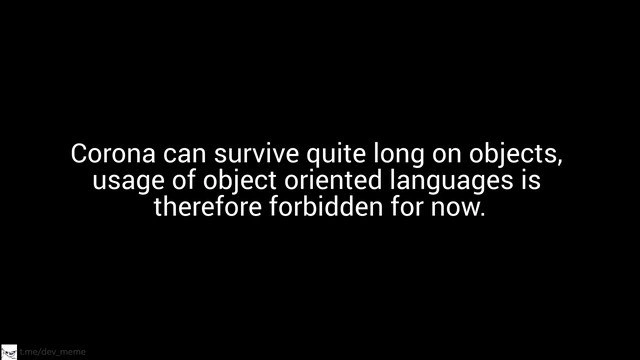
“Corona can survive quite long on objects, usage of object oriented languages is therefore forbidden for now.”
It’s a classic case of developer wordplay colliding with global crisis. In early 2020, health authorities warned that the coronavirus (which causes COVID-19) could linger on physical surfaces (objects) for hours or days. Meanwhile, in programming, an object is a core concept in Object-Oriented Programming (OOP) – it’s not a physical thing at all, but a bundle of data and functions living in memory. The meme mashes these contexts together: it satirically “bans” object-oriented programming languages (like Java, C++, C#, or Python) on the premise that their objects could harbor the virus. It’s absurd and that’s the point! The humor comes from a deliberate category error, almost like a type mismatch in code – treating software objects as if they were physical objects. This kind of DeveloperHumor thrives on such double meanings, and here it’s turbocharged by timely PandemicHumor.
For many seasoned devs, this joke landed during a period when we were inundated with real bans and lockdown rules. Offices were closed, travel was restricted, even handshake protocols were “forbidden for now.” So the meme plays out an alternate reality where programming paradigms are subject to pandemic rules. It’s as if the programming language police announced: “All OOP languages must be quarantined until further notice!” This ridiculous overreach tickles the techie brain. We know objects in code can’t carry a biological virus (no matter how buggy your Java code is, it can’t sneeze on you), so the “ban” is pure satire. By echoing serious public health messaging and applying it to coding, the meme creates an instant incongruity that seasoned developers find hilarious.
There’s also an in-joke here about programming language paradigms. Object-Oriented Programming has long been the dominant paradigm, but it’s not without controversy. Plenty of graybeard developers love to gripe about OOP’s complexities and LanguageQuirks – from tangled class hierarchies to objects that mutate state unexpectedly. This meme tongue-in-cheek implies a silver lining: “Oh darn, we have to give up OOP? Guess we have to use functional programming now… what a shame!” 😏 In reality, no one is banning Java or C#. But a veteran coder might jokingly cheer, “Time to dust off Haskell or C – those functional and procedural languages have no objects, so they must be safe from the corona!” It’s poking fun at the endless DevCommunities debates of OOP vs. functional. Imagine the sudden office ban: “No more Java or C++ until we flatten the class curve!” That phrase itself riffs on the pandemic slogan “flatten the curve,” blending it with OOP terminology (classes are OOP blueprints, a sly nod to class hierarchies). The senior dev brain eats this punny stuff up – it’s humor layered with insider knowledge.
This kind of covid_coding_humor was a coping mechanism for developers stuck at home. In Slack groups and forums, people shared jokes that mixed corona anxieties with coding life. It created a sense of camaraderie: whether you were sanitizing your groceries or refactoring legacy code, everyone needed a laugh. The watermark “me/dev_meme” suggests this came from an online dev meme page, one of many that sprang up or got extra popular during lockdown. They’d take serious announcements and give them a geeky twist like this. It’s funny because it’s obviously not true – a programming language can’t spread a virus – yet it momentarily sounds plausible if you only hear the buzzwords. It highlights how wordplay in tech can lead to ludicrous interpretations. The term “object” is overloaded: in everyday speech it’s any physical item, but in code it’s an instance of a class (a construct in software). By exploiting that ambiguity, the meme delivers a perfect “aha, I see what you did there” moment.
Experienced developers also appreciate the deeper irony that the meme accidentally touches on: in software, we do talk about “viruses” too – malicious programs that infect computers. Those are completely different from a biological virus, but hearing “virus on objects” might fleetingly make a techie think of a computer virus infecting an object (like an infected file or an in-memory object). It’s a fleeting overlap of jargon that makes the punchline even more satisfying. We know the difference, and that contrast is precisely why it’s funny. It’s like the meme is performing a cheeky type-cast: converting a medical warning into a coding context, which any strict compiler (or a logical mind) would reject – and that rejection is where the humor lies.
To top it off, consider how this joke mirrors the surreal reality of those early pandemic days. Suddenly everything was about sanitization and safety, even things that normally have nothing to do with health. Offices were talking about disinfecting keyboards and laptops. So a joke about “disinfecting code” or banning a programming style is a satirical extension of real precautions. One could half-jokingly imagine a developer dutifully writing a script to enforce the ban:
for language in programming_languages:
if language.paradigm == "Object-Oriented":
print(f"⚠️ {language.name} is temporarily banned due to virus risk!")
This snippet is totally nonsensical in practice, but it feels like the kind of officious rule we were bombarded with in 2020. And that’s why it’s comedic gold for those of us in the tech world – it underscores how crazy things felt, by applying that craziness to code. In sum, the meme strikes a chord with senior devs by combining shared pandemic experiences, a pinch of programming paradigm holy-war humor, and a clever linguistic twist. It’s an invitation to laugh at how ridiculous life can get, and only those fluent in both COVID news and coding lingo are in on the joke.
Description
The image is a simple black rectangle with centered white sans-serif text that reads: "Corona can survive quite long on objects, usage of object oriented languages is therefore forbidden for now." In the bottom-left corner, a faint grey watermark says "me/dev_meme." The joke plays on the double meaning of the word “objects,” conflating COVID-19’s ability to linger on physical surfaces with software’s object-oriented programming constructs. It satirically suggests developers must abandon OOP to stay safe, combining pandemic anxiety with classic developer wordplay about programming paradigms. The meme resonates with programmers familiar with OOP, language debates, and the surge of tech humor during lockdowns
Comments
6Comment deleted
Management finally agreed to the rewrite: since the virus survives on objects, we’re switching everything to pure functions - nothing like a pandemic to validate a decade-old FP pitch deck
Finally, a legitimate medical reason to refactor that 15-year-old enterprise Java monolith into pure functional programming - though explaining to the board why Haskell will save lives might be harder than explaining why we need another microservices migration
Finally, a legitimate excuse to refactor that legacy Java monolith into pure functional Haskell - it's not technical debt anymore, it's a CDC-mandated quarantine protocol. Though I suspect the real virus here is the 15-year-old singleton pattern that's been infecting our codebase since 2008
Finally, a virus enforcing immutability - OOP's side effects were always contagious
Pandemic policy: since the virus survives on objects, we’re migrating to pure FP - immutable data, side effects quarantined behind ports, and monads officially classified as PPE
Architecture review update: we refactored to pure functions to reduce surface area - the R0 of side effects finally dropped below one