Dev laughs at Windows 95 virus joke under pandemic prediction video
Why is this Microsoft meme funny?
Level 1: Computer Germs
Imagine your computer can catch a cold, kind of like a person can. A computer virus is like a germ or bug that makes your computer “sick” – it might stop the computer from working right or mess up your files. Back in the old days (when Windows 95 was new, which is like way before you were born), computers got these “colds” quite often, and people like Bill Gates worked hard to help fix and prevent them, sort of how a doctor tries to stop germs from spreading among people.
Now picture Bill Gates on stage giving a talk about how we aren’t ready for the next big sickness in humans (a real virus that makes people sick). Under that video, someone joked, “He’s been fighting viruses since Windows 95.” What do they mean? They’re basically saying, “This man was battling computer germs since 1995, and now he’s talking about real germs – so he’s a longtime germ-fighter!” It’s funny because it connects two things that are normally very separate: the virtual bugs in computers and the real bugs (viruses) that infect humans. It’s like saying a firefighter from a video game is now fighting actual fires in real life.
So the joke makes us smile because Bill Gates dealt with “sick computers” many years ago and here he is worrying about people getting sick. It’s a playful way to say he has tons of experience with any kind of “virus,” whether it’s on a hard drive or in a human body.
Level 2: Windows 95 Nostalgia
Let’s break down the meme’s references in simpler terms. Windows 95 was an old version of Microsoft’s Windows operating system released back in 1995 (hence the name). It was a hugely popular OS on personal computers and introduced a lot of people to the modern desktop experience. Because it was so widespread (millions of PCs ran Windows), it became a big target for early computer viruses. A computer virus is a malicious program designed to spread itself from one computer to another – kind of like how a cold virus spreads from person to person. When a computer “catches” a virus (say by running an infected file or opening a bad email attachment), the virus can do nasty things like delete your files, show weird messages, or use your computer to infect others. In the late 90s and early 2000s, dealing with viruses was a common headache: people would install antivirus software to detect and remove malware (malware = “malicious software”, an umbrella term that includes viruses). If you’ve ever heard your parents or teachers say “Don’t download that, it might have a virus,” that caution comes from those Wild West days of PC security!
Bill Gates, the co-founder of Microsoft, was the leading figure behind Windows. Throughout the Windows 95 era and beyond, Microsoft had to constantly battle these computer viruses. Gates’s team released security patches (updates to fix vulnerabilities) and worked with security companies to curb the damage. In fact, viruses were such a problem that Microsoft eventually built stronger security into Windows (for example, the built-in Windows Defender antivirus that computers use today is a result of lessons learned from all those earlier attacks). Bill Gates was essentially in charge of protecting the world’s PCs from digital epidemics during his tenure at Microsoft.
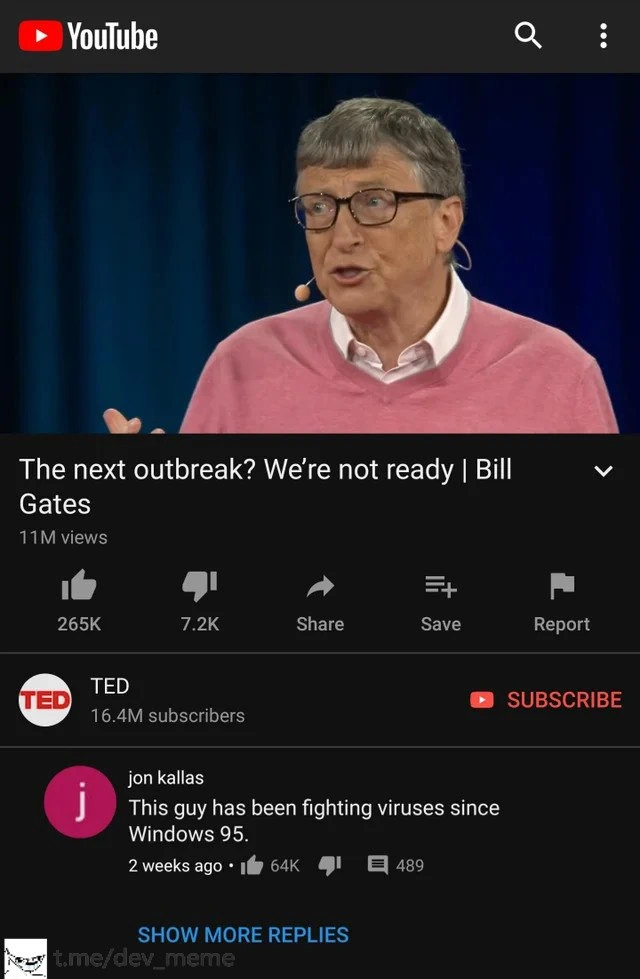
Now, fast-forward to the scenario in the meme: There’s a YouTube video (a TED talk) where Bill Gates is giving a presentation about a completely different kind of virus – a biological virus that could cause a global outbreak (this was a real talk he did about the risk of pandemics, several years before COVID-19 happened). The meme shows the YouTube app’s dark-themed interface with the talk’s title “The next outbreak? We’re not ready” and Bill on stage. Underneath, we see a highlighted user comment by someone named “jon kallas” which says: “This guy has been fighting viruses since Windows 95.” That comment is the punchline of the meme.
Why is that comment humorous? It’s playing on the two meanings of “virus.” Bill Gates fought computer viruses starting in the Windows 95 days, and here he is talking about real viruses that make people sick. The commenter is jokingly suggesting that Bill has decades of experience fighting viruses – implying he’s almost an expert in viruses in general – because of his background in computer security. It’s a form of techie humor to say someone’s been doing X “since Windows 95” – it means they’ve been doing it for a very long time (Windows 95 came out over 25 years ago!). It also specifically tickles tech folks because Windows 95 is an old-school reference that geeks love to reminisce about.
The categories listed (Microsoft, Security, TechHistory) all come into play here:
- Microsoft: because Windows 95 is a Microsoft product and Bill Gates co-founded the company.
- Security: because it’s about viruses (computer security threats) and the analogy to health security.
- TechHistory: because Windows 95 is a historical reference now, and it invokes the early era of widespread PC use and malware.
For a younger developer or someone new to IT, it helps to know that getting a computer virus was the big security problem for everyday users in the 90s. There were famous viruses/worms like “Melissa” and “ILOVEYOU” that spread through email and caused real damage. People would talk about viruses almost like we talk about hacks or data breaches today. So saying someone has been fighting viruses since that time is saying they’ve seen it all.
Additionally, Bill Gates in recent years has been very involved in global health initiatives (through the Gates Foundation). He’s invested in efforts to eradicate diseases like polio and has spoken publicly about pandemic preparedness. So in reality, he has been fighting actual viruses (through philanthropy) after stepping down from daily duties at Microsoft. The commenter probably meant it as a witty one-liner, but it lands even better because it’s partially true! Bill went from saving our computers from malware to trying to save people from epidemics.
The meme’s context (posted in late March 2020) is important: around that time the COVID-19 pandemic was growing global. Bill’s 2015 talk about an upcoming outbreak suddenly got a lot of attention for being prophetic. Tech communities saw the comment and found it hilarious and apt – it brought a bit of levity by relating the scary concept of a pandemic to something geeks have dealt with for ages, computer viruses. This is a good example of DeveloperHumor: mixing a real-world serious issue with a touch of tech insider reference. Even the format – using a screenshot of a YouTube comment – is a popular way to share jokes. Sometimes, the comments on serious videos contain meme-worthy gems, and this one was a perfect crossover joke for the tech crowd. If you’re in on the joke, you’ll laugh and maybe also appreciate how long and varied Gates’s “virus-fighting” journey has been.
In short, the meme is saying: “Bill Gates has been dealing with viruses for a long, long time – first the ones that crash computers, now the ones that crash society.” It’s a one-sentence wisecrack that ties together Microsoft’s history, the concept of malware, and the current events of 2020, making us laugh at how oddly full-circle it all is.
Level 3: From PC Plagues to Pandemic
“This guy has been fighting viruses since Windows 95.”
Seasoned developers immediately smirk at this top comment under a serious pandemic prediction video. The “guy” in question is Bill Gates, prominently featured giving a TED talk titled “The next outbreak? We’re not ready.” The commenter brilliantly bridges Gates’s two worlds: his legendary tenure battling computer viruses during the Windows era, and his current role sounding the alarm on biological viruses. It’s a classic piece of developer humor that mixes tech nostalgia, security insights, and a pinch of gallows humor (given the timing in March 2020, amid a real outbreak).
Why is this funny to those in the know? First, it’s an inside joke rooted in tech history. Gates spearheaded Microsoft during the 90s and early 2000s when Windows – especially Windows 95 and its successors – was the prime target for countless viruses and malware. Back then, getting a computer virus was practically a rite of passage (anyone remember the chaos of an unexpected “Your PC is infected” message or the Blue Screen of Death at the worst time?). The comment evokes that era, implying Bill has decades of virus-fighting experience under his belt. It humorously frames him as a grizzled veteran of the malware wars, now stepping up to advise on a literal viral war. For developers who lived through the 90s, this hits home: it recalls hours spent removing the likes of ILOVEYOU and Melissa viruses from family PCs, or updating Norton AntiVirus subscriptions via dial-up.
To illustrate how “since Windows 95” resonates, consider a few infamous outbreaks from that period that every IT old-timer remembers:
- CIH (Chernobyl) – A 1998 virus that targeted Windows 95/98 systems. It was nasty: on April 26 (the Chernobyl disaster anniversary), it would overwrite part of the computer’s BIOS chip, effectively bricking the PC. Microsoft had to reckon with the fallout as countless home users suddenly found their computers won’t even boot.
- Melissa (1999) – A fast-spreading email virus (via an infected MS Word document) that overloaded email servers worldwide. It was one of the first to show how quickly a virus could go “viral” through the nascent internet. Gates’s team had to rush out security bulletins and urge users to disable macros in Office – an early lesson that convenience features can become security holes.
- ILOVEYOU (2000) – This one was huge: a simple VBScript worm that arrived as a love-letter attachment. Millions of Windows PCs were infected within days, causing billions in damage globally. It was a wake-up call that computer viruses weren’t just pranks; they were capable of widespread disruption. Microsoft faced tough questions about Outlook’s security guardrails (since the worm spread via Outlook contacts).
By the early 2000s, Gates had seen enough carnage from digital viruses that he famously refocused Microsoft’s priorities on security (in 2002 he sent the “Trustworthy Computing” memo to all staff, essentially declaring war on malware). Features like automatic Windows Updates, the Windows Firewall, and later Microsoft’s own Windows Defender antivirus all trace back to this shift. In other words, Bill Gates really had been fighting computer viruses for a long time – rallying his company to fortify Windows and protect millions of PCs worldwide.
Now fast-forward to the TED talk shown in the meme (recorded in 2015, but eerily resurfacing during COVID-19’s onset in 2020). Gates is on stage warning that the world is unprepared for the next pandemic. The highlighted YouTube comment wryly points out that if anyone has experience in fighting virulent outbreaks, it’s this guy – he’s been at it since the Windows 95 days! It’s a clever alignment of context: Bill’s credibility in 2020 as a pandemic Cassandra is humorously bolstered by his street cred in fighting Windows malware decades earlier. Of course, battling email worms isn’t the same as stopping a coronavirus, but the joke leans on the metaphor. It helps that in both cases, success involves a mix of technology, coordination, and preventative measures (whether that’s patching operating systems or funding vaccine research).
There’s also an element of TechHistory pride in the joke. The Windows 95 era (mid-90s) is iconic among developers – a formative time for many careers. By invoking it, the commenter taps into a shared nostalgia. It’s like saying: “Bill was out there on the digital front lines when most people were still figuring out dial-up internet.” The 64K+ likes on the comment suggest thousands of others got the joke instantly, reminiscing about those virus-laden days. It’s an industry in-joke that rewards you for knowing that Microsoft had to grapple with endless malware in the 90s, and that “virus” has a double meaning here.
Another reason this hits home is timing and tone. In March 2020, the world was filled with anxiety about a very real virus. Technical folks coping with lockdowns likely watched this very TED talk as it went viral again for its almost prophetic content. Dropping a light-hearted Windows 95 reference in that heavy context provided comic relief. It’s a form of nerdy gallows humor: finding a familiar, less scary reference (computer virus) to momentarily defuse the fear of the deadly virus. Only a developer audience would take comfort in a Windows joke during a pandemic video – and that’s exactly what happened. “He’s been fighting viruses since Windows 95” turns Bill Gates into a kind of multi-genre hero, bridging his legacy from tech to public health with one witty punchline.
It’s also worth noting the meme format here: a YouTube comment screenshot. This has become a popular meme style – someone finds an unexpectedly hilarious or insightful comment beneath a video and shares it as an image. In developer meme circles, this comment is gold. It takes a serious Bill Gates talk on global health and reframes it through a programmer’s perspective. The contrast itself is funny: envisioning Bill applying CTRL+ALT+DELETE to a pandemic, or downloading an antivirus update for society. The meme doesn’t show any absurd Photoshop or typical cartoon; it uses the actual YouTube UI (dark mode, thumbs-up count, etc.) to give it realism. And because the comment is so on-point, it hardly needs any embellishment. The watermark t.me/dev_meme indicates it circulated in developer channels, where readers instantly get the Windows 95 reference.
In summary, at the senior-dev level this meme shines as a two-layer joke. It’s a Security gag (viruses and fighting them) blended with a TechHistory reference (Windows 95 battles) applied to a contemporary crisis. It pokes gentle fun at Bill Gates’s expense in a respectful way – acknowledging his long history with “viruses” of all sorts. And it’s a nod to how experiences in tech sometimes foreshadow challenges in the broader world. The absurdity and genius lie in connecting old-school PC malware struggles to modern epidemic response, all in one sentence under a YouTube video. For those of us who’ve watched both Windows and world events crash unexpectedly, it’s the kind of dark, nerdy humor that elicits a knowing chuckle and a head-nod.
Level 4: The Epidemiology of Code
In computer science lore, the term virus wasn’t chosen by accident – it directly parallels biological viruses in how it spreads and behaves. A computer virus is essentially a self-replicating program that infects other programs or files, much like a biological virus infects cells. In the 1980s, researchers like Fred Cohen formally analyzed these digital pathogens, even proving that the problem of detecting all possible viruses is undecidable (akin to the Halting Problem). In plain terms, there is no perfect algorithmic cure-all – an antivirus can’t anticipate every new virus strain any more than medicine can preempt every new disease. This sets up a perpetual cat-and-mouse game in both domains.
The analogy between malware outbreaks and epidemics runs surprisingly deep. Both can exhibit exponential spread: one infected computer on a network can rapidly fan out to thousands, just as one contagious person at a crowded event can spark a pandemic. Security researchers often borrow epidemiological models (like SIR – Susceptible, Infected, Recovered) to understand computer worm outbreaks. For example, the ILOVEYOU email virus in 2000 followed a curve of infection eerily similar to a biological epidemic, “going viral” across millions of PCs in days. Computer scientists talk about a virus’s reproduction rate in a network similarly to how epidemiologists discuss an R₀ value for diseases.
Crucially, defenses in both realms rely on recognition and response. Computers use antivirus databases of known malware signatures (snippets of code fingerprints) to immunize systems, while our bodies (or vaccines) recognize molecular signatures of germs. Both strategies struggle with mutations: a clever virus (digital or biological) can alter itself to evade known signatures. This is why your antivirus needs constant updates — just as flu vaccines are updated seasonally. Bill Gates, as the co-founder of Microsoft, witnessed firsthand that no matter how many patches or security updates Windows shipped, new viruses kept emerging. He championed initiatives (like Microsoft’s Trustworthy Computing push in the early 2000s) to build a stronger “immune system” into Windows. In parallel, Gates’s philanthropic work on global health has emphasized strengthening real-world immune systems and outbreak preparedness. The science of stopping malicious code and stopping microbes isn’t identical, but the underlying principles of containment, immunization, and adaptation align closely. By the time of that TED talk, Gates was essentially applying lessons from decades of fighting software epidemics to the realm of human disease.
It’s even a meta-joke that a talk about viruses went viral on YouTube. The mathematical growth of video shares follows an exponential curve just like an epidemic or a computer worm outbreak. So when we see a quip about “fighting viruses since Windows 95,” it’s nodding to these cross-domain parallels. The humor lands because it’s intellectually plausible (Gates’s experience with Windows malware gives him a systems-thinking approach to pandemics) and historically rich. A veteran of one kind of virus war is warning us about another, and on a fundamental level, the strategies to combat both rely on early detection, rapid response, and global cooperation. It’s a rare joke that survives on multiple layers of context: computational theory, epidemiology, and tech history all converging under a YouTube comment.
Description
A dark-theme YouTube mobile screenshot shows a paused talk: a grey-haired speaker in a pink sweater on a blue stage, their face blurred. The video title bar reads “The next outbreak? We’re not ready | [name redacted]” with “11M views”. Beneath are icons: thumbs-up 265K, thumbs-down 7.2K, Share, Save, Report. The channel row states “TED • 16.4M subscribers” with a red “SUBSCRIBE” button. A highlighted comment from user “jon kallas” says, “This guy has been fighting viruses since Windows 95.”, timestamped “2 weeks ago”, showing 64K likes and 489 replies. Lower left corner contains the watermark “t.me/dev_meme”. The meme’s punchline connects biological outbreaks to the long history of computer malware on early Microsoft operating systems, tapping into security nostalgia and developer humor about Windows 95 era virus battles
Comments
6Comment deleted
Humanity’s basically a legacy monolith - handshake.dll is still unsigned, airborne RPCs have zero test coverage, and management thinks a yearly Patch Tuesday will do the trick
Bill's pandemic response strategy: "Have you tried installing the latest security patches and rebooting the population every Tuesday?"
The comment perfectly encapsulates the irony that Gates spent decades patching security holes in Windows only to pivot to patching holes in global health infrastructure - proving that whether it's buffer overflows or viral outbreaks, the root cause is always inadequate input validation and a failure to sanitize your environment
Bill's been patching zero-days since Win95; pandemics are just unhotfixable exploits at global scale
Public health is just infosec with humans - R0 is the CVSS score, and some of us have been shipping Patch Tuesday since AutoRun.inf
Outbreaks and worms share a playbook: when R0 > 1 or an RCE drops, Patch Tuesday quietly rebrands to Postmortem Wednesday