Skip to content
DevMeme
3755 of 7435
Blaming every weird bug on cosmic ray bit flips post-Veritasium binge
Bugs Post #4095, on Jan 25, 2022 in TG

Blaming every weird bug on cosmic ray bit flips post-Veritasium binge

Why is this Bugs meme funny?

Level 1: The Dog Ate My Homework

Imagine you did something wrong or something bad happened, and you really, really don’t want it to be your fault. What do you do? You might come up with a crazy excuse – like a kid saying, “The dog ate my homework!” when they actually just forgot to do it. This meme is basically a programmer’s version of that. The programmer’s code has a bug (meaning it’s not working right), and instead of saying “I made a mistake,” they jokingly say “A cosmic ray from space flipped a computer switch and broke it!” That’s like blaming a shooting star for messing up your video game. 🌠 It’s a super silly, almost unbelievable excuse.

Why is that funny? Because it’s so over-the-top. It takes a very unlikely thing – a tiny space particle causing trouble – and uses it to avoid blame. It shows the programmer shaking their fist at the sky, kind of how you might shake your fist and say “Dang you, clouds!” if rain spoiled your outdoor fun. We laugh because we know the person is being dramatic and kidding around. Deep down, the developer probably knows their code has a regular bug, but it feels better (and more humorous) to pretend it was caused by something out of this world. It’s the same feeling as when you knock over a glass and go, “Ugh, gravity is out to get me today!” No one really thinks gravity had it in for them – it’s just a funny way to cope with messing up.

So, in plain kid-friendly terms: the meme is showing a coder blaming outer space for a mistake in their work. It’s like saying a magic cosmic ghost did it. 🙂 We all know that’s not the real reason, and that’s why it makes us smile. It takes the frustration of having a problem you can’t figure out and turns it into a playful “the universe did it!” joke. Just like you might giggle if your friend said an alien stole their pencil when they lost it, developers giggle when someone blames a “cosmic ray bit flip” for a computer bug. It’s a fun way to say, “This problem is so weird, maybe even something crazy like space rays caused it, haha!” In the end, it’s humor about taking the blame off yourself by pointing to the stars – a high-tech tall tale as an excuse for a simple goof.

Level 2: Cosmic Ray Crash Course

Let’s break down the basics behind this meme. Cosmic ray bit flip sounds like sci-fi, but it describes a real event where a tiny particle from space causes a computer error. Here’s what happens in simple terms: Computers store information in bits (imagine lots of little on/off switches represented by 1s and 0s). A cosmic ray is essentially a super-fast tiny particle (like a proton) zipping through space. If one of these particles hits a computer chip just right, it can knock a bit from a 0 to a 1 or from 1 to 0 – that’s the “bit flip.” When a bit flips unexpectedly, the computer’s calculation or data can suddenly be wrong, leading to a weird bug in the program. This kind of error is random and doesn’t come from any mistake in the code itself. Engineers call it a soft memory error or a single-event upset – “soft” meaning it’s not a permanent break, just a one-time freak event.

Now, normally as a developer you wouldn’t assume space particles are to blame for a bug in your app. Usually, a bug is caused by a mistake in the code logic, a misuse of an API, a missing check, something normal like that. Debugging involves systematically hunting for that mistake. But this meme shows a funny scenario where a developer has just watched an educational video (from Veritasium, a science channel) about these wild cosmic-ray-induced computer errors, and suddenly they’ve got a new theory for every unexplained glitch. It’s like getting a crash course in an exotic problem and then seeing that problem everywhere. Heisenbug is a term you might hear for those fluky bugs that seem to disappear when you try to debug them (think of it like a magic trick: the bug is there, then poof, it’s gone when you look closely). Those are the kind of bugs that drive you up the wall because you can’t easily reproduce them or figure out why they happened. After learning about cosmic rays, our developer meme character starts thinking, “Hey, maybe it wasn’t my code at all – maybe a cosmic ray zapped my computer and caused that Heisenbug!”

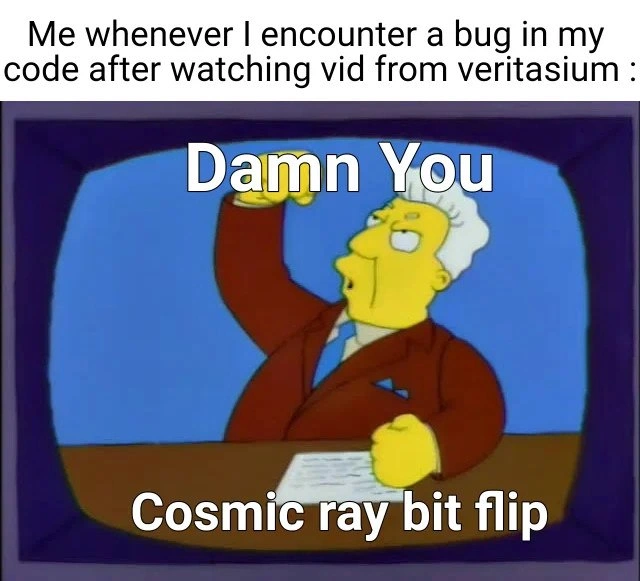
The image chosen is from The Simpsons: it features news anchor Kent Brockman on TV shaking his fist and yelling. The top text says “Damn You” and the bottom says “Cosmic ray bit flip.” This cartoon scene humorously represents the developer shaking their fist at the sky, blaming outer space for their woes. In the caption above the image, the meme creator writes, “Me whenever I encounter a bug in my code after watching [a] vid from veritasium:”. So the story is clear: they saw a cool Veritasium video about random cosmic events breaking computers, and now whenever their code misbehaves, they dramatically accuse the universe – “Damn you, cosmic ray bit flip!” It’s a playful exaggeration showing DebuggingFrustration. Instead of calmly searching for the real cause (which could be a typo or an off-by-one error), the person jumps to the most exotic cause they just learned about. This is a form of DeveloperHumor because every programmer knows the feeling of a bug they can’t immediately explain. It pokes fun at our temptation to find any explanation – even a far-fetched one – that spares us from feeling responsible for the error.

In simpler terms: the meme mixes hardware science with everyday coding. It educates (cosmic rays can flip bits!) and teases at the same time. Anyone who’s spent hours trying to fix a weird software problem can chuckle at the idea of finally throwing their hands up and saying, “Maybe it’s not me – maybe it was radiation from outer space!” It’s both a nerdy joke and a tiny bit of a tech lesson. Now you know that blame_the_hardware is a running joke – sometimes when a bug is really confusing, developers sarcastically say the computer must be at fault (like a memory glitch or, in this case, cosmic rays) rather than our beautiful code. It rarely is the true cause, but hey, it’s a funny way to cope with DebuggingFrustration when nothing makes sense. And if you ever hear someone mention a “cosmic ray bug,” you’ll know they’re referencing this very idea: a nearly supernatural explanation for a mundane coding problem.

Level 3: Galactic Scapegoat

Now, from a senior developer’s perspective, the humor kicks in because we’ve all experienced those bugs that seem absolutely baffling. Imagine a program that fails once and then works on every re-run – the classic “it only happened that one time” scenario. In developer lingo, that’s often dubbed a Heisenbug (after Heisenberg’s uncertainty principle) because the act of observing or debugging it makes it disappear. These are the ghost-like issues where you have no solid repro steps, and it almost feels like the universe is trolling you. So what do frustrated coders do? Half-jokingly, they blame the hardware or some cosmic coincidence. Enter the “cosmic ray bit flip” theory as a tongue-in-cheek scapegoat for any truly puzzling glitch. It’s an out-of-this-world excuse – literally blaming space particles for your BugsInSoftware.

This meme perfectly captures that delirious moment in Debugging_Troubleshooting where you’ve ruled out all the usual suspects. You’ve checked your logic, your data, your integration points, and nothing should be wrong… yet something crashed. After binge-watching a sciencey Veritasium video about stray cosmic particles flipping bits, it’s tempting (and darkly funny) to throw up your hands and declare: “Damn you, cosmic ray bit flip!” The image of Simpsons news anchor Kent Brockman shaking his fist at the sky embodies this dramatic DebuggingFrustration. He’s like a developer outwardly cursing a random proton from the Andromeda Galaxy for sneaking into the machine and sabotaging his otherwise perfect code. It’s absurd, which is why it’s funny.

Seasoned developers recognize this pattern of thought. It’s reminiscent of other classic tech jokes – like “It’s always DNS” when a website mysteriously fails, or “Mercury must be in retrograde” when everything goes haywire with no explanation. In practice, 99.999% of the time the cause of a weird bug is something prosaic: a missed edge case, a race condition, an off-by-one error, or some misconfigured setting. But there’s a sort of geeky comfort in humorously pinning blame on something as exotic as cosmic radiation. It’s a way to vent and say “Well, I can’t find the flaw, so maybe the universe just bit-flipped my program for giggles!” Other developers laugh because they’ve been there—DeveloperHumor thrives on these shared “faulty hardware” exaggerations. We all know that feeling of desperation where even the impossible starts to seem plausible.

Importantly, this meme also pokes fun at how a bit of new knowledge can skew our perspective. The veritasium_reference implies the coder recently learned about cosmic-ray-induced errors from Veritasium, a popular science YouTube channel. Freshly enlightened, they now see cosmic rays lurking behind every segfault and broken test. It’s like when someone reads about a rare disease and suddenly any mild symptom makes them think they have it. Here, the dev’s watched an eye-opening video on single_event_upset incidents and suddenly every bug becomes a potential physics experiment in their mind. The senior folks in the room chuckle because they know the Heisenbug game: today it’s cosmic rays, yesterday it was “maybe the compiler misoptimized my code,” and tomorrow it might be “gremlins in the framework.” In other words, we recognize this mix of techno-paranoia and humor. Yes, cosmic rays can flip bits, but using that as your go-to DebuggingFrustration outlet is a running joke. It’s a clever way of saying, “I’m utterly stumped, so I’ll just blame something I literally saw on Veritasium about space particles.”

In sum, the meme resonates because it dramatizes a real but ultra-rare problem as a convenient scapegoat. It’s HardwareHumor meeting developer self-awareness. The next time a teammate quips about cosmic rays causing a production outage, you’ll know they’re channeling this exact joke. It’s a senior-level inside joke about humility in debugging: sometimes we jokingly appeal to the cosmos when we can’t find a earthly explanation in our code. (Because admitting “I have no clue what went wrong” is hard – shouting “Cosmic rays!” with a grin is much more fun!)

Level 4: Radiation in the Machine

At the deepest technical level, this meme riffs on a real hardware phenomenon: high-energy particles from outer space messing with your computer’s memory. Yes, cosmic rays are not just science fiction – they really can flip bits in RAM or CPU registers. In physics terms, a charged particle (like a rogue proton from a cosmic ray or solar radiation) zips through a computer chip and ionizes the silicon. This sudden burst of charge can flip a 0 to a 1 (or vice versa) in a memory cell. Engineers call this a Single Event Upset (SEU), which is a fancy way to say one little cosmic ray caused a one-time error in data. It’s a kind of soft memory error: “soft” because it doesn’t permanently damage the hardware, just alters the stored bits momentarily. The device keeps working, but that one binary value might now be wrong – leading to a freakish software behavior.

From a computer architecture standpoint, cosmic-ray-induced bit flips are a serious concern in high-reliability systems. They’re the invisible gremlins of Hardware design. Ever wonder why server-grade RAM has ECC (Error-Correcting Code)? It’s to detect and fix these random flips on the fly. ECC memory chips carry extra parity bits that can correct single-bit errors automatically, so your database doesn’t crash just because a neutron from space decided to play dice with a byte. In environments with lots of radiation – think satellites, high-altitude flights, or Mars rovers – engineers go even further. They might use radiation-hardened circuitry or triple modular redundancy (three separate processors voting on each result) to ensure one flipped bit doesn’t wreak havoc. For instance, spacecraft electronics are designed to handle constant particle bombardment, using shielding and redundancy to survive cosmic onslaughts that would make a desktop PC faint.

What’s mind-blowing is how unavoidable this is at scale. There have been eerie instances in real life: a cosmic-ray bit flip once likely altered a single vote tally in a Belgian election, and supercomputers and avionics have logged countless “single-event upsets.” As chip components get smaller and more densely packed (modern nanometer-scale transistors), they actually become more susceptible to stray radiation – a tiny charged particle can flip a tiny bit more easily. It’s a fundamental reliability challenge stemming from the laws of physics; no matter how perfect your software is, the universe can introduce a random error. So fundamentally, this meme’s premise is rooted in the physics of computing: even if your code is bug-free, a stray cosmic particle can literally turn a 1 into a 0 and create a bizarre glitch. In theory, it’s an explanation for those one-in-a-billion weird crashes that leave even seasoned engineers scratching their heads. It’s the ultimate non-deterministic bug source – randomness from outer space! 🔬✨

Description

A still from The Simpsons shows news anchor Kent Brockman on a CRT-style television screen, wearing a brown suit and raising one fist toward the sky in dramatic frustration. Overlay text inside the screen reads, at the top, “Damn You” and at the bottom, “Cosmic ray bit flip.” Above the frame, a caption says, “Me whenever I encounter a bug in my code after watching vid from veritasium :”. The meme humorously depicts a developer who has just learned that stray cosmic rays can flip memory bits and now blames every mysterious software defect on that ultra-rare hardware phenomenon. It pokes fun at debugging culture, nondeterministic “Heisenbugs,” and the temptation to attribute bugs to exotic single-event upsets instead of one’s own code

Comments

7
Anonymous ★ Top Pick Cosmic rays are the new “it works on my machine” - the perfect alibi while I quietly bisect the undefined behavior that slipped past three code reviews and our “deterministic” CI pipeline
  1. Anonymous ★ Top Pick

    Cosmic rays are the new “it works on my machine” - the perfect alibi while I quietly bisect the undefined behavior that slipped past three code reviews and our “deterministic” CI pipeline

  2. Anonymous

    After 20 years in the industry, I've evolved from blaming the compiler, to blaming race conditions, to blaming cosmic rays - at least now my excuses have peer-reviewed papers and a 10^-9 probability instead of just my wounded pride

  3. Anonymous

    Statistically it was a cosmic ray; forensically it was the off-by-one you committed at 6pm Friday with the message 'minor fix'

  4. Anonymous

    Ah yes, the classic senior engineer progression: Year 1-5: 'It's probably my code.' Year 5-10: 'It's definitely the framework.' Year 10-15: 'Must be a compiler bug.' Year 15+: 'COSMIC RAYS!' Because once you've watched enough Veritasium, every heisenbug becomes a legitimate excuse to blame the universe itself. Sure, your null pointer dereference has nothing to do with that refactor you did at 2 AM, it's clearly a high-energy particle from a supernova 10,000 light-years away that just happened to flip the exact bit in your production server's RAM. The fact that ECC memory exists specifically to prevent this, and that cosmic ray-induced errors occur roughly once per 256MB per month at sea level, is completely irrelevant when you need to explain to your PM why the deployment failed

  5. Anonymous

    Amazing how space weather targets only the code I shipped yesterday - if it were really an SEU, we’d spec ECC/TMR; instead, git blame points to a very terrestrial off-by-one

  6. Anonymous

    I’ll believe the cosmic-ray bit flip once you show me the ECC counters - until then, it’s a race condition disguised as astrophysics

  7. Anonymous

    Heisenbugs? Amateur hour. Cosmic rays are the senior dev's 'works on my machine' for prod crashes

Use J and K for navigation