Pull Request Feedback So Vague It’s Like Warning Water About Being Wet
Why is this CodeReviews meme funny?
Level 1: Water Is Wet
Think about being in a swimming pool. Everything around you is water, right? Now imagine someone puts a big yellow sign next to you in the pool that says “CAUTION: WET FLOOR.” You’d probably laugh and say, “Well, duh! I’m in a pool, of course it’s wet!” It’s such an obvious and silly warning that it’s funny. That’s exactly the joke here. In the world of computer programmers, when one person finishes some work on code, another person might check it and leave a note. But sometimes the note they leave is as obvious as telling water that it’s wet. In the meme, the note left was “code change.” That’s like saying, “Hey, you changed the code,” which everyone already knows because that’s the whole point of checking the new code!
So the picture with the floating wet floor sign is making fun of how unhelpful that kind of note is. It’s showing that warning a pool about water is just as silly as giving a super obvious comment about a code change. Both make you go, “Thanks, I guess… but I already knew that!” The reason it’s funny is that we expect a helpful warning or useful feedback, but instead we get something ridiculously obvious. It’s like if you were doing homework and a friend looked at it and just said, “You wrote something on the paper.” Not helpful at all, right? You’d probably roll your eyes.
In simple terms, the meme is joking about people who give feedback that doesn’t actually help. It makes us laugh because we’ve all been in a situation where someone tells us what we already know. And whether you’re swimming in water or reading a code review, hearing “it’s wet” or “you changed the code” will just make you say, “Yeah… I know. That’s pretty obvious.”
Level 2: Obvious Warnings
Let’s break down the scene for those newer to code reviews or not yet familiar with pull requests. A Pull Request (PR) is how developers propose a set of code changes to be merged into a project’s codebase. When you open a PR (for example, on GitHub or GitLab), your teammates review the differences (the diff) between the old code and the new code you wrote. They then leave comments on the PR to give feedback – maybe suggesting improvements, asking questions, or catching mistakes. The goal of a code review is to maintain code quality and share knowledge. Good feedback in a PR is specific: it might say something like “This function is doing a lot; consider refactoring for clarity,” or “We need to handle the case when user is null to avoid a crash.” These comments help the author make the code better.
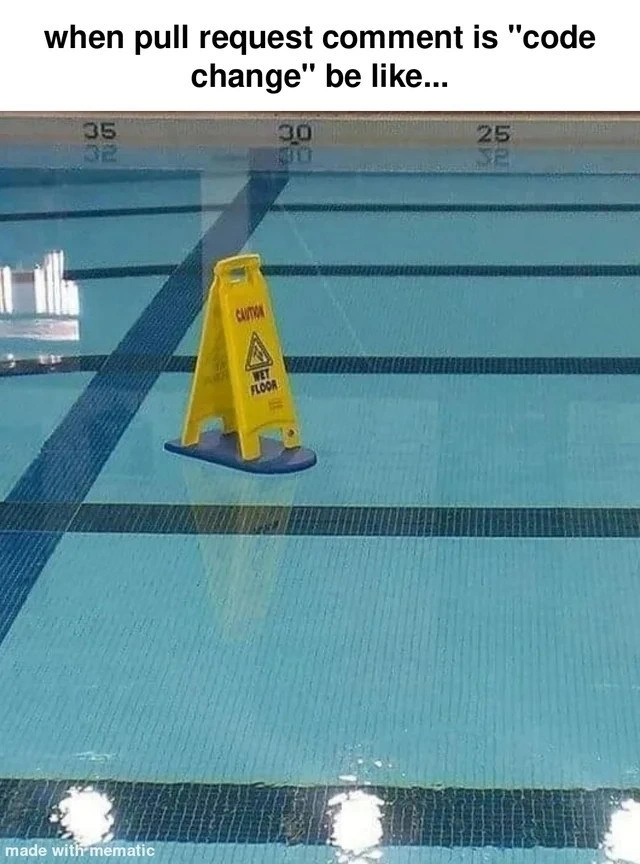
Now, what happens in the meme? The top text says: “when pull request comment is 'code change' be like...” and then we see a picture: a bright yellow caution sign that reads “CAUTION WET FLOOR” floating smack in the middle of a swimming pool’s deep end. In real life, that sign is used in hallways or bathrooms to warn people that the floor is slippery when it’s wet (so you don’t slip and fall). It’s a very useful warning in the right context. But in a pool? The entire pool is water – of course it’s wet everywhere! Telling swimmers that water is wet is as redundant as it gets. They already know; they’re literally in it. So the sign in the pool is an obvious warning that doesn’t help anyone. In fact, it looks pretty silly just bobbing there.
This is a direct analogy to the pull request comment "code change". When a reviewer leaves a comment that just says “code change,” it’s basically an obvious statement: yes, the code was changed – that’s why we have a pull request! For a newcomer to code reviews, imagine you submit your code and you’re eager to hear what your teammate thinks. You get a notification, open it, and see the comment: “code change.” At first, you might be puzzled. Did they mean something specific? Is there a hidden message? Or did they just type the first thing that came to mind? Very quickly, you realize it’s like someone reviewing an essay by commenting “you wrote words.” It’s true but completely unhelpful.
So why would someone do this? Sometimes, a reviewer might not know what to say or might feel obligated to leave some comment (maybe to show they at least looked at the code) even if they have no issues to report. It’s akin to the awkward social habit of saying something just to say something, even if it adds no value. A junior developer doing their first few code reviews might think they’re expected to comment on every PR, and if they don’t find any bugs or suggestions, they might still drop a generic comment like “updated function” or “code change here” by literally describing the diff. They might not realize that if you have nothing substantial to critique, it’s perfectly fine (and often better) to simply approve without nitpicking or stating the obvious.
Another angle: sometimes automated tools or templates can add noise. For instance, some continuous integration bots might leave a comment like “Lines changed: 5” or “🚀 code changes detected.” Ideally those tools provide useful info (like test results or coverage changes), but a poorly configured one could just echo trivial facts. However, in the meme scenario it’s clearly poking fun at a human doing it, since it says “when pull request comment is 'code change'.” It hints that the reviewer’s comment is as pointless as a wet floor sign in a pool.
For a junior developer, the lesson hiding in this humor is about communication in the developer workflow. CodeReviewPainPoints like this teach us that good communication matters. A comment should either applaud good work specifically (“Nice use of that regex!”), question something (“Could we use a library function here instead for clarity?”), or request a change (“This will break if items is empty; maybe add a check.”). If a comment only states what’s plainly visible (like “this is code” or “you changed X to Y”), it’s not actually reviewing the code – it’s just narrating. And that’s not useful. It can even be a bit annoying, much like imagine if you’re driving and your passenger points at the road and says, “you’re driving forward.” They’re not warning of any danger or helping navigate; they’re just stating the obvious.
The DeveloperExperience_DX aspect here is how such communication affects the team. When feedback is that empty, developers can feel frustrated or demotivated. If you’re on the receiving end, you might think, “Did they even read my code? Do they care? Why bother commenting at all?” It’s relatable because many of us have felt that letdown of expecting a useful review and getting nothing of substance. And if you’re accidentally giving such feedback as a new reviewer, this meme is a gentle nudge: it’s telling you, “Hey, just like a caution sign in a pool doesn’t help swimmers, a vague comment in a PR doesn’t help the author. Try to be more specific or just approve if it looks good!”
In summary, the image and caption together exaggerate a real communication breakdown to make a point. The floating caution sign warns about a wet surface in an all-water environment – completely redundant. The pull request comment "code change" warns that code was changed in a code change submission – likewise redundant. Both are hilariously ineffective at their jobs. For any developer, junior or senior, it’s a memorable visual reminder that clear and meaningful communication is crucial, and that stating the obvious is not the same as giving feedback.
Level 3: No-Op Comments
Imagine a code review where the only feedback your PR gets is a comment literally stating code change. This is the code-review equivalent of a CAUTION WET FLOOR sign drifting in the middle of a swimming pool. In other words, the reviewer has offered a tautologically true statement that adds zero information. It’s a classic code review anti-pattern: providing vague PR comments or useless feedback that’s as helpful as warning water about being wet. Experienced developers recognize this scenario instantly – it’s a blend of dark humor and shared pain in the realm of CodeReviewPainPoints.
Why is this funny (and frustrating)? In a healthy code review, comments should be specific and actionable: pointing out a bug, suggesting a clearer variable name, questioning a design choice, or highlighting a potential performance issue. But here the reviewer’s comment is a no-op, a null feedback that simply restates what the diff already shows. It’s like an automated script that describes the obvious: “changed code here” – a comment that does nothing to improve the code or educate the developer. This underlines a CommunicationBreakdown in the PullRequest process. Instead of a meaningful discussion, the review becomes a rote formality. Senior engineers often refer to this as a rubber stamp review: the reviewer might be just going through the motions to approve the PR without truly engaging with it. They leave a comment that technically fulfills the requirement of “review feedback” but doesn’t actually review anything.
The meme nails this absurdity by visually representing such a comment as a caution sign in a pool. In real life, a caution sign reading “WET FLOOR” is meant to warn people on solid ground that a surface is slippery. Stick that sign in a swimming pool, and it’s ridiculously redundant – the entire pool is water, of course it’s wet! Similarly, dropping a “code change” comment on a PR is redundant because every pull request, by definition, is a code change. It’s a self-evident truth. For developers who care about DeveloperExperience (DX) and effective team communication, this kind of non-feedback is borderline insulting: it shows the reviewer either didn’t understand the task of giving feedback, or didn’t invest the effort. There’s a shared developer humor here mixed with a bit of exasperation – many of us have been on the receiving end of such relatable dev experience moments. We chuckle because it’s true, but we also cringe remembering when we eagerly clicked on a review notification hoping for insight, only to see something as enlightening as “code changed.”
On a deeper level, this highlights problems in code review culture. In some teams, reviews are mandatory but rushed. Perhaps the reviewer was busy or felt obligated to leave some comment to avoid simply writing “LGTM” (Looks Good To Me) or hitting Approve with no comments at all. Ironically, a terse “LGTM” is often more helpful than saying nothing useful under the guise of feedback. Why? At least "LGTM" signals approval and that the reviewer didn’t find issues. But a comment like “code change” is pure noise – it neither approves nor critiques; it just states the obvious. This can create confusion: is the reviewer being sarcastic? Did they accidentally type a note to themselves? Or are they subtly hinting there's a change that shouldn’t be there? The author is left befuddled, trying to decipher meaning in a comment that has none. It’s a communication breakdown that wastes time and energy.
From an organizational perspective, such useless feedback points to a broken process. Code reviews are intended to catch bugs, spread knowledge, and maintain quality. When reviewers leave comments as empty as a floating caution sign, it defeats the purpose. It might indicate that reviewers aren’t trained in giving good feedback or that they don’t have enough context (so they panic-comment something trivial). It could also reflect a team culture where reviews are seen as a checklist item rather than an opportunity for improvement. In worst cases, maybe someone somewhere set a KPI for “number of review comments” so people pad their reviews with fluff to meet quotas. 😒 The result? Frustrated developers and missed opportunities for real improvement.
This meme resonates with veteran developers because it captures a common CodeReviewPainPoints scenario with perfect irony. It’s developer humor pointing out how absurd things can get when process exists without substance. Everyone who’s spent time in large codebases or fast-paced teams has a story of the pointless PR comment or the drive-by reviewer who offers a “Thanks, Captain Obvious!” remark. Like water being wet, we already know the code changed – what we need to know is why it’s good or how it could be better. The sign in the pool and the “code change” comment both say: “I’m technically doing something, but functionally doing nothing.” And that is a bit too real (and thus darkly funny) for those of us who have been on either side of such a review.
Description
The meme has a white top banner with the black text “when pull request comment is "code change" be like...”. Below, a photograph shows a bright-blue tiled swimming pool; in the middle of the deep water floats a yellow plastic caution sign that reads “CAUTION WET FLOOR” with the slipping-person icon. The sign, normally meant for a hallway, is uselessly warning the obviously wet pool, mirroring how an unhelpful pull-request comment saying merely “code change” provides no actionable information. The image humorously highlights pain points around code review communication, vague feedback, and developer frustration with uninformative PR comments
Comments
10Comment deleted
“Code change” as PR feedback is the wet-floor sign in the pool - 100 % correct, 0 % helpful, yet somehow it still clears the “two-reviewer” gate
After 15 years of reviewing code, the most valuable PR comment I've received was 'LGTM' - at least it didn't pretend to add value while wasting everyone's time like those 'consider using more descriptive variable names' comments on a method called calculateTotalPriceIncludingTaxAndShippingForInternationalOrdersWithDiscounts()
The reviewer left 'code change' on the PR, marked it as blocking, and went on PTO - the most thorough review the team has seen all quarter
Ah yes, the classic "just a small code change" comment that actually means "please refactor this entire module, update the architecture, migrate the database schema, and oh - could you also add comprehensive test coverage while you're at it?" It's the engineering equivalent of someone putting a wet floor sign in a swimming pool - technically accurate, but spectacularly missing the point. Senior engineers know this dance well: the more innocuous the PR comment sounds, the more architectural debt you're about to uncover. It's not a code review; it's an archaeological expedition disguised as a suggestion
"Code change" in a PR description is the wet floor sign floating in a pool: technically correct, useless for blast radius or reviewer sanity
Our two-approver policy devolved into two comments - “code change” and “LGTM” - the wet‑floor sign we toss into the data lake
'Code change' PR feedback: as insightful as spotting a race condition and noting 'timing issue' - thanks for the newsletter update
my friends call all of their commits like "ok" and "fix"... Comment deleted
upd😭 Comment deleted
As long as you squash them upon pr merge and then give a meaningful name to squash commit, it might be okay Comment deleted